
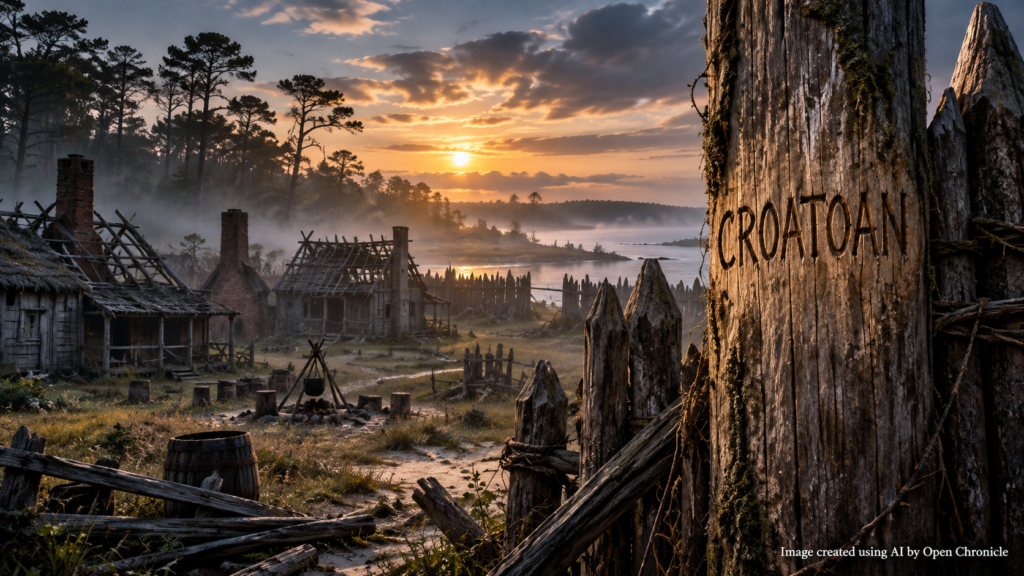
In 1590, an English governor returned to a settlement on the coast of North America and found it abandoned. The colonists were gone, their houses had been dismantled, and a single word pointed towards an uncertain destination. More than four centuries later, archaeology is bringing new evidence to one of the most enduring mysteries of early American history.
By Open Chronicle History Desk | The Unexplained Files
Historical Mysteries · Colonial America · Case Status: Partially Explained
The Settlement That Vanished
On 18 August 1590, John White stepped ashore on Roanoke Island, off the coast of what is now North Carolina, hoping to reunite with his family and the English settlers he had left behind three years earlier.
He had every reason to fear what he might find.
The settlement had been isolated for years, with no reliable supply line to England. Relations with neighbouring Indigenous communities had been complicated by earlier English expeditions, and the colonists faced the uncertainties of an unfamiliar environment.
Yet nothing could have fully prepared White for the scene that awaited him.
The settlement was deserted.
The houses had been taken down. The people were nowhere to be found. There was no obvious battlefield, no evidence of a general massacre and no clear indication that the inhabitants had fled in panic.
Instead, White discovered two messages carved into wood.
The letters CRO appeared on a tree.
On a post belonging to the settlement’s defensive palisade, someone had carved a longer word:
CROATOAN.
The message would become one of the most famous clues in American colonial history.
For centuries, the disappearance of the Roanoke settlers has been described as an inexplicable vanishing. But the historical evidence suggests a more complicated story, one involving abandonment, possible migration, Indigenous alliances, colonial failure and the limits of the surviving documentary record.
1. England’s First Ambitions in North America
The story of Roanoke began long before John White returned to its abandoned settlement.
During the late sixteenth century, England was attempting to challenge Spanish dominance in the Atlantic world. Spain had established an extensive colonial empire, while England remained a comparatively minor participant in overseas settlement.
Sir Walter Raleigh, a favourite of Queen Elizabeth I, received authority in 1584 to sponsor English exploration and colonisation in North America.
Roanoke Island, situated among the barrier islands and waterways of the Outer Banks, became an early focus of these ambitions.
English expeditions arrived in 1584 and 1585, gathering geographical information, establishing contacts with Indigenous peoples and assessing the region’s suitability for settlement.
The results were mixed.
The English recognised the area’s strategic potential, but their presence also generated tensions with local communities. Food shortages, cultural misunderstandings and violence undermined the possibility of stable cooperation.
An earlier military settlement established in 1585 ultimately failed.
Nevertheless, Raleigh’s colonial project continued.
In 1587, another expedition sailed across the Atlantic, this time carrying families rather than a predominantly military group.
Its objective was to establish a more permanent English presence in North America.
2. The Arrival of the 1587 Colonists
The expedition was led by John White, an artist and experienced observer of the region who had participated in earlier English voyages.
The settlers originally intended to establish their colony farther north, in the Chesapeake Bay region.
Instead, they were left on Roanoke Island, where earlier English expeditions had already encountered serious difficulties.
The precise reasons for this change remain debated, but its consequences were significant.
Roanoke was geographically isolated, exposed to severe weather and dependent upon uncertain supplies and relationships with nearby Indigenous communities.
The colony included men, women and children. Although popular retellings often refer to 115 missing settlers, historical accounts commonly give the expedition’s complement as 117 people. The exact population remaining when White departed is complicated by the surviving records.
Among the settlers were White’s daughter, Eleanor Dare, and her husband, Ananias Dare.
On 18 August 1587, Eleanor gave birth to Virginia Dare, traditionally remembered as the first English child born in an English colonial settlement in North America.
Her birth was a symbolic moment for England’s colonial ambitions.
It also added a deeply personal dimension to the tragedy that would follow.
When White eventually returned, he would be searching not only for the colony he governed but also for his daughter and granddaughter.
3. John White’s Departure
Within weeks of the settlers’ arrival, the colony faced a serious problem.
Supplies were inadequate, and the inhabitants needed additional support from England.
White agreed to return across the Atlantic to obtain provisions and assistance.
Before leaving, he established an arrangement with the colonists.
If they moved away from Roanoke Island, they were to leave a message indicating their new location. If they departed under serious danger or coercion, they were also to carve a cross as a warning.
This agreement would become crucial to the later investigation.
White expected to return relatively quickly.
Instead, international events intervened.
In 1588, England confronted the threat of the Spanish Armada. The mobilisation of ships for national defence made organising a relief expedition exceptionally difficult.
White’s attempts to return were repeatedly frustrated.
The settlers remained beyond his reach.
Three years passed before he was finally able to cross the Atlantic again.
By then, the situation on Roanoke Island had changed completely.
4. The Discovery of 18 August 1590
White’s return to Roanoke coincided with Virginia Dare’s third birthday.
The expedition approached the island expecting, or at least hoping, to discover evidence that the settlement had survived.
Instead, the search party encountered an abandoned site.
The surviving descriptions indicate that buildings had been dismantled rather than simply destroyed. A defensive enclosure had been erected, suggesting that the colonists had made changes to the settlement after White’s departure.
The two inscriptions offered the strongest evidence of what might have happened.
CRO was carved into a tree.
CROATOAN appeared on a palisade post.
Crucially, White did not report finding the cross that the settlers had agreed to use if they departed under duress.
This absence mattered.
It suggested that the colonists might have relocated deliberately rather than being forcibly removed.
White understood Croatoan as the name of an island and its Indigenous inhabitants.
The island is associated with present-day Hatteras Island, farther south along the Outer Banks.
He therefore believed that the settlers had moved there.
His interpretation was straightforward: the inscriptions were not necessarily a cryptic warning but a message indicating where the colonists had gone.
White attempted to investigate.
However, worsening weather disrupted the expedition. The ships were unable to complete the intended journey to Croatoan, and White eventually returned to England.
He never established what had happened to the people he had left behind.
His inability to follow the clue helped transform an unresolved colonial evacuation into a centuries-long historical mystery.
5. What Did CROATOAN Actually Mean?
The word CROATOAN is often presented in popular accounts as an ominous final message.
In historical context, it may have been something much more practical.
Croatoan referred both to an Indigenous community and to the island associated with that community.
The English had established contact with Croatoan people during their earlier expeditions.
One of the most important figures in those relationships was Manteo, an Indigenous intermediary who travelled to England and later assisted English expeditions in North America.
Manteo’s relationships with the English provided a possible connection between the Roanoke settlers and the Croatoan community.
If the colonists faced food shortages or other difficulties, seeking assistance from a familiar Indigenous population would have been a plausible survival strategy.
White himself believed that the carved message indicated relocation.
There is, however, an important distinction between a plausible interpretation and a proven outcome.
The inscription suggests a destination.
It does not establish that every colonist reached that destination, survived the journey or remained there permanently.
Nor does it exclude the possibility that the settlement fragmented into smaller groups.
The message may have identified the intended destination of some colonists while others travelled elsewhere.
That possibility has become increasingly relevant as archaeologists examine evidence beyond Roanoke Island.
6. The Leading Explanations
Over the centuries, several theories have attempted to explain the colony’s disappearance.
Some are supported by historical circumstances and archaeological findings. Others depend heavily on speculation.
Theory One: Relocation to Croatoan
The most direct explanation is that the colonists moved to Croatoan Island and sought protection or assistance from its Indigenous inhabitants.
This theory is supported by the carved inscription and by White’s understanding of the agreed communication system.
It is also consistent with the practical difficulties the colonists faced.
An isolated settlement with limited supplies might have been unable to survive without Indigenous cooperation.
Archaeological discoveries on Hatteras Island have included European objects from the relevant historical period.
However, such finds must be interpreted carefully.
European artefacts could have reached Indigenous communities through trade, exchange or other contact. Their presence does not automatically prove that the entire Roanoke colony relocated there.
No settlement site or burial ground has been conclusively identified as the home of all the missing colonists.
The Croatoan explanation remains compelling, but incomplete.
Theory Two: Movement Inland
Another possibility is that some settlers moved inland towards the waterways surrounding Albemarle Sound.
The colonists had discussed relocation before White departed, and the region offered potential advantages in terms of agriculture, freshwater access and contact with Indigenous communities.
This explanation has gained archaeological attention through investigations associated with the First Colony Foundation.
Researchers have examined sites in Bertie County and along the Chowan River, identifying material they interpret as evidence of English activity during the late sixteenth century.
The possibility that colonists established smaller settlements away from Roanoke has become an important alternative to the idea of a single destination.
Such a movement would also explain why searching only Roanoke Island failed to resolve the mystery.
Theory Three: Integration into Indigenous Communities
The colonists may not have remained together as a distinct English settlement.
Some could have joined Indigenous communities, adopting local practices and forming new family or social relationships.
In an environment where survival depended on access to food, shelter and local knowledge, integration could have offered greater security than maintaining an isolated European outpost.
This theory also challenges the assumption that the disappearance of an English colony necessarily meant the deaths of its inhabitants.
The settlement may have vanished as a political and cultural entity while some of its people survived.
However, later stories about descendants of the colonists are difficult to verify through the surviving historical record.
Claims of ancestry, linguistic similarities or cultural connections require careful investigation rather than automatic acceptance.
Theory Four: Disease, Hunger or Violence
Not every possible explanation involves successful relocation.
The colonists may have suffered from disease, malnutrition, environmental hardship or conflict.
Their dependence on uncertain food supplies made them vulnerable.
Earlier English expeditions had already damaged relations with some Indigenous communities, and the wider region was politically complex.
A combination of migration, hardship and deaths is entirely possible.
Yet the absence of clear evidence for a general massacre at the abandoned settlement weakens claims that all the colonists were killed there.
The available record does not establish a single catastrophic event that explains the fate of the entire group.
7. Archaeology Reopens the Investigation
For much of its history, the Roanoke mystery was dominated by written accounts, folklore and speculation.
Modern archaeology has changed the nature of the investigation.
Rather than treating the colony as a group that simply vanished, researchers have attempted to reconstruct the movements of English settlers across the wider region.
One important line of inquiry developed from John White’s sixteenth-century map of the Carolina coast.
Researchers identified a concealed fort symbol on the map, directing attention towards the western Albemarle Sound region.
Subsequent archaeological work at a location known as Site X, in present-day Bertie County, uncovered English material associated with the Elizabethan period.
The First Colony Foundation argued that these discoveries could indicate the presence of Roanoke colonists beyond the original island settlement.
The evidence included pottery and other artefacts whose dating and distribution suggested English activity.
Initially, researchers were cautious about interpreting Site X as the destination of the entire colony.
The site appeared too limited to account for all the settlers.
Instead, it raised the possibility that a smaller group had established a presence inland.
That distinction is essential.
Evidence of English occupation does not automatically reveal the fate of every missing colonist.
8. The 2026 Archaeological Claims
In June 2026, the First Colony Foundation published a stronger interpretation of its research.
The organisation reported that archaeological investigations at Sites X and Y, along the Chowan River, supported the existence of a dispersed English settlement dating to the period of the Roanoke colony.
According to the foundation, the artefact assemblages included evidence consistent with civilian settlement rather than a brief military expedition.
Researchers also highlighted a late sixteenth-century European cloth seal and material recovered from a second site, Site Y.
The foundation interpreted the discoveries as evidence that the colonists established a series of small communities or farms inland.
This would represent a significant shift in the understanding of Roanoke.
Instead of one settlement mysteriously disappearing, the inhabitants may have dispersed into a broader landscape where some continued to live for an uncertain period.
But the distinction between archaeological interpretation and definitive identification remains important.
The foundation’s findings provide a substantial argument for English activity in the region. They do not independently establish the names, movements or ultimate fate of every person who left Roanoke Island.
Nor do they fully settle the relationship between the inland evidence and the inscription CROATOAN.
It is possible that different groups followed different routes.
Some may have travelled south towards Croatoan, while others moved inland.
The colony’s disappearance may therefore have been a process rather than a single event.
9. Why Roanoke Became a Legend
Roanoke occupies a special place in American historical imagination because it combines a documented event with an incomplete ending.
The disappearance involved real people whose names appear in surviving records.
It occurred during England’s earliest efforts to establish permanent settlements in North America.
And it left behind a striking physical clue.
The word CROATOAN became a symbol of unresolved history, inspiring novels, television programmes, documentaries and supernatural interpretations.
Yet the legend often simplifies the evidence.
The colonists did not disappear from a secure and thriving settlement.
They were living in a fragile colonial experiment, dependent upon uncertain supplies and surrounded by communities whose political and economic circumstances were far more complex than early English narratives acknowledged.
Nor was CROATOAN necessarily an inexplicable message.
To John White, it was an intelligible geographical clue.
The greater mystery is why he was unable to follow that clue and why subsequent generations failed to establish a definitive account of the settlers’ fate.
Roanoke is therefore not simply a story about people who vanished.
It is also a story about the failure of an imperial project, the limitations of European historical records and the difficulty of reconstructing lives that continued beyond the view of colonial authorities.
10. What We Know, and What Remains Unanswered
More than four centuries after White returned to the abandoned settlement, several conclusions can be drawn with reasonable confidence.
The colonists were left on Roanoke Island in 1587.
White departed for England and could not return until 1590.
When he arrived, the settlement was abandoned, its structures had been altered or dismantled, and the inscriptions CRO and CROATOAN remained.
White interpreted the longer inscription as evidence of relocation.
Modern archaeology has identified material that may support the presence of English settlers elsewhere in the region.
What remains unresolved is the complete sequence of events.
Did the colonists initially move together before dividing into smaller communities?
Did some reach Croatoan while others travelled inland?
How many survived the years following White’s departure?
Did some become integrated into Indigenous societies?
And can the artefacts discovered in recent excavations be conclusively linked to named members of the 1587 expedition?
The surviving evidence does not yet answer all these questions.
The most plausible historical picture may involve relocation, dispersal and adaptation rather than a sudden collective disappearance.
But the exact fate of the colony’s inhabitants remains only partially reconstructed.
The Open Chronicle Assessment
THE UNEXPLAINED FILES
The Lost Colony of Roanoke
Most plausible explanation
The settlers abandoned Roanoke Island and relocated, potentially dividing between Indigenous communities near Croatoan and settlements farther inland.
Strongest evidence
John White’s 1590 account, the CROATOAN inscription, the absence of the agreed distress symbol and archaeological evidence of late-sixteenth-century English activity elsewhere in the region.
What remains unproven
The fate of individual colonists, the precise movements of the group and whether the archaeological sites identified in recent research account for the entire settlement.
Conclusion: A Colony Lost, or a Colony Transformed?
The enduring fascination of Roanoke rests on a simple image: an abandoned settlement and a word carved into wood.
For generations, that image encouraged the belief that more than a hundred people had vanished without explanation.
But the surviving evidence tells a more complicated story.
The colonists may have left deliberately. They may have sought protection among Indigenous communities, established settlements inland or dispersed across the region as their circumstances changed.
Some may have survived for years after the English government effectively lost contact with them.
The archaeological discoveries reported in recent years have made these possibilities increasingly difficult to dismiss.
Roanoke may never yield a single, complete answer.
Its history, however, demonstrates why the absence of a written record should not be confused with the absence of human lives.
The settlement disappeared from England’s view.
That does not necessarily mean its people disappeared from history.
Sources and Further Reading
Historical documentation, archaeological research and institutional assessments.
1590 Rescue Voyage
Account of John White’s return, the inscriptions and the failed attempt to reach Croatoan.
The Lost Colony
Historical overview of the English expeditions, the 1587 settlement and the 1590 disappearance.
Major Theories of the Lost Colony
Evaluation of relocation, Indigenous communities, environmental hazards and competing explanations.
An Archaeological Brief for Site X
Research report discussing English artefacts and the possibility of inland relocation.
The Lost Colony Is Found! How We Did It
June 2026 presentation of archaeological interpretations concerning Sites X and Y. These conclusions are the foundation’s claims and should not be treated as independent proof of every colonist’s fate.
Editorial Note
This investigation distinguishes contemporary documentary evidence from later interpretations and archaeological hypotheses. The commonly repeated figure of 115 missing settlers differs from the 117 people recorded for the 1587 expedition. The archaeological evidence is evolving, and claims of a definitive resolution require careful scrutiny.
The Mystery Continues
Explore real mysteries, unexplained phenomena and extraordinary stories through evidence, history and investigation.
RETURN TO MYSTERIES & THE UNKNOWN →