
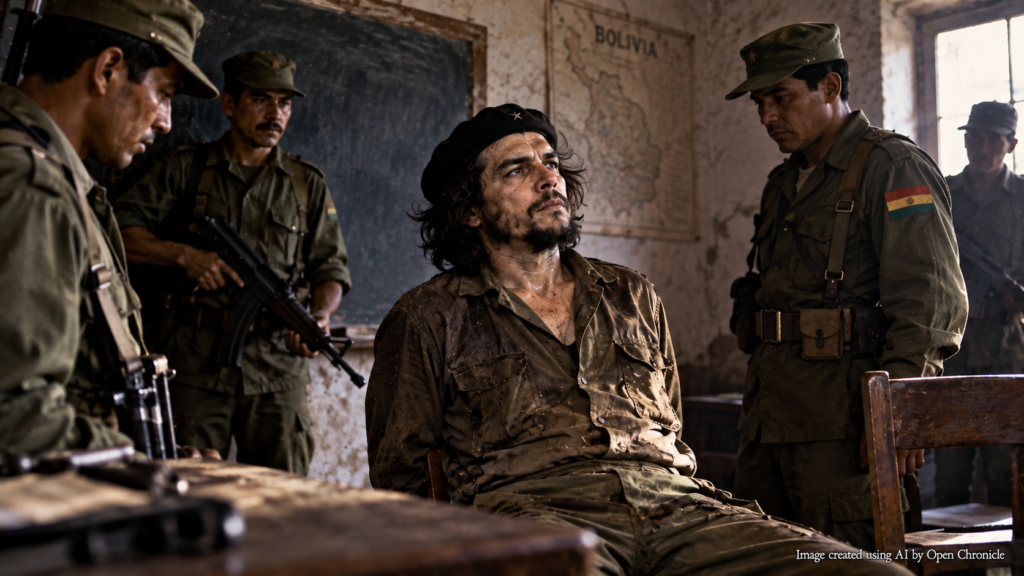
How the capture and execution of one of the Cuban Revolution’s most recognizable figures ended a guerrilla campaign in the Bolivian mountains, transformed a revolutionary leader into a global symbol and opened a debate about ideology, violence and political myth that continues today.
By Open Chronicle History Desk
On the morning of October 9, 1967, a wounded prisoner sat inside a small schoolhouse in the Bolivian village of La Higuera.
He was thirty-nine years old.
His clothes were dirty and torn. His hands were bound. A gunshot wound had left him unable to escape.
The prisoner was Ernesto “Che” Guevara, the Argentine-born revolutionary who had fought alongside Fidel Castro in Cuba and become one of the most recognizable figures of the Cold War.
Less than twenty-four hours earlier, Bolivian soldiers had captured him in a ravine near the village.
His guerrilla campaign had collapsed.
His small force had been weakened by hunger, disease, desertion, isolation and relentless military pursuit.
The peasant uprising he had hoped to inspire had not materialized.
The Bolivian government now faced a decision with international consequences.
Should Guevara be imprisoned and tried?
Or should he be killed before he could become the center of a political campaign for his release?
The decision was made to execute him.
A Bolivian sergeant entered the schoolhouse carrying a firearm.
Moments later, Guevara was dead.
The Bolivian military had eliminated the leader of a failed insurgency.
But his death produced a consequence that neither his captors nor his political opponents could fully control.
The revolutionary who had failed to ignite a continental uprising would become one of the most enduring political icons of the twentieth century.
His portrait would appear on posters, murals, banners and clothing around the world.
His writings would influence revolutionary movements.
His methods and political convictions would provoke fierce criticism.
And the circumstances of his death would transform a military defeat into a lasting historical legend.
October 9, 1967 was not simply the day Che Guevara died.
It was the day his political life ended and his mythology began.
1. Ernesto Guevara Before the Revolution
Ernesto Guevara was born on June 14, 1928, in Rosario, Argentina.
He grew up in a middle-class family and developed interests in literature, philosophy, politics and medicine.
Asthma affected him throughout his life, but it did not prevent him from travelling extensively.
As a young man, Guevara studied medicine at the University of Buenos Aires.
His travels across Latin America became particularly important in shaping his political outlook.
He encountered poverty, inequality, Indigenous communities, exploitative labor conditions and societies marked by sharp divisions between wealthy elites and impoverished populations.
These experiences contributed to his increasingly radical interpretation of Latin America’s political and economic problems.
He came to believe that the region’s inequalities were not simply the result of poor governance.
In his view, they reflected a wider system of economic dependency and political domination.
2. The Motorcycle Journey
In 1952, Guevara travelled across parts of South America with his friend Alberto Granado.
The journey later became famous through Guevara’s travel writings, published posthumously as The Motorcycle Diaries.
The two young men travelled through Argentina, Chile, Peru, Colombia and Venezuela.
They visited mining regions, rural communities and a leper colony in Peru.
The journey did not immediately transform Guevara into a committed revolutionary.
But it contributed to the development of a continental political identity.
He increasingly saw Latin America as a region connected by shared historical experiences, social inequalities and political struggles.
The idea that national borders should not limit political solidarity would become central to his later revolutionary strategy.
3. Guatemala and the Radicalization of Che
A decisive stage in Guevara’s political development occurred in Guatemala.
In 1954, the government of President Jacobo Árbenz was overthrown following a CIA-backed operation.
Árbenz had attempted land reforms that challenged powerful domestic interests and the holdings of the United Fruit Company.
The United States regarded his government through the strategic framework of the Cold War.
Guevara interpreted the overthrow as evidence that reformist governments in Latin America could be destroyed when they threatened established economic and geopolitical interests.
The experience strengthened his belief that revolutionary transformation required armed struggle.
He subsequently travelled to Mexico.
There, he encountered the Cuban revolutionary movement.
4. Meeting Fidel Castro
In Mexico, Guevara met Fidel Castro and other Cuban exiles preparing to overthrow the dictatorship of Fulgencio Batista.
Castro had already attempted an unsuccessful attack on the Moncada Barracks in 1953.
After imprisonment and exile, he was organizing a new expedition to Cuba.
Guevara joined the movement as a physician.
But he soon became more than its doctor.
He trained militarily, embraced the movement’s objectives and developed a close relationship with Castro.
The expedition departed Mexico aboard the yacht Granma in November 1956.
Its landing in Cuba was disastrous.
Government forces attacked the expedition, and only a small number of survivors regrouped in the Sierra Maestra mountains.
Among them were Fidel Castro, Raúl Castro and Che Guevara.
5. The Cuban Guerrilla War
From 1956 to 1958, Castro’s forces waged a guerrilla campaign against Batista’s government.
Guevara emerged as an important military commander.
He helped organize guerrilla units, enforce discipline and conduct operations.
He also became associated with the revolutionary movement’s ideological development.
The insurgency benefited from Batista’s growing political isolation, military weaknesses and widespread opposition to his rule.
By late 1958, the revolutionary forces had gained momentum.
Guevara played a significant role in the campaign around Santa Clara.
The battle became one of the final major engagements before Batista fled Cuba on January 1, 1959.
The revolutionaries entered Havana.
A new political era had begun.
6. Victory and Revolutionary Government
After the Cuban Revolution, Guevara occupied important positions in the new government.
He became associated with the revolutionary justice system, economic administration and international diplomacy.
He served as president of Cuba’s National Bank and later as minister of industries.
His political views became increasingly explicitly Marxist.
He advocated the construction of a socialist society and the transformation of economic relationships.
He also promoted a demanding concept of revolutionary commitment, emphasizing discipline, sacrifice and ideological motivation.
But governing a country presented challenges very different from fighting a guerrilla war.
Cuba faced economic disruption, international isolation and growing confrontation with the United States.
Guevara’s economic policies and management methods produced mixed results and substantial criticism.
7. Revolutionary Justice and Political Violence
One of the most controversial aspects of Guevara’s historical record concerns his involvement in revolutionary tribunals and executions after the Cuban Revolution.
At La Cabaña fortress in Havana, Guevara held a senior command position during a period when prisoners accused of crimes under Batista’s regime were tried and executed.
Supporters of the revolution regarded these proceedings as punishment for torture, killings and repression committed by the former dictatorship.
Critics questioned the fairness of the trials, the use of capital punishment and the political character of revolutionary justice.
Guevara defended revolutionary violence as an instrument of political transformation.
His role in these events remains central to historical debates about his legacy.
The image of Che as an idealistic revolutionary cannot be separated from his commitment to armed struggle and coercive political methods.
8. The Cold War
Guevara’s political career unfolded during the Cold War.
The United States and Soviet Union competed for global influence.
Revolutionary movements in Asia, Africa and Latin America became entangled in that confrontation.
Cuba aligned itself with the Soviet Union.
The failed Bay of Pigs invasion in 1961 and the Cuban Missile Crisis of 1962 intensified the confrontation.
Guevara regarded the struggle against capitalism and imperialism as international rather than exclusively Cuban.
He believed revolutionary movements could challenge American influence across the developing world.
This conviction eventually led him away from government office in Havana.
9. The Revolutionary Who Refused to Remain a Minister
By the mid-1960s, Guevara had become dissatisfied with remaining a government official.
He wanted to participate directly in revolutionary struggles elsewhere.
He believed that successful guerrilla movements could emerge in countries where social inequality, authoritarian government and foreign influence created revolutionary conditions.
His theory emphasized the role of a small armed vanguard capable of initiating a wider political uprising.
This approach became associated with foco theory.
Guevara’s commitment to exporting revolution would take him first to Africa and then to Bolivia.
10. The Congo Campaign
In 1965, Guevara travelled to the Congo to assist revolutionary forces.
The mission was unsuccessful.
He encountered organizational problems, political divisions, logistical weaknesses and serious disagreements among the groups involved.
His expectations about revolutionary solidarity did not match the conditions he found.
The experience demonstrated the limitations of transferring the Cuban guerrilla model to different political and social environments.
Guevara eventually withdrew.
But he did not abandon his ambition to establish another revolutionary front.
His attention turned toward South America.
11. Why Bolivia?
Bolivia occupied a strategic position in central South America.
It bordered several countries, including Argentina, Brazil, Chile, Paraguay and Peru.
Guevara believed a revolutionary base in Bolivia might eventually support insurgencies across the continent.
The country had experienced major political upheaval during the 1952 Bolivian National Revolution.
Mining unions, peasant organizations and political movements had played important roles in its modern history.
But Bolivia in 1966 was not Cuba in 1956.
Its political conditions, geography, military institutions and rural society differed significantly.
Guevara would discover that revolutionary enthusiasm could not simply be imported.
12. The Secret Arrival
Guevara entered Bolivia clandestinely in November 1966, using a false identity.
He had altered his appearance.
His beard had been shaved, and he wore glasses.
He joined a guerrilla organization operating in the country’s southeastern region.
The force included Cubans, Bolivians and other international volunteers.
Their objective was to establish a rural insurgency that could grow into a broader revolutionary movement.
The guerrillas established a base near the Ñancahuazú River.
From the beginning, however, they faced difficulties.
13. The Failure to Win Local Support
One of the central weaknesses of Guevara’s Bolivian campaign was its failure to build strong relationships with local communities.
Many rural residents were suspicious of the armed outsiders.
Language and cultural barriers complicated communication.
The guerrillas lacked the political networks necessary to transform military operations into a mass movement.
The local population did not respond as Guevara had expected.
Some peasants feared retaliation from government forces.
Others did not identify with the insurgents’ political objectives.
Without a reliable support network, the guerrillas struggled to obtain food, intelligence and recruits.
14. Political Isolation
The insurgency also suffered from disagreements with Bolivian communist leaders.
Guevara had expected greater cooperation from local political organizations.
But disputes over leadership, strategy and control undermined that relationship.
The Bolivian Communist Party did not provide the sustained support Guevara needed.
The guerrilla force became increasingly isolated.
This isolation was not merely a political inconvenience.
It became a direct military vulnerability.
Without effective urban contacts and local networks, the insurgents had difficulty receiving supplies, communicating and replacing losses.
15. The Bolivian Army Responds
The Bolivian government, led by President René Barrientos, mobilized military forces against the insurgency.
At first, the guerrillas achieved some tactical successes.
But the government gradually adapted.
Bolivian troops received training and assistance from the United States.
American personnel supported counterinsurgency efforts, particularly through training and intelligence cooperation.
The Bolivian Army’s Second Ranger Battalion, trained by U.S. Special Forces personnel, became especially important in the final pursuit of Guevara’s group.
The balance of forces increasingly favored the government.
16. The Guerrilla Campaign Deteriorates
During 1967, Guevara’s force suffered growing difficulties.
Supplies ran low.
Communication became unreliable.
Illness weakened fighters.
Some guerrillas were killed.
Others became separated from the main group.
The harsh terrain made movement exhausting.
Guevara’s asthma also complicated his physical condition.
The insurgents were forced into increasingly defensive operations.
Their original ambition had been to establish a revolutionary center capable of expanding across South America.
By the autumn of 1967, survival had become the immediate objective.
17. The Final Weeks
The Bolivian Army intensified its pursuit.
Government troops received intelligence concerning guerrilla movements.
The insurgents attempted to evade encirclement through mountainous terrain.
Their numbers had fallen sharply.
They were exhausted and increasingly short of food.
The campaign’s strategic assumptions had collapsed.
There was no general peasant uprising.
No expanding revolutionary army.
No secure territorial base.
The guerrillas remained committed to their cause, but their military position was deteriorating rapidly.
18. October 8, 1967: The Battle of Quebrada del Yuro
On October 8, Bolivian troops encountered Guevara’s group in the Quebrada del Yuro ravine.
Fighting broke out.
The guerrillas were outnumbered and surrounded.
Guevara was wounded.
His weapon was damaged during the engagement.
He was captured alive, along with other members of the group.
The battle marked the effective end of his Bolivian campaign.
The man who had helped lead a victorious guerrilla revolution in Cuba was now a prisoner of the Bolivian military.
19. The Capture
After his capture, Guevara was taken to the village of La Higuera.
He was held in a small schoolhouse.
His identity was confirmed.
News of his capture reached Bolivian authorities.
American intelligence personnel also became involved in the aftermath.
One of the most prominent was Félix Rodríguez, a Cuban-born CIA operative who was working with Bolivian forces.
The decision over Guevara’s fate, however, belonged to the Bolivian government.
20. The Decision to Execute Him
President René Barrientos’s government decided that Guevara should be executed rather than brought to trial.
The precise sequence of communications and decisions has been examined through military accounts, intelligence records and later testimony.
The central fact is clear.
Guevara was alive when captured.
He was killed while in Bolivian custody.
His death was not the result of a battlefield exchange of gunfire on October 9.
It was an execution.
21. October 9, 1967
On October 9, a Bolivian sergeant, Mario Terán, was assigned to carry out the execution.
Guevara remained inside the schoolhouse.
Accounts differ concerning the exact words exchanged in his final moments.
Several famous quotations attributed to him cannot be verified with complete certainty.
The widely repeated line about telling the soldier to shoot because he was only killing a man should therefore be treated as a reported recollection rather than a securely documented verbatim statement.
Terán fired.
Guevara died at the age of thirty-nine.
The revolutionary campaign in Bolivia had reached its final and irreversible moment.
22. The Body at Vallegrande
After the execution, Guevara’s body was transported to Vallegrande.
It was displayed publicly to journalists and other observers.
Photographs of his body circulated internationally.
The images became some of the most recognizable documents of the Cold War.
His appearance, with open eyes and a long beard, inspired comparisons with religious imagery.
Those comparisons contributed to the creation of a political mythology surrounding his death.
But the photographs also served an immediate government purpose.
They were intended to demonstrate that Guevara had been killed and that the insurgency had suffered a decisive defeat.
23. The Missing Remains
Guevara’s body was subsequently buried in a concealed location near Vallegrande.
For decades, the location of his remains was uncertain.
In 1997, a team searching near Vallegrande recovered skeletal remains identified as those of Guevara and several of his companions.
The remains were transferred to Cuba.
They were placed in a memorial complex at Santa Clara, the city associated with one of Guevara’s most important victories during the Cuban Revolution.
His return to Cuba transformed a clandestine burial into a major national commemoration.
24. The International Reaction
News of Guevara’s death spread rapidly around the world.
In Cuba, Fidel Castro announced the death of his former comrade and praised his revolutionary commitment.
The Cuban government organized public commemorations.
For revolutionary movements in Latin America, Africa and Asia, the execution became a powerful symbol.
For governments fighting communist insurgencies, it represented an important counterinsurgency success.
In the United States, officials regarded the destruction of Guevara’s guerrilla force as evidence that military assistance to allied governments could help contain revolutionary movements.
Declassified American documents show that Washington closely followed the capture and execution, although the initial reports contained uncertainty about whether Guevara was dead.
25. The United States and Guevara’s Death
The American role requires careful historical distinction.
The United States provided training and assistance to the Bolivian forces that pursued Guevara.
CIA personnel were also involved in intelligence activities connected to the campaign.
However, the documented execution order came from the Bolivian military command.
An October 11, 1967 memorandum by CIA Director Richard Helms recorded that Guevara had been captured wounded but alive on October 8, and that Bolivian Army Headquarters ordered his execution the following day.
The memorandum directly contradicted the initial Bolivian explanation that he had died from combat wounds.
The distinction matters.
American involvement in the counterinsurgency operation is documented. The decision to execute the prisoner is attributed in the available records to Bolivian military authorities.
26. A Military Defeat, a Symbolic Victory
Guevara’s Bolivian campaign was a military and political failure.
His force did not generate the popular uprising he expected.
It failed to establish a durable revolutionary base.
It became isolated and was eventually destroyed.
Yet his death produced an entirely different kind of influence.
Guevara became a symbol of revolutionary sacrifice.
For supporters, he represented internationalism, resistance to imperialism and a willingness to abandon personal comfort for political convictions.
For critics, he represented authoritarian revolutionary ideology, political violence and the romanticization of armed struggle.
Both interpretations became part of his historical legacy.
27. The Photograph That Conquered the World
One of the most recognizable images of the twentieth century is the portrait of Guevara taken by Cuban photographer Alberto Korda in 1960.
Known as Guerrillero Heroico, it depicts Guevara wearing a beret and looking toward the distance.
The photograph became especially prominent after his death.
Its reproduction spread through political posters, student movements, murals and commercial products.
Over time, the image acquired meanings that extended far beyond Guevara’s own political beliefs.
For some, it represented rebellion.
For others, idealism.
For still others, it became a commercial symbol disconnected from the history of the man himself.
The contrast was striking.
A revolutionary who opposed capitalism became one of the most commercially reproduced political faces in history.
28. Che and the Global Protest Movements
Guevara’s death occurred during a period of growing international political unrest.
The Vietnam War intensified opposition to American foreign policy.
Anti-colonial struggles continued across Africa.
Student movements challenged political and social institutions.
In 1968, protests erupted in Paris, Prague, Mexico City and numerous other locations.
Guevara’s image became associated with this wider culture of rebellion.
But not every movement that displayed his portrait shared his Marxist ideology or supported his guerrilla methods.
His symbolic identity increasingly exceeded the boundaries of his actual political program.
29. The Debate Over Revolutionary Violence
Any serious historical assessment of Guevara must confront his attitude toward violence.
He did not regard armed struggle as an unfortunate last resort in every circumstance.
He considered revolutionary warfare a legitimate and often necessary means of transforming society.
His writings emphasized discipline, sacrifice and the creation of revolutionary consciousness.
He also supported harsh punishment of political enemies and defended revolutionary executions.
These positions were not incidental to his worldview.
They were part of it.
The historical challenge is to examine his opposition to dictatorship and foreign domination without overlooking his acceptance of coercive revolutionary power.
30. The Failure of Foco Theory
Guevara’s Bolivian defeat raised fundamental questions about revolutionary strategy.
His approach assumed that a relatively small guerrilla force could help create the conditions for a wider revolution.
But Bolivia demonstrated that military determination alone could not substitute for political organization, local legitimacy and popular support.
The insurgency lacked reliable rural networks.
It suffered from disagreements with local communist leaders.
Its supply system was weak.
Government forces adapted.
The campaign therefore became a case study in the limits of exporting revolutionary methods from one country to another.
31. Bolivia After Che
Guevara’s death did not resolve Bolivia’s political problems.
The country continued to experience military governments, political instability and social conflict.
President René Barrientos died in a helicopter crash in 1969.
Further political upheavals followed.
The underlying issues of inequality, military influence and economic development remained unresolved.
The defeat of Guevara’s guerrilla force was a major victory for the Bolivian government, but it did not bring an end to Bolivia’s wider struggles over political power.
32. Che Guevara in Cuba’s Historical Memory
In Cuba, Guevara became one of the central figures of the revolution’s official historical narrative.
Schools, monuments, museums and public ceremonies commemorated his life.
His writings were incorporated into revolutionary political education.
The mausoleum in Santa Clara became an important memorial site.
His image appeared alongside that of Fidel Castro in the visual culture of the Cuban Revolution.
The Cuban government emphasized his dedication, discipline and internationalism.
Critics of the revolutionary system, meanwhile, continued to challenge the political practices and authoritarian institutions with which he had been associated.
33. The Man Behind the Myth
The historical Guevara was more complicated than the familiar image on posters.
He was a physician who became a guerrilla commander.
A Marxist revolutionary who served as a government minister.
An internationalist who believed national liberation struggles were interconnected.
An advocate of social transformation who accepted political violence.
A military leader whose achievements in Cuba were followed by failures in the Congo and Bolivia.
A political thinker whose ideas inspired movements but whose strategic assumptions often proved difficult to reproduce.
Reducing him either to a flawless hero or to a one-dimensional villain obscures the contradictions that make his life historically significant.
34. Why October 9 Matters
October 9, 1967 marked the end of Guevara’s attempt to spread the Cuban revolutionary model through armed struggle in South America.
It demonstrated the effectiveness of a Bolivian counterinsurgency campaign supported by American training and intelligence.
It exposed the limitations of a revolutionary strategy that lacked sufficient local support.
It also raised enduring questions about the treatment of captured combatants and the political consequences of extrajudicial executions.
Most importantly, Guevara’s death transformed his historical significance.
He ceased to be an active revolutionary commander.
He became a symbol whose meaning would be contested for generations.
October 9, 1967: The Last Hours of Che Guevara
A small schoolhouse in the Bolivian mountains.
A wounded prisoner.
Soldiers outside.
An order from the military command.
The man inside had travelled across Latin America, fought in Cuba, served in a revolutionary government, participated in an unsuccessful African campaign and attempted to establish another insurgency in Bolivia.
He believed that revolution could cross national borders.
He had devoted much of his adult life to that belief.
Now his final campaign had failed.
The Bolivian authorities believed that killing him would remove a dangerous revolutionary leader.
Militarily, they were correct.
Guevara would never again organize an insurgency.
But political memory does not always follow military logic.
His execution transformed the meaning of his defeat.
The photographs of his body circulated internationally.
His portrait became an emblem of rebellion.
His writings continued to influence activists.
His commitment to armed revolution and his role in political repression remained sources of controversy.
Nearly six decades later, the argument over Che Guevara has not disappeared.
Was he an internationalist revolutionary, an authoritarian ideologue, a failed guerrilla strategist or a symbol of resistance?
History offers evidence for a more complicated portrait than any single label can capture.
On October 9, 1967, Ernesto Che Guevara died in a schoolhouse in Bolivia. The debate over his life had only begun.
Historical Sources and Further Reading
These four sources are particularly valuable
because they include declassified records
rather than relying solely on later recollections.
Che Guevara and the CIA
in the Mountains of Bolivia
Collection of declassified American records
documenting the guerrilla campaign, capture,
execution and subsequent intelligence assessments.
Explore the Documentary Collection →
National Security Archive
Foreign Relations of the United States:
Capture and Execution of
Ernesto “Che” Guevara
October 11, 1967 CIA memorandum documenting
the capture and the order to execute Guevara.
Read the Original Memorandum →
U.S. Department of State
Statements by Ernesto “Che” Guevara
Prior to His Execution in Bolivia
October 13, 1967 memorandum recording
information about Guevara’s final
conversations and captivity.
Read the Declassified Document →
Foreign Relations of the United States
The Death of Che Guevara:
Declassified
Historical collection of CIA, State Department
and Pentagon documentation concerning
the circumstances of Guevara’s death.
Explore the Historical Records →
Declassified Historical Documents
Open Chronicle History distinguishes between
Guevara’s capture on October 8, 1967,
and his execution on October 9.
Although initial Bolivian military statements
attributed his death to wounds sustained
in combat, declassified American records
confirm that he was captured alive and
subsequently executed on orders from
Bolivian military headquarters.
Accounts of his final words vary,
and reported quotations should not
be presented as unquestionably verified.