
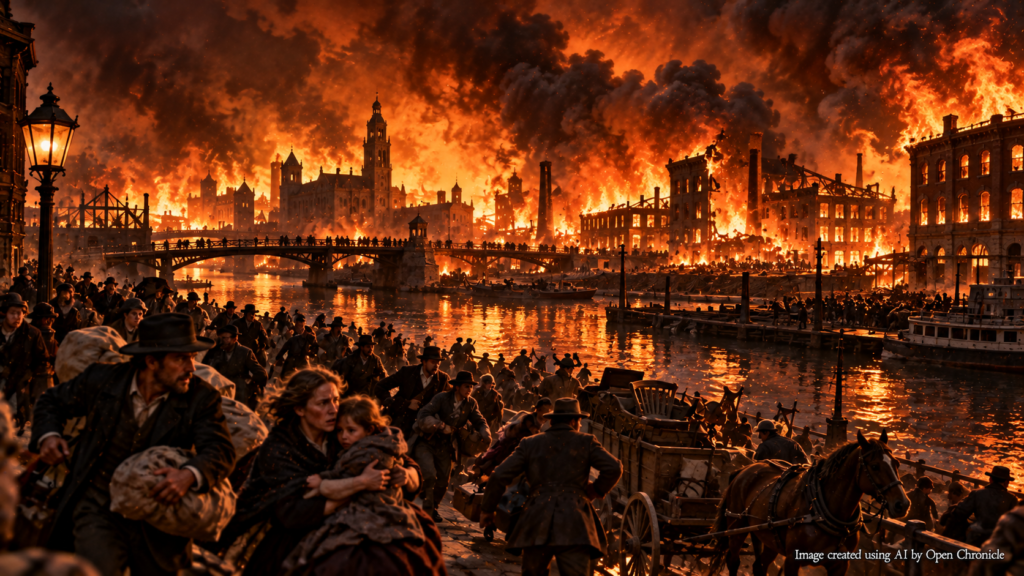
How a devastating fire destroyed much of Chicago, left approximately 100,000 people homeless, exposed the vulnerabilities of a rapidly industrializing American city and helped shape the future of urban architecture.
By Open Chronicle History Desk
On the evening of October 8, 1871, a small fire began in a barn on Chicago’s southwest side.
At first, it appeared to be another ordinary emergency in a city where fires were common.
Chicago was expanding at extraordinary speed. Its streets were crowded with wooden buildings, factories, warehouses, railway facilities and homes constructed as quickly as the growing population demanded.
The summer had been exceptionally dry.
Strong winds swept across the city.
Firefighters were exhausted after responding to numerous blazes.
And much of Chicago, including buildings, sidewalks and even sections of its streets, was made of wood.
Shortly after nine o’clock that Sunday evening, flames were discovered near the property of Patrick and Catherine O’Leary.
Within hours, the fire had escaped the neighborhood.
It crossed streets, overwhelmed fire crews and advanced toward the commercial center.
People fled through smoke-filled avenues, carrying children, furniture and whatever possessions they could save.
Churches, hotels, businesses and homes disappeared into the flames.
The courthouse burned.
The city’s business district was devastated.
By the time the fire finally burned out on October 10, approximately 300 people were dead, some 100,000 had been left homeless and more than 17,000 buildings had been destroyed.
An area of roughly 3.3 square miles lay in ruins.
Yet the catastrophe would become more than a story of destruction.
It would transform Chicago’s building practices, reshape its political and economic ambitions and contribute to the emergence of one of the world’s great architectural cities.
And at the center of the story was a cow that almost certainly never started the fire.
1. Chicago Before the Flames
In the middle of the nineteenth century, Chicago was one of the fastest-growing cities in the United States.
Its location near Lake Michigan made it an important transportation and commercial center.
The opening of the Illinois and Michigan Canal in 1848 strengthened connections between the Great Lakes and the Mississippi River system.
Railways expanded the city’s reach.
Agricultural products, lumber, livestock and manufactured goods passed through Chicago on an enormous scale.
Its population grew from fewer than 30,000 inhabitants in 1850 to approximately 300,000 by 1870.
This extraordinary growth brought wealth and opportunity.
It also created severe problems.
Infrastructure struggled to keep pace with expansion.
Neighborhoods were crowded.
Construction often prioritized speed and cost over durability.
Chicago was becoming a major American metropolis, but it was also accumulating the conditions for a disaster.
2. A City Built from Wood
Wood was central to Chicago’s development.
It was inexpensive, widely available and easy to use.
Houses were built from timber.
Commercial buildings incorporated extensive wooden structures.
Factories and warehouses stored combustible materials.
Wooden sidewalks lined many streets.
Even some road surfaces used wooden blocks.
The result was a city in which fire could move rapidly from one structure to another.
A single burning building could ignite an entire block.
In densely developed districts, the danger was multiplied.
Chicago’s physical environment had become an enormous concentration of fuel.
3. The Summer of 1871
The months preceding the fire were unusually dry.
Rainfall had been limited, leaving buildings, fences, yards and other combustible materials vulnerable.
Dry conditions affected much of the Great Lakes region.
October 1871 would also witness devastating fires in Wisconsin and Michigan.
Chicago’s disaster was therefore part of a wider period of extreme regional fire danger.
The dry weather alone did not cause the catastrophe.
But it made the city exceptionally vulnerable once a major fire began.
4. The Fire Department Under Pressure
Chicago maintained a professional fire department, but its resources were limited compared with the city’s rapid growth.
Firefighters depended on horse-drawn equipment, steam-powered engines, hydrants and the available water supply.
The department had already been responding to repeated fires.
On October 7, a major blaze had damaged part of the city.
Crews were exhausted.
Equipment required maintenance.
When the new fire broke out the following evening, the department was already operating under difficult conditions.
The timing could hardly have been worse.
5. October 8, 1871: The First Flames
The Great Chicago Fire began on Sunday evening, October 8, in or near a barn belonging to the O’Leary family on DeKoven Street.
The exact cause remains unknown.
The fire was reported at approximately 9 p.m.
The flames initially threatened nearby structures.
But strong winds helped drive the fire beyond its original location.
Sparks and burning debris travelled through the air.
Dry wooden buildings caught fire.
Within a short period, what might have remained a local emergency was developing into a citywide catastrophe.
6. The O’Leary Family
Patrick and Catherine O’Leary were Irish immigrants living in Chicago.
Their property became permanently associated with the disaster because the fire began in their barn.
Almost immediately, rumors circulated about how the blaze had started.
The most famous story claimed that a cow had kicked over a lantern while Catherine O’Leary was milking it.
The lantern supposedly ignited hay inside the barn.
The story was memorable, simple and easy to repeat.
It also lacked reliable evidence.
Catherine O’Leary denied the allegation.
Later historical investigations found no convincing basis for blaming her or her cow.
Yet the legend became one of the most enduring myths in American urban history.
7. The Cow That Became a Legend
The story of Mrs. O’Leary’s cow spread rapidly through newspapers and popular accounts.
It offered an explanation for a disaster that seemed almost impossible to comprehend.
One ordinary animal, one overturned lantern and an entire city destroyed.
But the legend concealed the real causes of the catastrophe.
Chicago had been built with combustible materials.
The weather was dry.
The wind was strong.
Fire protection systems were inadequate for the scale of the emergency.
The cow became a convenient symbol that distracted attention from these structural vulnerabilities.
It also contributed to the unfair public treatment of Catherine O’Leary, an immigrant woman who became associated with blame and ridicule.
The fire was real.
The famous explanation was not established fact.
8. A Fire Driven by Wind
As the blaze intensified, the wind became one of its most dangerous forces.
Flames were pushed northeastward through the city.
Burning embers travelled ahead of the main fire.
Buildings that had not yet been reached by the advancing flames began to ignite.
This phenomenon made the fire difficult to contain.
Firefighters could not simply establish a line at the edge of the burning district.
New fires were appearing beyond it.
The fire was no longer behaving like an isolated building emergency.
It had become a rapidly spreading urban conflagration.
9. The Failure of the Alarm System
Chicago’s firefighting response was complicated by problems with communication.
Confusion about the location of the fire contributed to delays and misdirected equipment.
The city’s alarm system depended on accurate reports and the coordination of available crews.
Under ordinary conditions, the system could function effectively.
But on October 8, the combination of exhaustion, communication difficulties and the speed of the spreading flames proved disastrous.
By the time firefighters reached the threatened area in sufficient numbers, the fire had already gained dangerous momentum.
10. The Flames Enter the City
The fire advanced through residential and commercial districts.
Wooden buildings burned rapidly.
The intense heat made nearby structures vulnerable even before flames reached them.
Roofs caught fire.
Windows shattered.
Streets filled with smoke.
Residents attempted to escape while carrying whatever belongings they could manage.
Some loaded possessions onto wagons.
Others fled on foot.
The fire moved faster than many people expected.
For thousands of Chicagoans, the catastrophe became a struggle to survive rather than an attempt to save property.
11. The Chicago River
The Chicago River appeared to offer a natural barrier.
Water should have separated the burning districts from other parts of the city.
But the river could not stop the disaster.
Burning materials, intense heat and windborne embers helped the fire cross sections of the waterway.
Lumberyards, industrial facilities and other combustible materials near the river increased the danger.
The crossing of the river marked a critical escalation.
Areas that residents had believed might remain safe were now threatened.
The fire continued toward the city’s commercial heart.
12. The Business District Burns
Chicago’s downtown contained major commercial institutions, hotels, offices, shops and warehouses.
The fire swept into this densely developed district.
Buildings collapsed.
Businesses were destroyed.
Streets became impassable.
The financial consequences were enormous.
Records, merchandise, machinery and property disappeared.
Some residents and business owners attempted to rescue documents or valuables.
Others abandoned everything.
The city’s economic center was being consumed.
13. The Courthouse and the Bell
Among the buildings destroyed was the Cook County Courthouse.
Its bell became associated with the dramatic final hours before the structure was engulfed.
The courthouse represented the authority of local government.
Its destruction symbolized the scale of the catastrophe.
Government records and administrative facilities were lost.
Public institutions that normally coordinated civic life were themselves becoming victims of the emergency.
The fire had reached the heart of the city.
14. Churches, Hotels and Landmarks
The destruction extended to some of Chicago’s most recognizable buildings.
Churches burned.
Hotels were lost.
Commercial landmarks collapsed.
The fire destroyed much of the city’s built environment, including places associated with civic pride and economic ambition.
But the devastation was uneven.
Some structures survived.
The Chicago Water Tower and nearby Pumping Station became famous symbols of survival, although the pumping machinery was damaged and water service was disrupted during the disaster.
These surviving landmarks would later become important reminders of the city that existed before 1871.
15. A City Without Water
As the fire spread, Chicago’s water infrastructure suffered severe damage.
The pumping station became inoperable.
Firefighters lost the reliable water pressure needed to combat the flames.
This development transformed an already overwhelming emergency into a nearly impossible one.
Crews could no longer depend on the city’s normal firefighting system.
The fire continued advancing while the capacity to stop it deteriorated.
Chicago’s dependence on vulnerable centralized infrastructure had become another critical weakness.
16. The Night of Panic
Thousands of people fled northward and toward open spaces.
Families became separated.
Animals escaped.
Wagons crowded the streets.
Smoke reduced visibility.
The heat was intense.
People sought refuge along the lakefront, in parks and in areas beyond the advancing fire.
Some entered the waters of Lake Michigan or the Chicago River to escape the heat.
Others waited through the night, uncertain whether the flames would reach them.
The disaster was experienced not as one continuous event but as thousands of individual emergencies.
Every family faced its own decisions.
What could be saved?
Where was safety?
Who was missing?
And would there be a home to return to?
17. The Human Cost
The Great Chicago Fire killed approximately 300 people.
The exact number remains uncertain because the destruction complicated the identification and recording of victims.
Some bodies were never recovered or identified.
Others died during the chaos of evacuation.
The death toll, although devastating, represented only part of the catastrophe.
Approximately 100,000 people were left homeless.
That was roughly one-third of the city’s population.
Entire neighborhoods disappeared.
Thousands of families lost their possessions, livelihoods and shelter.
18. The Destruction in Numbers
THE GREAT CHICAGO FIRE · OCTOBER 8–10, 1871
~300
People killed
100,000
People left homeless
17,000+
Buildings destroyed
3.3 mi²
Approximate area burned
Historical estimates vary. The figures are rounded and should not be interpreted as exact counts.
The property damage was estimated at approximately $200 million in 1871 dollars.
The destruction affected homes, businesses, warehouses, public buildings and essential infrastructure.
Chicago had experienced one of the most destructive urban fires in American history.
19. October 9: The City Continues to Burn
By Monday morning, October 9, the fire had not been contained.
Large sections of Chicago were still burning.
The flames continued northward.
Residents watched as entire neighborhoods disappeared.
The scale of the destruction became increasingly apparent.
Emergency shelters were overwhelmed.
People searched for missing relatives.
Government officials struggled to coordinate relief while the disaster remained active.
The city was still fighting for its survival.
20. October 10: The Fire Finally Ends
The fire finally burned out on October 10.
Rain helped extinguish the remaining flames, while changing conditions and the exhaustion of available fuel also contributed to the end of the disaster.
Chicago emerged into a landscape of ruins.
Brick walls stood without roofs.
Chimneys rose above destroyed neighborhoods.
Streets were filled with debris.
Thousands of residents had nowhere to live.
The fire was over.
The humanitarian emergency was only beginning.
21. The Relief Effort
Relief organizations, local authorities and volunteers began responding immediately.
Food, clothing, shelter and medical assistance were urgently needed.
Donations arrived from across the United States and from abroad.
The Chicago Relief and Aid Society became an important organization in coordinating assistance.
Temporary shelters were established.
Supplies were distributed.
The scale of public generosity became an important part of the city’s recovery.
But the needs were enormous.
Families had lost homes, employment and personal possessions.
Reconstruction would take years.
22. The National Response
News of Chicago’s destruction spread rapidly through newspapers and telegraph networks.
Americans across the country responded with donations.
Businesses contributed money and supplies.
Other cities organized relief campaigns.
International assistance also arrived.
The catastrophe became a national event.
Chicago’s recovery was no longer merely a local concern.
The city occupied such an important place in American transportation and commerce that its destruction affected the wider economy.
Helping Chicago rebuild became a symbol of national solidarity.
23. The Wider Fire Disaster of 1871
Chicago was not the only community devastated by fire in October 1871.
On the same night, the Peshtigo Fire swept through northeastern Wisconsin and nearby areas.
It killed far more people than the Chicago fire, with historical estimates commonly placing the death toll at 1,200 or more.
Fires also affected parts of Michigan.
These disasters reflected the extreme regional fire conditions.
Yet Chicago received much greater national and international attention.
Its size, economic importance and extensive newspaper coverage made it the most famous fire of that period.
The contrast remains a reminder that historical memory is influenced not only by the scale of suffering but also by the visibility of the places affected.
24. Rebuilding Chicago
Chicago’s recovery began with remarkable speed.
Business owners sought to reopen.
Construction workers arrived.
New buildings rose from the ruins.
The city’s strategic advantages had not disappeared.
Its railway connections remained important.
Its location on the Great Lakes continued to support commerce.
Investors believed Chicago would recover.
The rebuilding process became an opportunity to reconsider how the city should be constructed.
But it was not a simple transformation from wood to stone.
Cost, regulation, political influence and the needs of residents shaped the reconstruction.
25. New Building Regulations
The fire exposed the dangers of extensive wooden construction.
Chicago authorities introduced and revised regulations intended to reduce the risk of future conflagrations.
Fire-resistant materials became increasingly important in central districts.
Brick, stone, iron and later steel were used more extensively.
Building codes evolved.
Fire protection became a greater concern for architects, engineers and municipal officials.
The process was gradual and contested.
Not every neighborhood was rebuilt to the same standard.
But the fire accelerated a long-term transformation in urban construction.
26. The Rise of Modern Architecture
Chicago eventually became one of the world’s most influential centers of modern architecture.
In the decades following the fire, architects and engineers experimented with new structural systems and commercial building designs.
The growth of steel-frame construction, elevators and modern foundations made taller buildings possible.
Architects associated with the Chicago School helped transform the urban skyline.
Figures such as William Le Baron Jenney, Daniel Burnham, John Wellborn Root and Louis Sullivan contributed to this architectural development.
The fire did not directly invent the skyscraper.
Technological, economic and architectural changes were already underway.
But the rebuilding and subsequent growth of Chicago created important conditions for experimentation.
The city’s destruction became part of the longer story of modern urban design.
27. The Home Insurance Building
Completed in 1885, the Home Insurance Building became one of Chicago’s most famous early tall buildings.
Designed by William Le Baron Jenney, it used an innovative metal structural system.
It is frequently described as an early skyscraper, although historians debate how the term should be applied and which building deserves the title of first skyscraper.
The building represented a broader transformation.
Cities were beginning to grow vertically.
Architecture was moving beyond the limitations of traditional load-bearing masonry.
Chicago became a laboratory for modern commercial construction.
28. The World’s Columbian Exposition
In 1893, Chicago hosted the World’s Columbian Exposition.
The event celebrated the four-hundredth anniversary of Columbus’s 1492 voyage, although it opened a year after the anniversary.
The exposition attracted millions of visitors.
Its monumental buildings, technological displays and urban planning demonstrated Chicago’s renewed international ambitions.
Only twenty-two years had passed since the fire.
The city that had been devastated in 1871 now presented itself as a modern metropolis capable of hosting one of the largest international exhibitions of the nineteenth century.
The exposition became a powerful symbol of recovery.
29. The Myth of Mrs. O’Leary’s Cow
The story of the cow survived long after the fire.
It appeared in books, newspapers, songs and popular culture.
Generations of Americans learned that Chicago had burned because a cow kicked over a lantern.
But historians have repeatedly challenged the claim.
In 1997, the Chicago City Council formally exonerated Catherine O’Leary and her cow from responsibility for the disaster.
The gesture was symbolic.
More than a century had passed.
But it acknowledged the injustice of attaching blame to a family without sufficient evidence.
The myth remains famous.
The historical record is considerably less certain about the initial ignition.
30. Who Really Started the Fire?
Several alternative explanations have been proposed.
Some accounts suggested accidental ignition.
Others raised the possibility of human activity near the barn.
Later theories attempted to identify individuals who might have been responsible.
None has produced a universally accepted explanation supported by decisive evidence.
The exact ignition source remains unknown.
This uncertainty is important.
Historians can identify where the fire began and explain the conditions that allowed it to spread.
They cannot establish with confidence the precise action that produced the first flames.
The distinction between a documented event and an unverified explanation is central to responsible historical reporting.
31. The Fire and the Immigrant City
Chicago’s population included large immigrant communities.
Irish, German, Scandinavian and other European immigrants contributed to the city’s rapid growth.
Many worked in industrial jobs, construction, transportation and domestic service.
The O’Leary family belonged to this immigrant urban society.
The speed with which blame attached to Catherine O’Leary reflected wider social prejudices.
Her identity as an Irish immigrant woman helped make her an easy target for sensational reporting.
The fire’s mythology therefore reveals something about nineteenth-century American society beyond the disaster itself.
It shows how class, ethnicity and gender could influence the assignment of public blame.
32. A Turning Point in Fire Protection
The Great Chicago Fire became an important case study for urban fire safety.
It demonstrated the danger of allowing dense concentrations of combustible buildings to develop without adequate protective infrastructure.
It exposed the vulnerability of water systems.
It showed how strong winds and airborne embers could overwhelm conventional firefighting strategies.
It emphasized the importance of communication, emergency coordination and resilient construction.
These lessons influenced debates about fire prevention in Chicago and other growing cities.
The disaster contributed to a broader recognition that urban safety required planning, regulation and investment.
33. Chicago’s Economic Resilience
The speed of Chicago’s recovery was remarkable.
Its economic foundations remained strong.
The city continued to serve as a transportation hub.
Its access to agricultural markets and industrial networks encouraged investment.
Reconstruction created demand for labor and materials.
Businesses returned.
Population growth resumed.
By the late nineteenth century, Chicago had become one of the largest cities in the United States.
The fire had destroyed much of the built environment.
It had not destroyed the geographical and economic advantages that supported the city’s rise.
34. The Great Fire in American Memory
The Great Chicago Fire became part of America’s national historical imagination.
It represented catastrophe, vulnerability and reconstruction.
For some, it illustrated the dangers of uncontrolled urban expansion.
For others, it became a story of resilience and enterprise.
The image of Chicago rising from its ashes became central to the city’s identity.
But this optimistic narrative can obscure the suffering of the people who lost homes, relatives and livelihoods.
The rebuilding of a great city was not experienced equally by everyone.
The historical story includes both collective recovery and individual loss.
35. Why October 8 Matters
October 8, 1871 marks the beginning of a catastrophe that transformed Chicago.
The fire exposed the vulnerabilities of rapid urbanization.
It destroyed thousands of buildings and displaced an enormous proportion of the population.
It accelerated debates over building standards and fire prevention.
It contributed to the conditions in which Chicago became a center of architectural innovation.
It also produced one of the most enduring historical myths in the United States.
The Great Chicago Fire remains a reminder that disasters are rarely caused by one simple mistake.
They emerge when environmental conditions, infrastructure, institutional weaknesses and human decisions interact.
The first flame may be small.
The system that allows it to become a catastrophe is often much larger.
October 8, 1871: The Night Chicago Burned
Imagine Chicago on that Sunday evening.
A barn catches fire.
The wind rises.
Wooden rooftops begin to ignite.
Firefighters rush through crowded streets.
Families watch flames approaching their homes.
The river fails to stop the blaze.
The commercial district disappears into smoke.
By morning, thousands are fleeing.
By the following night, the city is still burning.
And when the fire finally ends, much of Chicago lies in ruins.
Yet the story does not finish with the destruction.
Workers return.
Businesses reopen.
Buildings rise.
Architects experiment with new possibilities.
Within a generation, Chicago has become a symbol of modern American urban development.
The catastrophe of 1871 did not create the modern city by itself.
But it became one of the defining events in Chicago’s transformation.
On October 8, 1871, a fire began in a small barn. By the time it ended, it had changed the history of an American metropolis.
Open Chronicle History · Research & Sources
Historical Sources and Further Reading
This article draws on historical archives, contemporary
newspaper reporting, museum research and government
records documenting the Great Chicago Fire of 1871,
its human consequences and the reconstruction of the city.
01 · Chicago History Museum
City on Fire: Chicago in 1871
Museum educational research examining Chicago’s
wooden construction, the outbreak and spread of
the fire, the experiences of residents and the
historical evidence surrounding Catherine O’Leary
and the famous cow legend.
Chicago History Museum · Historical Education
02 · Library of Congress
Great Chicago Fire of 1871:
Chronicling America
Research guide providing access to contemporary
American newspaper accounts, historical timelines
and primary-source reporting published during and
immediately after the catastrophe.
Explore the Historical Newspapers →
Library of Congress · Primary Sources
03 · National Archives Museum
150 Years Ago: The Great Chicago Fire
An institutional examination of the disaster,
drawing on federal archival evidence, including
testimony about the fire’s movement across the
Chicago River, the conditions that accelerated
its spread and the destruction of the city.
Read the National Archives Research →
U.S. National Archives · Historical Records
04 · Library of Congress
The Great Conflagration:
Chicago, Its Past, Present and Future
A contemporary 1871 publication by James W.
Sheahan and George P. Upton documenting the
destruction of Chicago and early interpretations
of the disaster. This historical source provides
insight into how the catastrophe was described
and understood by observers of the period.
Explore the Original 1871 Publication →
Library of Congress · Digitized Historical Book
Editorial Note
Open Chronicle History distinguishes between
the documented outbreak of the Great Chicago Fire
on October 8, 1871, and the popular story that
Catherine O’Leary’s cow overturned a lantern.
The precise cause of ignition has never been
conclusively established, and the accusation
against the O’Leary family is unsupported
by reliable evidence.
Historical estimates of the death toll,
buildings destroyed and total area burned
vary between sources. Figures presented in
this article are approximate and reflect
widely used historical estimates rather
than definitive individual counts.
The fire began on October 8, continued
through October 9 and was extinguished
on October 10, 1871. Its architectural
consequences developed over subsequent
decades and should not be interpreted as
the immediate invention of the skyscraper.
Open Chronicle History Desk