
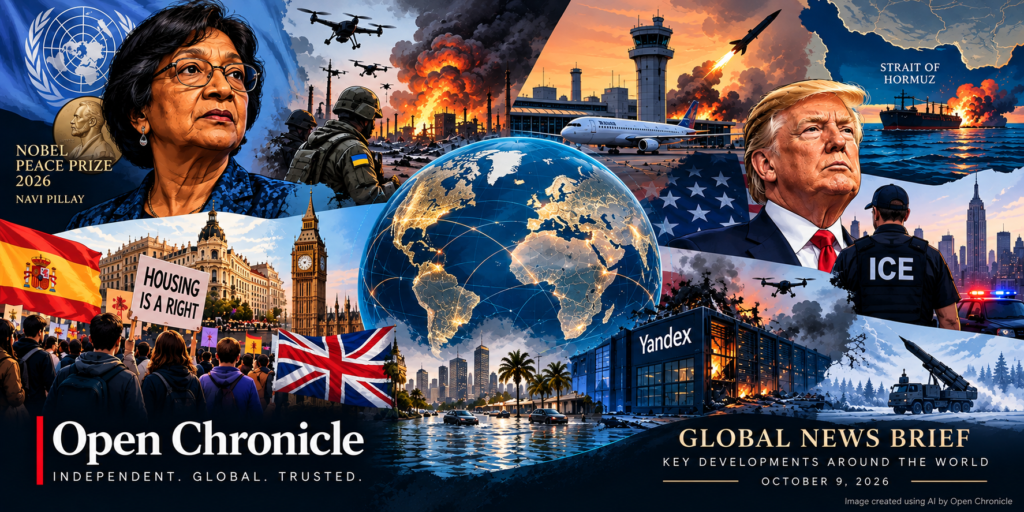
The 2026 Nobel Peace Prize has been awarded to South African human rights jurist Navi Pillay as conflicts in Ukraine and the Middle East continue to intensify. Ukrainian drones have reportedly struck Russian industrial and digital infrastructure, Houthi attacks have disrupted Saudi aviation, and a shooting involving US immigration officers has triggered controversy in New York. Across Europe, housing protests, political tensions and security concerns are shaping a turbulent international news cycle.
By Open Chronicle with agencies
October 9, 2026
The international news agenda on Friday is dominated by a combination of military escalation, diplomatic uncertainty, political unrest and mounting economic pressure.
From the announcement of the Nobel Peace Prize in Oslo to renewed Ukrainian strikes inside Russia, developments across several continents illustrate the increasingly interconnected nature of international security.
In the Middle East, attacks attributed to Yemen’s Houthi movement have raised concerns about Saudi Arabia’s security and the safety of regional aviation. Reports of explosions near the Strait of Hormuz have added to fears surrounding one of the world’s most important energy corridors.
In the United States, immigration enforcement, the approaching midterm elections and controversial developments involving capital punishment are generating political debate.
Meanwhile, European governments face a difficult combination of security threats, public protests and economic uncertainty.
International Affairs: Navi Pillay Awarded the 2026 Nobel Peace Prize
South African jurist Navanethem “Navi” Pillay has been named the recipient of the 2026 Nobel Peace Prize, according to multiple reports following Friday’s announcement.
The former United Nations High Commissioner for Human Rights has spent decades working in international law, human rights protection and accountability for serious violations of international humanitarian law.
Pillay previously served as a judge at the International Criminal Court and the International Criminal Tribunal for Rwanda, becoming an influential figure in the development of international criminal justice.
Her career has included extensive work addressing discrimination, crimes against humanity and the protection of vulnerable populations.
More recently, she has been associated with United Nations investigations into alleged violations of international law in the Palestinian territories and Israel.
The award comes during a period in which international legal institutions face growing political pressure and questions about their ability to hold governments and armed groups accountable.
Pillay’s recognition places international justice at the centre of this year’s Nobel Peace Prize discussion.
Her selection also carries particular significance for South Africa, where her legal career developed during the apartheid era, when racial discrimination restricted professional opportunities and political rights.
Ukraine War: Drone Strikes Target Russian Chemical Facilities and Energy Infrastructure
Ukraine has reportedly carried out another series of drone attacks against industrial installations inside Russia, targeting facilities associated with chemical production, energy infrastructure and digital services.
Among the reported targets is the Redkino Experimental Chemical Plant in Russia’s Tver region.
The facility has been described in reporting as a manufacturer of chemical components with potential applications in rocket propulsion and other industrial processes.
Reports indicate that drones struck the installation, although the extent of the damage and the effect on production remain uncertain.
Other reported attacks affected oil infrastructure in several Russian regions, including an oil refinery in Ukhta and an oil depot near Belgorod.
The incidents form part of Ukraine’s continuing campaign against facilities that may contribute to Russia’s economic resources or military supply chains.
Ukrainian attacks on Russian territory have increasingly involved long-range drones capable of reaching installations far beyond the immediate battlefield.
Moscow has responded with continued missile, drone and aerial bomb attacks against Ukrainian cities and infrastructure.
The competing operations underline the expanding geographical scope of the conflict.
Yandex Data Centre Suffers Further Damage
Reports from Russia indicate that a Ukrainian drone strike against a Yandex data centre has caused significant disruption to several infrastructure modules.
Some reports describe parts of the facility as completely disabled.
Yandex has acknowledged damage associated with the attack, according to the supplied reporting, although the full technical consequences remain unclear.
The incident is notable because digital infrastructure is increasingly becoming a target in modern conflicts.
Data centres support cloud computing, business applications, communications and a wide range of civilian services.
Attacks on such facilities can therefore produce economic disruption beyond the immediate physical damage.
However, the available reports do not establish that the affected Yandex infrastructure was being used for military purposes.
Russian Airstrikes Continue Across Ukraine
Russian attacks have continued against Ukrainian population centres, with reports of civilian deaths and widespread disruption.
Several reports describe a particularly deadly strike against passenger buses in eastern Ukraine, while other attacks have affected residential areas and energy infrastructure.
Ukrainian authorities have also reported explosions and air raid warnings in Kharkiv, Sumy, Kyiv and Odesa.
As colder weather approaches, attacks against electricity and heating infrastructure are increasing concerns about the country’s ability to maintain essential services.
Residents in Kyiv and other major cities are reportedly considering temporary relocation because of the growing risk of power failures and disruptions to daily life.
Ukrainian officials have accused Russia of deliberately targeting civilian infrastructure.
Russia continues to deny intentionally attacking civilians.
Independent verification of individual casualty figures and military claims remains difficult during ongoing hostilities.
Poland Activates Military Aviation Following Russian Strikes
Russian attacks near Ukraine’s western border have prompted heightened military readiness in Poland.
Reports indicate that Polish military aviation was deployed and air defence systems placed on alert following Russian operations near Polish territory.
Such responses have become an important part of NATO’s defensive posture along its eastern flank.
Poland has repeatedly emphasized the need to protect its airspace as missile and drone attacks continue close to the alliance’s borders.
The latest alerts highlight the continuing risk that military activity in Ukraine could produce incidents affecting neighbouring NATO members.
Middle East: Houthi Attacks Disrupt Saudi Aviation
Saudi Arabia is facing renewed security pressure following attacks attributed to Yemen’s Houthi movement.
Saudi authorities have reported three deaths following attacks affecting facilities at Riyadh’s King Khalid International Airport and Saudi aviation assets.
One of those reported killed was an airline pilot.
The incidents have caused significant disruption to commercial aviation, with reports indicating that hundreds of flights were cancelled.
The Saudi-led coalition operating in Yemen announced that it had destroyed three Houthi missile launch platforms.
The United Nations has condemned attacks against Saudi airports.
The developments have raised concerns about the vulnerability of civilian aviation infrastructure during the expanding regional confrontation.
Airports represent particularly sensitive targets because disruptions can affect thousands of passengers, international transport connections and commercial operations.
Saudi Arabia’s security concerns also have broader implications for regional energy markets and international trade.
Explosions Reported Near the Strait of Hormuz
Reports of heavy explosions near the Strait of Hormuz have intensified concerns about maritime security.
Iranian state media suggested that commercial tankers may have encountered naval mines, although the circumstances have not been independently established.
The Strait of Hormuz is a critical maritime passage connecting the Persian Gulf with international shipping routes.
A significant share of the world’s seaborne oil exports passes through the area.
Any prolonged disruption could affect energy prices, insurance costs and international shipping.
The latest reports come amid heightened military tensions involving Iran, the United States and regional governments.
At the time of the supplied reporting, the precise cause of the explosions and the condition of the vessels involved remained uncertain.
Trump Rules Out New Iran Attack Before US Midterms
President Donald Trump has reportedly ruled out launching a new American attack against Iran before the November midterm elections.
The announcement comes amid reporting that the Pentagon has been examining additional military options, including a possible intensive strike campaign.
Other reports suggest that American aircraft carrier deployments are being considered or adjusted as part of regional contingency planning.
Trump has referred to ongoing diplomatic contacts as productive, while administration officials have maintained pressure on Iran through sanctions and warnings.
Washington has also announced additional measures targeting vessels associated with Iran’s oil trade.
The developments suggest that military planning and diplomatic efforts are continuing simultaneously.
However, reports about possible strike options do not establish that a decision to launch an operation has been made.
Gaza Faces Severe Humanitarian Shortages
The humanitarian situation in Gaza remains critical.
According to reports citing the United Nations, available shelter supplies are sufficient to meet only approximately 17% of anticipated winter requirements.
Nearly two million people are reported to need humanitarian assistance.
Aid organizations have warned that damaged housing, displacement and restrictions affecting humanitarian operations are making preparations for winter increasingly difficult.
Reports of further deaths following Israeli military activity have added to concerns about civilian protection.
More than 100 organizations have reportedly criticized the continuing humanitarian situation and questioned the effectiveness of existing ceasefire arrangements.
Meanwhile, Palestinian political factions have discussed postponing legislative elections because of deteriorating conditions.
Reports from Cairo suggest that Palestinian groups have reached an understanding to delay the vote.
The Palestinian Authority has also faced renewed diplomatic tensions over Israeli measures affecting the British consulate in Jerusalem.
The developments underline the continuing intersection of humanitarian, political and diplomatic challenges surrounding the conflict.
Lebanon and Syria Remain Under Pressure
Regional tensions have also affected Lebanon and Syria.
The Israeli military reported that one of its soldiers was killed and three others wounded in southern Lebanon.
Separately, Syria has called for an international investigation into the reported targeting and sinking of the cargo vessel Alpha Watan in the Black Sea.
The circumstances surrounding the vessel’s reported sinking have not been independently established in the supplied material.
These incidents illustrate the wider regional and international consequences of conflicts that increasingly involve maritime routes, military deployments and cross-border security concerns.
United States: ICE Shooting Sparks Political Confrontation in New York
A shooting involving US Immigration and Customs Enforcement officers has triggered controversy in New York City.
According to local reporting, an immigration officer shot and wounded a man during an attempted arrest.
A five-year-old child was reportedly inside or near the vehicle at the time.
The incident prompted protests and renewed criticism of federal immigration enforcement operations.
New York’s mayor has reportedly called on President Trump to withdraw ICE personnel from the city following the shooting.
The circumstances of the confrontation, including the actions of the officers and the person who was shot, remain subject to investigation.
The incident comes as immigration enforcement continues to generate significant political disagreement across the United States.
Critics have raised concerns about the use of force and the effect of enforcement operations on families and local communities.
Supporters of stricter immigration enforcement argue that federal authorities must be able to carry out immigration laws.
The New York shooting is likely to add further pressure to an already polarized national debate.
Pentagon Plans Livestream of Fort Hood Gunman’s Execution
The US military is reportedly preparing to livestream the execution of Nidal Malik Hasan, the former Army psychiatrist convicted of carrying out the 2009 mass shooting at Fort Hood, Texas.
Hasan was sentenced to death following the attack, which killed 13 people and wounded dozens more.
Reports indicate that the execution would be carried out by firing squad.
The Pentagon’s reported decision to make the execution available through a livestream has generated controversy.
Some survivors and relatives of victims have expressed support for the execution while questioning whether broadcasting it is appropriate.
Critics have described the proposed livestream as an unnecessary public spectacle.
The case raises difficult questions about military justice, transparency, the death penalty and the treatment of victims’ families.
The supplied reports describe preparations for the execution but do not establish that it has taken place.
Christa Pike Reportedly Recovering After Failed Execution Attempt
Attorneys representing death row prisoner Christa Pike say she is walking with assistance and eating following a failed execution attempt.
The case has renewed debate about capital punishment procedures and the medical consequences of unsuccessful executions.
Her lawyers have described an improvement in her physical condition following the incident.
The available reporting does not provide enough independently verified medical information to establish the full extent of her recovery.
The case is likely to intensify scrutiny of execution protocols and the legal responsibilities of authorities carrying out capital punishment.
US Immigration Restrictions Affect Technology Companies
New restrictions affecting employment-based immigration have created uncertainty for technology companies and foreign workers.
Reports indicate that US authorities have suspended certain green card applications involving major technology employers, including Microsoft, Adobe and several Indian IT companies.
The measures have raised concerns among workers using the H-1B visa system who hope to obtain permanent residency.
Employment-based immigration is a major component of the American technology sector’s recruitment model.
Companies frequently rely on international workers for engineering, software development, artificial intelligence and specialized technical roles.
Microsoft has reportedly stated that a large majority of its H-1B applications concern existing employees.
Indian technology companies have also sought to reassure workers and investors that their recruitment strategies remain viable.
The developments have added tension to US relations with India, particularly after remarks by Vice President JD Vance concerning foreign technology workers drew criticism.
The full scope and duration of the reported application suspensions remain unclear from the supplied headlines.
Europe: Spain’s Housing Crisis Intensifies Ahead of Election
Spain’s housing crisis has become a central political issue ahead of a reported snap election.
Large demonstrations have taken place in Madrid, where protesters have demanded stronger protections for tenants and measures to address rising housing costs.
The death of an 87-year-old woman following her removal from a longtime residence has become a focal point of public anger.
Reports describe thousands of demonstrators gathering to mourn the woman and protest against eviction practices.
Housing activists have also criticized investment funds accused of purchasing residential property and pursuing aggressive financial returns.
Such investors are frequently described by campaigners as vulture funds.
Spain has experienced sustained pressure on housing affordability, particularly in major cities and areas with significant tourism demand.
Rising rents, limited affordable housing and the growth of investment-driven property ownership have contributed to public dissatisfaction.
The protests have increased political pressure on the government to address housing insecurity.
French Student Protests Continue
France is experiencing another wave of demonstrations led by students and supported by wider sections of society.
Protests have taken place in Paris and other cities, with participants demanding improved education funding and criticizing police responses.
Reports indicate that police used tear gas near a barricaded high school in Paris.
Student organizers have pledged to continue their demonstrations despite some concessions.
The unrest has become part of a broader debate about public services, economic pressures and the relationship between the government and younger generations.
French authorities have maintained that security measures are necessary when demonstrations become disruptive or violent.
Protesters and civil liberties advocates have questioned whether some police responses have been proportionate.
The political consequences will depend partly on whether the movement expands beyond educational institutions.
Labour Wins British By-Election
Britain’s Labour Party has won a parliamentary by-election in Holborn and St Pancras, according to the supplied reporting.
The result represents a setback for Green Party leader Zack Polanski, whose attempt to secure a parliamentary seat was unsuccessful.
The contest attracted attention because of the constituency’s association with Prime Minister Keir Starmer.
Although Labour retained the seat, the election has renewed discussion about competition between progressive political parties.
The result may also influence debate within the Green Party about its leadership and electoral strategy.
Montenegro Detains Figure Linked to Russian Rybar Network
Authorities in Montenegro have reportedly detained a Russian figure associated with Rybar, a prominent pro-Kremlin Telegram channel.
Rybar has developed a large following through military reporting, battlefield commentary and information related to Russia’s war against Ukraine.
The detention has attracted attention because of allegations connecting the network to Russian influence activities.
European governments have become increasingly concerned about hybrid threats involving disinformation, cyber operations and covert political influence.
However, the precise legal grounds for the detention and any proven involvement in unlawful activities require confirmation from official judicial sources.
European Energy Security Faces Renewed Pressure
European governments are preparing for another difficult winter as reports point to low natural gas storage levels and possible supply constraints.
Some assessments suggest that the European Union may need to reduce winter gas demand to balance supply.
Energy security has remained a major strategic concern since Russia’s full-scale invasion of Ukraine.
Although European countries have diversified imports and expanded alternative energy supplies, market volatility continues to affect prices and industrial competitiveness.
The European Union is also seeking to reduce dependence on Chinese supplies of critical minerals.
Recent policy initiatives have focused on metals needed for clean energy technologies, batteries and industrial manufacturing.
Together, the developments illustrate Europe’s continuing effort to strengthen economic resilience while managing geopolitical competition.
Asia Pacific: China, Technology and Regional Security
China Faces Questions Over Consumer Spending
China’s Golden Week holiday has produced mixed economic signals.
Reports indicate that spending per domestic tourist trip has fallen to its lowest level in four years, even as overseas travel has increased.
The figures suggest that Chinese consumers remain cautious about discretionary spending.
China’s economy continues to face challenges related to domestic demand, property market weakness and international trade tensions.
European governments have also intensified pressure on Beijing over trade imbalances and access to critical materials.
At the same time, China’s technological development and industrial capacity remain central to international economic competition.
South Korea Tests Domestically Developed Hypersonic Missile
South Korea has reportedly conducted a test of a domestically developed hypersonic missile.
The development reflects Seoul’s continuing efforts to strengthen its military capabilities amid regional security concerns.
Hypersonic weapons can travel at very high speeds and may be designed to manoeuvre during flight, creating additional challenges for some air defence systems.
The reported test also comes during a period of strained relations with North Korea.
Pyongyang has again rejected medical assistance offered by Seoul, emphasizing political conditions for improved relations.
The continuing disagreement highlights the limited progress in inter-Korean engagement.
China and the Philippines Clash Over South China Sea Incident
China and the Philippines have exchanged accusations following a dispute involving a medical mission in the South China Sea.
The incident adds to a series of confrontations over maritime access, territorial claims and activities in contested waters.
The South China Sea remains a major strategic flashpoint because of its shipping routes, fisheries and military importance.
Disagreements between Beijing and Manila have repeatedly raised concerns about the possibility of accidental escalation.
Regional governments continue to face the challenge of maintaining maritime security while avoiding direct military confrontation.
Indonesia’s Wildfires Disrupt Malaysia and Singapore
Smoke from Indonesian wildfires has spread across parts of Southeast Asia, worsening air quality in neighbouring countries.
Malaysia has reportedly closed schools in affected areas.
Singapore has also experienced elevated pollution levels, with some reports describing the country’s worst haze conditions of 2026.
Regional haze episodes can create serious public health risks, particularly for children, older adults and people with respiratory conditions.
They can also disrupt aviation, education and economic activity.
The latest episode has renewed questions about forest management, land clearing and regional cooperation on environmental protection.
Africa: Sudan Conflict and South African Unrest
Sudanese Commander Reportedly Defects to Army
A commander associated with the Rapid Support Forces has reportedly defected to the Sudanese army.
The development comes as Sudan’s conflict continues to produce displacement, destruction and humanitarian suffering.
The war between the Sudanese Armed Forces and the RSF has destabilized large areas of the country and severely disrupted essential services.
Reports of defections may indicate changes in local military relationships, but their broader operational significance remains uncertain.
The United Nations has extended the arms embargo affecting Darfur while discussions continue over possible additional sanctions.
International efforts to secure a political settlement have so far struggled to produce a lasting ceasefire.
South Africa Sees Anti-Migrant Violence
South Africa has experienced renewed unrest involving anti-immigration demonstrations.
Reports describe vehicles being set on fire, shops being looted and confrontations linked to anger over migration and asylum policies.
The incidents highlight continuing social tensions surrounding unemployment, public services and immigration.
South Africa has experienced previous episodes of violence directed against foreign nationals.
Authorities face pressure to prevent further attacks and protect affected communities.
The unrest comes during a period in which the country is also receiving international attention following Navi Pillay’s Nobel Peace Prize recognition.
Ethiopia and Eritrea Exchange Security Warnings
Ethiopia has told the United Nations Security Council that it may need to defend itself against threats associated with Eritrea.
The statement reflects continuing tensions between the two neighbouring countries.
Relations between Ethiopia and Eritrea have been shaped by decades of conflict, border disputes and regional political competition.
Renewed military confrontation could have serious consequences for stability in the Horn of Africa.
Diplomatic engagement remains essential to preventing further escalation.
Americas: Prison Violence in Mexico and Flooding in Chile
Mexican Prison Riot Leaves 10 Dead
A prison riot in Mexico’s Sinaloa state has killed 10 people and injured 16 others, according to the supplied reports.
The violence occurred in a region already affected by organized crime and disputes between criminal groups.
Sinaloa has long been associated with powerful drug trafficking organizations, and instability has placed considerable pressure on local security institutions.
The latest prison violence raises concerns about the authorities’ ability to maintain control of detention facilities.
The incident was reportedly the second major prison disturbance in the state within a week.
Investigations are expected to examine how the violence began and whether organized criminal networks played a role.
Chile Declares Emergency Following Santiago Flooding
Heavy rainfall has caused flooding in Santiago, damaging homes, vehicles and infrastructure.
Reports indicate that several people were injured.
President José Antonio Kast has reportedly declared a state of catastrophe in response to the emergency.
Flooding has affected roads and neighbourhoods, complicating transport and emergency operations.
The incident highlights the vulnerability of urban areas to extreme rainfall, particularly where drainage systems and infrastructure are unable to cope with sudden increases in water volume.
Emergency services have been working to assess damage and assist affected residents.
Technology and Cybersecurity: AI and Digital Infrastructure Become Strategic Targets
Technology has emerged as a recurring theme in Friday’s international news.
OpenAI has reportedly banned accounts linked to influence operations associated with Russia and Iran.
The reports reflect growing concerns about the use of generative artificial intelligence to produce political messaging, disinformation and coordinated online content.
Separately, American authorities have announced action against infrastructure allegedly used by a Chinese hacking group associated with Integrity Technology.
The FBI has reportedly seized tools linked to Chinese cyber operations.
These developments illustrate the increasingly important role of digital platforms in international competition.
Artificial intelligence, cloud computing, telecommunications and cybersecurity are no longer exclusively commercial concerns.
They are becoming integral to national security, diplomatic relations and military operations.
The reported Ukrainian attack against Yandex infrastructure reinforces this trend by demonstrating how digital systems can become exposed to physical attacks during armed conflict.
Meanwhile, disputes involving technology companies and immigration restrictions in the United States highlight the growing intersection between industrial policy, labour markets and geopolitical competition.
Global Climate: El Niño Could Remain Strong Into 2027
The World Meteorological Organization has reportedly warned that El Niño conditions could become exceptionally strong and persist into February 2027.
El Niño is a climate phenomenon associated with changes in sea surface temperatures and atmospheric circulation across the tropical Pacific Ocean.
Its effects can influence rainfall, drought conditions, tropical cyclone activity and temperatures in different parts of the world.
The consequences vary considerably by region.
Some areas may experience increased rainfall and flooding, while others face heightened drought risks.
The warning comes as several countries are already dealing with significant environmental pressures, including wildfires in Southeast Asia and flooding in South America.
Meteorological agencies will continue monitoring ocean temperatures and atmospheric conditions to assess how the event develops.
The possibility of a strong El Niño adds another dimension to global concerns about food security, water availability and disaster preparedness.
The Global Picture: Conflicts, Economic Pressure and Political Uncertainty
The developments reported on October 9 illustrate a world facing simultaneous challenges across several interconnected areas.
Military conflict remains a central driver of international instability.
Russia’s war against Ukraine continues to expand beyond the battlefield through attacks on energy facilities, industrial installations and digital infrastructure.
In the Middle East, Houthi operations, the confrontation involving Iran and the humanitarian crisis in Gaza are contributing to regional insecurity.
Economic pressures are shaping political developments in Europe and the United States, particularly through housing costs, energy prices and immigration debates.
At the same time, technological competition is becoming more closely connected to national security.
Artificial intelligence, cybersecurity and digital infrastructure increasingly influence how governments pursue their strategic objectives.
Against this backdrop, the decision to award the Nobel Peace Prize to Navi Pillay places renewed attention on international law and accountability.
Her recognition offers a reminder that the protection of human rights remains an important part of the international agenda, even as military confrontation and geopolitical rivalry dominate the headlines.
The coming days will reveal whether diplomatic efforts can reduce some of these tensions or whether further escalation will deepen the challenges confronting governments and international institutions.
Editorial Note
This Global News Brief is based on the international news headlines and agency reports supplied for October 9, 2026.
The report brings together developments from multiple regions and distinguishes reported events from claims that remain unverified.
Some breaking stories, particularly those involving military operations, casualties, security incidents and diplomatic negotiations, may evolve as additional information becomes available.
The Open Chronicle Global News Brief is intended to provide a broad editorial overview of the international news cycle rather than an exhaustive account of every reported development.