
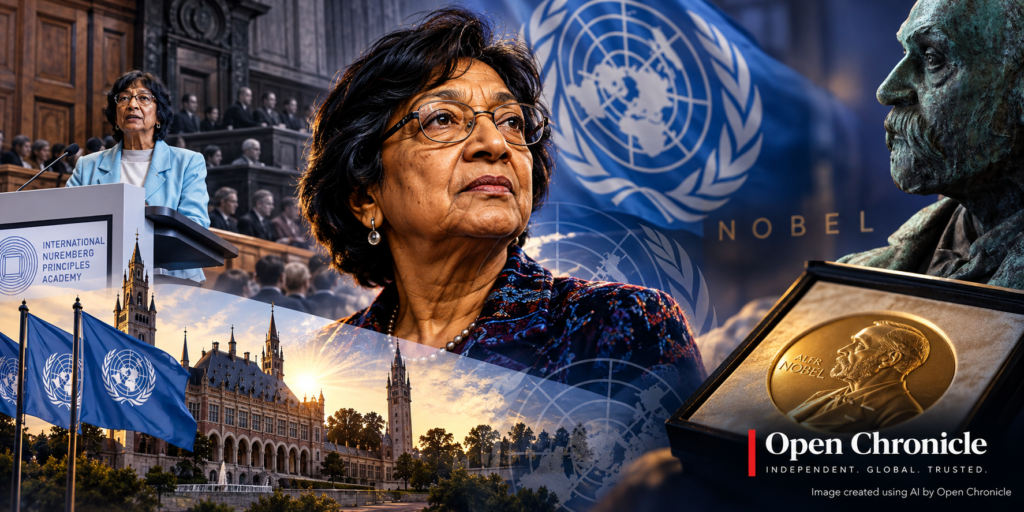
South African human rights jurist Navanethem “Navi” Pillay has been awarded the 2026 Nobel Peace Prize for her lifelong commitment to international law, accountability and the protection of human rights. From confronting apartheid in South Africa to prosecuting genocide in Rwanda and defending international justice at the United Nations, her career has helped shape the modern international legal system.
By Open Chronicle with agencies
October 9, 2026
South African jurist Navanethem “Navi” Pillay has won the 2026 Nobel Peace Prize, receiving one of the world’s most prestigious honours for her decades of work advancing international justice, defending human rights and strengthening the principle that no individual or government should stand above the law.
The Norwegian Nobel Committee recognized the 85-year-old lawyer and former United Nations High Commissioner for Human Rights for her efforts to promote universal legal principles and hold states and political leaders accountable for serious violations of international law.
The award comes at a moment when international courts and human rights institutions are facing increasing political pressure, with armed conflicts and disputes over accountability testing the foundations of the international legal order.
For Pillay, the announcement carried an extraordinary historical significance.
She learned that she had won the prize while visiting Courtroom 600 in Nuremberg, Germany, where leading figures of Nazi Germany were prosecuted following the Second World War.
The setting connected the beginning of her interest in international justice with the recognition of a career devoted to the same principles.
“Perhaps it was meant to be that I was in this historic courtroom, 600, where the Nuremberg trials were held, when the announcement was made and I was informed of the award,” Pillay said.
A Nobel Peace Prize Announced in the Courtroom Where Modern International Justice Took Shape
Courtroom 600 occupies a central place in the history of international criminal law.
Following the defeat of Nazi Germany in 1945, the Nuremberg trials established important precedents for prosecuting individuals responsible for war crimes, crimes against humanity and crimes against peace.
The proceedings helped advance the principle that senior political and military officials could face individual criminal responsibility for atrocities committed under their authority.
For Pillay, the trials had been an intellectual inspiration long before she became an international judge.
As a law student at the University of Natal during South Africa’s apartheid era, she encountered transcripts of the Nuremberg proceedings.
The documents introduced her to the possibility that international law could provide a means of holding powerful individuals accountable for grave crimes.
Decades later, she found herself standing in the courtroom associated with those proceedings as news arrived that she had received the Nobel Peace Prize.
The moment symbolized the continuity between the postwar development of international criminal law and the institutions that Pillay would later help shape.
She dedicated the award to survivors of international crimes and to those working to ensure that perpetrators are brought to justice.
Their “compassion and courage continue to ensure that impunity will not be allowed to reign,” she said.
From Apartheid South Africa to the International Stage
Navanethem Pillay was born on September 23, 1941, in Durban, South Africa, into a family of Indian origin with Tamil roots.
Her childhood was shaped by poverty and the institutionalized racial discrimination of apartheid.
Her father worked as a bus driver and took on additional employment to support the family, while her mother raised the children.
Despite difficult financial circumstances, her parents placed considerable importance on education.
“We grew up very poor,” Pillay recalled in an interview with the United Nations.
At a time when opportunities for non-white South Africans were severely restricted, she pursued higher education and entered a legal profession dominated by white men.
She graduated from the University of Natal with a Bachelor of Arts degree in 1963 and obtained her law degree in 1965.
Her determination to pursue legal work developed against the background of a political system that denied basic rights to the majority of South Africa’s population.
Rather than accepting those restrictions, Pillay used the law as a means of challenging them.
Breaking Barriers in South Africa’s Legal Profession
In 1967, Pillay became the first woman of colour to establish a law practice in Natal Province, according to the Institute for African Women in Law.
Her achievement was particularly significant in a society where racial and gender discrimination were embedded in public institutions.
She represented opponents of apartheid and political detainees, drawing attention to abuses including torture and prolonged solitary confinement.
Her legal work placed her in direct confrontation with the authorities responsible for enforcing apartheid legislation.
In 1973, she helped secure the right of political prisoners to consult legal counsel.
The achievement represented an important advance in the protection of detainees under a system that routinely restricted access to legal representation.
Her professional experience also exposed the inequalities within South Africa’s judiciary.
According to a Harvard Law School profile, Pillay was not permitted to enter a judge’s chambers while working as a lawyer.
She nevertheless continued to build a career that would eventually take her into some of the world’s most influential judicial institutions.
Following the end of apartheid and South Africa’s first democratic elections in 1994, new opportunities emerged within the country’s legal system.
In 1995, Pillay became the first woman of colour to serve as an acting judge on South Africa’s High Court.
That same year, she began a new chapter in international justice.
Rwanda: A Landmark Contribution to International Criminal Law
In 1995, Pillay was elected as a judge of the International Criminal Tribunal for Rwanda.
The tribunal had been established by the United Nations Security Council to prosecute individuals responsible for genocide and other serious violations of international humanitarian law committed during the 1994 genocide.
The atrocities in Rwanda had demonstrated the devastating consequences of ethnic hatred, political extremism and the failure of international institutions to prevent mass violence.
The tribunal’s task was to establish individual criminal responsibility through judicial proceedings.
Pillay served as a judge until 2003 and became the tribunal’s president in 1999, holding that position until the end of her service.
Her work contributed to the development of international criminal jurisprudence, particularly in relation to genocide and sexual violence.
The Akayesu Judgment and the Recognition of Sexual Violence as Genocide
One of the most significant cases in Pillay’s judicial career involved Jean-Paul Akayesu, the former mayor of Taba commune in Rwanda.
Pillay was one of three judges who heard the case.
In 1998, the tribunal convicted Akayesu of genocide, crimes against humanity and direct and public incitement to commit genocide.
The judgment became a landmark in international criminal law.
It recognized that rape and sexual violence could constitute acts of genocide when committed with the specific intent required under the Genocide Convention.
The tribunal also recognized rape as a crime against humanity in the circumstances established by the case.
The decision represented a major development in the legal treatment of sexual violence during armed conflict.
Historically, such abuses had frequently been marginalized in investigations and prosecutions of wartime atrocities.
The Akayesu judgment helped establish that sexual violence could be central to campaigns of persecution and destruction rather than merely an incidental consequence of war.
Speaking following the Nobel announcement, Pillay recalled the importance of that decision.
She said it was “outrageous” that the abuse of women and children during conflicts had previously been treated as “collateral damage or as reward for the hard fighting soldiers”.
Her contribution to the case remains one of the most enduring elements of her legal legacy.
From Rwanda to the International Criminal Court
After leaving the Rwanda tribunal, Pillay continued her international judicial career.
In 2003, she became a judge at the International Criminal Court, serving until 2008.
The ICC was established as a permanent institution with jurisdiction over genocide, crimes against humanity, war crimes and the crime of aggression, subject to the conditions governing its jurisdiction.
Its creation represented a major development in the international legal system.
Unlike temporary tribunals established to address particular conflicts, the ICC was designed to provide a permanent framework for prosecuting individuals responsible for the most serious international crimes.
Pillay’s appointment reflected her experience in international criminal justice and her involvement in developing legal principles concerning accountability.
Her work at the court formed part of a broader effort to strengthen the international community’s ability to respond to mass atrocities through judicial processes.
However, the ICC has also faced persistent political and institutional challenges.
Its effectiveness depends on cooperation from states, including assistance with investigations, access to evidence and the enforcement of arrest warrants.
These limitations have remained central to debates about international criminal justice.
Leading the United Nations Human Rights System
In 2008, Pillay became the United Nations High Commissioner for Human Rights.
She held the position until 2014.
As the UN’s senior human rights official, she was responsible for promoting and protecting human rights across the international system.
Her tenure coincided with major international developments, including political uprisings, armed conflicts and continuing debates over state sovereignty and humanitarian protection.
The role required engagement with governments, international organizations and civil society groups on issues ranging from discrimination and political repression to accountability for serious abuses.
Pillay consistently emphasized that human rights protections should apply universally.
Her approach reflected the belief that international legal standards must not depend on the political influence or strategic importance of the states involved.
The principle of equal accountability became one of the defining themes of her international career.
Gaza Investigations and the Political Pressure on International Justice
One of Pillay’s most recent prominent responsibilities was chairing the United Nations Independent International Commission of Inquiry on the Occupied Palestinian Territory, including East Jerusalem, and Israel.
The commission was tasked with investigating alleged violations of international human rights law and international humanitarian law.
In September 2025, the commission concluded that Israeli authorities and security forces had committed and were continuing to commit genocide against Palestinians in Gaza.
The commission also concluded that Israeli President Isaac Herzog, Prime Minister Benjamin Netanyahu and then Defence Minister Yoav Gallant had incited genocide.
Israel rejected the commission’s findings.
The conclusions were those of a United Nations investigative commission and did not constitute a final judgment by an international court.
That distinction is important because investigative commissions and judicial institutions perform different functions.
Commissions of inquiry gather evidence, assess alleged violations and present findings, while international courts determine legal responsibility through their respective judicial procedures.
The commission’s findings became part of a wider international debate over the conduct of military operations in Gaza, the protection of civilians and the interpretation of international humanitarian law.
The controversy also illustrated the political pressures facing institutions responsible for investigating allegations against states and senior officials.
For Pillay, the broader question has remained whether international legal principles can be applied consistently, including when powerful governments are involved.
The International Court of Justice and the Myanmar Genocide Case
Pillay’s legal career has also extended to proceedings before the International Court of Justice.
She is serving as a judge ad hoc selected by The Gambia in the case concerning alleged violations of the Genocide Convention by Myanmar.
The proceedings arise from allegations connected to the treatment of the Rohingya population.
The case is significant because it concerns the responsibility of a state under the Genocide Convention.
Unlike the International Criminal Court, which prosecutes individuals, the International Court of Justice resolves legal disputes between states and addresses questions of state responsibility.
Pillay’s participation illustrates the breadth of her experience across different areas of international law.
Her career has included the prosecution of individual perpetrators, the protection of human rights through United Nations institutions and judicial proceedings concerning the obligations of states.
International Law Under Increasing Political Pressure
In her remarks following the Nobel announcement, Pillay warned that the international legal system is facing serious challenges.
“We are living through an era when international law and human rights are under significant political attack,” she said.
She specifically referred to pressure on the International Criminal Court and other institutions responsible for investigating and prosecuting international crimes.
The concern extends beyond the future of individual courts.
International legal institutions depend on the willingness of states to respect their authority and cooperate with their decisions.
When governments reject legal obligations or seek to undermine judicial independence, the effectiveness of the international system can be weakened.
Pillay warned that attacks on international criminal justice risk reversing progress achieved since the Nuremberg trials.
“They risk returning us to a world in which power rather than law determines whose suffering matters,” she said.
Her remarks reflect a central tension in international relations.
Governments retain considerable political and military power, while international institutions rely on legal rules and cooperation to restrain abuses.
The Nobel award highlights the importance of preserving those institutions even when their findings or decisions generate political controversy.
Peace Requires Justice, Says Nobel Committee
Announcing the award, the Norwegian Nobel Committee emphasized the relationship between international law and lasting peace.
“Peace requires justice,” the committee said.
Its statement presented the rule of law as an essential foundation for resolving conflicts without violence.
The committee’s recognition of Pillay reflects a broader understanding of peace that extends beyond ceasefires and diplomatic agreements.
Accountability for atrocities, protection of fundamental rights and access to independent courts can play important roles in preventing further violence.
Without credible legal mechanisms, victims may be denied justice and perpetrators may believe they can act without consequences.
Pillay’s career has been closely associated with the effort to challenge that assumption.
From representing political detainees under apartheid to participating in genocide prosecutions, her work has emphasized the importance of legal accountability.
A Message to World Leaders
Following the Nobel announcement, Pillay called on political leaders to respect international law and fulfil their obligations to protect human rights.
Her message emphasized that states have legal responsibilities that cannot simply be disregarded for political convenience.
“That is an obligation I call upon every state to fulfill,” she said.
She also reaffirmed her commitment to independent courts and a legal order based on consistent principles rather than selective enforcement.
For Pillay, international justice cannot function effectively if legal standards are applied differently depending on a country’s political alliances or international influence.
Her position reflects the principles that have guided her work throughout her professional life.
The Nobel recognition, she said, had strengthened her determination to continue defending those principles.
A Career That Helped Transform International Justice
Navi Pillay: A Lifetime in Law and Human Rights
-
1941 | Durban, South Africa
Born into a family of Indian origin during the apartheid era.
-
1967 | Legal Pioneer
Became the first woman of colour to establish a law practice in Natal Province.
-
1973 | Political Prisoners’ Rights
Helped secure access to legal counsel for political detainees.
-
1995 | International Criminal Tribunal for Rwanda
Appointed as a judge and later served as tribunal president.
-
1998 | Akayesu Judgment
Participated in the landmark decision recognizing sexual violence as a possible act of genocide.
-
2003 | International Criminal Court
Began serving as a judge at the ICC.
-
2008 | United Nations
Became UN High Commissioner for Human Rights, serving until 2014.
-
2025 | Gaza Commission of Inquiry
Chaired a UN commission that issued major findings concerning alleged international crimes.
-
2026 | Nobel Peace Prize
Recognized for her contribution to international law, human rights and accountability.
Timeline based on the biographical and institutional information supplied for this article.
Pillay’s career spans several of the most important developments in international criminal justice since the Second World War.
Her early legal work challenged the discriminatory structures of apartheid.
Her judicial service in Rwanda contributed to groundbreaking interpretations of genocide and sexual violence.
Her work at the International Criminal Court supported the development of permanent international criminal justice.
As United Nations High Commissioner for Human Rights, she advocated universal protections across national boundaries.
Her subsequent involvement in international investigations and proceedings has continued to place accountability at the centre of her professional life.
These achievements reflect the evolution of international law from the postwar trials at Nuremberg to the complex institutions operating today.
From Nuremberg to the Nobel Peace Prize
There is a powerful historical symmetry in the circumstances surrounding Pillay’s Nobel Peace Prize.
As a young law student in apartheid South Africa, she discovered the Nuremberg trials through their written records.
The proceedings introduced her to the possibility of an international legal system capable of confronting grave abuses of power.
She subsequently devoted her career to making that principle meaningful through legal representation, judicial decisions and international institutions.
More than six decades after beginning her legal studies, she learned of the Nobel award while standing in the courtroom where that vision had acquired much of its modern legal foundation.
The setting offered a reminder of how international justice develops across generations.
The institutions that emerged after the Second World War have expanded, but they remain dependent on political cooperation and public confidence.
Pillay’s Nobel Peace Prize recognizes not only her personal achievements but also the continuing importance of the principles she has defended.
At a time of armed conflict, political polarization and growing challenges to international legal institutions, her message remains clear: lasting peace requires accountability, independent justice and respect for the rule of law.