
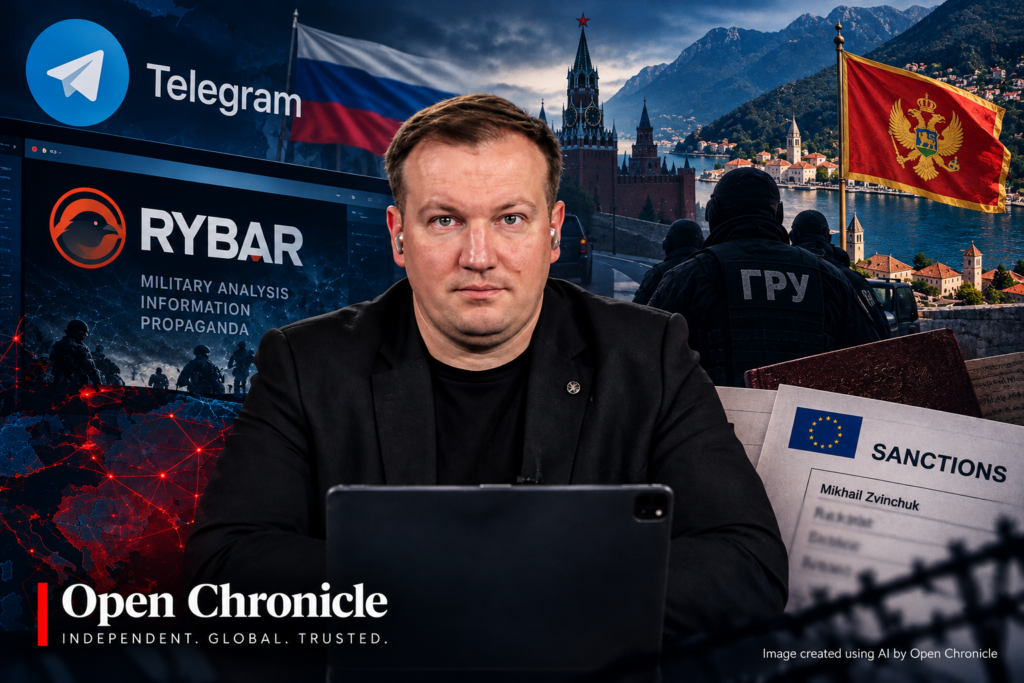
Montenegrin security agencies have reportedly detained Mikhail Zvinchuk, founder of the influential pro-Kremlin Telegram project Rybar, alongside his wife and several other Russian nationals. The operation, conducted near the Bay of Kotor, has drawn attention to Russia’s alleged information influence activities in Europe and the growing security concerns surrounding hybrid warfare, disinformation and foreign interference.
By Open Chronicle with agencies
October 9, 2026
Montenegrin law enforcement and intelligence authorities have reportedly detained Mikhail Zvinchuk, the founder of the Russian military commentary and information project Rybar, during a security operation in the coastal town of Risan.
The detention was reported on Friday, October 9, by Montenegrin newspapers Pobjeda and Vijesti, citing sources within the country’s security services.
According to the reports, Zvinchuk was taken into custody alongside his wife, Valeriya Zvinchuk, and three other individuals described by local media as associates.
The operation reportedly targeted people suspected of involvement in a Russian influence network that Western authorities have linked to Kremlin propaganda and disinformation activities.
The Russian Foreign Ministry has acknowledged the reports, stating that its embassy in Montenegro is seeking clarification about the circumstances of the detentions.
The precise legal grounds for the operation, whether formal criminal charges have been filed and the current legal status of those detained have not been established in the available reporting.
Security Operation Near the Bay of Kotor
The detentions reportedly took place in Risan, a historic coastal town on Montenegro’s Bay of Kotor.
According to Vijesti, the operation involved Montenegrin security agencies investigating a network associated with Russian information influence activities.
The newspaper reported that the individuals targeted were connected to an organization previously identified by British and American authorities as participating in Kremlin-aligned propaganda operations.
Pobjeda reported that five people were detained, including Mikhail and Valeriya Zvinchuk.
The outlet also described Zvinchuk as a colonel in Russia’s military intelligence service, commonly known as the GRU, and linked him to hybrid operations.
That characterization remains an allegation reported by the newspaper. The information provided does not independently establish his current military rank or formal intelligence affiliation.
The operation has attracted attention because of Zvinchuk’s prominent position within Russia’s wartime information environment.
Rybar has become one of the most widely followed Russian-language Telegram projects covering military developments, particularly Russia’s war against Ukraine.
Its influence extends beyond battlefield commentary, with Western authorities accusing the network of participating in broader information operations.
Rybar Confirms Detention but Rejects Implications of Illegal Activity
Rybar’s official Telegram channel confirmed that its founder had been detained alongside other Russian citizens.
In a statement, the project maintained that Zvinchuk and his companions were legally present in Montenegro.
The channel said the group had planned several activities during the visit, including filming the Cetinje Monastery, an important religious and historical site in Montenegro.
According to Rybar, an official request to conduct filming had already been submitted.
The project also stated that its representatives were in contact with the Russian Foreign Ministry.
The explanation presents a different account of the group’s activities from the security concerns described in Montenegrin media reports.
At present, the available information does not establish whether the planned filming was connected to the investigation or whether authorities suspect other activities.
The distinction is important because detention during a security investigation does not itself establish criminal responsibility.
Who Is Mikhail Zvinchuk?
Mikhail Zvinchuk is a Russian military commentator and former employee of the Russian Ministry of Defence’s press service.
He established Rybar together with Denis Shchukin, developing the project into a prominent source of military reporting and commentary.
Rybar initially attracted attention through detailed coverage of military operations, including battlefield maps, assessments and commentary on developments in Ukraine.
Over time, the project developed a substantial audience among Russian-speaking readers interested in military affairs.
Its principal Telegram channel has accumulated more than 1.5 million followers.
The network’s popularity has made it an influential part of the Russian information environment, particularly during the war against Ukraine.
Unlike traditional state television outlets, Telegram channels can distribute information rapidly, reach international audiences and circulate material through networks of affiliated accounts.
These characteristics have made the platform important for both independent reporting and state-aligned information campaigns.
Investigative publication The Bell has reported that financing connected to Rybar involved Yevgeny Prigozhin, the late founder of the Wagner Group.
That reported connection has contributed to questions about the project’s financial relationships and political independence.
However, the supplied reporting does not establish the full extent of those financial arrangements.
European Sanctions and Alleged Kremlin Connections
Zvinchuk is subject to sanctions imposed by the European Union and the United Kingdom.
The European Union has linked him to a working group established by Russian President Vladimir Putin to coordinate mobilization efforts supporting Russia’s war against Ukraine.
The restrictions reflect European concerns about individuals and organizations involved in supporting the Russian military campaign.
Sanctions are an important component of the European response to Russia’s invasion of Ukraine.
They are intended to restrict financial activity, access to resources and other forms of cooperation involving designated individuals and organizations.
In Zvinchuk’s case, the sanctions also demonstrate the attention Western governments have directed toward information networks associated with Russia’s wartime activities.
The allegations surrounding Rybar extend beyond ordinary political commentary.
Western authorities have identified the project as part of a broader ecosystem of influence operations intended to shape perceptions of international events.
Such operations may involve coordinated messaging, amplification through social media and the distribution of narratives designed to influence public opinion.
Nevertheless, sanctions designations and intelligence assessments should be distinguished from criminal convictions.
United States Offered Reward for Information About Rybar Network
In October 2024, American authorities announced a reward of up to $10 million for information concerning individuals associated with Rybar and alleged foreign information influence operations.
The American initiative identified 19 people, including Mikhail Zvinchuk and his wife, Valeriya.
The reward was connected to an investigation into activities described by US authorities as efforts to influence audiences through coordinated information campaigns.
The designation highlighted Washington’s concern about the role of Russian digital networks in international political communication.
Rybar’s substantial online following gives it the ability to distribute narratives rapidly across national boundaries.
Content published through Telegram can also be reproduced by other websites, social media accounts and political commentators.
This creates opportunities for individual messages to circulate far beyond their original audience.
For investigators, establishing whether such dissemination constitutes ordinary political expression or a coordinated foreign influence operation requires evidence concerning financing, direction, organization and intent.
The reported detentions in Montenegro bring those questions into renewed focus.
OpenAI Previously Blocked Accounts Linked to Rybar
The investigation into Rybar also intersects with concerns about the use of artificial intelligence in information operations.
In February 2026, OpenAI announced that it had blocked a group of accounts connected to the project, according to the supplied reporting.
The company said the accounts had been used to generate large volumes of content in Russian, English and Spanish.
The reported activity illustrated how generative artificial intelligence can be incorporated into coordinated information campaigns.
AI systems can assist users in producing text, translating material and adapting messages for different audiences.
When deployed as part of an organized influence operation, these capabilities can make it easier to produce multilingual content at scale.
The concern is not simply that artificial intelligence can generate political commentary.
Rather, investigators focus on whether such tools are being used to support deceptive coordination, misrepresent the origin of information or manipulate public debate.
The reported action against accounts associated with Rybar reflects the growing importance of technology companies in identifying and disrupting suspected information operations.
It also demonstrates how digital influence activities can cross the boundaries between traditional media, social platforms and artificial intelligence services.
Czech Investigation Exposed Alleged Rybar Activities in Europe
The Montenegro operation follows another incident involving individuals reportedly associated with Rybar.
In September 2026, Czech police detained and questioned two Russian nationals, Vitaly Chashchukhin and Igor Dolmatov.
The men had previously been approached by journalists from the Czech investigative outlet Seznam Zprávy.
According to the supplied reporting, journalists arranged a meeting in Prague and secretly recorded material that they said demonstrated the men’s involvement with Rybar.
Following questioning by Czech authorities, both individuals were ordered to leave the country within three days.
They were also reportedly declared persona non grata.
The case drew attention to the activities of Russian media figures operating within European countries.
Chashchukhin and Dolmatov reportedly reside in Germany.
Chashchukhin has collaborated with Russian media organizations including Izvestia, Fifth Channel and REN TV, all of which are subject to sanctions.
His reporting has portrayed Germany as a country experiencing economic deterioration, with struggling businesses and declining living standards.
According to the supplied material, his commentary has also promoted the argument that Germany could improve its economic situation by ending military assistance to Ukraine and restoring energy relationships with Russia.
These narratives align with themes frequently promoted by Kremlin-aligned media, although the existence of similar arguments does not, by itself, establish covert direction or unlawful activity.
The Czech case illustrates the difficulty European authorities face when investigating networks that operate through a mixture of journalism, political advocacy and alleged coordinated influence activity.
Why Montenegro Matters in Russia’s Information Strategy
Montenegro occupies a strategically significant position in southeastern Europe.
The country joined NATO in 2017 and has pursued closer integration with European institutions.
Its geographical position on the Adriatic Sea, historical relationships with Russia and domestic political divisions have made it an important setting for debates over Russian influence in the Western Balkans.
Montenegro has previously experienced tensions involving allegations of Russian interference in its political affairs.
The country’s membership in NATO also gives security developments within its territory wider relevance for the alliance.
For European governments, concerns about Russian hybrid activities are not limited to conventional military threats.
They also involve potential interference in political institutions, information environments and public confidence.
The reported operation in Risan therefore carries implications beyond the detention of one prominent Russian commentator.
It raises questions about how governments identify and respond to suspected foreign influence networks operating within their borders.
At the same time, the investigation’s findings will be essential in determining whether the allegations reported by local media can be substantiated.
Hybrid Warfare and the Expanding Information Battlefield
The Rybar case reflects a broader transformation in contemporary international security.
Military confrontation increasingly takes place alongside digital campaigns intended to shape perceptions, influence political debates and affect public confidence.
These activities are frequently described as components of hybrid warfare.
The term generally refers to the combination of conventional and unconventional methods used to pursue strategic objectives.
Such methods can include cyber operations, economic pressure, covert influence, information manipulation and other activities conducted below the threshold of open military conflict.
Russia has repeatedly been accused by Western governments of employing hybrid methods against European countries.
Moscow has rejected many such accusations.
Information operations are particularly difficult to investigate because the boundaries between legitimate political communication and coordinated manipulation are not always immediately apparent.
A news channel may publish factual information, partisan commentary and misleading material within the same broader output.
Investigators therefore seek to determine whether there is evidence of covert control, undisclosed financing, coordinated deception or unlawful foreign direction.
Rybar’s role in the Russian information environment makes the project an important subject for this kind of scrutiny.
The Strategic Importance of Telegram Networks
Telegram has become one of the most influential platforms for distributing military and political information related to Russia’s war against Ukraine.
Russian military commentators, Ukrainian officials, independent journalists and political organizations use the platform to communicate directly with large audiences.
Rybar’s main channel, with more than 1.5 million followers, is among the prominent Russian-language military information sources.
Its reporting has included battlefield developments, military analysis and commentary on international affairs.
The platform’s structure allows material to spread quickly through reposting and networks of related channels.
This can make Telegram an effective communication tool during fast-moving events.
However, the same characteristics can also complicate efforts to establish the origin and reliability of information.
Claims may circulate widely before they can be independently verified.
The use of anonymous sources, unofficial military reporting and politically motivated commentary further increases the challenges facing readers and investigators.
For European security agencies, understanding these networks has become part of the wider effort to identify potential foreign interference.
Russia Seeks Clarification as Investigation Continues
The Russian Foreign Ministry has said its embassy in Montenegro is working to clarify the circumstances surrounding the detentions.
Rybar has maintained that its representatives were legally present in the country and engaged in legitimate activities.
Montenegrin media, meanwhile, have described the operation as an investigation into suspected Russian hybrid influence activities.
These competing accounts highlight the importance of further official information.
Key questions remain unresolved, including the specific grounds for detention, the evidence held by investigators and whether prosecutors intend to bring charges.
The available reporting also does not establish whether all five individuals remain in custody.
Any legal proceedings will need to distinguish between political activity, journalism and conduct that may violate Montenegrin law.
For now, the incident remains a developing security and diplomatic story.
A New Test for European Counterintelligence
The reported detention of Mikhail Zvinchuk represents a significant development in the continuing confrontation between Russia and European governments over information influence and security.
Rybar’s extensive audience, its connections to Russia’s military information environment and its inclusion in Western sanctions and investigative measures have made the project an important focus of international attention.
The cases reported in Montenegro and the Czech Republic suggest that European authorities are paying closer attention to the activities of individuals associated with Russian media and influence networks.
They also illustrate how the boundaries between journalism, political messaging, intelligence activity and hybrid operations have become increasingly contested.
The outcome of the Montenegrin investigation will depend on evidence that has not yet been made public in the supplied reporting.
Until then, allegations concerning intelligence affiliations or unlawful operations should not be treated as established judicial findings.
What is already clear is that information networks have become a major part of the security debate surrounding Russia’s war against Ukraine.
As European governments strengthen their responses to suspected foreign interference, the Rybar case may become an important example of how these concerns are investigated and addressed within NATO member states.
Open Chronicle | Research & Documentation
Sources and Further Reading
Media investigations, official sanctions records,
institutional statements and research concerning
the reported detention of Mikhail Zvinchuk,
the Rybar network and Russian information
influence activities in Europe.
Pobjeda, Montenegro
Reporting published October 9, 2026,
concerning the security operation in Risan
and the reported detention of Mikhail
Zvinchuk and other individuals.
Vijesti, Montenegro
Reporting on the Montenegrin security
operation and allegations concerning
a Russian hybrid influence network.
Rybar Telegram Channel
Statement concerning the reported detention
of Mikhail Zvinchuk and other Russian citizens,
their legal presence in Montenegro and contact
with the Russian Foreign Ministry.
European Union Council
Sanctions documentation concerning Mikhail
Zvinchuk and his reported involvement in
Russian mobilization activities connected
to the war against Ukraine.
United Kingdom Government
Sanctions information relating to Russian
individuals and organizations associated
with the conflict in Ukraine.
United States Department of State
October 2024 announcement concerning a
reward of up to $10 million for information
related to individuals associated with
Rybar and alleged foreign influence
operations.
OpenAI
February 2026 reporting on the disruption
of accounts allegedly associated with Rybar
and the use of generative artificial
intelligence to produce multilingual content.
Seznam Zprávy, Czech Republic
Investigative reporting concerning Vitaly
Chashchukhin and Igor Dolmatov and their
alleged activities associated with Rybar.
The Bell
Investigative reporting on the origins,
financing and development of Rybar,
including reported connections to
Yevgeny Prigozhin.