
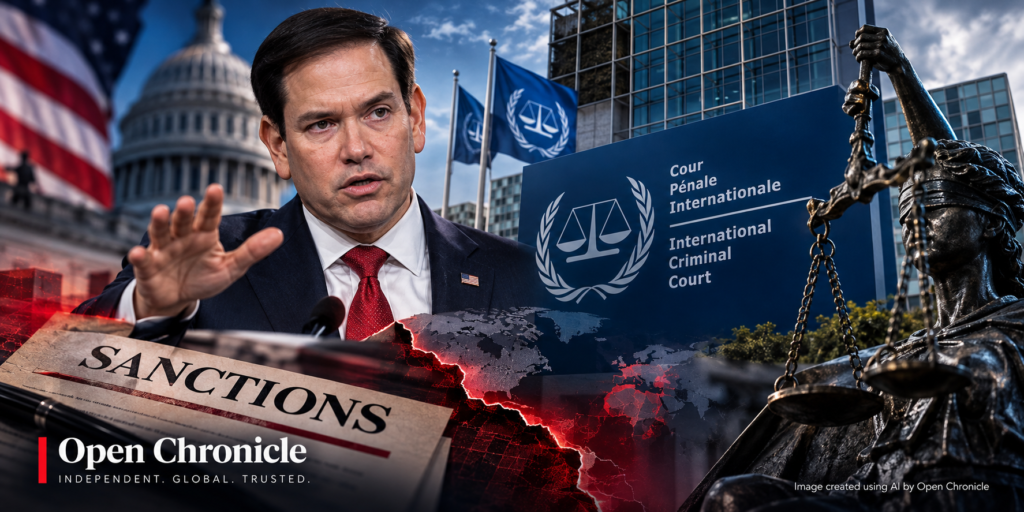
The United States has announced new sanctions against the International Criminal Court, targeting its financial operations and restricting transactions with American entities. Secretary of State Marco Rubio says Washington will not allow the prosecution of US citizens, while the court condemns the measures as an attempt to obstruct international justice.
By Open Chronicle with agencies
October 9, 2026
The administration of US President Donald Trump has announced sweeping new sanctions against the International Criminal Court (ICC), intensifying a longstanding confrontation between Washington and the institution responsible for prosecuting genocide, war crimes and crimes against humanity.
US Secretary of State Marco Rubio confirmed the measures on Friday, declaring that the administration would prevent the court from pursuing American citizens and restrict its ability to conduct financial transactions involving the United States.
In a video statement, Rubio described the ICC as a hostile institution and said Washington intended to significantly weaken its operational capacity.
“We will ban transactions with this rogue court, cutting off their resources and crippling their ability to operate against us,” Rubio said.
He added that President Trump “will never allow” the court “to prosecute Americans.”
The announcement represents a major escalation in Washington’s opposition to the ICC and raises questions about the future of international criminal accountability at a time when conflicts across the world have placed growing demands on international judicial institutions.
Sanctions Target the Court’s Financial Operations
According to the measures announced by Washington, assets belonging to the International Criminal Court within US jurisdiction will be blocked.
American individuals and companies will also face restrictions on conducting transactions with the institution.
The administration has provided a six-month period for affected businesses and organizations to wind down existing commercial relationships with the court.
The restrictions could create significant operational difficulties for the ICC, particularly where its financial services, technology infrastructure or international transactions involve American companies or institutions.
The full practical consequences will depend on how the sanctions are implemented and whether exemptions or specific authorizations are made available.
Unlike earlier measures targeting individual court officials, the latest sanctions are directed at the institution itself.
That distinction could broaden their impact considerably.
The ICC relies on international cooperation, financial services and administrative infrastructure to support investigations, judicial proceedings and assistance to victims.
Restrictions affecting those systems could complicate its ability to carry out its mandate, even in cases unrelated to American citizens.
Rubio Declares Washington Will Not Accept ICC Jurisdiction Over Americans
The Trump administration has framed its latest decision as a defence of American sovereignty.
Rubio’s statement reflects Washington’s longstanding objection to the possibility that an international tribunal could investigate or prosecute US nationals without the consent of the United States.
The United States is not a party to the Rome Statute, the treaty that established the International Criminal Court.
Successive American administrations have expressed concerns about the court’s authority over US personnel, particularly members of the armed forces deployed overseas.
However, the ICC’s jurisdiction is not determined exclusively by the nationality of a suspect.
Under the Rome Statute, the court may exercise jurisdiction in certain circumstances when alleged crimes occur on the territory of a state that has accepted its authority, even if the accused person is a citizen of a country that has not joined the treaty.
This legal framework has been central to disputes involving American military operations abroad.
Washington argues that exposing its personnel to prosecution by a court whose founding treaty it has not ratified raises fundamental questions of sovereignty and accountability.
Supporters of the ICC maintain that international criminal justice would be seriously weakened if nationality alone prevented investigations into alleged atrocities.
The disagreement has persisted for decades and remains one of the most significant divisions between the United States and the international criminal justice system.
Announcement Follows Nobel Peace Prize Recognition for Navi Pillay
The sanctions were announced just hours after South African jurist and former international judge Navi Pillay was named the recipient of the 2026 Nobel Peace Prize, according to the supplied reporting.
Pillay has spent much of her professional career working on international human rights law and accountability for serious crimes.
Her judicial and institutional experience includes service at international criminal tribunals and the United Nations.
The supplied report also associates her with investigations concerning possible criminal responsibility involving American military personnel in Iraq and Afghanistan.
However, the material does not provide sufficient detail to establish the precise nature of that role or the specific proceedings involved.
Although the timing of the sanctions announcement attracted attention, the measures reportedly had been prepared before the Nobel Peace Prize decision.
There is therefore no established basis in the supplied information to conclude that Pillay’s recognition triggered Washington’s action.
Nevertheless, the proximity of the two announcements highlights the contrasting positions now shaping the debate over international justice.
While the Nobel recognition celebrates the importance of legal accountability, the United States is moving to restrict the operations of one of the world’s principal institutions responsible for prosecuting international crimes.
Washington’s Dispute With the ICC Extends to Israel
The latest sanctions follow earlier American measures against individual ICC officials.
Those restrictions were largely connected to investigations and judicial proceedings involving Israel, one of Washington’s closest allies.
The ICC’s activities concerning the Israeli-Palestinian conflict have generated intense political opposition from both American and Israeli officials.
Washington has challenged the court’s authority and objected to proceedings involving Israeli leaders.
The Trump administration’s latest action suggests a broader strategy that extends beyond sanctions against particular judges or prosecutors.
By targeting the institution’s financial operations, Washington is attempting to constrain the court’s ability to function.
The measures also raise concerns about their potential effects on investigations involving other countries and conflicts.
The ICC handles cases concerning alleged international crimes across multiple regions.
Financial restrictions imposed on the institution could therefore affect proceedings that have no direct connection to the United States or Israel.
International Criminal Court Rejects Sanctions
The ICC responded by condemning Washington’s decision and reaffirming its commitment to judicial independence.
In a statement, the court described the sanctions as “an attempt to obstruct the course of justice and to prevent the Court from doing what it was created to do.”
ICC President Tomoko Akane said the institution would continue carrying out its responsibilities despite political and financial pressure.
“The Court will continue to fully discharge its mandate, with independence and impartiality, acting only on the basis of the law and the evidence, for the sake of the countless victims of grave crimes,” Akane said.
Her statement reflects the institution’s position that criminal investigations and judicial proceedings must be determined by evidence and applicable law rather than political pressure.
The court has repeatedly emphasized that its mandate is to address the most serious crimes of international concern.
Its legitimacy depends on maintaining judicial independence while operating within the jurisdiction established by its founding treaty.
The confrontation with Washington now presents a significant test of that independence.
What Is the International Criminal Court?
The International Criminal Court was established in 2002 following the entry into force of the Rome Statute.
Headquartered in The Hague, Netherlands, it is a permanent international tribunal with jurisdiction over four principal categories of crimes: genocide, crimes against humanity, war crimes and the crime of aggression, subject to the treaty’s jurisdictional rules.
The ICC was created to address situations in which national authorities are unwilling or genuinely unable to investigate and prosecute serious international crimes.
This principle, known as complementarity, means that the court is intended to operate as a judicial mechanism of last resort rather than replace national criminal justice systems.
The institution prosecutes individuals, not governments or states.
Its proceedings can involve political leaders, military commanders and other individuals suspected of responsibility for crimes within its jurisdiction.
The court also depends heavily on cooperation from national governments.
Unlike a state, the ICC does not possess its own police force capable of independently enforcing arrest warrants around the world.
Its ability to conduct investigations, secure arrests and implement judicial decisions therefore depends on legal cooperation and institutional support.
The United States has never ratified the Rome Statute, although its relationship with the court has varied across different administrations.
A New Challenge for International Criminal Justice
The American sanctions come at a particularly sensitive moment for international legal institutions.
Armed conflicts, allegations of atrocities and disputes over accountability have placed increasing pressure on the international justice system.
The ICC’s supporters argue that accountability for serious international crimes is essential to preventing impunity.
They maintain that investigations should proceed regardless of the nationality or political influence of those accused.
Critics, including the Trump administration, argue that the court can overreach its authority and expose nationals of countries outside the Rome Statute to proceedings they have not consented to.
The disagreement reflects a wider tension between national sovereignty and international legal accountability.
The court’s institutional independence is central to its mission, but its practical effectiveness depends on resources, cooperation and access to financial and administrative systems.
Measures that restrict those resources could create obstacles extending well beyond any single investigation.
For countries that support the ICC, Washington’s decision may also raise difficult questions about how to protect international judicial institutions from unilateral financial pressure.
The Financial Dimension of International Legal Pressure
The latest American measures demonstrate how economic sanctions can be used not only against governments, businesses or individuals, but also against international institutions.
By restricting access to financial transactions and blocking assets within US jurisdiction, Washington is seeking to exert pressure without directly intervening in the court’s judicial proceedings.
The approach relies on the importance of the American financial system to international operations.
Even organizations headquartered outside the United States may depend on financial intermediaries, technology providers or service companies with American connections.
As a result, restrictions imposed by Washington can have consequences beyond its national territory.
The six-month wind-down period provides some time for affected entities to review their relationships with the ICC.
However, the supplied announcement does not establish whether the court will be able to replace affected services or how significantly its operations may be disrupted.
Those questions will become increasingly important as the restrictions take effect.
A Confrontation With Wider Diplomatic Consequences
The sanctions could complicate relations between Washington and governments that regard the International Criminal Court as an essential component of the international legal order.
Many American allies are parties to the Rome Statute and have supported the court’s work.
Those countries may now face a difficult balance between maintaining close relations with the United States and defending the independence of an institution they have committed to support.
The dispute could also intensify debate over whether international judicial institutions are sufficiently protected from economic and political coercion.
For Washington, the issue remains one of sovereignty and preventing what the administration regards as unacceptable jurisdiction over American citizens.
For the ICC, the central principle is that allegations of the gravest international crimes must be assessed through independent legal procedures.
These positions are not easily reconciled.
The latest sanctions suggest that the Trump administration is prepared to use significant economic leverage to advance its interpretation of American national interests.
International Law Faces a Defining Test
The confrontation between Washington and the International Criminal Court illustrates the growing pressure on institutions designed to uphold international legal accountability.
Rubio’s announcement signals a determination to prevent the ICC from pursuing cases involving American citizens and to impose financial consequences on the institution itself.
The court, meanwhile, has rejected the measures and pledged to continue its work independently.
The practical impact of the sanctions remains uncertain.
Much will depend on their implementation, the availability of alternative financial arrangements and the response of countries that support the ICC.
Yet the broader significance is already apparent.
The dispute concerns more than the relationship between the United States and a single international tribunal.
It raises fundamental questions about the reach of international criminal law, the limits of national sovereignty and the ability of judicial institutions to operate when confronted by powerful governments.
For the ICC, the challenge is to preserve its independence and continue proceedings based on law and evidence.
For the Trump administration, the objective is to prevent what it regards as unauthorized legal action against American nationals.
The outcome could influence the future relationship between international justice and state power for years to come.
Sources and Further Reading
Official institutional records, international legal documentation and statements concerning United States sanctions against the International Criminal Court.
United States Department of State
Statements and official documentation concerning the Trump administration’s sanctions against the International Criminal Court and Secretary of State Marco Rubio’s position on ICC jurisdiction.
International Criminal Court
Institutional statements concerning the sanctions, including the response attributed to ICC President Tomoko Akane, and information on the court’s mandate and judicial independence.
Rome Statute of the International Criminal Court
The founding treaty establishing the court’s jurisdiction, institutional structure and the principle of complementarity.
United Nations Treaty Collection
Official treaty records concerning the Rome Statute and participation by states.
Norwegian Nobel Committee
Information concerning the reported 2026 Nobel Peace Prize announcement recognizing Navi Pillay.