
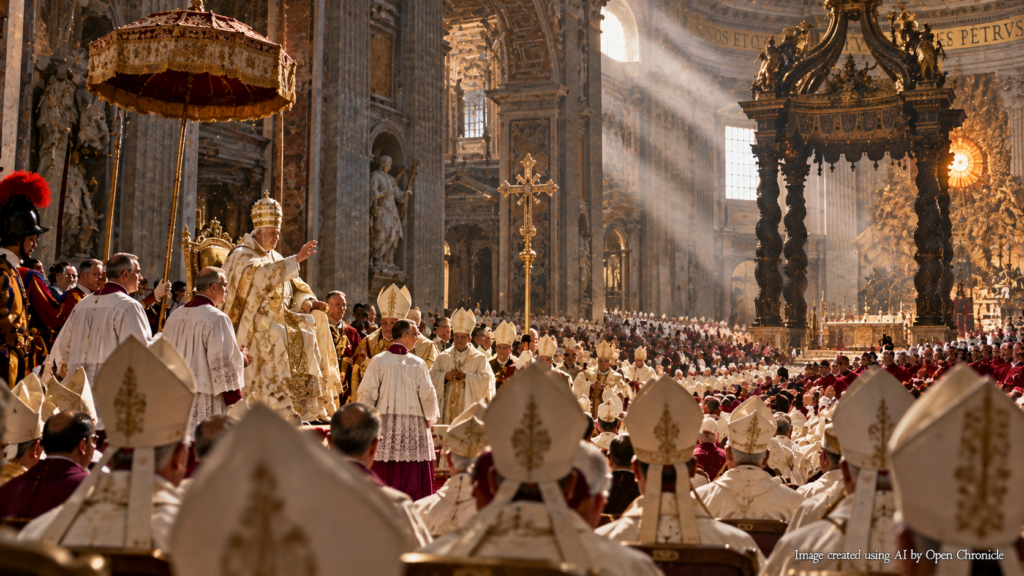
How Pope John XXIII brought thousands of bishops to Rome for a historic council that would reshape Catholic worship, religious freedom, relations with other faiths and the Church’s place in the modern world.
By Open Chronicle History Desk
On the morning of October 11, 1962, a remarkable procession entered St. Peter’s Basilica in Vatican City.
Thousands of Catholic bishops, dressed in ceremonial vestments, moved through one of Christianity’s most important churches.
They had travelled to Rome from Europe, the Americas, Africa, Asia and Oceania.
They represented a religious institution with nearly two thousand years of history, hundreds of millions of followers and a presence in almost every country on Earth.
At the center of the gathering was Pope John XXIII.
He was seventy-nine years old.
When he had been elected pope in 1958, many observers expected a relatively brief and uneventful pontificate.
Instead, he had made a decision that surprised the Catholic world.
He had summoned an ecumenical council.
The purpose was not to resolve a single doctrinal controversy or condemn one particular movement.
John XXIII wanted the Church to examine how it communicated its faith, exercised its mission and engaged with a world undergoing extraordinary change.
The Second World War had ended only seventeen years earlier.
The Cold War divided Europe.
Nuclear weapons threatened humanity.
Decolonization was transforming Africa and Asia.
Television was changing communication.
Scientific and technological developments were reshaping daily life.
And traditional religious institutions were confronting new questions about authority, freedom, social justice and modern society.
Inside St. Peter’s Basilica, the bishops were about to begin a process that would challenge established habits and generate intense debates.
Over the following three years, the council would produce sixteen major documents.
Catholic worship would change.
The Church’s relationship with Judaism and other religions would enter a new phase.
Religious freedom would receive a major theological and institutional affirmation.
The role of bishops, laypeople and the Church in contemporary society would be reconsidered.
The council would not settle every disagreement.
Indeed, some of its decisions would generate controversies that remain unresolved.
But October 11, 1962 marked the beginning of one of the most consequential transformations in modern Catholic history.
1. The Catholic Church Before Vatican II
In the decades before the Second Vatican Council, the Catholic Church possessed a highly centralized institutional structure.
Rome exercised considerable authority over doctrine, liturgy and ecclesiastical administration.
The papacy occupied a central position in Catholic life.
Theological education often emphasized established scholastic traditions.
In much of the Latin Church, the Mass was celebrated in Latin according to a standardized Roman rite.
The priest ordinarily celebrated facing the altar, with the congregation participating through prayers, gestures, music and devotional practices that varied by location.
Catholicism was a global religion, but many of its most visible institutional practices retained a distinctly European character.
The Church had also experienced centuries of tension with political and intellectual movements associated with modernity.
The relationship between Catholicism and the modern world was therefore complex.
2. The Legacy of the First Vatican Council
The First Vatican Council met between 1869 and 1870.
It addressed questions concerning faith, reason and papal authority.
Its most famous decision concerned papal infallibility under carefully defined conditions.
The council was interrupted during the political upheavals surrounding the unification of Italy.
It did not complete its broader program of work.
By the middle of the twentieth century, many Catholic theologians believed that the Church needed a more comprehensive reflection on its nature, mission and relationship with society.
The Second Vatican Council would revisit some of these questions from a different historical perspective.
3. A World Transformed by War
The twentieth century had profoundly changed the international environment in which the Church operated.
Two world wars devastated Europe.
The Holocaust exposed the consequences of racial hatred, antisemitism and state-sponsored mass murder.
The rise of totalitarian governments challenged religious institutions.
The Cold War divided much of the world between rival ideological blocs.
In Eastern Europe, communist governments restricted religious activities and persecuted clergy and believers.
Meanwhile, colonial empires were disintegrating.
Newly independent nations were emerging across Africa and Asia.
Catholic communities in these regions increasingly expected their experiences and perspectives to receive greater recognition.
The Church was no longer able to understand its global mission primarily through European political and cultural assumptions.
4. The Election of John XXIII
Angelo Giuseppe Roncalli was elected pope on October 28, 1958.
He took the name John XXIII.
Born in 1881 in northern Italy, Roncalli had served as a priest, military chaplain, Vatican diplomat and patriarch of Venice.
His diplomatic career included assignments in Bulgaria, Turkey, Greece and France.
These experiences exposed him to different Christian traditions, political systems and cultural environments.
His personality was often described as warm, approachable and pastoral.
At the time of his election, his advanced age encouraged expectations of a transitional pontificate.
Those expectations proved mistaken.
5. The Announcement That Surprised Rome
On January 25, 1959, John XXIII announced his intention to convene an ecumenical council.
The announcement surprised many members of the Catholic hierarchy.
Ecumenical councils were rare events.
They required extensive preparation and involved bishops from across the world.
John XXIII believed the Church needed renewal.
He frequently associated the council with the Italian term aggiornamento, commonly understood as bringing up to date.
The term did not mean abandoning Catholic doctrine.
Rather, it expressed the desire to examine how the Church could present its teachings and fulfill its mission in contemporary circumstances.
The pope wanted an approach characterized by pastoral engagement rather than an emphasis on condemnation.
6. What Is an Ecumenical Council?
In Catholic understanding, an ecumenical council is a gathering of bishops from across the Church, convened and confirmed by the pope, to address matters of doctrine, discipline and ecclesiastical life.
Such councils have played important roles throughout Christian history.
The Council of Nicaea in 325 addressed major theological controversies.
The Council of Chalcedon in 451 developed influential formulations concerning Christology.
The Council of Trent, held between 1545 and 1563, shaped Catholic reform during the Reformation era.
The Second Vatican Council was the twenty-first ecumenical council recognized by the Catholic Church.
Its importance lay not only in the number of participants but also in the breadth of the questions it examined.
7. Preparing the Council
Preparations began years before the opening ceremony.
Catholic bishops, religious superiors, universities and other institutions were consulted about subjects the council should address.
Commissions prepared draft documents.
These drafts covered theology, liturgy, Church government, relations with other Christians and contemporary social questions.
But the preparatory process did not determine the final outcome.
Once the bishops assembled, many challenged the proposed texts and demanded more substantial discussion.
This would become one of the defining characteristics of Vatican II.
The council was not simply a ceremonial gathering assembled to approve decisions already made.
It became a forum for genuine debate.
8. October 11, 1962: The Opening Ceremony
On October 11, the bishops gathered in St. Peter’s Basilica.
Approximately 2,500 council fathers participated in the opening period, making Vatican II one of the largest assemblies of Catholic bishops in history.
The ceremony reflected the Church’s ancient traditions.
There were formal processions, liturgical celebrations and solemn addresses.
But the geographical diversity of the gathering revealed a modern global institution.
Bishops from countries undergoing decolonization sat alongside representatives of Europe’s historic Catholic centers.
The council would increasingly reflect that international character.
9. Pope John XXIII’s Opening Address
John XXIII delivered an address known by its opening Latin words, Gaudet Mater Ecclesia, meaning “Mother Church Rejoices.”
The speech established the council’s general tone.
The pope rejected an excessively pessimistic interpretation of the modern world.
He urged the Church to distinguish between the substance of its teachings and the ways those teachings were expressed.
He emphasized pastoral communication.
He also argued that the Church should respond to error with an approach shaped by mercy rather than relying primarily on condemnation.
The speech did not provide a detailed blueprint for every reform.
But it established a direction that would influence the council’s work.
10. The Idea of Aggiornamento
Aggiornamento became one of the most recognizable words associated with Vatican II.
It expressed the desire for renewal.
The Church was being asked to examine its methods, language and institutions in light of contemporary conditions.
The concept was sometimes misunderstood.
Supporters of reform did not necessarily seek to abandon tradition.
Conservative participants did not necessarily reject all change.
The central disagreements concerned how Catholic tradition should be interpreted and developed.
The relationship between continuity and renewal would become one of the council’s most enduring theological questions.
11. The Bishops Take Control of the Debate
During the council’s opening weeks, participants challenged aspects of the preparatory arrangements.
Many bishops wanted greater influence over the commissions responsible for drafting and revising documents.
The council’s debates demonstrated that the assembled bishops were prepared to exercise an active role.
Different theological perspectives emerged.
Some participants emphasized institutional continuity and caution.
Others advocated more extensive reform.
The discussions were often intense.
Yet the council continued to work through procedures of debate, revision and voting.
This process helped give its final documents broad episcopal legitimacy.
12. A Global Church Finds Its Voice
One of Vatican II’s defining features was its international character.
Catholic bishops from Africa, Asia and Latin America participated in discussions that had often been dominated by European perspectives.
The growth of Catholic communities outside Europe raised questions about language, culture and local religious practices.
Could Catholic worship better reflect the cultures of different societies?
How should the Church engage with religious traditions outside Christianity?
What responsibilities did Catholics have toward poverty, inequality and political oppression?
These questions were particularly important in countries undergoing rapid social and political transformation.
The council contributed to a wider recognition that Catholicism was a global community rather than simply a European institution with overseas missions.
13. The First Major Reform: The Liturgy
One of the council’s earliest major achievements concerned Catholic worship.
On December 4, 1963, Pope Paul VI promulgated Sacrosanctum Concilium, the Constitution on the Sacred Liturgy.
The document called for the renewal of liturgical life.
It emphasized the importance of active participation by the faithful.
It also allowed a broader role for vernacular languages, while retaining Latin’s recognized place in the Roman rite.
The reforms were implemented over subsequent years.
They transformed the experience of worship for millions of Catholics.
14. The Mass Before and After Vatican II
Before the council, the Latin Church generally celebrated Mass according to the Roman Missal established through earlier reforms and subsequent revisions.
Latin was the principal liturgical language.
The priest normally celebrated at an altar oriented in the same direction as the congregation.
After Vatican II, liturgical reforms introduced wider use of local languages and revised many prayers, readings and ceremonial practices.
Celebration facing the congregation became widespread.
However, the council itself did not issue a universal requirement that every priest celebrate Mass facing the people.
The distinction between what Vatican II explicitly mandated and what developed through later implementation is historically important.
The transformation was substantial, but it unfolded over time.
15. The Role of Ordinary Catholics
Vatican II placed renewed emphasis on the participation of lay Catholics in the life and mission of the Church.
The council taught that all baptized Christians share in the Church’s mission, although they have different responsibilities and ministries.
Laypeople were encouraged to engage more actively in religious education, charitable work, social life and public affairs.
The council did not abolish the distinction between ordained clergy and lay members.
But it presented a broader understanding of the Church as a community of believers.
This approach influenced Catholic organizations, parish life and theological reflection in subsequent decades.
16. Lumen Gentium: Understanding the Church
One of the council’s central documents was Lumen Gentium, the Dogmatic Constitution on the Church, promulgated on November 21, 1964.
It examined the nature of the Church, its mission and the responsibilities of its members.
The document described the Church as the People of God.
It emphasized the role of bishops collectively, while maintaining the authority of the pope.
It also addressed the universal call to holiness.
The document became a foundational text for postconciliar Catholic ecclesiology.
Its influence extended into discussions about governance, participation and the relationship between clergy and laity.
17. The Relationship Between Pope and Bishops
The council reconsidered the role of bishops within the Church’s structure.
It emphasized episcopal collegiality, the understanding that bishops collectively share responsibility for the universal Church in communion with the pope.
This did not eliminate papal primacy.
Rather, it sought to articulate more fully the relationship between papal authority and the episcopal college.
The discussions were significant because they concerned the balance between central administration and the responsibilities of local churches.
Questions about that balance continue to influence Catholic debates today.
18. The Bible and Catholic Life
Vatican II encouraged renewed engagement with Scripture.
The Dogmatic Constitution on Divine Revelation, Dei Verbum, was promulgated on November 18, 1965.
It addressed the relationship between Scripture, tradition and the Church’s teaching authority.
The document encouraged access to the Bible and serious biblical study.
It also reflected developments in Catholic biblical scholarship.
The wider availability of translations and renewed emphasis on scriptural readings contributed to changes in religious education and worship.
19. Relations With Other Christians
The council marked an important turning point in Catholic relations with other Christian communities.
For centuries, divisions between Catholics, Orthodox Christians and Protestant denominations had shaped European and global religious history.
Vatican II encouraged dialogue and cooperation.
The Decree on Ecumenism, Unitatis Redintegratio, was promulgated in November 1964.
It recognized elements of Christian faith and sanctification outside the visible structures of the Catholic Church.
The document did not erase theological differences.
But it established a more constructive framework for relations with other Christians.
20. The Catholic Church and Judaism
One of Vatican II’s most historically significant decisions concerned relations with Judaism.
The declaration Nostra Aetate, promulgated on October 28, 1965, rejected the idea that Jews collectively could be held responsible for the death of Jesus.
It condemned antisemitism and emphasized the spiritual relationship between Christianity and Judaism.
The declaration emerged in a world still confronting the consequences of the Holocaust.
Its importance extended beyond Catholic theology.
It contributed to a new phase of Jewish-Catholic dialogue.
The document did not eliminate centuries of prejudice.
But it represented a major institutional change in the Catholic Church’s approach to Jewish communities.
21. Relations With Islam and Other Religions
Nostra Aetate also addressed the Church’s relationship with non-Christian religions.
It expressed respect for Muslims and encouraged mutual understanding.
It recognized elements of truth and holiness in other religious traditions.
The declaration also discussed Hinduism and Buddhism.
These statements were important in an increasingly interconnected world.
They helped establish a basis for interreligious dialogue.
The council maintained Catholic theological claims while encouraging a less confrontational approach to other faiths.
22. Religious Freedom
The declaration Dignitatis Humanae, promulgated on December 7, 1965, became one of the council’s most consequential texts.
It affirmed the right to religious freedom.
The document emphasized that individuals should not be coerced by civil authorities in matters of religious belief, within the requirements of a just public order.
This represented a significant development in Catholic teaching concerning the relationship between religious truth, individual conscience and political authority.
The declaration emerged during a period when religious persecution remained widespread.
Its implications extended into debates about human rights, constitutional government and freedom of conscience.
23. The Church in the Modern World
The Pastoral Constitution Gaudium et Spes was promulgated on December 7, 1965.
It examined the relationship between the Church and contemporary society.
The document addressed human dignity, marriage, family life, culture, economics, politics, peace and international cooperation.
It reflected the council’s determination to engage with the major problems of the modern world.
Rather than treating contemporary society solely as a threat, the document recognized both its achievements and its dangers.
It became one of Vatican II’s most influential statements about Catholic social responsibility.
24. The Nuclear Age
Vatican II took place during one of the most dangerous periods of the Cold War.
The Cuban Missile Crisis occurred in October 1962, only days after the council opened.
The confrontation brought the United States and Soviet Union close to nuclear war.
John XXIII appealed publicly for peace during the crisis.
In 1963, he issued the encyclical Pacem in Terris, addressing peace, human rights and international relations.
The council’s later discussions of war and peace reflected the existential dangers of nuclear weapons.
The bishops recognized that modern warfare threatened destruction on a scale previously unimaginable.
25. The Death of John XXIII
John XXIII did not live to see the council completed.
He died on June 3, 1963.
His death raised questions about the council’s future.
Would the next pope continue the project?
Would the reforms be slowed or abandoned?
The answer came with the election of Giovanni Battista Montini, who became Pope Paul VI on June 21, 1963.
Paul VI announced that the council would continue.
He would oversee its remaining sessions and promulgate its major documents.
26. Pope Paul VI Continues the Council
Paul VI inherited a process already marked by major debates.
He sought to guide the council toward agreement while managing competing theological perspectives.
His leadership was important in securing the adoption of the council’s documents.
He also took steps that reflected the council’s ecumenical aspirations.
In January 1964, he met Ecumenical Patriarch Athenagoras in Jerusalem.
The meeting was a major symbolic moment in relations between the Catholic and Orthodox Churches.
The two leaders later participated in a process that culminated in the removal from memory and the midst of the Churches of the mutual excommunications associated with 1054.
The theological divisions between Catholicism and Orthodoxy remained, but relations entered a new phase.
27. The Four Sessions of Vatican II
SECOND VATICAN COUNCIL · 1962–1965
-
1962: First Session
October 11 to December 8. Opening under John XXIII, initial debates and challenges to preparatory drafts.
-
1963: Second Session
September 29 to December 4. Continued under Paul VI; the Constitution on the Sacred Liturgy and the decree on social communications were promulgated.
-
1964: Third Session
September 14 to November 21. Major documents on the Church, ecumenism and the Eastern Catholic Churches were promulgated.
-
1965: Fourth Session
September 14 to December 8. The council adopted its remaining documents, including texts on religious freedom, non-Christian religions and the Church in the modern world.
28. The Sixteen Documents
Vatican II produced sixteen documents.
They included four constitutions, nine decrees and three declarations.
The constitutions addressed the liturgy, the Church, divine revelation and the Church’s relationship with the modern world.
The decrees covered subjects such as ecumenism, missionary activity, the role of bishops, priestly formation, religious life and the apostolate of laypeople.
The declarations addressed Christian education, non-Christian religions and religious freedom.
Together, these texts formed the documentary foundation of the council’s reforms.
Their interpretation and implementation would occupy the Church for decades.
29. December 8, 1965: The Council Closes
The Second Vatican Council formally concluded on December 8, 1965.
Pope Paul VI presided over the closing ceremonies.
The council had lasted more than three years.
Thousands of bishops had participated.
The Church had adopted a major body of teaching and reform.
But the closing ceremony did not mark the end of the transformation.
It marked the beginning of implementation.
The practical consequences of Vatican II would unfold through liturgical changes, new institutions, theological debates and pastoral initiatives.
30. The Reforms Reach the Parishes
For ordinary Catholics, the most visible changes occurred in parish life.
Mass increasingly took place in local languages.
Congregational participation became more prominent.
Scriptural readings were expanded.
Religious education underwent revision.
New forms of parish involvement developed.
The pace and character of implementation varied between countries and communities.
Some Catholics welcomed the changes enthusiastically.
Others experienced confusion or felt that familiar traditions were disappearing too quickly.
The reforms were therefore both a source of renewal and a cause of tension.
31. The Traditionalist Reaction
Not all Catholics accepted the postconciliar reforms.
Some criticized changes to the liturgy.
Others questioned theological interpretations associated with the council.
Archbishop Marcel Lefebvre became one of the most prominent figures in traditionalist opposition.
He founded the Society of Saint Pius X in 1970.
Disagreements over liturgical practice, authority and the interpretation of Vatican II eventually produced a major conflict with Rome.
The traditionalist movement illustrated the continuing tensions between continuity and reform.
These debates remain part of Catholic life.
32. Progressive Expectations and Disappointment
Some Catholics believed Vatican II would lead to more extensive institutional changes.
They expected greater participation in Church governance.
Others anticipated changes in teachings concerning sexuality, marriage or clerical discipline.
Not all of these expectations were fulfilled.
The council did not authorize the ordination of women to the priesthood.
It did not abolish priestly celibacy in the Latin Church.
It did not redefine the Church’s central doctrinal commitments.
For some reform-minded Catholics, the postconciliar period therefore brought disappointment.
The council had opened a new chapter, but it had not resolved every contested question.
33. Vatican II and Latin America
The council influenced Catholic communities throughout Latin America.
Its emphasis on social responsibility and engagement with contemporary conditions contributed to wider debates about poverty and inequality.
The 1968 meeting of Latin American bishops in Medellín became especially significant.
The conference sought to apply Vatican II’s teaching to the region’s social realities.
It helped shape discussions about structural injustice, pastoral responsibility and liberation theology.
These developments generated both enthusiasm and controversy.
They demonstrated that Vatican II’s influence extended far beyond European theological institutions.
34. Vatican II and Africa
In Africa, the council coincided with decolonization and the growth of independent nations.
Catholic communities increasingly sought recognition of local cultural traditions and leadership.
The council’s emphasis on the global character of the Church supported discussions about inculturation.
This involved considering how Catholic worship and practice could engage with local cultures without abandoning central religious commitments.
African bishops and theologians became increasingly influential in the decades following Vatican II.
The council contributed to the transformation of Catholicism into a more visibly diverse global institution.
35. Vatican II and Asia
Catholic communities in Asia faced distinct religious and cultural environments.
Christians often lived as minorities within societies shaped by Buddhism, Hinduism, Islam and other traditions.
The council’s statements on interreligious dialogue became especially important.
Its teaching encouraged engagement with religious traditions beyond Christianity.
The growth of local Catholic theological reflection also contributed to discussions about culture, spirituality and mission.
The Asian experience demonstrated the importance of interpreting the council within different historical and social contexts.
36. The Media and the Council
Vatican II took place during the expansion of television and modern mass communication.
Journalists followed the debates.
Newspapers reported disagreements between bishops and theologians.
Catholics around the world learned about the council through radio, television and the press.
The visibility of the proceedings created expectations and sometimes misunderstandings.
Public discussion frequently simplified complex theological disagreements.
The council became one of the first major global religious events experienced through modern mass media.
This helped turn its decisions into subjects of international public debate.
37. The Council and Modern Catholic Identity
Vatican II changed how many Catholics understood their relationship with the Church.
It encouraged greater engagement with Scripture.
It emphasized participation in worship.
It supported ecumenical and interreligious dialogue.
It presented the Church as a community with responsibilities toward the wider human family.
These developments influenced Catholic education, charitable organizations, missionary activity and social movements.
But Catholic identity did not become uniform after the council.
Different communities interpreted its teachings in different ways.
The result was a period of both creativity and conflict.
38. Was Vatican II a Revolution?
Historians and theologians disagree about how best to characterize Vatican II.
Some describe it as a revolution in Catholic institutional culture.
Others emphasize continuity with earlier theological traditions.
Still others regard it as a complex reform whose meaning has been contested since its conclusion.
The council did not formally abandon Catholic doctrine.
But it significantly changed the language, priorities and pastoral methods through which the Church addressed contemporary society.
Its importance therefore lies partly in the relationship between continuity and change.
The council was transformative without being a complete institutional rupture.
39. The Debate Over Interpretation
One of the central questions after Vatican II concerned how its documents should be interpreted.
Some emphasized the council’s reforming spirit.
Others argued that its texts must be understood in continuity with previous Catholic teaching.
Pope Benedict XVI later famously distinguished between interpretations based on rupture and those emphasizing reform within continuity.
The debate reflects the complexity of the council itself.
Its documents emerged through negotiation among bishops holding different perspectives.
They contain both affirmations of established teaching and significant developments in pastoral and theological emphasis.
The council’s legacy cannot be reduced to a single slogan.
40. Vatican II in the Twenty-First Century
More than sixty years after its opening, Vatican II continues to influence Catholic life.
Its documents remain central to theological education.
Its liturgical reforms shape worship in parishes around the world.
Its teachings on religious freedom and interreligious dialogue remain important.
Its understanding of the Church as the People of God continues to influence discussions about participation and governance.
Debates about its interpretation remain active.
The council is therefore not simply an episode of twentieth-century history.
It remains part of the Catholic Church’s contemporary identity.
41. Why October 11 Matters
October 11, 1962 marked the beginning of a historic process of institutional reflection and reform.
The council brought bishops from across the world into sustained discussion about the Church’s mission.
It produced major changes in Catholic worship.
It transformed official approaches to other Christian communities and non-Christian religions.
It affirmed religious freedom.
It encouraged engagement with modern social, political and cultural questions.
It also generated controversies that have shaped Catholic debates for generations.
The significance of Vatican II lies not only in the decisions adopted between 1962 and 1965.
It lies in the continuing effort to interpret and apply those decisions.
October 11, 1962: The Day the Church Opened a New Chapter
Imagine St. Peter’s Basilica on that October morning.
Thousands of bishops gather beneath its enormous dome.
They represent countries separated by oceans, languages and political systems.
Some have lived through war.
Others come from newly independent nations.
Some are committed to extensive reform.
Others fear that rapid change could weaken religious tradition.
At the center stands an elderly pope who believes the Church must engage more openly with the modern world.
He has called the bishops together without knowing precisely how their debates will unfold.
The discussions will be difficult.
The decisions will be consequential.
The reforms will transform the religious lives of millions.
And the controversies will continue long after the council closes.
John XXIII will not live to see the work completed.
But the gathering he convened will become one of the defining events of modern Catholic history.
On October 11, 1962, the Second Vatican Council opened in Rome. It began a transformation whose consequences continue to shape the Catholic Church and its relationship with the world.
Historical Sources and Further Reading
These primary historical sources document the
opening of the Second Vatican Council, the
objectives articulated by Pope John XXIII
and the principal reforms adopted between
1962 and 1965.
Pope John XXIII: Consilium
Apostolic letter dated February 2, 1962,
formally establishing October 11 as the
opening date of the Second Vatican Council.
A primary document explaining the pope’s
decision and expectations for the assembly.
Read the Original Papal Document →
Gaudet Mater Ecclesia:
Opening Address of Vatican II
The opening address delivered by Pope
John XXIII on October 11, 1962.
The speech established the council’s
pastoral orientation and emphasized
renewal, dialogue and the presentation
of Catholic teaching in the modern world.
Read the Historic Opening Address →
Documents of the Second Vatican Council
The complete collection of sixteen
conciliar documents, including the
four constitutions, nine decrees
and three declarations promulgated
between 1963 and 1965.
Explore the Official Council Documents →
Gaudium et Spes:
The Church in the Modern World
Pastoral constitution promulgated
on December 7, 1965, examining
human dignity, social responsibility,
economic development, political life,
peace and the Church’s relationship
with contemporary society.
Read the Pastoral Constitution →
Open Chronicle History distinguishes
between the opening of the Second
Vatican Council on October 11, 1962,
under Pope John XXIII, and its formal
conclusion on December 8, 1965,
under Pope Paul VI. The council’s
reforms were developed across four
sessions and implemented over
subsequent years.
The sixteen conciliar documents
addressed Catholic worship, ecclesial
authority, divine revelation, religious
freedom, ecumenism, relations with
non-Christian religions and the Church’s
responsibilities in contemporary society.
Some practices widely associated
with Vatican II developed during
later implementation rather than
being explicitly required by the
council itself. Its historical
interpretation remains the subject
of theological and scholarly debate.