
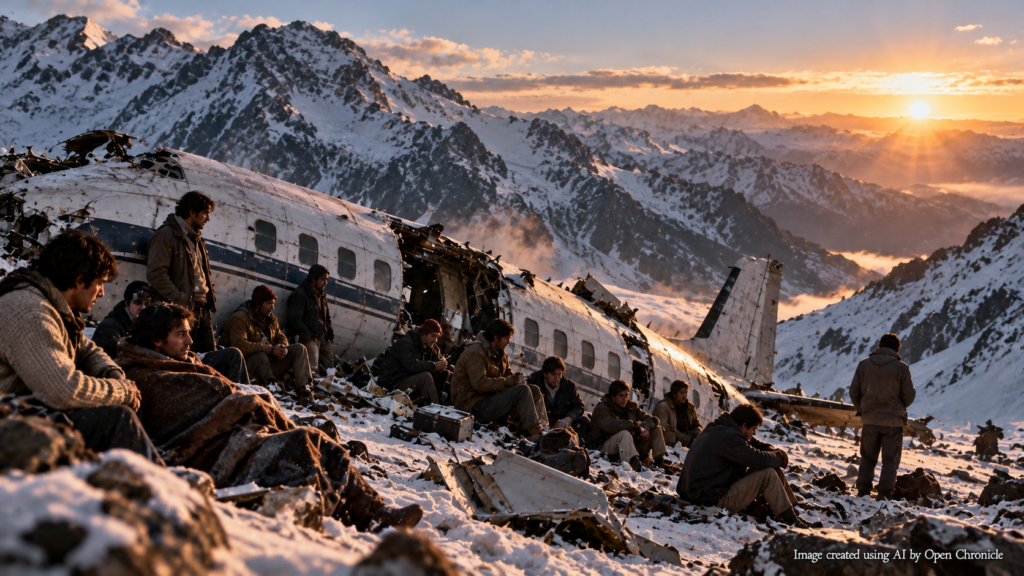
How a chartered aircraft carrying a Uruguayan rugby team crashed in the Andes, leaving survivors trapped in the mountains for 72 days and confronting them with some of the most difficult decisions imaginable.
By Open Chronicle History Desk
On the afternoon of October 13, 1972, a Fairchild FH-227D aircraft was flying across the Andes between Argentina and Chile.
On board were 45 people, including members of a Uruguayan amateur rugby team, their relatives and friends, and five crew members.
The passengers were travelling from Montevideo to Santiago, Chile.
For many, it was supposed to be an exciting journey.
The young athletes were members of the Old Christians Club, a rugby team associated with a school in Montevideo.
They were looking forward to playing a match and spending time together.
But the aircraft was crossing one of the most dangerous mountain regions in the world.
The Andes rose around it in enormous walls of rock, ice and snow.
Weather conditions were difficult.
Visibility was limited.
The flight crew believed the aircraft had progressed farther west than it actually had.
As the pilots began descending, the mountains remained directly ahead.
Moments later, the aircraft struck a ridge.
Both wings were torn away.
The tail section separated.
The remaining fuselage slid down a snowy slope before coming to rest high in the mountains.
Some passengers died immediately.
Others were critically injured.
Those who survived found themselves trapped in a frozen wilderness without adequate clothing, food or medical supplies.
They had little idea where they were.
They could not communicate with the outside world.
And they had no way of knowing whether rescuers would ever find them.
What followed would become one of the most remarkable survival ordeals of the twentieth century.
For 72 days, a group of young people fought against freezing temperatures, starvation, avalanches, injury and despair.
Their story would raise profound questions about survival, human morality and the strength of collective determination.
1. Uruguay in the Early 1970s
In 1972, Uruguay was experiencing political and economic tensions.
But rugby remained an important part of the social lives of many young people in Montevideo.
The Old Christians Club had developed a close-knit team culture.
Many players had known one another for years.
Their friendships extended beyond the rugby field.
They shared schools, families and social networks.
This familiarity would later become crucial.
The survivors were not strangers forced together by an accident.
They were friends and teammates who already understood the importance of cooperation.
2. The Old Christians Rugby Team
The team was composed largely of young men in their late teens and twenties.
They were enthusiastic amateur athletes rather than professional sportsmen.
Their planned trip to Chile included a rugby match and social activities.
Relatives and friends accompanied them.
The flight was chartered through the Uruguayan Air Force.
The aircraft, a twin-engine Fairchild FH-227D, was intended to carry the group across the Andes.
The journey was routine in its purpose but challenging in its geography.
3. The Flight Begins
The aircraft departed Montevideo on October 12, 1972.
Poor weather prevented a direct continuation across the Andes.
The plane stopped overnight in Mendoza, Argentina.
On October 13, the flight resumed.
The intended route required the aircraft to navigate through mountain terrain before descending toward Santiago.
The Andes presented serious hazards.
Mountain weather could change rapidly.
Cloud cover could obscure peaks.
And accurate navigation was essential.
4. A Dangerous Mountain Crossing
The aircraft travelled southward from Mendoza toward the Planchón Pass area, a route used to cross the Andes.
The pilots relied on navigation procedures and estimates of their progress.
The aircraft did not have modern satellite navigation systems.
Strong winds and mountainous terrain complicated the journey.
At a critical moment, the crew believed they had reached a position that would allow descent toward Santiago.
They had not.
The aircraft was still over the mountains.
5. October 13, 1972: The Crash
The pilots began descending while the aircraft remained dangerously close to the surrounding peaks.
The plane emerged from cloud cover near a mountain ridge.
There was insufficient room to avoid the terrain.
The aircraft struck the mountain.
A wing was torn away.
The tail section separated.
The fuselage continued forward before sliding down a steep snow-covered slope.
It eventually came to rest in a remote valley high in the Andes.
The accident was violent and chaotic.
Passengers were thrown from their seats.
Some died immediately.
Others suffered serious injuries.
The survivors were surrounded by snow and towering mountains.
6. The Valley of Tears
The crash site was located in the Andes, in a remote area of Argentina near the Chilean border.
The location became known as the Valley of Tears.
The wreckage lay at an altitude of approximately 3,500 meters.
The surrounding landscape was dominated by snow, ice and steep mountain ridges.
There were no roads nearby.
No settlements were visible.
The survivors had no reliable map.
They did not know precisely where they were.
The isolation was almost complete.
7. The First Hours
The immediate aftermath was dominated by confusion and injury.
The fuselage had been severely damaged.
Several passengers were dead.
Others were trapped or badly wounded.
The survivors attempted to free people from the wreckage.
They gathered supplies.
They tried to protect the injured from the cold.
Medical resources were extremely limited.
Some passengers had basic knowledge of first aid.
Others improvised treatment.
The temperature fell as evening approached.
The first night would be a struggle simply to remain alive.
8. A Shelter Made from Wreckage
The surviving fuselage became the group’s only substantial shelter.
The passengers used luggage, seats and other materials to block openings.
They attempted to reduce exposure to the freezing wind.
The shelter was cramped.
The injured required space.
The survivors slept close together to conserve body heat.
The wreckage offered some protection.
But it could not eliminate the danger of hypothermia.
The group had entered an environment for which none of them was properly equipped.
9. The First Deaths After the Crash
The crash did not kill everyone who would eventually die in the mountains.
Several badly injured passengers survived the initial impact but died during the following days.
The survivors attempted to care for them with inadequate medical equipment.
There were no hospitals.
No trained emergency teams.
No reliable way to summon assistance.
Each death deepened the psychological burden.
The group was forced to confront the possibility that rescue might not arrive in time.
10. The Search Operation
Authorities in Chile, Argentina and Uruguay became involved in the search for the missing aircraft.
Search aircraft flew over the mountainous region.
But locating the wreckage was extraordinarily difficult.
The white fuselage blended into the snow.
The crash site was remote.
Weather conditions limited visibility.
The pilots’ last reported position did not accurately identify where the aircraft had crashed.
Rescuers searched a vast and difficult landscape.
The survivors sometimes saw or heard aircraft in the distance.
But the search planes did not locate them.
11. The Search Is Suspended
After days without success, the official aerial search was suspended.
The decision reflected the limited prospects of finding survivors in such severe conditions.
But the people inside the wreckage were still alive.
They had no way of contacting rescuers.
They continued to wait.
The suspension of the search became one of the most devastating developments in the ordeal.
It meant that survival would increasingly depend on their own actions.
12. The Radio Announcement
The survivors had access to a small radio.
Through broadcasts, they eventually learned that the search for their aircraft had been called off.
The news was devastating.
Some had believed that rescue was only a matter of time.
Now they faced a different reality.
They might have to find a way out of the mountains themselves.
But they were weak.
They had little food.
They were surrounded by difficult terrain.
And they did not know the route to safety.
13. The Food Runs Out
The aircraft had carried only limited food.
The survivors collected what remained.
They divided small portions among the group.
The supplies included snacks, sweets and other provisions brought for the journey.
But these were soon exhausted.
The mountain environment offered almost nothing edible.
There were no plants available beneath the snow.
No animals could be hunted.
The survivors faced starvation.
Their bodies required energy to withstand the cold.
Without food, their chances of survival diminished every day.
14. The Most Difficult Decision
Eventually, the survivors confronted an extraordinary moral dilemma.
The bodies of those who had died remained preserved by the freezing temperatures.
The group began discussing whether they could use the remains as a source of food.
For many, the idea was deeply disturbing.
Most had been raised within Catholic families.
They struggled with religious, emotional and moral questions.
They were not deciding between ordinary food and an unacceptable alternative.
They were deciding whether to die of starvation or consume the remains of people who had already died.
After intense discussion, some members of the group began eating human flesh from the deceased.
The decision would later become one of the most widely discussed aspects of the disaster.
15. Survival and Moral Complexity
The survivors’ decision has often been described in sensational terms.
But the historical context is essential.
They did not kill anyone for food.
They consumed the remains of people who had died in the crash or during the subsequent ordeal.
The decision occurred under extreme conditions of starvation and isolation.
Some survivors later explained that they understood the act as a form of mutual sacrifice.
Others described the psychological difficulty of overcoming their initial revulsion.
The experience cannot be adequately understood through ordinary assumptions about choice.
It was an extreme survival situation.
16. Faith in the Mountains
Religious belief played an important role for several survivors.
Prayer offered comfort.
Catholic ideas about sacrifice, the body and communion influenced some of their discussions.
But the group did not share one uniform interpretation.
Individuals struggled differently with fear, grief and moral uncertainty.
Their religious background did not eliminate the psychological burden.
Instead, it became one of the ways they attempted to make sense of their circumstances.
17. The Importance of Cooperation
Survival depended on collective effort.
The group organized tasks.
Some gathered snow to melt into drinking water.
Others cared for injured companions.
Several worked on improving shelter.
Food was shared.
Decisions were discussed.
The social bonds formed before the crash helped sustain cooperation.
The survivors were forced to create a small community governed by necessity.
Their survival was not simply the achievement of one individual.
It depended on collective discipline and mutual support.
18. Water from Snow
Although snow surrounded the wreckage, obtaining drinking water required effort.
Eating snow directly could worsen heat loss.
The survivors improvised methods to melt it.
They used pieces of metal and sunlight to produce water.
This was essential.
Dehydration could become dangerous even in a frozen environment.
The group had to solve practical problems using materials recovered from the aircraft.
Ingenuity became a survival tool.
19. The Threat of Avalanches
The mountains remained dangerous long after the crash.
The wreckage lay in an area vulnerable to snow movement.
On the night of October 29, an avalanche struck the fuselage.
Snow poured into the shelter.
Several survivors were buried.
Eight people died.
Others were trapped beneath the snow.
The avalanche transformed an already desperate situation into another catastrophe.
20. Buried Alive
The survivors who escaped immediate suffocation struggled to free themselves and others.
The fuselage was filled with snow.
Movement was extremely difficult.
They had limited space and little air.
For days, the remaining group endured confinement while attempting to reopen the shelter.
The experience intensified the sense of isolation.
Even the place that had protected them from the weather could become a deadly trap.
21. The Number of Survivors Falls
Of the 45 people aboard the aircraft, 16 would ultimately survive.
The others died in the crash or during the ordeal.
Each death affected the group.
The survivors were losing friends, relatives and teammates.
Some had to continue living beside the bodies of people they had known for years.
The psychological burden was immense.
Yet the group continued to organize itself around the possibility of survival.
22. The Decision to Escape
As the weeks passed, the survivors understood that waiting indefinitely was not a viable strategy.
They began planning an expedition out of the mountains.
The challenge was enormous.
They had no proper mountaineering equipment.
They lacked accurate maps.
Their clothing was inadequate.
Their physical condition had deteriorated.
But remaining at the crash site meant continuing exposure to starvation and cold.
An escape attempt offered the only realistic possibility of reaching help.
23. The Sleeping Bag
One of the group’s most important innovations was an improvised sleeping bag.
The survivors used insulating materials recovered from the aircraft.
The sleeping bag was designed to protect expedition members during nights spent outside the fuselage.
Without it, an extended journey through the mountains would have been even more dangerous.
The project demonstrated the importance of practical engineering under extreme conditions.
Every available material had to serve a purpose.
24. The First Explorations
Before attempting the final escape, members of the group made shorter expeditions around the crash site.
They examined the surrounding terrain.
They searched for possible routes.
They attempted to understand their location.
One expedition discovered the aircraft’s tail section.
The wreckage contained supplies and equipment.
The survivors also found a radio transmitter, but attempts to make it operational were unsuccessful.
These explorations provided valuable experience.
They also revealed the enormous difficulty of crossing the mountains.
25. Choosing the Expedition Members
Eventually, the group selected members for the most ambitious journey.
Fernando Parrado and Roberto Canessa would become central figures.
Antonio Vizintín initially accompanied them.
The expedition required strength, determination and the ability to endure prolonged exposure.
The group concentrated its limited resources on giving the climbers the best possible chance.
Their success would determine whether the remaining survivors could be rescued.
26. December 12, 1972: The Final Expedition Begins
On December 12, Parrado, Canessa and Vizintín began the decisive attempt to escape.
They carried limited supplies.
Their equipment was improvised.
They expected to find a route toward inhabited territory.
But the surrounding mountains were more formidable than anticipated.
The expedition required climbing steep slopes at high altitude.
The physical demands were enormous.
The men were already weakened by weeks of starvation.
27. Climbing Toward the Summit
The climbers ascended a mountain west of the crash site.
They hoped to see the green valleys of Chile beyond the ridge.
Instead, the summit revealed more mountains stretching into the distance.
The discovery was psychologically devastating.
They were much farther from safety than they had imagined.
But they did not abandon the effort.
They adjusted their plans.
The group decided that Vizintín should return to the wreckage so that the remaining food would last longer for Parrado and Canessa.
The two men continued westward.
28. Fernando Parrado
Fernando Parrado had suffered severe personal losses.
His mother died in the crash.
His sister survived the initial impact but died later.
Parrado himself had initially been unconscious and was believed by some companions to be close to death.
Yet he recovered.
He became one of the principal organizers of the escape attempt.
His determination was shaped by the desire to return to his family and bring help to the remaining survivors.
His journey through the mountains became one of the defining elements of the story.
29. Roberto Canessa
Roberto Canessa was a young medical student and rugby player.
During the ordeal, he helped care for injured survivors.
His medical knowledge, although limited by the available resources, was valuable.
Canessa joined Parrado on the final expedition.
The two men faced difficult terrain, exhaustion and uncertainty.
Their partnership became essential to the rescue.
30. The Long Walk Toward Chile
Parrado and Canessa continued across mountains, snowfields and valleys.
They descended from the highest terrain.
The landscape gradually began to change.
Snow gave way to areas with vegetation.
The appearance of running water and signs of animal life suggested that they were approaching lower elevations.
They had little food.
Their bodies were exhausted.
But the possibility of reaching inhabited territory was becoming more realistic.
31. The First Signs of Human Life
After days of walking, the two men discovered evidence of human activity.
They encountered signs that people used the valleys.
Eventually, they saw a man on the opposite bank of a river.
The man was Chilean muleteer Sergio Catalán.
The river was too loud and difficult to cross for direct conversation.
But the encounter offered the first real contact with the outside world since the crash.
32. The Message Across the River
Catalán understood that the men needed help.
He returned with writing materials and used a method of passing a message across the river.
Parrado wrote a note explaining that he and others had survived an aircraft crash in the mountains.
The message described their desperate situation.
Catalán alerted authorities.
The discovery initiated the rescue operation.
After more than two months of isolation, the survivors had finally made contact with the outside world.
33. December 22, 1972: Rescue Begins
Chilean authorities organized a helicopter rescue.
On December 22, helicopters reached the crash site.
The remaining survivors were weak but alive.
The difficult mountain terrain limited the number of people who could be evacuated immediately.
The operation continued the following day.
By December 23, all sixteen survivors had been rescued.
Their ordeal had lasted 72 days.
34. The World Learns the Story
News of the rescue spread rapidly.
The survival of sixteen people after more than two months in the Andes astonished the public.
Families in Uruguay celebrated.
Journalists travelled to interview the survivors.
The story attracted international attention.
At first, reports emphasized endurance, cooperation and the extraordinary journey undertaken by Parrado and Canessa.
But the revelation that survivors had consumed human remains soon became a central focus of media coverage.
35. The Public Reaction
The disclosure produced shock.
Some observers initially reacted with condemnation.
Others recognized the extreme conditions under which the decision had been made.
The survivors publicly explained their actions.
They emphasized that no one had been killed for food.
They described the experience as a desperate response to starvation.
Over time, public understanding became more sympathetic.
The story raised questions about how ordinary moral judgments apply when human beings face imminent death.
36. The Catholic Church and the Survivors
Because many of the survivors were Catholic, their actions generated religious discussion.
Catholic clergy and commentators generally distinguished between murder and the consumption of the remains of those already dead under conditions of extreme necessity.
The survivors themselves offered different personal reflections on the experience.
Some connected their actions to religious ideas about sacrifice.
Others emphasized survival and responsibility toward their companions.
The ordeal became a subject of moral and theological reflection.
37. The Psychological Aftermath
Rescue did not immediately end the consequences of the disaster.
The survivors returned to a world that had believed them dead.
They faced grief over lost friends and relatives.
They had to process weeks of fear, starvation and extreme physical hardship.
Some struggled with the attention generated by the story.
Others eventually spoke publicly about their experiences.
The psychological consequences were complex and individual.
Survival had required extraordinary resilience, but it had also involved profound trauma.
38. The Book Alive
In 1974, British writer Piers Paul Read published Alive: The Story of the Andes Survivors.
The book was based on extensive interviews.
It became an international bestseller.
The narrative introduced the ordeal to a wider audience.
It also helped establish the story as one of the most famous survival accounts of the twentieth century.
The book was later adapted into a 1993 film.
39. Society of the Snow
Decades later, the story received renewed attention through the film Society of the Snow, directed by J. A. Bayona.
The film, released in 2023, drew on the book La sociedad de la nieve by Pablo Vierci.
It placed particular emphasis on the collective experience of the passengers and the lives of those who died.
The film introduced the story to a new generation.
It also encouraged renewed discussion of the survivors’ experiences and the historical details of the tragedy.
40. The Survivors’ Later Lives
Many survivors returned to education, careers and family life.
Fernando Parrado became a businessman and public speaker.
Roberto Canessa became a pediatric cardiologist.
Others pursued different professional and personal paths.
Their later lives demonstrated that the ordeal did not define every aspect of their identities.
Yet the experience remained a permanent part of their personal histories.
Some chose to speak publicly about the lessons they drew from it.
Others maintained a more private relationship with the tragedy.
41. The Andes Crash and Survival Psychology
The disaster has become an important case study in survival psychology.
It illustrates the role of social cohesion.
It demonstrates how leadership can emerge through practical action rather than formal authority.
It shows the importance of cooperation under extreme stress.
It also reveals the psychological consequences of uncertainty and prolonged isolation.
The survivors’ decisions were shaped by their relationships, beliefs, physical condition and available information.
Their experience cannot be reduced to a single explanation.
Survival depended on a combination of collective organization, ingenuity, individual determination and circumstances beyond their control.
42. The Importance of Hope
Hope played a central role in the survivors’ accounts.
But hope was not always expressed as optimism.
At times, it meant continuing to perform necessary tasks despite fear.
It meant melting snow.
Repairing shelter.
Sharing food.
Caring for the injured.
Planning another expedition.
The group survived partly because individuals continued acting even when the outcome was uncertain.
Hope became a practical commitment to remaining alive.
43. Why October 13 Matters
October 13, 1972 marks the beginning of an extraordinary human ordeal.
The crash killed passengers and crew members.
It left survivors trapped in one of the world’s most hostile environments.
It forced them to confront starvation, injury, avalanches and profound moral dilemmas.
Their eventual rescue demonstrated the importance of cooperation and determined action.
The story also became a powerful reminder of the limits of human control over nature.
Modern aircraft, navigation systems and organized rescue operations could not prevent the disaster or immediately locate the survivors.
For more than two months, their lives depended largely on one another.
October 13, 1972: Seventy-Two Days Between Life and Death
Imagine the silence after the crash.
The engines have stopped.
The fuselage lies broken in the snow.
The surrounding mountains seem endless.
Some passengers are dead.
Others are injured.
Those who remain alive do not know where they are.
They expect rescue.
Days pass.
Food disappears.
The search is suspended.
An avalanche buries the shelter.
More people die.
The survivors are forced to make decisions they could never have imagined before boarding the aircraft.
Eventually, two young men begin walking toward the distant valleys.
They cross mountains.
They descend through snow and rock.
They continue until they find another human being.
And that encounter brings rescuers back to the wreckage.
Sixteen people survive.
Twenty-nine do not.
The story is often described as a miracle.
But its historical meaning is also found in the ordinary actions that made survival possible.
Sharing resources.
Protecting companions.
Improvising solutions.
Making painful decisions.
And refusing to abandon those still waiting in the mountains.
On October 13, 1972, an aircraft crashed in the Andes. Seventy-two days later, sixteen people emerged from one of the most extraordinary survival ordeals in modern history.
Historical Sources and Further Reading
The following historical references and
survivor accounts provide additional context
for Uruguayan Air Force Flight 571, the
conditions faced by those stranded in the
Andes and the rescue of sixteen survivors
in December 1972.
Uruguayan Air Force Flight 571
Historical reference covering the October
1972 aircraft accident, the survivors’
isolation in the Andes, the conditions
of their ordeal and their eventual rescue.
Explore the Historical Overview →
Memory of the Andes Tragedy
A museum in Montevideo dedicated to
preserving the history of Flight 571,
remembering those who died and
documenting the experiences of the
sixteen survivors.
Alive: The Story of the Andes Survivors
Piers Paul Read’s 1974 account, based on
interviews with survivors, documenting
the crash, the struggle for survival,
the mountain expedition and the rescue.
An important early narrative of the event.
La sociedad de la nieve
Pablo Vierci’s account of the Andes
tragedy, drawing on the experiences
of the survivors and placing particular
emphasis on the relationships, decisions
and collective experience of the group.
The book inspired the later film
Society of the Snow.
Open Chronicle History identifies
October 13, 1972, as the date on
which Uruguayan Air Force Flight 571
crashed in the Andes. The aircraft
carried 45 people. Sixteen ultimately
survived, while 29 died during the
accident or the subsequent ordeal.
The final expedition began on
December 12, 1972. After Fernando
Parrado and Roberto Canessa reached
inhabited territory, the rescue took
place on December 22 and 23, ending
a 72-day ordeal.
The survivors’ consumption of the
remains of deceased passengers is
presented in its historical context:
an extreme situation of starvation
and isolation. Accounts of individual
experiences vary, and later books
and film adaptations should be
distinguished from contemporaneous
documentation.