
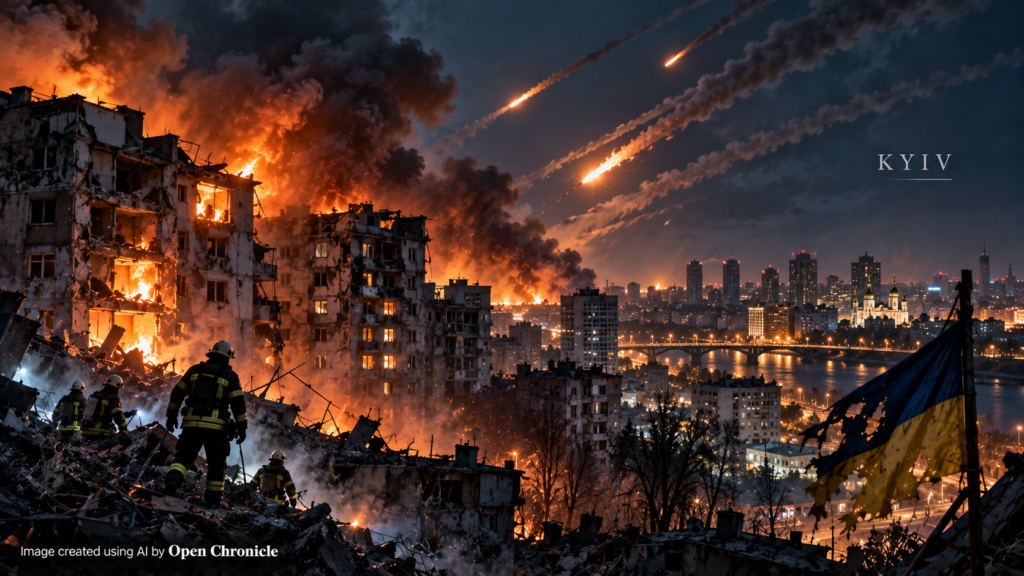
At least four people were killed and dozens wounded in overnight Russian attacks across Ukraine, including a three-wave ballistic missile assault on Kyiv. The bombardment followed diplomatic discussions involving Moscow, Washington and Kyiv, underscoring the distance between renewed negotiations and a possible ceasefire.
By Open Chronicle News Desk with Agencies
KYIV, UKRAINE — October 22, 2026
Russia launched a large-scale overnight missile and drone assault across Ukraine, striking the capital Kyiv and several other regions just hours after President Vladimir Putin agreed in principle to resume trilateral peace negotiations with Ukraine and the United States.
At least four people were killed and dozens injured, including five children, according to Ukrainian officials, as attacks damaged residential buildings, energy infrastructure, transport facilities and commercial properties.
Kyiv endured several hours of explosions and air defence activity as Russian forces launched 21 ballistic missiles against the capital in three successive waves, Ukrainian President Volodymyr Zelenskyy said.
The attacks followed talks in St Petersburg between Putin and US Special Envoy Steve Witkoff, during which the Russian leader reportedly expressed conditional willingness to return to three-way negotiations.
No date has been established for the proposed talks, and the two countries remain deeply divided over the terms of ending the war.
The latest bombardment has reinforced Ukrainian concerns that Moscow is maintaining military pressure despite renewed diplomatic contacts.
Kyiv Targeted by Three Waves of Ballistic Missiles
Ukraine’s capital experienced an extended nighttime assault as Russian ballistic missiles struck multiple locations across the city.
According to Zelenskyy, 21 ballistic missiles were launched against Kyiv in three waves, damaging civilian and critical infrastructure.
Residential apartment buildings were among the locations affected, alongside energy facilities, a railway station, parts of the Kyiv metro system, shopping centres and businesses.
One person was reported killed in the capital.
The strikes disrupted another night for residents already accustomed to seeking shelter during repeated Russian attacks.
Ballistic missiles present particular challenges for air defence systems because of their high speeds and relatively short interception windows.
The reported use of several successive waves can also complicate emergency responses, forcing rescue teams and residents to remain alert to the possibility of further strikes.
The full extent of the damage and the number of buildings rendered unusable were not immediately established in the information available.
Cluster Munition Allegation Raises Civilian Protection Concerns
Ukrainian presidential adviser Serhii Beskrestnov said that one Russian ballistic missile carrying cluster munitions had targeted central Kyiv.
Cluster munitions are weapons designed to release multiple smaller explosive submunitions over an area.
Their use in populated environments raises serious humanitarian concerns because the submunitions can disperse across a wide area and some may fail to explode immediately, leaving dangerous remnants.
The allegation concerning the missile’s payload has not been independently verified in the information provided.
If confirmed, the use of such a weapon in a densely populated urban area would raise additional questions about civilian protection and compliance with international humanitarian law.
The reported strike comes amid continuing international concern over the impact of explosive weapons on Ukrainian cities.
Russian Attacks Strike 12 Ukrainian Regions
The overnight bombardment extended well beyond Kyiv.
Zelenskyy said Russian aerial attacks affected 12 Ukrainian regions, leaving at least four people dead and scores wounded.
Five children were among those injured, according to the Ukrainian president.
The reported strikes involved a combination of attacks on urban areas, transport infrastructure and energy facilities.
The geographic scale of the operation placed additional pressure on emergency services, which were responding to incidents across multiple regions.
Ukrainian authorities have repeatedly warned that large-scale attacks can strain the country’s air defence capabilities, particularly when missiles and drones are launched against different locations within a short period.
The full number of projectiles launched across Ukraine was not established in the supplied information.
Deadly Strike Hits Market in Lozova
Among the deadliest incidents reported overnight was a Russian strike on a market in Lozova, in the northeastern Kharkiv region.
Regional Governor Oleh Syniehubov said two women, aged 50 and 60, were killed and dozens of other people injured.
The attack struck a civilian commercial area, according to the regional authorities.
The Ukrainian State Emergency Service separately reported another fatality resulting from strikes elsewhere in the Kharkiv region.
The incidents contributed to the nationwide death toll reported by Ukrainian officials.
Markets and commercial districts can be particularly vulnerable during attacks because they bring together civilians, workers and visitors in relatively concentrated areas.
The information available does not establish whether the market was deliberately targeted or provide an independently verified assessment of the intended military objective.
Nevertheless, the reported civilian casualties illustrate the continuing human cost of strikes affecting populated areas.
Moscow Claims More Than 800 Ukrainian Drones Intercepted
The latest Russian bombardment came as Moscow reported an exceptionally large wave of Ukrainian drone attacks against Russian territory.
The Russian military said on Wednesday that its air defence systems had intercepted more than 800 drones launched by Ukraine toward Moscow and other Russian cities.
The claim has not been independently verified.
The Russian statement did not, in the supplied account, establish how many drones may have reached their intended targets or provide a comprehensive assessment of damage.
The reported scale of the Ukrainian drone operations highlights the expanding geographic reach of aerial warfare.
While Russia continues to use missiles and drones against Ukrainian cities and infrastructure, Ukraine has increasingly relied on unmanned systems to strike or threaten targets inside Russian territory.
Both countries have invested heavily in drone technology, making unmanned aircraft a central feature of the conflict.
The reported Russian interception figure should be treated as a military claim rather than an independently established count.
Putin Agrees in Principle to Renewed Three-Way Talks
The military escalation unfolded against the backdrop of renewed diplomatic efforts involving Washington, Moscow and Kyiv.
On Wednesday, Putin met US Special Envoy Steve Witkoff in St Petersburg.
According to the account of the discussions, the Russian president agreed in principle to resume negotiations involving Russia, Ukraine and the United States.
The development followed Witkoff’s meeting on Tuesday with Zelenskyy in Norway.
After that meeting, the American envoy spoke of new momentum toward a potential diplomatic breakthrough.
However, the latest contacts have not produced a confirmed date for the proposed trilateral negotiations.
Nor has either side announced a substantive agreement on the central disputes preventing an end to the fighting.
The diplomatic opening therefore remains preliminary.
Zelenskyy Says Only Leaders Can Break the Deadlock
Zelenskyy has expressed scepticism about whether another round of lower-level negotiations can produce meaningful results.
The Ukrainian president argued that a meeting involving national leaders would be necessary to overcome the existing deadlock.
Asked about the possibility of further technical discussions between negotiating delegations, he responded cautiously.
“We’ll see what happens this time,” Zelenskyy said.
His comments reflect the continuing difficulty of translating diplomatic contacts into an agreement acceptable to both Moscow and Kyiv.
The two governments remain divided over fundamental questions concerning territory, security guarantees and the conditions for ending hostilities.
Although American mediation has created opportunities for renewed discussions, there is no indication in the supplied information that those differences have been resolved.
The latest Russian strikes have further complicated the political environment surrounding the negotiations.
Zelenskyy Questions Moscow’s Commitment to Peace
Following the overnight attacks, Zelenskyy argued that Russia’s military actions contradicted suggestions of a meaningful change in Moscow’s position.
The bombardment demonstrated that there had been no real change in Russia’s attitude toward the war, the Ukrainian president said.
His remarks underline a central problem facing the diplomatic process.
For Kyiv, renewed negotiations must be accompanied by evidence that Moscow is prepared to alter its military approach and consider an acceptable settlement.
For Russia, continued battlefield operations may remain part of its strategy while diplomatic discussions proceed.
These positions create a difficult environment for mediation.
The timing of the attacks, coming only hours after Putin’s reported agreement in principle to resume talks, has intensified doubts in Ukraine about the prospects for an early breakthrough.
However, the sequence of events alone does not establish the operational decisions or intentions behind the Russian strikes.
Ukraine Braces for Another Winter Under Attack
Beyond the immediate casualties and destruction, the bombardment has renewed fears about the vulnerability of Ukraine’s energy system.
Russian strikes reportedly damaged energy infrastructure during the overnight attacks.
Ukrainian officials have warned that Moscow is preparing another campaign against electricity generation, transmission and other essential services as colder weather approaches.
The strategy is widely described in Ukraine as the weaponisation of winter.
Damage to energy infrastructure can leave households without electricity, heating and, in some cases, reliable water supplies.
The consequences become particularly severe during periods of freezing temperatures.
Repeated strikes can also complicate repairs, requiring engineers to restore facilities while additional attacks remain possible.
Ukraine has sought to strengthen its air defences and repair damaged infrastructure, but the scale and persistence of Russian attacks continue to pose major challenges.
Ukrainian authorities believe Russia is accumulating ballistic missiles for further strikes during the colder months.
That assessment remains an attribution to Ukrainian officials rather than an independently confirmed account of Russian stockpiles or future operational plans.
The Strategic Importance of Energy Infrastructure
Ukraine’s electricity system has become a central element of the war’s wider impact on civilian life.
Power supplies are essential not only for household heating and lighting but also for hospitals, water systems, communications networks, rail transport and industrial activity.
Attacks affecting the electricity grid can therefore produce consequences far beyond the facilities directly struck.
Disruption to railways and urban transport can further complicate emergency response and daily life.
The reported damage to Kyiv’s metro system, railway facilities and energy infrastructure illustrates how a single large-scale assault can affect several interconnected urban services.
The humanitarian consequences will depend on the extent of the damage, the availability of backup systems and the speed of repairs.
As winter approaches, Ukraine faces the challenge of maintaining essential services while continuing to defend its territory.
The Big Picture: Diplomacy Continues, but the War Shows No Sign of Slowing
The latest developments expose the central contradiction facing efforts to end the Russia–Ukraine war.
Diplomatic contacts involving Washington, Moscow and Kyiv have resumed, and Putin has reportedly agreed in principle to participate in another round of trilateral negotiations.
Yet the fighting continues at high intensity.
Russia’s overnight strikes killed civilians, damaged infrastructure and subjected Kyiv to successive waves of ballistic missiles.
At the same time, Moscow claims its air defences intercepted more than 800 Ukrainian drones targeting Russian territory.
The two sides remain engaged in extensive aerial operations while their political positions on ending the war remain far apart.
Three developments will be particularly important in the coming weeks.
First, whether the proposed negotiations take place. An agreement in principle does not guarantee that a meeting will be scheduled or that substantive progress will follow.
Second, whether attacks on civilian and energy infrastructure intensify. Ukraine is entering the colder months with renewed concerns about electricity, heating and water supplies.
Third, whether the United States can narrow the differences between Moscow and Kyiv. The latest diplomatic contacts have created an opening, but no breakthrough has been announced.
For Ukrainians, the immediate reality remains the danger of further missile and drone attacks.
For international mediators, the challenge is to transform preliminary diplomatic signals into a process capable of addressing the fundamental disputes driving the conflict.
The latest bombardment demonstrates that renewed peace discussions have not yet translated into reduced military operations, leaving Ukraine facing another dangerous period as winter approaches.
Sources and Further Reading
The principal developments described in this article are supported by international news reports published on October 22, 2026. Casualty figures and damage assessments may differ according to the publication time of individual reports and subsequent official updates.
Associated Press — Russian Missiles Pound Kyiv as Moscow Says Over 800 Ukrainian Drones Downed
Reporting on Russian missile attacks against Kyiv and other Ukrainian regions, civilian casualties, Ukrainian drone operations against Russian territory and diplomatic developments involving Moscow, Kyiv and Washington.
Reuters — Russia Pounds Kyiv as Ukraine Launches Drones Despite Talks
Coverage of the reported 21 ballistic missiles launched against Kyiv, Ukrainian drone attacks and diplomatic contacts involving Russian President Vladimir Putin, Ukrainian President Volodymyr Zelenskyy and US representatives.
The Guardian — Ukraine War Briefing: Kremlin Questions Peace Proposals
Background on the diplomatic discussions between Vladimir Putin and US Special Envoy Steve Witkoff, the Kremlin’s position on peace proposals and the continuing obstacles to a negotiated settlement.
Le Monde — War in Ukraine: Putin Refuses to Back Down
Analysis of the Kremlin’s negotiating position, the challenges facing renewed peace initiatives and the political and strategic differences that continue to obstruct a settlement of the Russia–Ukraine war.
Editorial Note
This article is an original Open Chronicle news synthesis based on Ukrainian official statements and international reporting published on October 22, 2026.
Casualty figures, missile counts and damage assessments reflect information available during the reporting period and may change as emergency operations continue. Russian claims concerning the interception of more than 800 Ukrainian drones are attributed to Russian military authorities and have not been independently verified.
The article distinguishes reported military developments from diplomatic statements and broader strategic analysis.