
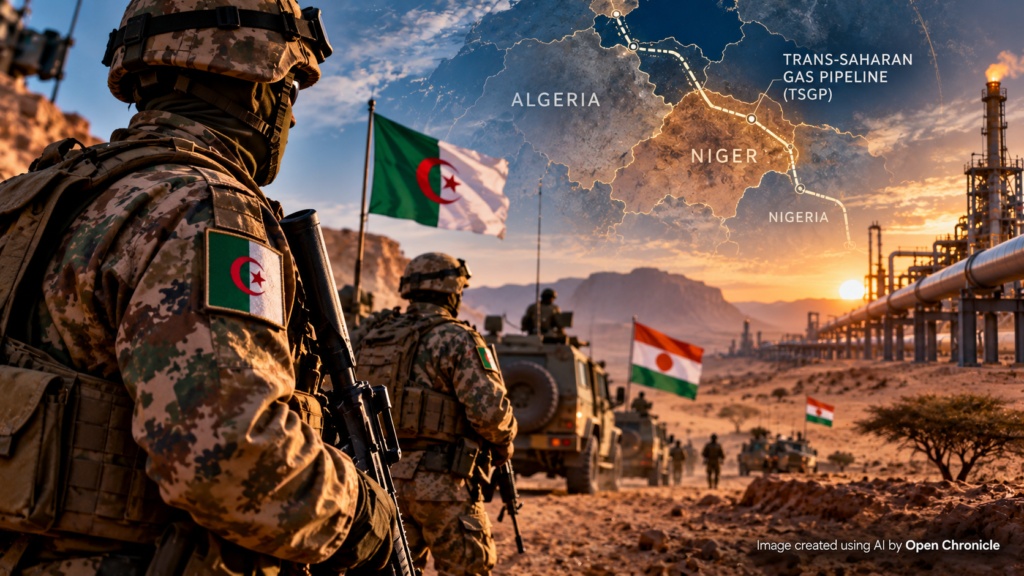
Algeria’s parliament has authorized the deployment of troops to neighbouring Niger to protect strategic energy infrastructure and strengthen regional security, marking the country’s first foreign military deployment since the 1973 Arab-Israeli war. The decision signals a significant evolution in Algiers’ defence policy amid growing instability in the Sahel and renewed efforts to develop the Trans-Saharan Gas Pipeline.
By Open Chronicle News Desk with Agencies
ALGIERS | October 26, 2026
Algeria has approved the deployment of military forces to neighbouring Niger, marking a historic departure from more than five decades of avoiding overseas military operations and signalling a significant shift in the country’s approach to regional security.
Both chambers of Algeria’s parliament voted on Sunday to authorize the deployment, which is intended to protect strategic energy facilities and reinforce security cooperation with Niger.
The decision represents the first foreign deployment of Algerian troops since the country sent forces to support Egypt during the 1973 Arab-Israeli war.
It comes at a time of growing security concerns across the Sahel, where armed groups continue to conduct attacks and governments are struggling to secure remote border regions.
The move also reflects Algeria’s expanding economic interests in Niger, particularly the proposed Trans-Saharan Gas Pipeline, a major energy infrastructure project designed to transport Nigerian natural gas through Niger and Algeria to European markets.
For Algiers, the deployment represents a new willingness to use military presence beyond its borders to protect strategic interests.
Parliament Authorizes a Historic Military Operation
The decision received approval from both chambers of Algeria’s parliament.
According to statements issued by the legislature, the upper house supported the proposal unanimously among the 148 members present.
The lower house also approved the deployment by what it described as an absolute majority, although it did not release a detailed breakdown of the vote.
Under Algeria’s constitutional framework, amended in 2020, the deployment of military forces outside national territory requires approval by a two-thirds parliamentary majority.
The parliamentary authorization therefore provides the constitutional basis for the operation.
However, the information released does not specify the number of troops involved, the precise locations where they will operate, or the duration of the mission.
Those details will be important in determining whether Algeria intends to establish a limited protective presence around infrastructure or participate in broader security operations.
The decision nevertheless represents a significant milestone in Algerian military policy.
For decades, the country has maintained a cautious approach to deploying armed forces beyond its borders, preferring diplomacy, regional cooperation and the principle of non-interference in the internal affairs of other states.
The authorization to send troops into Niger suggests that this approach is evolving in response to new strategic circumstances.
A Major Shift in Algeria’s Defence Doctrine
Algeria has traditionally emphasized national sovereignty, territorial defence and diplomatic engagement as central principles of its foreign policy.
Its reluctance to deploy troops abroad has been shaped by its history of anti-colonial struggle and its longstanding commitment to non-intervention.
The last comparable deployment occurred during the October 1973 Arab-Israeli war, when Algeria sent military forces to support Egypt.
More than five decades later, the country’s leadership appears increasingly willing to consider military action beyond national borders when essential security and economic interests are at stake.
Abdellah Akir, an international relations researcher, described the decision as a historic departure from Algeria’s established military doctrine.
According to Akir, the deployment reflects the need to protect Algeria’s strategic position in the Sahel while securing infrastructure connected to the planned Trans-Saharan Gas Pipeline.
Geoff Porter, an analyst with North Africa Risk Consulting, also identified the decision as evidence of an important change in Algerian policy.
Porter argued that Algeria has traditionally attempted to defend its interests through diplomatic negotiations, international law and multilateral institutions.
However, the increasingly competitive international environment has encouraged Algiers to adopt more tangible methods of protecting its regional influence.
The deployment, in this interpretation, does not necessarily represent the abandonment of Algeria’s foreign policy principles.
Instead, it demonstrates a willingness to pursue those principles through a more direct military presence.
Niger’s Security Crisis Drives Closer Cooperation
Niger has experienced persistent attacks by armed groups, particularly in remote regions where government control remains limited.
The country shares an approximately 960-kilometre desert border with Algeria, creating significant security challenges for both governments.
Militant organizations operating across the Sahel have exploited difficult terrain, weak state institutions and porous borders to conduct attacks and facilitate illicit activities.
The threats include jihadist violence, weapons trafficking, organized crime and cross-border smuggling.
For Algeria, instability in northern Niger presents a direct security concern because armed groups can operate across areas that are difficult to monitor and control.
The two governments have consequently agreed to deepen military and intelligence cooperation.
Their objectives include improving border security, combating armed organizations and protecting infrastructure considered strategically important.
The planned Algerian deployment is expected to form part of this broader security partnership.
However, the precise operational responsibilities of the Algerian contingent have not yet been publicly established.
The Trans-Saharan Gas Pipeline Becomes a Strategic Priority
Energy security is central to the decision.
Algeria and Niger are working to advance the Trans-Saharan Gas Pipeline, a long-delayed project intended to transport natural gas from Nigeria through Niger to Algeria.
From Algeria, the gas could be exported to European markets through existing and potentially expanded infrastructure.
The proposed pipeline has been discussed for decades but has faced repeated delays caused by financing difficulties, political instability and security concerns.
The project has acquired renewed strategic significance as European countries seek to diversify their energy supplies and reduce dependence on vulnerable or politically sensitive sources.
For Algeria, already an important natural gas supplier to Europe, the pipeline could reinforce its position as a major regional energy hub.
For Niger, the project offers the prospect of investment, transit revenues and infrastructure development.
Nigeria would gain an additional route for exporting its substantial natural gas reserves.
However, the pipeline’s proposed route crosses areas affected by insecurity, making the protection of construction sites, transport corridors and future installations an important consideration.
Algeria’s decision to deploy troops therefore connects national security policy with long-term economic planning.
The operation could help reassure investors and participating governments that the infrastructure will receive stronger security protection.
Nevertheless, military deployment alone cannot resolve the project’s financial, logistical and political challenges.
President Tebboune Signals Algeria’s Commitment to Niger
Algerian President Abdelmadjid Tebboune had already indicated that his government was prepared to take stronger measures to support Niger.
During a televised address on October 3, Tebboune declared that Algeria would protect its southern neighbour.
“We will protect Niger no matter what,” the president said.
He also referred to unnamed countries that he accused of conspiring against Niger.
Tebboune linked Algeria’s commitment to the growing economic relationship between the two countries, emphasizing agreements involving energy, mining and other sectors.
His remarks suggested that Algiers views stability in Niger as essential to protecting investments and strategic projects.
The president’s statements also reflected concern about competition for political and economic influence in the Sahel.
Algeria has traditionally regarded the region as a central part of its security environment.
Instability in neighbouring countries can affect border security, trade, migration and the movement of armed groups.
The parliamentary decision now provides a formal institutional basis for the stronger military commitment that Tebboune had previously signalled.
Military Cooperation Expands Following High-Level Visit
The parliamentary vote followed a visit to Algeria by Niger’s Defence Minister Salifou Modi.
During the visit, Modi met President Tebboune and Algerian army chief Saïd Chengriha.
The discussions focused on strengthening bilateral military cooperation and addressing shared security concerns.
According to Algerian reports, the two countries signed a military cooperation protocol.
The full terms of the agreement were not publicly disclosed.
The agreement nevertheless forms part of a broader effort to rebuild and expand relations between Algiers and Niamey.
Algeria has also provided Niger with four military helicopters.
According to Algeria’s defence ministry, the aircraft were supplied at the request of Nigerien authorities.
The transfer demonstrates the practical dimension of the growing military partnership.
Alongside security assistance, Algeria has expanded its involvement in Niger’s civilian infrastructure.
In June, it inaugurated a 40-megawatt power plant intended to supply electricity to Niamey and surrounding communities.
These initiatives indicate that the relationship increasingly combines military cooperation, energy development and economic assistance.
Relations Recover After Diplomatic Dispute
The rapprochement follows a period of significant diplomatic tension.
Relations between Algeria and Niger deteriorated after Algerian forces shot down a drone originating from Mali in 2025.
The incident triggered a dispute involving Algeria and members of the Alliance of Sahel States, which includes Mali, Niger and Burkina Faso.
Niger joined its regional allies in recalling its ambassador from Algiers.
The confrontation complicated Algeria’s efforts to maintain influence in the Sahel at a time when the region’s military-led governments were developing new security partnerships.
However, Algeria and Niger subsequently moved to repair relations.
The process accelerated as both governments recognized the importance of cooperation on border security and energy infrastructure.
Algeria has also resumed diplomatic relations with Mali.
The latest military agreement with Niger suggests that Algiers is seeking to restore its role as a major regional security actor.
Rather than relying exclusively on diplomatic engagement, the government now appears prepared to reinforce its partnerships through direct military commitments.
Regional Rivalries Add a Geopolitical Dimension
The deployment also carries implications for Algeria’s relations with other regional powers.
Researcher Abdellah Akir suggested that the decision sends a message to countries competing for influence in the Sahel, including Morocco and the United Arab Emirates.
Algeria has experienced significant diplomatic disagreements with both governments.
Its rivalry with Morocco remains one of the defining geopolitical tensions in North Africa.
Relations with the United Arab Emirates have also deteriorated amid disagreements over regional policies and strategic influence.
The Sahel has become an increasingly competitive environment involving North African governments, Gulf states and other international actors.
Military cooperation, infrastructure investment and energy projects have become important instruments of influence.
By establishing a military presence in Niger, Algeria may seek to reinforce its position as a leading security partner for countries along its southern frontier.
However, the operation could also generate new diplomatic sensitivities if other governments interpret it as an attempt to expand Algeria’s regional influence.
Niger’s Military Government and the Challenge of Stability
Niger has been governed by General Abdourahamane Tiani since a military coup in July 2023 removed elected President Mohamed Bazoum.
Bazoum has remained in detention since the takeover.
The military-led government has faced persistent security challenges while seeking to redefine Niger’s foreign partnerships.
Its relationships with neighbouring countries have become increasingly important as regional security arrangements undergo major changes.
The government has also confronted internal instability, including an attempted mutiny in August 2026.
The reported incident added to concerns about the durability of Niger’s security institutions.
Algeria’s decision to deepen military cooperation comes against this backdrop.
For Niamey, assistance from Algeria could provide additional resources for protecting infrastructure and strengthening border security.
For Algiers, supporting Niger may help prevent instability from spreading toward its own territory.
Nevertheless, the relationship also raises broader questions about Algeria’s engagement with military-led governments in the Sahel and its longstanding support for constitutional sovereignty.
What Remains Unclear About the Deployment
Despite the significance of the parliamentary vote, several operational questions remain unanswered.
The Algerian authorities have not publicly disclosed the size of the military contingent, its equipment or its intended deployment schedule.
It is also unclear whether Algerian personnel will operate exclusively around energy facilities or undertake additional missions involving border patrols, intelligence support and protection of transport routes.
The command structure and arrangements for cooperation with Nigerien forces have not been detailed.
The legal and operational rules governing the use of force will also be important.
A limited infrastructure-protection mission would carry different risks from a broader counterinsurgency deployment.
The absence of these details makes it premature to assess the operation’s likely military effectiveness or long-term consequences.
The parliamentary decision authorizes a deployment, but it does not by itself establish that Algerian troops have already entered Niger or begun operations.
The Big Picture: Algeria Redefines Its Role in the Sahel
Algeria’s decision to authorize the deployment of troops to Niger marks an important moment in the evolution of its foreign and defence policies.
For more than five decades, Algiers avoided foreign military deployments, relying instead on diplomacy, border defence and regional engagement.
The new decision suggests that the country’s leadership increasingly regards direct military cooperation beyond its borders as necessary to protect national interests.
Several factors have contributed to this change.
The continuing expansion of armed groups across the Sahel threatens Algeria’s southern security environment.
The Trans-Saharan Gas Pipeline has increased the economic importance of stability in Niger.
Regional competition has intensified, while diplomatic relationships have become more fluid.
Together, these developments have created pressure for Algeria to adopt a more assertive approach.
The operation could strengthen cooperation with Niger, improve protection for strategic infrastructure and reinforce Algeria’s influence in the Sahel.
But it also introduces new risks.
Overseas deployments can expose military personnel to armed attacks, create complex political obligations and draw governments into conflicts that are difficult to contain.
The effectiveness of Algeria’s new strategy will depend on the mission’s scope, coordination with Nigerien authorities and the wider security environment.
The central significance of the parliamentary vote extends beyond the deployment itself: Algeria is signalling that the defence of its strategic interests may now require a military presence outside its own territory.
Whether this becomes an exceptional mission or the beginning of a more permanent transformation in Algerian security policy will depend on developments in Niger and the broader Sahel.
Editorial Note
This article is an original Open Chronicle news synthesis based on the supplied reporting concerning Algeria’s parliamentary authorization of a military deployment to Niger on October 25, 2026. The reported parliamentary votes, statements by officials and assessments from analysts are attributed to the source material. The number of troops, deployment timetable, precise mission parameters and operational rules have not been independently established. Parliamentary authorization should not be interpreted as confirmation that troops have already deployed. Assessments of Algeria’s changing military doctrine and regional strategic interests are contextual analysis.