
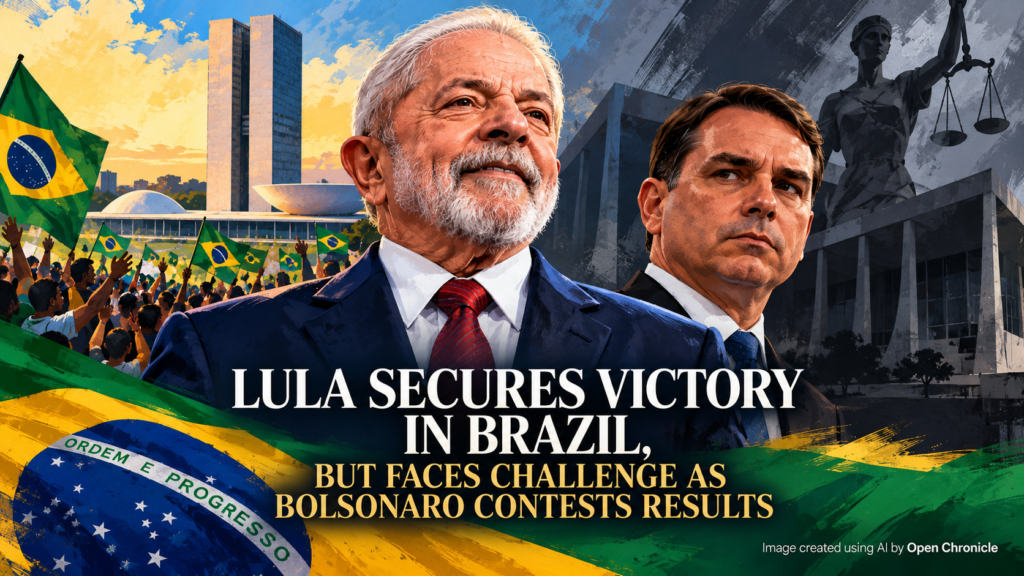
The Brazilian president secured more than 64 million votes in a decisive runoff victory, but his conservative rival is seeking to annul the election, raising the prospect of a prolonged political confrontation in Latin America’s largest democracy.
By Open Chronicle News Desk with Agencies
BRASÍLIA | October 26, 2026
Brazilian President Luiz Inácio Lula da Silva has secured reelection for a historic fourth, nonconsecutive term, completing a remarkable political comeback in Sunday’s presidential runoff. His victory, however, faces an immediate challenge from defeated rival Senator Flávio Bolsonaro, who has announced plans to seek the annulment of the results.
Lula received more than 64 million votes, compared with just under 60 million for Bolsonaro, securing a margin of nearly four percentage points in one of Brazil’s most consequential elections in recent years.
The president, who is approaching his 81st birthday, is expected to begin his new term on January 5, 2027.
His victory reinforces his position as one of Latin America’s most influential political figures and establishes Brazil as a potential counterweight to the growing number of right-wing governments in the region aligned with US President Donald Trump.
But the election has also demonstrated the continuing strength of the political movement associated with former President Jair Bolsonaro.
Flávio Bolsonaro, the former president’s son, has refused to concede and is preparing a legal challenge based on the controversial extension of voting hours on election day.
The dispute threatens to prolong Brazil’s political polarization even as electoral authorities and influential political figures move to recognize Lula’s victory.
A Decisive Victory After a Difficult Campaign
Lula’s reelection represents another extraordinary chapter in a political career spanning more than four decades.
The former trade union leader and founder of the Workers’ Party previously governed Brazil between 2003 and 2010 before returning to the presidency in 2023.
His latest victory followed a demanding campaign against Flávio Bolsonaro, who emerged as the principal representative of Brazil’s conservative movement after his father’s removal from active electoral politics.
According to the reported results, Lula attracted approximately 10 million additional voters between the first round and the runoff.
That expansion proved decisive.
Although Bolsonaro retained substantial support in conservative regions, Lula successfully broadened his electoral coalition, particularly among voters concerned about economic conditions, social programmes and the political direction of the country.
The final margin of nearly four percentage points gives Lula a significant electoral advantage over his challenger.
However, the result also demonstrates the depth of Brazil’s political divisions.
Almost 60 million voters supported Bolsonaro, providing the conservative opposition with a substantial political base that could continue to influence national politics throughout Lula’s next term.
Flávio Bolsonaro Seeks to Annul the Election
Speaking at a news conference on Sunday, Flávio Bolsonaro announced his intention to request the annulment of the presidential runoff.
His challenge centres on the decision to extend voting hours nationwide following disruptions that affected access to polling stations.
The extension was introduced at the request of both presidential candidates, although they cited different circumstances.
Lula’s campaign requested additional voting time because of public transportation difficulties in São Paulo and Salvador, two cities where he enjoyed significant electoral support.
Bolsonaro’s campaign also requested an extension after heavy rainfall affected voting conditions in southern Brazil, where conservative candidates had performed strongly during the first round.
The decision was approved by a Supreme Court justice shortly before polling stations were scheduled to close at 5 p.m.
However, the announcement created logistical complications.
Brazil’s electronic voting system normally allows polling stations to close and results to be processed rapidly. Consequently, some polling stations were reportedly already completing their procedures when the extension was announced.
Bolsonaro has argued that the disruption provides grounds to challenge the election.
Nevertheless, the precise legal mechanism through which he intends to seek annulment remains unclear.
No evidence has been established that the extension altered the outcome or that significant electoral fraud occurred.
Brazil’s Electoral Institutions Recognize Lula’s Victory
Despite Bolsonaro’s objections, Brazil’s electoral institutions have moved to recognize Lula’s reelection.
Kassio Nunes, the president of Brazil’s electoral authority and a Supreme Court justice originally appointed by former President Jair Bolsonaro, was among the officials who acknowledged Lula’s victory on Sunday.
His recognition is politically significant because it suggests that the country’s principal electoral institutions are not preparing to reject the announced result.
Brazil has used electronic voting machines since the 1990s, when authorities introduced the technology to reduce fraud and improve the speed and reliability of vote counting.
The system allows results to be calculated within hours of polling stations closing.
Although the technology has repeatedly been questioned by political opponents, investigations have not established significant systematic fraud capable of undermining its credibility.
The scale of Lula’s victory also complicates any attempt to overturn the result.
With a margin of approximately four million votes, Bolsonaro would face a substantial challenge in demonstrating that irregularities were serious enough to justify annulling the election.
The Shadow of Jair Bolsonaro
The dispute inevitably recalls the political confrontation that followed Brazil’s 2022 presidential election.
Former President Jair Bolsonaro repeatedly questioned the integrity of the electronic voting system before and after losing to Lula.
His allegations were not supported by evidence of widespread electoral fraud.
The political crisis that followed culminated in investigations into an attempted coup.
Jair Bolsonaro is now serving a 27-year prison sentence in connection with the attempted overthrow of Brazil’s democratic institutions, according to the supplied reporting.
His son has inherited much of the conservative political movement that developed around the former president.
Flávio Bolsonaro’s presidential campaign demonstrated that the family’s influence remains substantial despite Jair Bolsonaro’s imprisonment.
The younger Bolsonaro’s refusal to concede may therefore resonate with millions of supporters who remain deeply distrustful of Lula and his Workers’ Party.
However, political analysts suggest that Brazil’s institutions are unlikely to support an effort to overturn the result without compelling legal evidence.
Political Establishment Moves Behind Lula
Early reactions from Brazilian institutions and international leaders suggest that Lula’s victory will be recognized both domestically and abroad.
Brian Winter, editor-in-chief of Americas Quarterly and a specialist in Brazilian politics, described Bolsonaro’s prospects of overturning the election as extremely difficult.
According to Winter, influential political and economic figures are increasingly accepting the result, even when they do not support Lula politically.
The response indicates that important sectors of Brazil’s political establishment may be reluctant to enter another prolonged confrontation over electoral legitimacy.
For business leaders, investors and institutional authorities, a contested election could create uncertainty at a time when Brazil faces significant economic challenges.
A prolonged dispute could also complicate preparations for the new presidential term and delay negotiations over the next government’s legislative agenda.
Nevertheless, analysts caution against underestimating the Bolsonaro family’s ability to mobilize political opposition.
Its supporters remain influential in Congress, regional governments and conservative social movements.
Even without successfully challenging the election result, the movement could create considerable difficulties for Lula’s administration.
A Right-Wing Congress Will Complicate Lula’s Fourth Term
Winning the presidency does not guarantee Lula an easy path to governing.
Brazil’s newly elected Congress is expected to remain dominated by conservative and centre-right forces.
Flávio Bolsonaro’s party will hold more seats than any other single political party, giving the opposition substantial influence over legislation and parliamentary negotiations.
This balance of power could complicate Lula’s attempts to advance economic reforms, social spending programmes and environmental policies.
The president will need to build alliances with centrist parties and negotiate support for individual legislative initiatives.
Brazil’s fragmented political system traditionally requires presidents to assemble broad congressional coalitions.
Such arrangements can provide stability but often involve difficult compromises over spending priorities, government appointments and public policy.
For Lula, the challenge will be particularly demanding because of the continuing political confrontation with the Bolsonaro movement.
The president must simultaneously defend his electoral mandate, maintain institutional stability and secure sufficient congressional support to govern effectively.
Economic Pressures Threaten the New Administration
Brazil’s economic outlook represents another major challenge.
The country faces concerns over public finances, government spending and the possibility of renewed fiscal instability.
Lula’s political programme has traditionally emphasized poverty reduction, social protection and public investment.
However, expanding social programmes while maintaining investor confidence will require careful management of the federal budget.
A possible fiscal crisis could limit the government’s ability to fulfil campaign commitments.
Brazil must also confront structural problems involving productivity, infrastructure, inequality and public security.
Organized crime remains a significant concern in several regions, while economic disparities continue to shape political attitudes.
The government will need to demonstrate that its policies can deliver improvements in living standards without undermining financial stability.
That task may become more difficult if the opposition uses its congressional strength to obstruct major initiatives.
Lula’s Victory Reshapes Latin America’s Political Balance
The election also carries important consequences for regional diplomacy.
In recent years, several Latin American governments have shifted toward conservative political leadership, often emphasizing closer relations with Washington.
Lula’s victory provides a prominent alternative to that trend.
As president of Latin America’s largest economy, Lula is expected to continue advocating multilateral diplomacy, regional cooperation and a more independent international role for Brazil.
His administration has also emphasized environmental protection, particularly in the Amazon rainforest, and cooperation among emerging economies.
Flávio Bolsonaro had promised to strengthen relations with the Trump administration, reflecting the ideological proximity between the Bolsonaro movement and the American president.
Lula’s reelection therefore introduces another period of potential tension between Brasília and Washington.
However, Brazil and the United States maintain important economic and diplomatic relationships that extend beyond individual administrations.
Trade, investment, energy, agriculture and security cooperation will continue to shape bilateral relations.
Trump had not publicly commented on Lula’s victory at the time covered by the supplied reporting.
International Recognition Strengthens Lula’s Position
The international response to the election could influence the political confrontation over its legitimacy.
Early indications suggest that governments across Latin America and other regions are prepared to recognize Lula’s victory.
Such recognition would strengthen the president’s position by demonstrating that international partners regard the electoral process as having produced a legitimate result.
It could also discourage efforts to challenge the election through political pressure rather than established legal procedures.
Nevertheless, international recognition cannot substitute for domestic institutional legitimacy.
Brazil’s electoral authorities and courts remain responsible for evaluating any formal complaints submitted by Bolsonaro’s campaign.
The coming days will therefore be important in determining whether the dispute remains confined to legal proceedings or develops into a broader political confrontation.
What Happens Next?
Several developments will determine the immediate future of Brazilian politics.
The first concerns whether Flávio Bolsonaro formally submits a legal request to annul the election and what evidence he presents in support of that demand.
The second involves the response of Brazil’s electoral institutions.
Any challenge will need to be assessed through the country’s established legal procedures.
A third factor will be the behaviour of Bolsonaro’s supporters.
Large-scale demonstrations or attempts to delegitimize the result could intensify political tensions, particularly given Brazil’s experience following the 2022 election.
Finally, attention will turn toward Lula’s preparations for his next administration.
The president must begin negotiations with congressional parties, establish legislative priorities and prepare an economic programme capable of addressing fiscal concerns.
His ability to secure political cooperation will be essential to the success of his fourth term.
The Big Picture: A Historic Victory in a Deeply Divided Democracy
Lula da Silva’s reelection represents a historic achievement in Brazilian politics.
Few political leaders have demonstrated a comparable ability to return repeatedly to national power across different political and economic periods.
His victory also demonstrates the resilience of a political movement built around social inclusion, public investment and an active international role for Brazil.
Yet the result is not an unconditional mandate.
Nearly 60 million Brazilians voted for Flávio Bolsonaro, confirming that the conservative movement associated with his family remains a powerful force.
The challenge to the election result adds another layer of uncertainty to an already polarized political environment.
Brazil’s institutions now face the responsibility of ensuring that electoral disputes are resolved through credible legal procedures rather than political confrontation.
For Lula, the greater test will come after the immediate dispute is settled.
He must govern with a conservative Congress, manage difficult fiscal conditions and maintain public confidence in a political system that has experienced repeated crises.
Internationally, his fourth term could strengthen Brazil’s position as an influential voice in Latin America and the wider Global South.
Domestically, however, the president faces a more complicated reality.
Lula has won the election decisively. Whether he can transform that victory into four years of effective government will depend on his ability to navigate the enduring power of the Bolsonaro movement, restore political confidence and deliver economic stability.
The election has settled who will lead Brazil. It has not settled the country’s political divisions.
Editorial Note
This article is an original Open Chronicle news synthesis based on the information supplied concerning Brazil’s presidential runoff on October 25, 2026, and the political developments reported on October 26. Election figures, statements and legal challenges are presented according to the supplied reporting. Flávio Bolsonaro’s intention to contest the result does not establish electoral fraud or invalidate Lula’s victory. Assessments concerning Brazil’s institutions, congressional balance and future political stability are contextual analysis rather than confirmed predictions.