
OPEN CHRONICLE | WORLD NEWS | ISRAEL ELECTIONS 2026
The first parliamentary election since the October 7, 2023, Hamas attacks pits Benjamin Netanyahu’s governing coalition against an ideologically diverse opposition led by Gadi Eisenkot. With neither bloc projected to secure a majority, Israel faces a potentially prolonged struggle over its political future.
By Open Chronicle with agencies
JERUSALEM, October 27, 2026 — More than seven million Israelis are eligible to vote on Tuesday in a parliamentary election widely regarded as one of the most consequential in the country’s history, with the future of Prime Minister Benjamin Netanyahu’s government, democratic institutions and national security policies at stake.
The election for Israel’s 26th Knesset, the country’s 120-member parliament, is the first since the Hamas-led attacks of October 7, 2023, and comes after years of political polarisation, regional conflict and mounting disputes over the direction of Israeli society.
While Netanyahu has presented the election as a decisive moment for Israel’s security and national survival, political analysts argue that the central question extends beyond military threats and foreign policy.
For many voters, the contest represents a choice over the character of Israel’s democracy, the accountability of its political leadership and the relationship between religion and the state.
A Referendum on Netanyahu and Israeli Democracy
At the centre of the election is Netanyahu, whose coalition of right-wing and ultra-Orthodox parties has governed through one of the most turbulent periods in Israel’s modern history.
His administration faces continued scrutiny over the security failures that preceded the October 7 attacks, as well as longstanding controversies surrounding judicial reform, institutional independence and political accountability.
Udi Sommer, a political science professor and head of the Barak Leadership Center at Tel Aviv University, described the election as a referendum on Israeli democracy.
“It’s also about Netanyahu’s performance and accountability for the people who were in charge on Oct. 7,” Sommer told the Jewish Telegraphic Agency.
The opposition, led by former military chief Gadi Eisenkot, has sought to turn dissatisfaction with the government into a broader political movement capable of replacing Netanyahu.
However, the opposition alliance brings together parties with significantly different ideological positions, making the formation of a stable governing coalition a considerable challenge.
Eisenkot Leads a Diverse Opposition
Eisenkot, a former chief of staff of the Israel Defense Forces, has emerged as Netanyahu’s principal political challenger.
His Yashar party and potential coalition partners are seeking to present themselves as an alternative capable of restoring confidence in state institutions, improving governance and rebuilding Israel’s international standing.
The opposition’s priorities include strengthening democratic safeguards, addressing divisions within Israeli society and reconsidering policies affecting the ultra-Orthodox community.
Tani Frank, director of the Shalom Hartman Institute’s Center for Judaism and State Policy, said the stakes were significant for both political camps.
For Netanyahu, the election could represent a final major opportunity to advance strategic objectives during the remaining years of US President Donald Trump’s administration.
Those objectives could include further action concerning Iran and efforts to expand the Abraham Accords, the diplomatic normalisation agreements between Israel and several Arab countries.
For the opposition, Frank said, the election is an urgent effort to protect democratic institutions, restore effective governance and ensure Israel’s international credibility.
The integration of the rapidly growing Haredi, or ultra-Orthodox, population into Israeli society has also become an increasingly important political issue, particularly regarding military service, education and economic participation.
More Than 7.3 Million Eligible Voters
According to figures attributed to Israel’s Central Elections Committee, approximately 7.3 million citizens are eligible to participate in Tuesday’s vote.
Election authorities have prepared an extensive nationwide operation to accommodate voters.
The arrangements include 12,018 polling stations, approximately 18,000 ballot boxes and an estimated 450 million printed ballot papers.
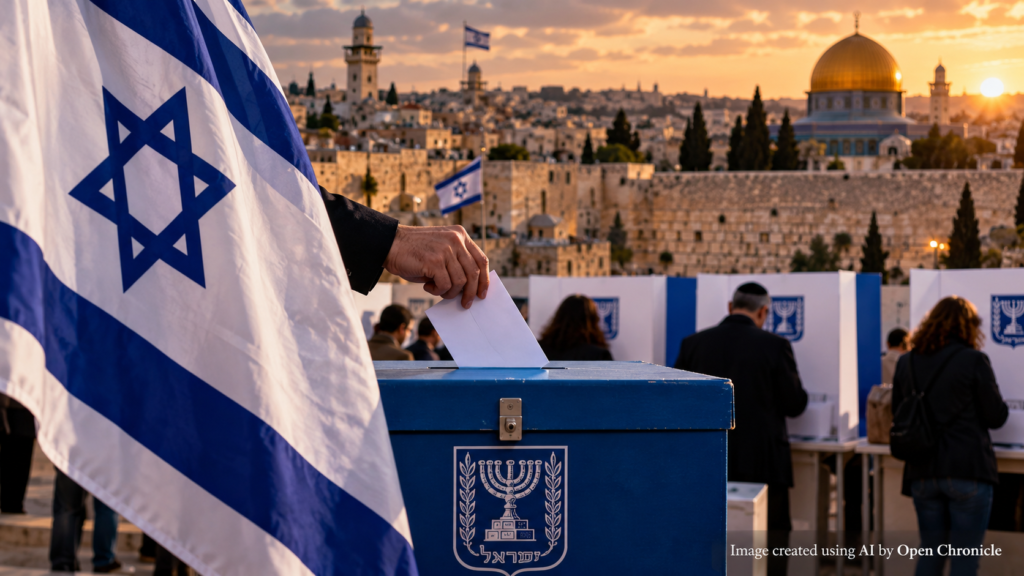
Unlike electoral systems in which voters select individual candidates, Israelis vote for national party lists through a proportional representation system.
Each party is identified by letters or an acronym printed on its ballot paper. Voters place their selected paper inside an envelope before depositing it in a ballot box.
Election Day is a national holiday in Israel, allowing most employees and students to participate in the democratic process.
While schools and many workplaces remain closed, commercial establishments and entertainment venues may continue operating.
Reports also indicate that tens of thousands of Israeli citizens living abroad have returned to the country to participate in the election, reflecting the unusually high political stakes.
Extensive Security Measures Across Israel
Security authorities have announced a major nationwide deployment to protect polling stations and ensure that voting can proceed without disruption.
Approximately 20,000 police officers are expected to be deployed across the country, with responsibility for maintaining public order, preventing disturbances and protecting access to polling locations.
Police have emphasised the importance of allowing all eligible citizens to exercise their voting rights safely.
Election integrity is another major concern.
The Central Elections Committee has announced plans to use approximately 15,000 cameras operated by election inspectors to identify potential irregularities.
Specialised police cyber units are also expected to monitor attempts to interfere with the electoral process through online disinformation and other digital threats.
These precautions reflect the heightened political tensions surrounding the election and the importance of public confidence in the final result.
Polls Point to a Political Deadlock
The final opinion polls published before Election Day suggest that neither Netanyahu’s coalition nor the opposition is likely to secure the 61 parliamentary seats required to form a majority government.
Most surveys place Netanyahu’s political bloc at approximately 50 seats, leaving it substantially short of the threshold needed to govern independently.
Eisenkot’s Yashar party and its potential allies appear better positioned in some projections, but they too remain short of an outright majority.
The result could therefore depend on smaller political parties and the willingness of rival factions to negotiate coalition agreements.
Israel’s electoral system makes such negotiations central to government formation.
Although Netanyahu and Eisenkot are the principal contenders for the premiership, voters do not elect the prime minister directly.
Instead, the president consults parliamentary parties after the election and assigns a candidate the task of forming a government.
That candidate must assemble sufficient parliamentary support to secure the confidence of the Knesset.
Arab Parties Could Become Decisive
One of the most significant uncertainties concerns the role of Israel’s Arab-majority political parties.
The Joint List and Ra’am are projected to secure a combined 14 or 15 parliamentary seats, potentially giving them considerable influence over the formation of the next government.
Neither grouping is expected to support a Netanyahu-led coalition.
However, analysts suggest that one or both could consider supporting an opposition-led minority government, even without formally joining the governing coalition.
Such an arrangement could provide the parliamentary backing needed to replace Netanyahu while allowing Arab parties to remain outside the cabinet.
The political feasibility of this scenario remains uncertain.
Cooperation between Jewish-majority and Arab-majority parties has historically faced substantial ideological and political obstacles, particularly over national security, the Israeli-Palestinian conflict and the definition of Israel as a Jewish and democratic state.
Nevertheless, the narrow margins projected by opinion polls mean that the decisions of these parties could prove decisive.
Smaller Parties Could Change the Outcome
Three smaller parties are also attracting attention because of their proximity to Israel’s electoral threshold.
Amcha Yisrael, the Reservists and the Haredi Public Party are each competing to secure the minimum 3.25% of valid votes required to enter parliament.
Under Israel’s proportional electoral system, parties that fail to reach this threshold receive no parliamentary representation.
Their votes are effectively excluded from the allocation of Knesset seats, potentially benefiting larger parties and altering the balance between political blocs.
If one or more of these smaller parties crosses the threshold, the resulting redistribution of seats could significantly affect coalition negotiations.
Conversely, if they fail to qualify, the parliamentary arithmetic could shift in unexpected ways.
This uncertainty makes the final vote count particularly important, even if the broader balance between Netanyahu’s supporters and opponents remains relatively stable.
The Possibility of Another Election
Political analysts increasingly consider a parliamentary deadlock one of the most plausible outcomes.
If neither Netanyahu nor Eisenkot can assemble a governing majority, Israel could enter another prolonged period of coalition negotiations.
A failure to form a government could eventually result in another election.
Frank warned that the question of who remains in office during such a political impasse could become especially important.
Netanyahu could seek to remain prime minister while further attempts are made to establish a governing coalition, as occurred during Israel’s repeated elections between 2019 and 2020.
The opposition, meanwhile, would need to assemble enough parliamentary support to replace the government, potentially without relying on the full participation of Arab-majority parties.
This could involve temporary agreements designed primarily to facilitate a transfer of power rather than establish a durable coalition.
Israel has experienced several periods of political instability in recent years, with repeated elections exposing the difficulty of reconciling the country’s increasingly fragmented political landscape.
Another inconclusive result could prolong uncertainty at a time when Israel faces substantial domestic and regional challenges.
A Defining Moment for Israel’s Political Future
Beyond the immediate question of who will become prime minister, Tuesday’s election carries broader implications for Israel’s institutions and national identity.
The country remains divided over judicial independence, the influence of religious parties, military service obligations, economic inequalities and the balance between national security and democratic accountability.
The consequences of the October 7 attacks continue to shape public debate, while Israel’s relations with its neighbours and international partners remain central to the political agenda.
For Netanyahu’s supporters, the election offers an opportunity to maintain political continuity and pursue long-term strategic objectives.
For his opponents, it represents a chance to change the country’s leadership and redefine its political direction.
The final outcome may depend less on which party wins the largest number of seats than on which political leader can build a functioning parliamentary majority.
As millions of Israelis cast their ballots, the country faces a decision that could determine not only its next government but also the direction of its democracy for years to come.
Editorial Note
This article is based on election information, polling projections and expert assessments supplied for the October 27, 2026, parliamentary election. Seat projections are estimates rather than official results. The reported election arrangements, party positions and quotations have not been independently verified for this edition. Official results and subsequent coalition negotiations may change the political outlook described above.