
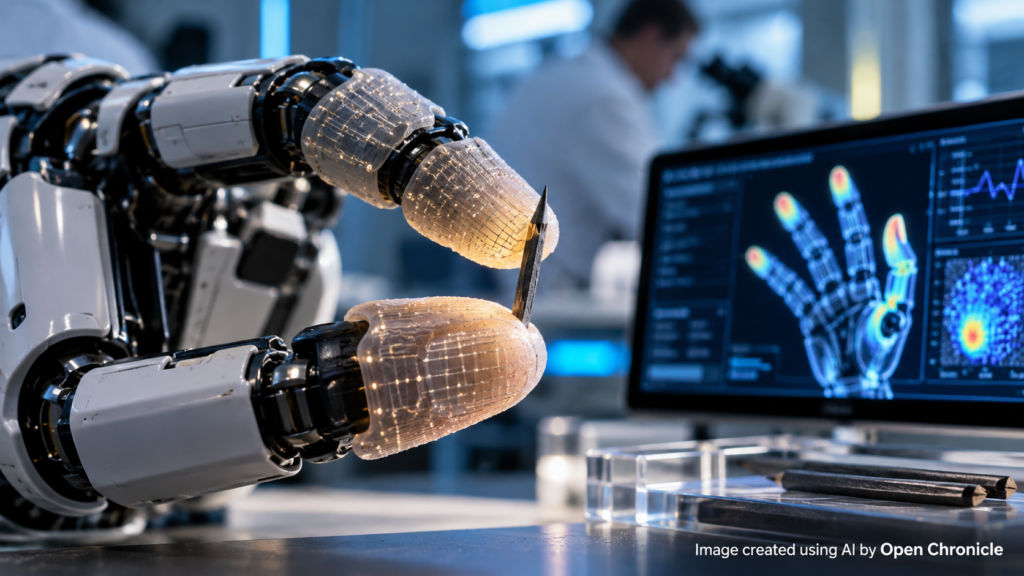
An experimental electronic skin capable of detecting delicate contact and responding to potentially damaging objects points towards a new generation of robots that can interact more safely with the physical world.
By Open Chronicle Technology Desk
Beyond the mechanical grip
Robots have become remarkably capable of performing repetitive industrial tasks, navigating unfamiliar environments and interpreting visual information. Yet one of the most ordinary human abilities remains surprisingly difficult to reproduce: the sense of touch.
A person can pick up a fragile object, adjust the pressure of their fingers and react instinctively when encountering something sharp. These actions depend on a complex biological system that combines pressure receptors, sensory nerves and rapid responses.
For robots, the challenge is considerably greater.
Traditional robotic grippers generally rely on carefully calibrated movements, mechanical force sensors or visual feedback. While these technologies can be highly effective in controlled environments, handling unpredictable objects without damaging them remains a significant engineering problem.
Recent research into artificial electronic skin offers a possible solution.
By integrating sensing capabilities into flexible materials, scientists are developing surfaces that allow machines to detect physical contact across different locations and respond more intelligently to their surroundings.
The objective is not simply to build robots that can feel pressure. It is to create machines capable of using tactile information to make better decisions.
A new approach to electronic skin
Research published in Nature Machine Intelligence in October 2026 describes an experimental electronic skin designed to provide robots with sophisticated tactile sensing capabilities.
The technology belongs to a growing field known as electronic skin, or e-skin, which attempts to reproduce selected functions of biological skin through engineered materials and electronic systems.
Unlike conventional rigid sensors, electronic skin can be designed to conform to curved or moving surfaces, making it particularly suitable for robotic hands and grippers.
The central challenge is combining flexibility, sensitivity and reliable signal processing.
A useful robotic skin must distinguish meaningful physical contact from background noise, identify where contact occurs and provide information quickly enough for a robot to respond.
In experimental demonstrations associated with the research, robotic systems were able to manipulate delicate objects, including thin pencil leads, and respond to contact involving pointed objects.
These demonstrations illustrate two different but closely related capabilities.
The first is precision: detecting and controlling contact forces when manipulating fragile materials.
The second is protection: recognising potentially harmful contact and triggering an appropriate response.
Both are essential if robots are to move beyond predictable industrial settings into environments where physical interactions are less controlled.
Why handling a pencil lead matters
At first glance, holding a pencil lead may seem like a modest achievement for a sophisticated robotic system.
In practice, it provides a useful demonstration of the difficulties involved in precision manipulation.
A thin pencil lead is small, fragile and easily damaged by excessive gripping force.
A robot must apply enough pressure to hold the object securely without breaking it.
Human fingers perform similar adjustments almost automatically, using tactile feedback to regulate grip.
Robotic systems must reproduce this process through sensors, control algorithms and mechanical actuators.
Electronic skin can contribute by providing additional information about contact conditions, potentially reducing the need to rely exclusively on predefined gripping forces.
This is particularly important when a robot encounters objects with unfamiliar shapes, textures or mechanical properties.
Rather than requiring every interaction to be programmed in advance, tactile feedback can help a robotic system adapt its movements according to what it detects.
However, a successful laboratory demonstration does not establish that the technology can already handle the full range of objects encountered in homes, hospitals or industrial facilities.
Such applications would require additional testing under substantially more complex conditions.
Recognising potentially dangerous contact
Another significant aspect of artificial skin research concerns the ability to detect potentially damaging physical interactions.
Biological skin does more than provide information about the external environment. It also contributes to protective responses.
Touching a sharp object can trigger rapid withdrawal, often before a person has consciously evaluated the danger.
Researchers are exploring whether robotic systems can reproduce a simplified version of this behaviour.
In the experimental work reported in October, the electronic skin was used in demonstrations involving pointed contact, suggesting a possible pathway towards protective robotic responses.
For machines operating near people, sensitive equipment or fragile materials, this capability could be valuable.
A robotic arm that recognises unexpected contact may be able to stop, reduce its applied force or withdraw before causing further damage.
Nevertheless, detecting sharp contact is not equivalent to experiencing pain.
Robotic electronic skin does not reproduce human consciousness or biological sensation. It converts physical interactions into signals that a machine can interpret and use.
The distinction is important because descriptions of robots that can feel may otherwise suggest capabilities that the technology does not possess.
From industrial automation to healthcare
The potential applications of electronic skin extend across several areas of robotics.
In manufacturing, tactile sensors could improve the handling of delicate electronic components, precision instruments and materials that are difficult to manipulate using fixed gripping forces.
In healthcare, advanced tactile feedback might eventually assist robotic systems designed for rehabilitation, patient support or carefully controlled medical procedures.
Such uses would require rigorous safety validation and specialised engineering.
Service robots could also benefit from improved tactile perception when handling everyday objects or interacting with unfamiliar surroundings.
Another promising area involves prosthetic technology.
Although electronic skin does not automatically restore biological sensation, related sensing systems could contribute to future prosthetic devices that provide users with more detailed information about physical contact.
The broader significance lies in reducing the gap between mechanical movement and physical understanding.
A robot that can detect contact but cannot interpret its significance remains limited. A robot that can integrate tactile feedback into its control system may become substantially more adaptable.
The engineering breakthrough: processing touch quickly
One of the most important findings concerns the speed and organisation of sensory information.
The research team, led by scientists at Southern University of Science and Technology in China and collaborating institutions, developed an iontronic skin incorporating more than 10,000 sensing elements.
The system achieves a density of approximately 1,110 sensing units per square centimetre and reads signals at 100 frames per second.
Instead of processing every sensor individually through a conventional sequential architecture, it uses frequency encoding and hierarchical processing inspired by the organisation of biological sensory systems.
An intermediate processing stage compresses information before transmitting it to higher-level software.
According to the reported experiments, the researchers achieved a 268-fold reduction in transmitted data while retaining 98.2% classification accuracy across ten tested object categories. The complete sensing and interpretation process took approximately 23 milliseconds.
These results suggest that artificial skin can combine detailed tactile information with rapid processing, although performance in broader operating environments remains to be established.
Nature Machine Intelligence+1
What still needs to be solved
Despite the promising results, electronic skin faces several obstacles before widespread commercial deployment becomes realistic.
One challenge is durability. Flexible sensing materials must withstand repeated movement, friction, stretching and environmental exposure without losing accuracy.
Another concerns integration. Robotic systems need compact electronics capable of processing large volumes of tactile information without excessive energy consumption or mechanical complexity.
The researchers acknowledge that the current encoding and decoding circuitry remains relatively bulky. Integrating these functions into specialised chips could reduce the size of future systems.
Reliability is equally important.
Robots working alongside people must respond consistently to unexpected contact, including situations involving multiple objects, irregular surfaces or sudden changes in pressure.
A system that performs well in controlled experiments may require extensive redesign before it can operate safely for thousands of hours in demanding environments.
A new frontier for intelligent machines
The development of artificial skin reflects a broader change in robotics.
For decades, much of the field concentrated on movement, mechanical strength, automation and computer vision.
Increasingly, researchers are focusing on the physical intelligence required for machines to interact with complex environments.
Touch is a critical part of that transition.
A robot may be able to recognise an object visually without knowing how firmly to grasp it. It may calculate a movement accurately while remaining unable to detect that an unexpected obstacle has entered its path.
Tactile sensing provides another layer of information that can make these interactions more responsive.
The October 2026 research represents an important experimental contribution to that ambition.
It does not mean that robots have acquired human sensation or that commercially available machines can now reproduce the full capabilities of biological skin.
What it demonstrates is that dense tactile sensing, efficient information processing and protective responses can be combined within a robotic system.
The next challenge will be turning those laboratory capabilities into durable, affordable and reliable technology.
For the future of robotics, the ability to understand physical contact may prove as important as the ability to see, move or calculate.
Sources and Further Reading
Scientific research and specialist reporting supporting this Open Chronicle Technology article.
Nature Machine Intelligence
Li, Z. et al. Large-scale iontronic skins with neural-hierarchical processing architecture. Published 16 October 2026. The original peer-reviewed research and experimental documentation.
Tech Xplore
Artificial skin helps robots grasp pencil lead and pull away from needles. Published 27 October 2026. Detailed reporting on the demonstrations, processing architecture and engineering limitations.
Electronics For You
Artificial Skin Gives Robotic Fingers a Sense of Touch. Published 28 October 2026. Additional technical reporting on sensor processing and robotic manipulation.
Editorial Note
This article is based on peer-reviewed research published in October 2026 and subsequent specialist reporting. The applications discussed beyond the reported experiments represent potential future developments rather than demonstrated commercial capabilities. The research describes engineered tactile sensing and protective responses, not biological pain or conscious sensation.