
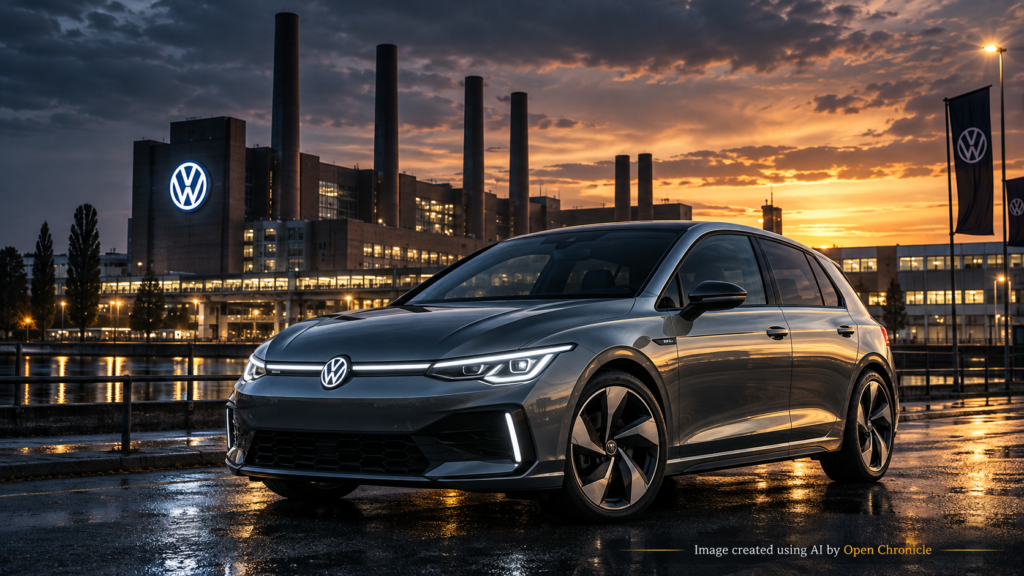
By Open Chronicle Auto Magazine
31 October 2026 | Automotive Industry, Electric Mobility & Manufacturing
Europe’s largest carmaker has temporarily suspended preliminary development work on the all-electric Golf at Wolfsburg, exposing the financial and industrial challenges behind one of its most important future models. The decision does not mean the electric Golf has been cancelled, but it raises a much larger question: can Volkswagen finance its technological transformation while protecting the manufacturing system that made it a global automotive powerhouse?
A Symbolic Decision at the Heart of Volkswagen
The Volkswagen Golf has been one of the defining automobiles of modern European motoring for more than half a century. Since its introduction in 1974, it has represented the combination of practicality, engineering sophistication and mass-market accessibility that helped establish Volkswagen as an industrial giant.
Now, the car’s electric future has become entangled in the manufacturer’s most serious restructuring pressures in years.
On 30 October 2026, reports emerged that Volkswagen had temporarily suspended preliminary development work on the future all-electric Golf, widely referred to as the ID. Golf, at its headquarters in Wolfsburg, Germany.
The decision was communicated to employees by senior management and subsequently confirmed in reporting on the company’s financial situation.
Thomas Schäfer, the executive responsible for Volkswagen’s volume brands, acknowledged the significance of the decision and the financial constraints behind it.
The company intends to resume the suspended work once the necessary investment can be accommodated.
Importantly, Volkswagen has not announced the cancellation of the electric Golf. Its works council has also maintained that the interruption should not affect the model’s planned introduction.
Nevertheless, the decision is extraordinary in its symbolism.
The Golf is not simply another product in Volkswagen’s portfolio. It is one of the vehicles most closely associated with the company’s identity, its German manufacturing heritage and its reputation for producing technologically advanced cars for ordinary motorists.
When financial pressures begin affecting the development of a future Golf, the implications extend far beyond a single vehicle.
Wolfsburg: The Industrial Heart of an Automotive Empire
Wolfsburg occupies a unique position within Volkswagen’s history.
The city developed around the company’s automotive operations, and its principal manufacturing complex became one of the most recognisable symbols of German industrial strength.
For decades, the factory has been associated with mass production, engineering expertise and the economic success of the Volkswagen brand.
The transition towards electric vehicles was supposed to open another chapter in that history.
Instead, Wolfsburg now faces the challenge of adapting its industrial structure while reducing costs and maintaining competitiveness.
According to information reported from Volkswagen management communications, the Wolfsburg operation was approximately €300 million short of its cost-reduction target.
Other German factories, including Emden and Zwickau, were described as making better progress towards their respective efficiency objectives.
The disparity illustrates a fundamental challenge for established automotive manufacturers.
Factories designed around decades of combustion-engine production cannot necessarily be transformed into highly competitive electric-vehicle operations simply by replacing one assembly line with another.
Manufacturing efficiency depends on the entire industrial system, including workforce organisation, logistics, supplier relationships, production volumes, energy consumption, automation and the complexity of the vehicles being assembled.
For Wolfsburg, the challenge is particularly significant because the plant is expected to remain central to Volkswagen’s future.
The temporary suspension of ID. Golf development work therefore reflects not only pressure on a vehicle programme, but also the difficulty of reconciling the company’s technological ambitions with the economics of its industrial base.
The Financial Numbers Behind the Decision
Volkswagen’s financial results for the first nine months of 2026 reveal why management is pursuing more aggressive cost controls.
The group reported approximately €233.4 billion in revenue during the period, compared with €238.7 billion in the corresponding months of 2025.
Its reported operating result fell dramatically, from approximately €5.4 billion to just €71 million.
Vehicle sales declined to around 5.9 million units, approximately 11 percent below the previous year’s level.
The third quarter was especially difficult.
Volkswagen recorded an operating loss of approximately €5.86 billion, compared with a loss of €1.3 billion in the same quarter of 2025.
Special accounting items, including significant effects associated with Porsche, contributed substantially to the deterioration.
These exceptional charges are important when interpreting the figures. They mean the reported quarterly loss should not be understood as evidence that Volkswagen’s ordinary vehicle operations alone generated a loss of that magnitude.
Nevertheless, underlying profitability remains a serious concern.
For the first nine months of 2026, Volkswagen reported an operating return on sales of 3.8 percent before special items.
That is a relatively narrow margin for a manufacturer attempting to finance multiple generations of new vehicles, battery technology, software platforms and manufacturing infrastructure.
The group has also identified approximately €31 billion in cost measures under its broader transformation programme.
In this environment, even projects carrying historically important names are being subjected to tighter financial scrutiny.
Why the Electric Golf Matters
The electric Golf occupies a strategic position that differs from many of Volkswagen’s earlier battery-electric vehicles.
When the company introduced the ID. family, it adopted a separate naming and design identity for its electric models.
The ID.3, ID.4 and other vehicles represented a deliberate attempt to establish a new generation of products distinct from traditional Volkswagen nameplates.
The Golf, however, carries decades of recognition and customer loyalty.
An electric Golf offers the possibility of connecting Volkswagen’s established reputation with the technologies of the next automotive era.
For customers who have owned several generations of Golf, the transition to an electric version could feel more familiar than moving to an entirely different product family.
The name also carries considerable significance in the European compact-car market.
The Golf has historically competed on a combination of usability, perceived quality, driving characteristics and engineering refinement.
Transferring those qualities into an electric vehicle will require more than installing a battery beneath a familiar body shape.
Volkswagen must deliver a competitive combination of range, charging performance, efficiency, software reliability, interior quality and price.
It must also do so in a market where expectations are evolving rapidly.
A vehicle developed for launch near the end of the decade will compete against electric cars that may be significantly more advanced than those available today.
That makes delays and investment interruptions particularly sensitive.
The SSP Platform and Volkswagen’s Technological Gamble
The future electric Golf is expected to use Volkswagen’s next-generation Scalable Systems Platform, known as SSP.
The architecture forms part of the company’s ambition to reduce technical complexity and develop a more unified foundation for future vehicles.
Historically, Volkswagen has operated numerous vehicle platforms across its different brands and market segments.
That approach helped the group produce a broad range of automobiles, but it also created substantial engineering and manufacturing complexity.
SSP is intended to simplify this structure.
In principle, a common technical architecture can reduce duplication, support more consistent software development and allow manufacturers to distribute engineering costs across larger production volumes.
It may also improve the integration of batteries, electrical systems and digital vehicle functions.
However, such benefits depend on successful implementation.
Developing a new vehicle architecture requires considerable investment before it generates meaningful revenue.
Software integration, electronic systems, manufacturing preparation and component validation can all introduce delays or unexpected costs.
SSP has already experienced changes to its original development timetable.
The suspension of preliminary work on the electric Golf therefore adds another layer of uncertainty to a technological programme that Volkswagen considers central to its future competitiveness.
There is also an important distinction between the platform’s ambitions and what has already been achieved.
The projected advantages of SSP are strategic objectives, not evidence that Volkswagen has already delivered the promised reductions in cost or complexity.
China’s Competitive Pressure Is Reshaping the Equation
Volkswagen’s difficulties cannot be separated from the transformation of the Chinese automotive market.
For years, China represented one of the most important sources of sales and profitability for major German automotive manufacturers.
Volkswagen developed an extensive industrial and commercial presence in the country, supported by local partnerships and strong consumer recognition.
The rapid expansion of Chinese electric-vehicle manufacturers has fundamentally altered that environment.
Companies such as BYD, Geely and other domestic competitors have become increasingly influential in electric mobility, battery integration, digital technology and vehicle pricing.
Many Chinese manufacturers have benefited from highly integrated supply chains, substantial domestic production capacity and experience developing electric vehicles for a highly competitive market.
Volkswagen must now defend its position against competitors that have developed capabilities in precisely the technologies shaping the next generation of automobiles.
The pressure is not confined to China.
Chinese brands are also expanding in Europe, where they are challenging established manufacturers on equipment levels, technology, design and, in some segments, pricing.
For Volkswagen, the challenge is therefore twofold.
It must improve its competitiveness in China while preventing the erosion of its position in Europe.
Both objectives require substantial investment.
Yet the financial returns available to support that investment are under pressure.
Electric Vehicles Are Selling, but Profitability Remains Difficult
One of the most revealing elements of Volkswagen’s recent financial disclosures is the distinction between demand for electric vehicles and the profitability of producing them.
The company reported that battery-electric vehicle orders in Europe increased by 39 percent during the first nine months of 2026.
Electric vehicles also represented approximately 40 percent of its European order backlog.
These figures indicate that demand for Volkswagen Group electric vehicles remains meaningful.
However, stronger electric-vehicle demand does not automatically translate into higher profits.
The company has acknowledged that its electric vehicles currently generate lower earnings than combustion-engine vehicles.
This creates a difficult industrial paradox.
Volkswagen must expand electric mobility to remain competitive in the long term, but the transition can place additional pressure on profitability in the short term.
Battery costs, research expenditure, software development, production conversion and competitive pricing all influence the economics of the transformation.
Manufacturers must also continue supporting existing combustion-engine vehicles while investing in their eventual successors.
The result is a period in which companies are effectively financing two technological systems simultaneously.
For a group operating numerous brands and factories, the burden can be considerable.
The temporary suspension of electric Golf development work illustrates how this tension can affect individual investment decisions.
The Employment and Political Dimension
Volkswagen’s restructuring has consequences extending well beyond the automotive industry.
The company is a major employer and an essential component of Germany’s manufacturing economy.
Its operations support extensive networks of suppliers, engineering businesses, logistics companies and specialised industrial services.
Management’s plans for substantial workforce reductions and possible factory closures have generated opposition from labour representatives.
The IG Metall union has been considering further industrial action, while employees have expressed concern about the distribution of investment between German facilities and international operations.
The proposed expansion of Audi manufacturing in the United States has added to those tensions.
For workers in Wolfsburg, decisions about future vehicle development are directly connected to questions about employment, factory utilisation and the long-term future of German automotive production.
An electric Golf manufactured in Wolfsburg would carry both commercial and symbolic importance.
It could demonstrate that one of Germany’s most historic automotive production centres remains capable of building vehicles for the next technological era.
The temporary suspension of development work does not mean that ambition has been abandoned.
But it reinforces the uncertainty surrounding the pace and cost of the transition.
A Wider European Industrial Problem
Volkswagen’s predicament reflects pressures affecting much of Europe’s established automotive industry.
Traditional manufacturers are attempting to transform complex industrial organisations while facing stronger international competition and uncertain consumer demand.
They must comply with changing environmental regulations, invest in batteries and software, manage energy and labour costs, and adapt production capacity to shifting market conditions.
At the same time, governments increasingly view automotive manufacturing as a strategic industry.
Vehicle production supports employment, technological research, exports and the development of advanced manufacturing capabilities.
The transition towards electric mobility is consequently becoming an industrial-policy challenge as much as an automotive one.
Questions surrounding batteries, critical minerals, charging infrastructure, international trade and technological independence now influence decisions once dominated by engine performance, production efficiency and vehicle design.
Volkswagen sits at the centre of this transformation.
Its scale gives it considerable resources and industrial expertise.
But the same scale also makes rapid restructuring difficult.
What Happens Next for the ID. Golf?
The immediate question is whether Volkswagen can resume the suspended development work without materially affecting the electric Golf’s timetable.
The company’s works council has expressed confidence that the lost time can be recovered.
That position should be understood as an expectation rather than a guarantee.
Future progress will depend on Volkswagen’s ability to secure the required investment, achieve its cost targets and advance the underlying technology.
Several factors will determine whether the electric Golf ultimately succeeds.
First, the vehicle must arrive with technology competitive against the electric cars available at the time of its introduction.
Second, Volkswagen must establish a manufacturing cost structure that allows the model to compete commercially without placing excessive pressure on margins.
Third, the company must ensure that software and electronic systems meet customer expectations for reliability and ease of use.
Finally, the electric Golf must preserve enough of the traditional model’s identity to appeal to existing customers while offering genuine advantages over combustion-engine alternatives.
These are substantial challenges, but they are not necessarily insurmountable.
Volkswagen has repeatedly adapted its products and industrial strategy during periods of technological change.
The question is whether it can now do so quickly enough.
The Golf as a Test of Europe’s Automotive Future
The Volkswagen Golf has survived oil crises, changing emissions standards, economic recessions, globalisation and successive technological revolutions.
Its history is closely connected to the development of modern European car ownership.
The electric Golf is intended to continue that legacy in a market where the underlying technologies, competitors and economic assumptions are changing.
The temporary suspension of preliminary development work is therefore more than a short-term budgetary measure.
It reveals the tension between Volkswagen’s long-term ambitions and its immediate financial constraints.
It also illustrates the wider dilemma confronting Europe’s established automotive manufacturers.
They cannot afford to stop investing in the future.
But they are finding it increasingly difficult to finance the transition using the business models that made them successful.
For Volkswagen, the electric Golf remains an important opportunity to connect its industrial heritage with a new generation of mobility.
Whether the company can deliver that vehicle on schedule, at a competitive price and with sustainable profitability will help determine how successfully it navigates the next chapter of its history.
The electric Golf has not been cancelled. But its temporary development freeze has exposed a question that reaches far beyond Wolfsburg: how does an automotive giant reinvent itself when the cost of transformation is rising faster than its ability to generate profits?
Sources and Further Reading
The following official corporate disclosures, financial reports and independent news investigations provide the factual basis for this article. Interpretations of Volkswagen’s long-term industrial strategy are editorial analysis by Open Chronicle Auto Magazine.
30 October 2026. Official confirmation of the temporary suspension of ID. Golf development, investment discipline and brand profitability.
30 October 2026. Independent reporting on internal management communications, Wolfsburg’s cost targets, workforce tensions and the ID. Golf programme.
29 October 2026. Official group financial performance, operating results, vehicle sales, cash flow and electric vehicle demand.
29 March 2024. Official historical documentation covering the Golf’s introduction, industrial significance and worldwide production.
30 October 2026. Specialist automotive reporting on the temporary development pause and its implications for Volkswagen’s future electric model range.
This article combines verified corporate disclosures and independent reporting with original editorial analysis. Volkswagen has confirmed a temporary suspension of development work on the future ID. Golf, not the cancellation of the vehicle programme. Statements concerning potential delays, future competitiveness and industrial consequences are assessments of possible outcomes rather than confirmed developments. Financial figures reflect information available as of 31 October 2026.