
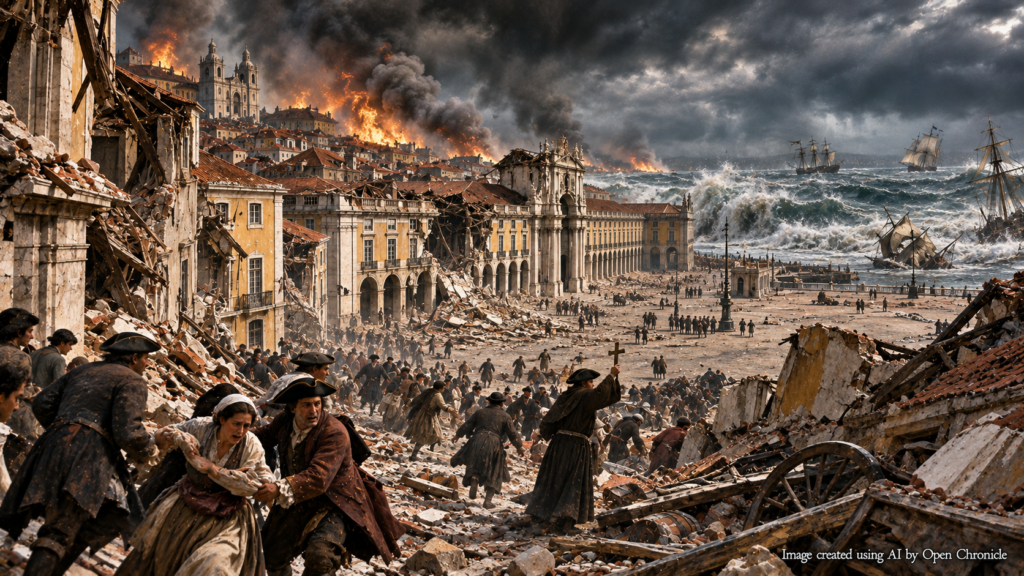
How a devastating earthquake, tsunami and fires destroyed much of Portugal’s capital, challenged European ideas about nature and divine providence, and inspired one of the most ambitious urban reconstruction projects of the eighteenth century.
By Open Chronicle History Desk
On the morning of November 1, 1755, Lisbon was one of Europe’s great Atlantic capitals.
Merchant vessels crowded its harbor. Church bells marked All Saints’ Day, one of the most important dates in the Catholic calendar. Families gathered for religious services, while traders and sailors prepared for another day in a city whose prosperity depended on commerce across oceans.
Then, without warning, the ground began to shake.
Buildings swayed and collapsed.
Churches filled with worshippers were damaged or destroyed.
Streets disappeared beneath falling masonry.
Terrified residents rushed toward open spaces, including the broad waterfront beside the River Tagus.
But the earthquake was only the beginning.
A tsunami followed, sending destructive waves into the estuary and along parts of the Atlantic coastline.
Fires broke out across Lisbon.
Over the following days, flames consumed buildings that had survived the initial shocks.
The combined disaster devastated the Portuguese capital.
Thousands died, although the exact number remains uncertain.
Royal residences, churches, libraries, warehouses and private homes were destroyed.
Portugal’s imperial capital had suffered one of the most consequential urban catastrophes in European history.
Yet the Lisbon earthquake was more than a tragedy.
Its effects were felt across Portugal, Spain and Morocco, while tsunami waves were recorded far beyond the immediate region.
News of the disaster spread through European intellectual circles.
Philosophers debated whether such suffering could be reconciled with the belief that the world was governed by a benevolent providence.
Scientists and officials sought explanations based on natural processes.
Portugal’s government, led by Sebastião José de Carvalho e Melo, the future Marquis of Pombal, organized relief and began rebuilding the capital.
The reconstruction introduced a new urban plan, more regular streets and buildings designed with greater attention to earthquake resistance.
Lisbon became a laboratory for ideas about disaster management, urban planning and the relationship between government and society.
The earthquake of 1755 was therefore both an immense human catastrophe and a turning point in the history of modern Europe.
1. Lisbon Before the Disaster
In the middle of the eighteenth century, Lisbon was the political and commercial center of the Portuguese monarchy.
Its harbor connected Europe with Brazil, Africa and Asia.
Ships transported sugar, tobacco, gold and other commodities through imperial trading networks.
The city’s wealth was closely associated with Portugal’s overseas empire.
But this prosperity rested partly on colonial exploitation and enslaved labor.
Lisbon’s commercial importance made the catastrophe particularly disruptive.
2. Portugal Under King José I
King José I had ascended the Portuguese throne in 1750.
His government inherited an extensive empire and a complex administrative system.
The monarchy depended heavily on Atlantic commerce.
Gold arriving from Brazil had helped finance royal expenditure, religious institutions and monumental architecture.
Lisbon symbolized the power and prestige of the Portuguese crown.
The earthquake would challenge that image of stability.
3. A City of Churches and Palaces
Eighteenth-century Lisbon contained imposing churches, convents, aristocratic residences and commercial districts.
Its streets reflected centuries of gradual development.
Many neighborhoods were densely built.
Buildings frequently stood close together along narrow streets.
Such conditions increased the danger when structures collapsed and fires spread.
The city’s architectural richness also meant that the disaster destroyed an enormous cultural heritage.
4. All Saints’ Day
November 1 was All Saints’ Day.
Many residents were attending Mass or preparing for religious observances.
Churches were especially important gathering places.
Candles and lamps were commonly used in religious settings and homes.
The date therefore shaped the human consequences of the earthquake.
The destruction of religious buildings also gave the catastrophe a powerful spiritual significance.
5. The First Violent Shocks
The earthquake struck during the morning, commonly placed at approximately 9:30 to 9:40 a.m. local time.
Accounts describe several periods of intense shaking.
The precise duration and sequence are difficult to reconstruct from historical testimony.
Walls collapsed.
Roofs fell.
Streets filled with debris.
Residents struggled to escape buildings.
The violence of the shaking indicated a major offshore seismic event.
6. How Powerful Was the Earthquake?
Modern estimates generally place the earthquake among the largest known events in the Atlantic region.
Published magnitude estimates vary, often falling roughly between magnitude 8 and 9.
The exact magnitude cannot be measured directly because modern seismographs did not exist in 1755.
Researchers instead reconstruct the event using historical accounts, geological evidence and tsunami observations.
The earthquake’s precise source and rupture characteristics remain subjects of scientific investigation.
7. The Earthquake’s Origin
The earthquake originated offshore, southwest of the Iberian Peninsula.
The region lies near the complex boundary between the African and Eurasian tectonic plates.
Several geological structures have been proposed as possible sources.
Scientists continue to investigate how the earthquake ruptured the seafloor.
Although the broad tectonic setting is understood, the exact fault or combination of faults responsible remains debated.
8. Lisbon Begins to Collapse
The shaking caused widespread destruction.
Many masonry buildings were unable to withstand the movement.
Churches, houses and public structures collapsed.
The narrow streets became dangerous corridors filled with falling stones and timber.
People who survived the initial shocks faced the risk of being trapped beneath debris.
The city quickly descended into confusion.
9. The Destruction of Religious Buildings
Lisbon’s churches suffered particularly severe damage.
Among the most famous losses was the Royal Hospital of All Saints, a major institution whose complex was devastated.
The Carmo Convent was also badly damaged.
Its surviving Gothic ruins would eventually become one of the city’s most recognizable reminders of the catastrophe.
The destruction of sacred buildings profoundly affected contemporary interpretations of the event.
10. The Royal Palace
The Ribeira Palace, situated near the Tagus waterfront, was destroyed.
It had been one of the principal residences of the Portuguese monarchy.
Its collections included artworks, archives and other valuable objects.
The destruction represented a major cultural and administrative loss.
The royal family survived, having been outside the palace when the earthquake struck.
The monarchy nevertheless faced a crisis of extraordinary proportions.
11. The Waterfront Becomes a Refuge
Many residents fled toward the open areas beside the Tagus.
The waterfront appeared safer than streets surrounded by collapsing buildings.
But the riverfront would soon become another danger zone.
The earthquake had disturbed the sea.
A tsunami was approaching.
12. The Tsunami
Following the earthquake, destructive tsunami waves reached Lisbon and other coastal locations.
Historical accounts describe unusual changes in water levels before the arrival of powerful waves.
The precise timing, height and sequence varied by location.
In the Tagus estuary, the tsunami caused additional deaths and damage.
People who had sought safety near the waterfront were particularly vulnerable.
13. The Destruction Along the Coast
The tsunami affected more than Lisbon.
Communities along Portugal’s southern and western coasts experienced severe damage.
The Algarve was particularly hard hit.
Coastal settlements, fishing facilities and vessels suffered destruction.
The disaster demonstrated that the earthquake’s effects extended across a large geographic area.
14. The Impact in Morocco
The earthquake and tsunami also affected Morocco.
Coastal communities experienced destructive waves.
Historical accounts describe severe damage and loss of life in several locations.
The precise distribution of earthquake and tsunami damage remains a subject of research.
The catastrophe was therefore not exclusively Portuguese.
It was a regional disaster affecting populations on both sides of the Strait of Gibraltar.
15. Waves Across the Atlantic
The tsunami propagated across a large part of the Atlantic.
Historical observations indicate unusual sea-level disturbances in distant locations.
The event demonstrated the ability of a major submarine earthquake to affect coastlines far from its source.
Modern tsunami research continues to use the 1755 disaster as an important historical case study.
16. Fire Engulfs Lisbon
As survivors struggled with the earthquake and tsunami, fires spread through the city.
Open flames, damaged heating and lighting equipment, and the destruction of buildings contributed to the danger.
The precise origins of individual fires are difficult to establish.
What is clear is that extensive areas burned.
The fires continued for several days.
They destroyed buildings and possessions that had survived the earthquake.
17. Three Disasters in One
The Lisbon catastrophe involved three major destructive processes.
First came the earthquake.
Then came the tsunami.
Finally, widespread fires consumed large parts of the urban center.
Each disaster complicated rescue and recovery.
The combined effects explain why the destruction was so extensive.
Lisbon was not simply damaged by ground shaking.
It experienced a cascading urban catastrophe.
18. How Many People Died?
The number of deaths remains uncertain.
Historical estimates differ substantially.
Many modern accounts suggest tens of thousands of fatalities across the affected region.
Some figures refer only to Lisbon, while others include surrounding territories.
Population records were incomplete.
Many victims were never formally identified.
For this reason, precise casualty totals should be treated cautiously.
19. The Survivors
Thousands of people survived but lost their homes.
Families became separated.
Food supplies were disrupted.
Medical assistance was limited.
The destruction of roads and buildings complicated rescue operations.
The authorities faced an urgent humanitarian emergency.
Shelter, food, sanitation and public order became immediate priorities.
20. The Destruction of Cultural Heritage
The earthquake destroyed important libraries, archives and artworks.
Religious institutions lost manuscripts and historical records.
Private collections disappeared.
The loss was not limited to buildings.
Lisbon suffered the destruction of centuries of accumulated cultural memory.
Some surviving monuments and documents became especially valuable because so much else had vanished.
21. The Royal Family’s Escape
King José I and his family survived the earthquake.
The king developed a lasting fear of enclosed masonry buildings, according to historical accounts.
The royal household subsequently occupied temporary accommodation outside the devastated city center.
The event influenced royal life and the physical organization of government.
The monarchy’s survival allowed political authority to continue during the emergency.
22. Sebastião José de Carvalho e Melo
One of the central figures in the response was Sebastião José de Carvalho e Melo.
He served as a leading minister under José I.
He would later become known as the Marquis of Pombal.
The earthquake strengthened his political influence.
He helped coordinate emergency measures and reconstruction.
His response became one of the most famous examples of eighteenth-century state intervention after a natural disaster.
23. Emergency Government
The government organized measures to restore order.
Authorities sought to remove bodies, secure food supplies and prevent disorder.
Military personnel and officials participated in the response.
The state also attempted to manage movement and protect surviving property.
The measures were shaped by the administrative and coercive practices of the eighteenth century.
They should not be confused with modern humanitarian standards.
Nevertheless, the response represented an ambitious attempt to manage a major urban emergency.
24. Preventing Disease
The presence of bodies and debris created fears of disease.
Authorities prioritized burial and disposal of the dead.
Sanitation became an important concern.
Medical understanding in the eighteenth century differed substantially from modern epidemiology.
But officials recognized that the disaster’s consequences could continue long after the initial destruction.
Public health concerns influenced emergency decisions.
25. Food and Supplies
The destruction disrupted markets, warehouses and transportation.
Food shortages threatened survivors.
The government attempted to restore supplies and regulate distribution.
Maintaining access to essential goods was necessary to prevent further suffering.
Lisbon’s position as a major port complicated the situation.
Its commercial infrastructure had suffered severe damage.
26. The Question of Reconstruction
After the immediate emergency, Portuguese authorities faced a fundamental decision.
Should Lisbon be rebuilt along its former streets?
Should the city be relocated?
Or should the devastated center be reconstructed according to a new plan?
The decision would shape the city’s future.
It also created an opportunity to rethink urban design.
27. The Pombaline Reconstruction
The government adopted a major reconstruction program.
The central district known today as the Baixa Pombalina was redesigned.
The new plan emphasized regular streets, standardized buildings and broad public spaces.
The reconstruction represented a significant departure from the older medieval urban pattern.
It became one of Europe’s most important eighteenth-century urban planning projects.
28. A New Street Grid
The rebuilt city center featured a more regular street layout.
Broad streets improved circulation.
Uniform building heights and facades created a coherent architectural appearance.
The plan reflected contemporary ideas about order, administration and urban functionality.
It also made the city easier to organize and manage.
The new Lisbon was intended to be more resilient and efficient.
29. The Gaiola Pombalina
One of the most distinctive features of Pombaline construction was the use of internal timber frameworks.
These structures became known as gaiolas pombalinas.
The timber framework was intended to improve the ability of buildings to withstand movement.
The system is frequently cited as an early example of earthquake-conscious construction.
Its effectiveness depended on design, materials and workmanship.
The innovation reflected a new awareness of seismic risk.
30. Testing Building Designs
Historical accounts describe attempts to assess structural responses to shaking.
One frequently repeated account concerns soldiers marching to simulate vibrations.
The precise details and extent of such tests are difficult to establish.
Nevertheless, the reconstruction clearly incorporated deliberate attention to earthquake resistance.
The disaster encouraged a practical approach to structural safety.
31. Praça do Comércio
The former royal palace area was transformed during reconstruction.
The Praça do Comércio became one of Lisbon’s defining public spaces.
Its broad open square and surrounding arcades reflected the new urban vision.
The site symbolized the transition from the royal waterfront palace to a commercial and administrative center.
Today, it remains one of the most recognizable landmarks of Lisbon.
32. The Birth of Modern Seismological Inquiry
The Lisbon earthquake became an important event in the history of earthquake studies.
Officials gathered information about the disaster.
Questions were distributed to local authorities concerning the effects of the shaking.
These inquiries recorded observations about damage, water behavior and other phenomena.
The resulting documentation became valuable for later researchers.
The earthquake helped encourage systematic investigation of seismic events.
33. The Historical Earthquake Questionnaire
The Portuguese government collected reports from communities across the country.
The questions sought information about the earthquake’s timing, duration and effects.
They also addressed changes in wells, rivers and other natural features.
Such records are important because instrumental seismology did not yet exist.
The reports provide evidence for modern attempts to reconstruct the earthquake.
They also illustrate the growing role of organized observation in the study of natural disasters.
34. The Enlightenment Confronts Catastrophe
The earthquake occurred during the European Enlightenment.
Intellectuals were debating reason, religion, science and the nature of human progress.
The destruction of Lisbon raised difficult questions.
Why had a major Christian city been devastated on a religious holiday?
How could such suffering be explained?
The catastrophe became a subject of philosophical controversy.
35. Voltaire’s Response
The French philosopher Voltaire was deeply affected by news of the disaster.
He addressed the catastrophe in his Poem on the Lisbon Disaster.
The earthquake also influenced the intellectual background of his novel Candide, published in 1759.
Voltaire challenged optimistic interpretations that treated every event as part of a necessarily perfect world.
The destruction of Lisbon became a powerful example in his criticism of philosophical optimism.
36. Rousseau’s Interpretation
Jean-Jacques Rousseau offered a different perspective.
He argued that human choices and patterns of settlement could intensify the consequences of natural disasters.
Dense urban construction placed large numbers of people at risk.
His response introduced questions that remain important in disaster studies.
Natural hazards become catastrophes partly through the vulnerability of human communities.
37. Immanuel Kant and Earthquakes
Immanuel Kant wrote about earthquakes in the aftermath of the Lisbon disaster.
He attempted to explain seismic phenomena through natural processes.
His specific geological theories were not correct by modern standards.
But his work reflected an effort to investigate earthquakes without relying exclusively on supernatural explanations.
The disaster contributed to the development of naturalistic approaches to seismic events.
38. Religion and Divine Providence
The earthquake provoked intense religious debate.
Some interpreted the disaster as divine punishment.
Others rejected the idea that the suffering of innocent people could be explained so simply.
Religious authorities, philosophers and ordinary believers struggled with its meaning.
The catastrophe did not produce a universal abandonment of religious explanations.
Instead, it stimulated competing interpretations of nature, suffering and providence.
39. The Limits of Enlightenment Optimism
The destruction of Lisbon challenged confidence in the rational order of the universe.
For some thinkers, the catastrophe exposed the inadequacy of philosophical systems that minimized suffering.
For others, it demonstrated the importance of improving human knowledge and institutions.
The debate became one of the defining intellectual responses to natural disaster in eighteenth-century Europe.
40. The Economic Consequences
The earthquake disrupted Portugal’s economy.
Commercial buildings, warehouses and port facilities suffered damage.
The destruction affected trade and public finances.
Reconstruction required enormous resources.
The monarchy faced difficult choices about taxation, spending and administration.
The disaster’s economic consequences extended beyond the immediate loss of buildings.
41. The Portuguese Empire
Portugal’s overseas empire helped provide resources for reconstruction.
Commercial and fiscal connections with Brazil were particularly important.
But the empire itself rested on unequal power relations, colonial extraction and slavery.
The rebuilding of Lisbon must therefore be understood within the wider Atlantic economy.
The catastrophe affected the imperial center, while the resources available for recovery were shaped by Portugal’s global connections.
42. Pombal’s Political Ascendancy
The earthquake strengthened Carvalho e Melo’s position within the Portuguese government.
His influence expanded in subsequent years.
He introduced major administrative, economic and educational reforms.
His political career also involved authoritarian measures and severe repression of opponents.
The legacy of Pombal is therefore complex.
He is remembered both for modernization and for the coercive methods of his government.
43. The Távora Affair
In 1758, an attempt was made on the life of King José I.
The subsequent investigation led to accusations against members of the aristocracy.
The Távora affair resulted in executions and political repression.
Pombal used the crisis to weaken powerful opponents.
Although the affair occurred several years after the earthquake, it formed part of the broader consolidation of his authority.
The reconstruction of Lisbon and the expansion of state power became closely connected.
44. The Expulsion of the Jesuits
In 1759, the Portuguese government expelled the Jesuits from Portugal and its territories.
The decision formed part of Pombal’s wider conflict with the religious order.
It reflected struggles over education, political authority and imperial administration.
The earthquake itself did not directly cause the expulsion.
But the political changes that followed the disaster helped create the environment in which Pombal exercised increasing power.
45. The Reconstruction Takes Decades
Lisbon was not rebuilt overnight.
The reconstruction continued over many years.
Some areas were redesigned according to the Pombaline plan.
Others retained elements of their older urban structure.
The resulting city combined surviving architecture with new construction.
The transformation became a lasting feature of Lisbon’s identity.
46. The Carmo Convent Ruins
The ruins of the Carmo Convent remain among the most visible reminders of the earthquake.
The Gothic arches stand open to the sky.
They preserve evidence of the destruction.
The site has become an important historical and cultural landmark.
Its survival helps visitors understand the scale of the catastrophe.
The ruins also demonstrate how a city can incorporate the memory of disaster into its urban landscape.
47. The Earthquake in European Memory
News of the catastrophe spread rapidly through European diplomatic and commercial networks.
Printed accounts described the destruction.
Artists produced images of ruined Lisbon.
Writers and philosophers debated the meaning of the event.
The earthquake became one of the best-known natural disasters of the eighteenth century.
Its memory extended far beyond Portugal.
48. Modern Seismic Risk
Portugal remains exposed to seismic hazards.
The geological region responsible for the 1755 earthquake continues to be studied.
Modern building standards, monitoring systems and emergency planning aim to reduce risk.
But historical earthquakes remind us that low-frequency, high-impact events can have enormous consequences.
The 1755 disaster remains relevant to contemporary discussions of resilience.
49. What the Earthquake Teaches Us
The Lisbon earthquake demonstrated that natural disasters are shaped by more than physical forces.
Urban design matters.
Building construction matters.
Emergency response matters.
Government capacity matters.
Social inequality influences vulnerability and recovery.
The catastrophe also showed the importance of collecting reliable information.
These lessons remain central to modern disaster risk reduction.
50. Why November 1 Matters
November 1, 1755 marks one of the most consequential natural disasters in European history.
The earthquake devastated Lisbon.
The tsunami affected Atlantic coastlines.
Fires destroyed much of the capital.
Thousands of people died.
But the disaster also transformed urban planning, government administration and scientific inquiry.
It became a major subject of Enlightenment philosophy.
Its consequences can still be seen in Lisbon’s architecture and historical memory.
November 1, 1755: The City That Rose from the Ruins
Imagine Lisbon in the days after the earthquake.
Smoke rises above ruined streets.
The waterfront is covered with debris.
Church towers have collapsed.
Families search for missing relatives.
Survivors gather in temporary shelters.
The city that had connected Portugal to a global empire lies devastated.
No one knows how long recovery will take.
No one can yet imagine the new streets and squares that will emerge.
But the reconstruction begins.
Officials organize supplies.
Engineers study building methods.
Architects prepare plans.
The government attempts to impose order on the ruins.
Over time, a new Lisbon takes shape.
Its streets become broader.
Its buildings become more regular.
Its architecture reflects a growing awareness of seismic danger.
The catastrophe enters European philosophy.
It influences scientific investigation.
It becomes part of the history of modern urban planning.
The Lisbon earthquake reminds us that disasters are not only moments of destruction.
They can expose weaknesses in societies and institutions.
They can force difficult political choices.
They can inspire new forms of knowledge.
But those transformations must never obscure the suffering that made them necessary.
On November 1, 1755, Lisbon was devastated by an earthquake, tsunami and fires. The disaster destroyed much of the Portuguese capital, but its aftermath reshaped the city and influenced the intellectual, scientific and political history of modern Europe.
Historical Sources and Further Reading
Institutional and scientific references providing historical context for the Great Lisbon Earthquake of November 1, 1755, its regional consequences, the reconstruction of Portugal’s capital and its influence on European intellectual history.
Lisbon Earthquake of 1755
Historical overview of the earthquake, the destruction of Lisbon, the tsunami and fires, and the political and intellectual consequences of the catastrophe.
Read the Historical Overview →
Seismology and Historical Earthquakes in Portugal
Portugal’s national scientific institution responsible for seismic monitoring and information about earthquakes, seismic hazards and the geological setting of the Portuguese territory.
Explore Portuguese Seismology →
World Heritage and Historic Urban Conservation
Institutional resources on the conservation of historic urban environments, providing a broader framework for understanding the preservation and historical significance of reconstructed city centers.
Explore UNESCO Heritage Resources →
This Gulf of Fire: The Great Lisbon Earthquake, or Apocalypse in the Age of Science and Reason
Edward Paice’s historical study of the 1755 catastrophe, examining the destruction of Lisbon, the experiences of survivors, the political response and the earthquake’s influence on Enlightenment thought.
The Great Lisbon Earthquake occurred on November 1, 1755, and was followed by a destructive tsunami and extensive fires. The earthquake’s precise magnitude, offshore rupture location, casualty figures and the characteristics of tsunami waves remain subjects of historical and scientific investigation. Because instrumental seismic records did not exist at the time, modern reconstructions rely on documentary testimony, geological evidence and numerical modeling. This article distinguishes established historical events from uncertain estimates and recognizes that the reconstruction of Lisbon was shaped by the political authority of the Portuguese monarchy and Sebastião José de Carvalho e Melo, later Marquis of Pombal. The earthquake’s philosophical significance is discussed within the broader intellectual context of the European Enlightenment.