
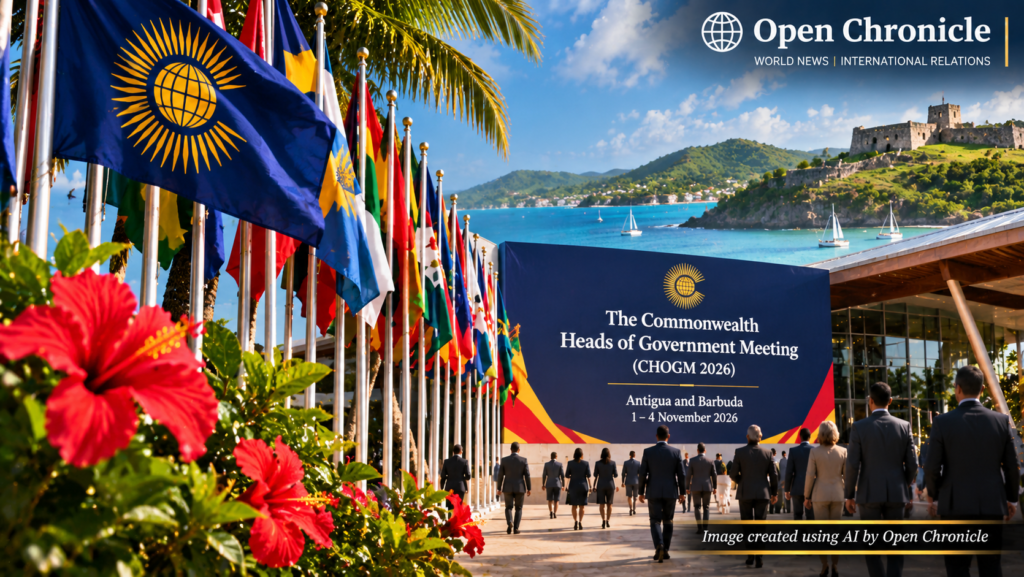
Representing 2.7 billion people, the Commonwealth is meeting in the Caribbean amid rising economic uncertainty. For its smaller members, the summit is an opportunity to turn diplomatic influence into investment, climate protection and economic resilience.
By Open Chronicle
2 November 2026 | World News | International Relations
ST JOHN’S, ANTIGUA AND BARBUDA. Leaders and representatives from across the Commonwealth are gathering in the Caribbean this week for a summit that could help determine how the 56-nation organisation responds to an increasingly fragmented international economy.
The 28th Commonwealth Heads of Government Meeting, taking place from November 1 to 4, brings together governments from Africa, Asia, Europe, the Americas and the Pacific under the theme Accelerating Partnerships and Investment for a Prosperous Commonwealth.
Trade, climate resilience, technological innovation and investment are among the central priorities.
Yet behind the diplomatic programme lies a more immediate concern: many Commonwealth countries are struggling with economic shocks, the rising cost of living, environmental threats and the consequences of geopolitical competition.
Commonwealth Secretary-General Shirley Botchwey has described the summit as an opportunity to translate cooperation into practical results.
Speaking to the Associated Press ahead of the meeting, she highlighted the combined pressures of conflict, economic disruption, climate change and increasingly contentious trade policies.
For the host nation, Antigua and Barbuda, the gathering also carries symbolic importance. The summit coincides with the country’s 45th anniversary of independence, celebrated on November 1.
The event places one of the Caribbean’s smaller countries at the centre of a diplomatic network representing more than a quarter of humanity.
A Global Organisation With an Unusual Reach
The Commonwealth brings together 56 independent countries with a combined population of approximately 2.7 billion people.
Its members include some of the world’s largest economies and most populous nations, alongside small island states facing significant development challenges.
India, the United Kingdom, Canada, Australia, South Africa and numerous African, Caribbean and Pacific countries participate in the organisation.
More than 60% of the Commonwealth’s population is aged 29 or younger, giving education, employment and technological skills particular importance in discussions about its future.
The organisation also includes 33 of the world’s 42 small states, according to its official figures.
This combination creates an unusual diplomatic platform.
Countries with vastly different economic resources can raise common concerns, exchange expertise and pursue cooperation without belonging to a political or economic union.
However, the diversity of the membership also presents difficulties.
National interests do not always align, and Commonwealth declarations do not automatically translate into enforceable policies.
The organisation’s effectiveness therefore depends heavily on whether participating governments turn their commitments into concrete programmes.
Climate Change: An Existential Issue for Island Nations
For many Caribbean and Pacific members, climate change is not an abstract long-term concern.
It is already influencing infrastructure planning, government budgets, agriculture, tourism and coastal protection.
Rising sea levels threaten low-lying communities, while stronger climate-related hazards can damage homes, ports, roads and essential services.
Small island economies are particularly exposed because a single major disaster can affect a substantial proportion of national infrastructure.
Their ability to recover is often constrained by limited fiscal resources and high borrowing costs.
Climate financing is therefore expected to feature prominently in the summit’s discussions.
Developing countries have repeatedly argued that access to affordable financing is essential if they are to invest in adaptation and resilience.
For island nations, such funding can support coastal defences, renewable energy systems, water infrastructure and disaster preparedness.
The challenge is ensuring that international commitments lead to resources that vulnerable countries can actually obtain.
A programme announced at a diplomatic summit has limited value if financing remains inaccessible or arrives too slowly.
This distinction between political ambition and implementation is likely to shape how the Antigua meeting is judged.
The $34 Billion Investment Opportunity
One of the summit’s most significant economic elements is a portfolio of proposed projects submitted by developing Commonwealth countries.
According to the Commonwealth Secretariat, 20 developing member states have presented investment-ready projects collectively valued at approximately $34 billion.
The proposals are intended to attract interest from investors, development partners and other financing institutions.
They cover areas connected to climate resilience, trade and youth employment.
The figure illustrates the scale of investment opportunities that the organisation hopes to mobilise.
However, the $34 billion represents the stated value of proposed projects, not money already committed or delivered.
That distinction matters.
Projects may require additional assessment, negotiations, guarantees or financial restructuring before investment can proceed.
The summit provides an opportunity to connect governments with potential funding partners, but its success will ultimately depend on how many proposals advance beyond discussions.
For developing countries, the benefits could extend beyond individual projects.
Successful investment partnerships may strengthen infrastructure, improve access to markets and support employment in sectors that have historically struggled to attract financing.
Trade Cooperation in a Fragmented Global Economy
International trade is another central issue.
The Commonwealth spans major consumer markets, manufacturing economies, agricultural exporters and resource-producing countries.
This geographical reach creates opportunities for commercial relationships across several continents.
However, businesses face obstacles including transport costs, regulatory differences, financing difficulties and disruptions to international supply chains.
Growing trade tensions have added further uncertainty.
Tariffs and restrictions introduced by major economies can affect exporters far beyond the countries directly involved in political disputes.
For smaller states, these pressures can be particularly difficult to absorb.
Many depend heavily on a limited range of products, services or export destinations.
Diversifying trade relationships can help reduce that vulnerability.
The Commonwealth Business Forum, running from November 2 to 4, is intended to facilitate commercial partnerships and investment.
Organisers expect more than 900 delegates, including political leaders, business executives, investors and representatives of international institutions.
The programme includes discussions on finance, innovation, climate resilience, education, tourism and healthcare.
Whether these meetings generate lasting economic results will depend on the agreements and investment decisions that follow.
Digital Skills and the Future of Employment
The Commonwealth’s demographic profile gives digital transformation particular urgency.
With a majority of its population under the age of 30, governments face the challenge of preparing millions of young people for economies increasingly shaped by artificial intelligence, automation and digital services.
The opportunities are considerable.
Digital technologies can help small businesses reach international customers, improve public administration and expand access to education.
They can also create employment opportunities in regions where traditional industries offer limited prospects.
However, the benefits are unlikely to be distributed equally.
Countries with unreliable electricity supplies, expensive internet access or limited technical training may struggle to participate in the digital economy.
A widening technological divide could reinforce existing economic inequalities.
Education and skills development are therefore important elements of the summit’s economic agenda.
The Commonwealth Business Forum includes sessions devoted to innovation, entrepreneurship and education.
The Commonwealth Youth Forum, taking place from November 2 to 4 at the University of the West Indies Five Islands Campus, provides a parallel opportunity for younger representatives to participate in discussions about the organisation’s future.
The question is whether these initiatives can help governments develop programmes that provide practical training, improve connectivity and support sustainable employment.
Small States Seek Greater Influence
The Commonwealth offers smaller countries something that is often difficult to obtain in larger international institutions: a platform where their concerns can receive sustained attention.
For states facing climate threats, debt pressures and limited administrative resources, cooperation can help strengthen their negotiating capacity.
At a ministerial meeting of small states on November 2, Singapore’s Second Minister for Foreign Affairs, Sim Ann, emphasised the vulnerability of smaller countries to external shocks.
She identified climate change, technological disruption and geopolitical conflict among the challenges requiring stronger international partnerships.
Her remarks also highlighted the economic potential of countries with extensive maritime territories, even when their land area and population are relatively small.
This perspective is particularly relevant to Caribbean and Pacific nations.
Their ocean resources can support fisheries, renewable energy, tourism and other economic activities.
However, developing those opportunities requires investment, technical expertise and effective environmental protection.
The Commonwealth’s challenge is to help smaller members access these resources without increasing unsustainable financial dependence.
Antigua and Barbuda Takes the Diplomatic Stage
Hosting the summit is a significant undertaking for Antigua and Barbuda.
The Caribbean country is welcoming political leaders, business representatives, civil society organisations and international delegations during a period of considerable global uncertainty.
Prime Minister Gaston Browne has presented the gathering as an opportunity to strengthen cooperation and encourage shared prosperity.
The timing is especially symbolic.
On November 1, Antigua and Barbuda marked 45 years since independence from Britain.
The anniversary provides a reminder of how the Commonwealth itself has evolved.
Originally closely associated with Britain’s imperial history, the modern organisation includes independent states with diverse political systems, economies and historical experiences.
Its contemporary relevance depends less on those historical connections than on its ability to address shared problems.
For Antigua and Barbuda, hosting the summit also offers an opportunity to draw attention to the priorities of Caribbean nations, particularly climate resilience, sustainable tourism and economic diversification.
Australia and the Wider Diplomatic Agenda
The meeting is also attracting attention from larger Commonwealth members seeking to strengthen regional and international relationships.
Australian Prime Minister Anthony Albanese confirmed his participation in an official statement issued on October 31.
Australia identified climate change, ocean protection, trade, investment and artificial intelligence among its priorities.
The Australian government also intends to use the gathering to advance its campaign for a seat on the United Nations Security Council for the 2029 to 2030 term.
Albanese’s participation is notable because it marks the first visit by an Australian prime minister to the Caribbean since 2009, according to his office.
The visit illustrates how Commonwealth meetings can serve several diplomatic purposes simultaneously.
Alongside discussions involving the organisation as a whole, governments can hold bilateral meetings, strengthen commercial relationships and pursue broader foreign policy objectives.
This flexibility is one of the Commonwealth’s advantages.
It also means that outcomes may emerge through individual partnerships rather than through a single collective agreement.
Can the Commonwealth Deliver Measurable Results?
The central test facing the Antigua summit is implementation.
The Commonwealth has the geographical reach, institutional relationships and diplomatic networks to bring together countries facing similar challenges.
Its members also possess substantial differences in wealth, development needs and political priorities.
These differences can make collective action difficult.
Climate financing, for example, may require commitments from wealthier members and international institutions.
Trade initiatives may depend on regulatory changes or private investment.
Digital skills programmes require funding, infrastructure and sustained educational partnerships.
Announcements made during the summit will therefore need to be assessed against measurable outcomes.
Important indicators will include whether proposed investment projects secure financing, whether new partnerships establish practical delivery mechanisms and whether vulnerable states gain improved access to climate resilience resources.
The $34 billion project portfolio is particularly relevant because it provides a potential basis for tracking progress.
If substantial investment materialises, the summit could demonstrate the organisation’s ability to connect diplomatic cooperation with economic development.
If commitments remain largely aspirational, questions about the Commonwealth’s practical influence will persist.
A Meeting With Consequences Beyond the Caribbean
The Antigua gathering takes place at a moment when many countries are reassessing their international partnerships.
Geopolitical competition, economic uncertainty and technological change are encouraging governments to seek more diversified relationships.
For Commonwealth members, the organisation offers an existing network through which those relationships can develop.
Its value may be especially significant for smaller states that lack the diplomatic resources of major powers.
However, the organisation cannot eliminate the structural disadvantages confronting its most vulnerable members.
Climate threats, high financing costs and technological inequalities require sustained action extending well beyond a four-day summit.
The discussions in Antigua may establish priorities and encourage investment, but the long-term results will depend on what happens after delegates return home.
For the Commonwealth’s 2.7 billion people, the measure of success will not be the number of declarations issued in Antigua. It will be whether cooperation produces tangible improvements in economic opportunity, resilience and everyday life.
Sources and Further Reading
The following sources support the factual reporting, institutional background and analysis presented in this article.
1. Associated Press | Dozens of Commonwealth Leaders Descend on Antigua During Global Political Turbulence
November 2, 2026 | International Reporting
Reporting by Dánica Coto on the summit, international economic pressures and comments from Commonwealth Secretary-General Shirley Botchwey.
2. Commonwealth Secretariat | Commonwealth Heads of Government Meeting 2026
2026 | Official Summit Information
Official summit information confirming the dates, location, participating membership, demographic figures and policy priorities.
3. Commonwealth Secretariat | CHOGM 2026 Is Our Moment to Shape What Comes Next
October 2026 | Official Commonwealth Announcement
Official announcement outlining the summit’s objectives and the approximately $34 billion portfolio of proposed investment projects.
4. Commonwealth Enterprise and Investment Council | Commonwealth Business Forum 2026
October 29, 2026 | Business and Investment Forum
Official programme details covering participation, trade, investment, climate resilience, innovation and education.
5. Prime Minister of Australia | 2026 Commonwealth Heads of Government Meeting
October 31, 2026 | Official Government Statement
Official statement confirming Prime Minister Anthony Albanese’s participation and Australia’s diplomatic priorities.
6. Ministry of Foreign Affairs of Singapore | Commonwealth Ministerial Meeting of Small States
November 2, 2026 | Official Diplomatic Statement
Official remarks by Second Minister Sim Ann addressing climate vulnerability, technological disruption, economic resilience and cooperation among small states.
Editorial Note
This article was prepared on November 2, 2026, while the Commonwealth Heads of Government Meeting was underway in Antigua and Barbuda. It draws on Associated Press reporting and official information from the Commonwealth Secretariat, participating governments and the Commonwealth Enterprise and Investment Council. The approximately $34 billion investment portfolio represents proposed projects rather than confirmed financing. References to anticipated agreements, economic benefits and policy outcomes should not be interpreted as announcements of completed commitments. Assessments of the Commonwealth’s effectiveness and future challenges constitute editorial analysis.