
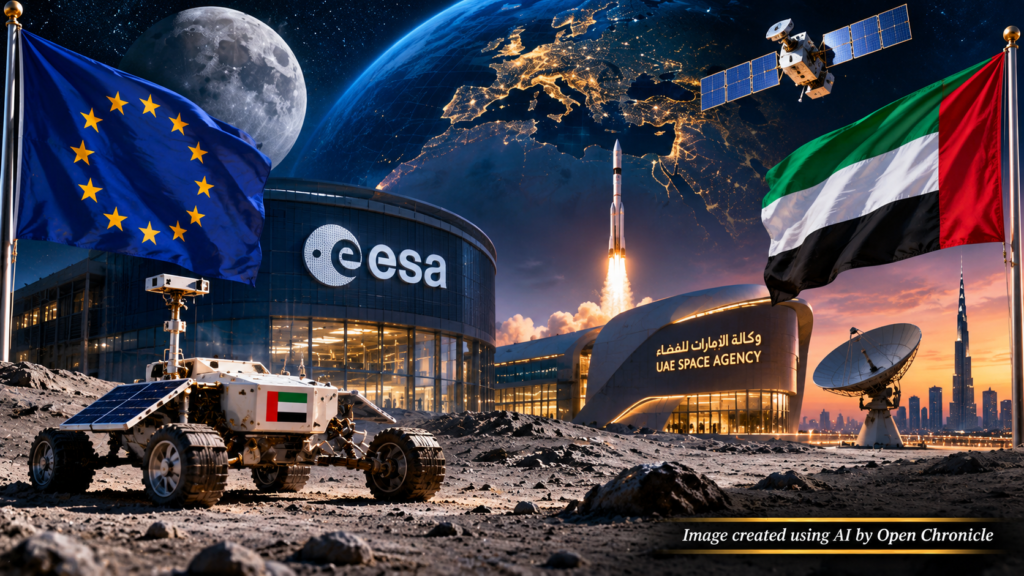
As competition intensifies over lunar exploration, satellite technology and strategic access to space, the European Space Agency is exploring closer cooperation with the United Arab Emirates.
By Open Chronicle
November 2, 2026 | Space & Technology | Europe | Middle East
Europe is looking towards the United Arab Emirates as it seeks to strengthen its international space partnerships, expand opportunities for scientific cooperation and reduce strategic vulnerabilities in an increasingly competitive global space industry.
The European Space Agency’s outreach to the Gulf reflects a broader transformation in the international space sector, where emerging space nations are becoming important partners for established agencies.
The UAE has invested heavily in satellite development, planetary exploration and astronaut programmes, positioning itself as one of the most ambitious space powers in the Middle East.
For Europe, closer cooperation could provide access to additional scientific expertise, investment and opportunities for joint missions.
However, such partnerships also raise questions about Europe’s long-term autonomy, its relationship with NASA and the balance between international cooperation and strategic independence.
Europe Seeks Greater Independence in Space
The visit by European Space Agency Director General Josef Aschbacher to Dubai and Abu Dhabi this week comes at a sensitive moment for Europe’s space ambitions.
In an interview with Reuters published on November 2, Aschbacher acknowledged that Europe’s dependence on American space technology had become a strategic concern.
The rapid expansion of SpaceX, combined with uncertainty surrounding several major NASA programmes, has exposed the limitations of Europe’s independent capabilities.
Although Europe maintains its own satellite infrastructure, launch programmes and scientific missions, it continues to depend on American providers for transporting astronauts into orbit.
The relationship with NASA remains important, but recent changes in Washington’s priorities have prompted European officials to reconsider how much of their long-term exploration strategy should depend on decisions made outside Europe.
Two projects illustrate the challenge.
The Lunar Gateway, conceived as a space station orbiting the Moon, has faced changes and uncertainty in American planning. The Mars Sample Return programme, intended to bring samples collected on Mars back to Earth, has also encountered major difficulties.
Both projects were expected to involve significant European contributions.
Their uncertain future has strengthened arguments for a more diversified network of international partnerships.
Aschbacher told Reuters that approximately 5% of ESA’s budget is connected to cooperation with the United States.
While that proportion may appear relatively modest, the strategic significance of the projects involved is considerable.
Europe’s vulnerability is therefore not simply a question of expenditure. It also concerns access to essential capabilities, the continuity of major scientific programmes and the ability to determine its own exploration priorities.
Why the United Arab Emirates Matters
The UAE has emerged as one of the most active new participants in the international space industry.
Its national programme combines government investment, scientific research, commercial satellite operations and international partnerships.
In July 2020, the country launched the Emirates Mars Mission, making it the first Arab nation to send a spacecraft towards Mars.
The Hope probe subsequently entered Martian orbit, providing scientific observations of the planet’s atmosphere.
The UAE has also developed an astronaut programme, sending Hazza Al Mansouri to the International Space Station in 2019 and Sultan Al Neyadi on a longer mission in 2023.
These achievements have helped establish the country as a credible partner for more experienced space agencies.
However, the Emirates still faces important technological limitations.
It does not possess an independent orbital launch capability comparable to Europe’s Ariane programme, nor does it operate its own global satellite navigation system.
These gaps create opportunities for cooperation.
Europe can offer experience in spacecraft engineering, scientific instrumentation, satellite navigation and launch technology.
The UAE can contribute investment, industrial development and a growing national commitment to space exploration.
For both sides, the potential partnership offers advantages that extend beyond individual missions.
A Possible European and Emirati Mission to the Moon
Lunar exploration is emerging as one of the most promising areas of cooperation.
The Mohammed bin Rashid Space Centre is developing a programme of robotic missions designed to investigate the lunar surface.
The Rashid rover initiative aims to collect information about the Moon’s terrain and environmental conditions, potentially supporting future exploration activities.
According to reporting by The National on October 30, Aschbacher is interested in discussing a possible mission involving European spacecraft technology and an Emirati lunar rover.
Japan could also participate through the private space company ispace.
The proposed concept, described as LUNA Bridge, would combine capabilities from several international partners.
Such an arrangement could allow European and Emirati engineers to test technologies relevant to future lunar infrastructure.
Robotic exploration is particularly important because spacecraft can investigate landing sites, surface conditions and potential operational hazards before astronauts arrive.
The Moon is increasingly viewed not only as a scientific destination but also as a possible location for long-term research installations.
Europe’s interest in working with the UAE therefore fits into a wider effort to secure a role in future lunar activities.
No final agreement on the proposed mission has been announced, and the discussions remain exploratory.
Emirati Astronauts Could Join a European Programme
Human spaceflight is another potential area of cooperation.
Reuters reported that discussions include the possible participation of an Emirati astronaut in ESA’s EPIC programme.
The initiative would involve a mission to the International Space Station using a SpaceX spacecraft.
The proposal illustrates both the opportunities and the contradictions facing Europe’s space strategy.
On one hand, it would strengthen cooperation between European and Emirati astronaut programmes.
On the other, the mission would still depend on an American commercial launch provider.
That dependence highlights the distinction between expanding international partnerships and achieving genuine technological autonomy.
Europe can diversify its scientific and industrial relationships without immediately eliminating its reliance on the United States for crew transportation.
Developing independent human launch capabilities would require substantial investment, technological development and sustained political support.
For the foreseeable future, cooperation with established international providers is likely to remain part of Europe’s approach.
Satellite Technology and the Growing Commercial Space Economy
The discussions are not limited to scientific exploration.
Satellite manufacturing, telecommunications and Earth observation are increasingly important elements of the relationship between Europe and the Gulf.
During his visit, Aschbacher is expected to examine industrial cooperation involving companies working on satellite constellations.
One example is the partnership between the French-American company Loft Orbital and Abu Dhabi-backed Marlan Space.
The companies are developing satellite infrastructure intended to support commercial and institutional customers.
Such projects reflect the transformation of the space industry from a sector dominated by national agencies into a broader commercial ecosystem.
Satellites now provide essential services for communications, environmental monitoring, agriculture, transportation and disaster management.
They also support national security through reconnaissance, secure communications and the monitoring of strategic infrastructure.
For the UAE, investment in satellite technology forms part of a wider effort to diversify its economy and develop advanced industrial capabilities.
For Europe, cooperation with Gulf companies could expand commercial opportunities while strengthening relationships with a rapidly growing regional market.
However, partnerships involving technologies with both civilian and military applications may require careful consideration of export controls, security requirements and strategic interests.
The Financial Challenge Facing European Space Ambitions
Greater autonomy will require significant additional investment.
Aschbacher has estimated that Europe needs approximately €10 billion over the next decade to strengthen its independent space capabilities.
The figure reflects the scale of the challenge facing European governments.
Developing launch systems, scientific spacecraft, exploration infrastructure and new industrial technologies requires long-term financing.
Unlike individual commercial projects, major space programmes frequently depend on commitments extending across multiple political and budgetary cycles.
The possibility of attracting investment from the UAE may therefore be attractive.
However, Aschbacher has emphasised that European governments must first agree on their own financial commitments.
International partnerships cannot replace the need for a coherent European funding strategy.
The question is particularly important because Europe must balance space investment against other strategic priorities, including defence, energy security and industrial competitiveness.
The success of its autonomy ambitions will depend not only on finding new partners but also on maintaining political agreement among participating European states.
Cooperation Without Abandoning NASA
Europe’s search for new partners should not be interpreted as a decision to abandon its longstanding relationship with NASA.
The two agencies have cooperated on major scientific and exploration missions for decades.
European technology has contributed to important international projects, including spacecraft systems and scientific instruments.
The European Service Module for NASA’s Orion spacecraft is one example of the depth of that relationship.
The current debate concerns the risks of relying too heavily on a single international partner for strategically important programmes.
Diversification could allow Europe to preserve cooperation with the United States while developing additional options with the UAE, Japan, India and other space nations.
This approach would also provide greater flexibility if future projects were delayed, restructured or cancelled.
The central challenge is finding a balance between independence and cooperation.
Complete technological self-sufficiency would be extremely expensive and, in some areas, economically inefficient.
Excessive dependence, however, could leave Europe vulnerable to changes in foreign policy or commercial priorities.
The Gulf’s Expanding Role in Space Geopolitics
The UAE’s growing importance reflects a broader shift in the geography of space exploration.
Countries that once played relatively minor roles are now investing in national space agencies, scientific missions and commercial infrastructure.
This expansion is creating new partnerships and increasing competition for technological leadership.
The Gulf has particular advantages, including substantial investment capacity and a political commitment to economic diversification.
Space technology also supports wider national objectives involving advanced manufacturing, artificial intelligence, telecommunications and environmental monitoring.
For Europe, engaging with these emerging space powers could help strengthen its position in an increasingly competitive international environment.
At the same time, such partnerships will need to navigate geopolitical tensions, industrial competition and questions about access to sensitive technologies.
The growing connection between civilian space programmes and national security makes these considerations particularly important.
A Turning Point for Europe’s Space Strategy
The European Space Agency’s discussions in the UAE represent more than an attempt to establish another international research partnership.
They reflect a strategic reassessment of Europe’s position in the global space industry.
For decades, cooperation with the United States has provided European scientists and engineers with access to some of the world’s most ambitious exploration programmes.
That relationship remains valuable, but recent uncertainty has demonstrated the importance of maintaining alternative capabilities and partnerships.
The UAE offers an opportunity to develop cooperation in lunar exploration, astronaut missions, satellite technology and commercial space infrastructure.
Whether the discussions produce binding agreements or major joint missions remains to be seen.
The more significant question is whether Europe can convert its ambitions for autonomy into sustained investment and independent technological capabilities.
Europe is not seeking to explore space alone. It is seeking the freedom to decide how, when and with whom it explores.
Sources and Further Reading
1. Reuters | Europe Space Chief Heads to Gulf as Bloc Looks Beyond US
November 2, 2026 | International Reporting
Reporting by Florence Loève on Josef Aschbacher’s visit, European strategic autonomy, lunar cooperation, astronaut missions and investment requirements.
2. The National | Europe’s Space Chief Looks to the UAE for Collaborations on Moon Exploration
October 30, 2026 | Space Exploration Interview
Interview with ESA Director General Josef Aschbacher covering the proposed lunar partnership, Emirati rovers, Earth observation and long-term cooperation.
3. European Space Agency | ESA at IAC 2026, Day 2
October 2026 | Official ESA Communications
Official ESA coverage of international cooperation discussions, including engagement with the United Arab Emirates Space Agency.
4. European Space Agency | Josef Aschbacher at the International Astronautical Congress 2026
October 6, 2026 | Official ESA Recording
Official ESA recording discussing international partnerships and Europe’s ambitions in human and robotic space exploration.
Editorial Note
This article is based on Reuters reporting published on November 2, 2026, interviews with ESA Director General Josef Aschbacher and official European Space Agency communications. The proposed cooperation between ESA and the United Arab Emirates remains under discussion. References to possible lunar missions, astronaut participation and future financial arrangements should not be interpreted as confirmation that binding agreements have been concluded. The broader implications for European strategic autonomy are editorial analysis based on the reported developments.