
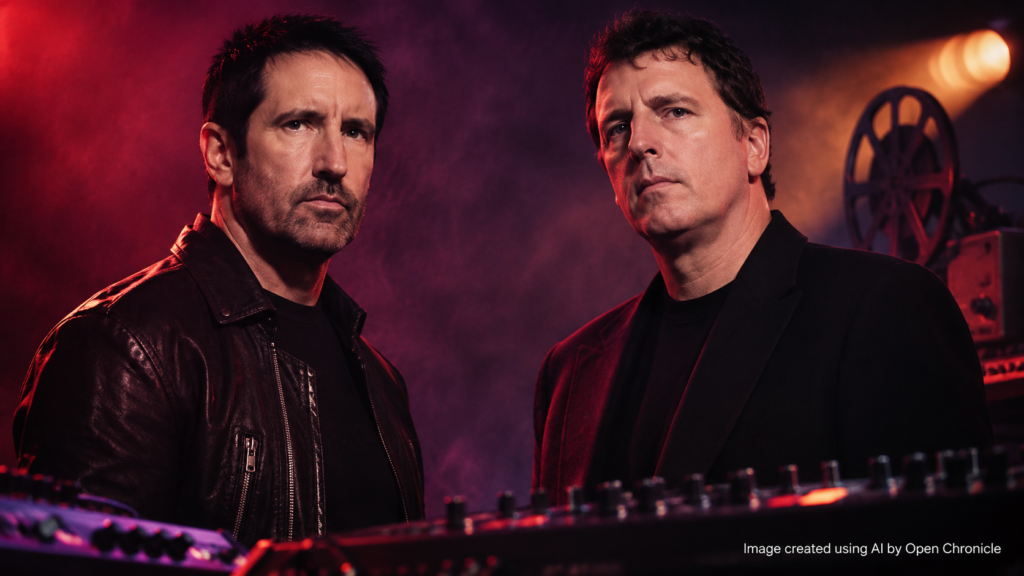
The Nine Inch Nails musicians will score The Further Mis-Adventures of Cliff Booth, extending one of contemporary cinema’s most distinctive musical partnerships into the world of Quentin Tarantino’s Hollywood.
By RhythmNest | Music & Context | 3 November 2026
Some of cinema’s most memorable creative partnerships are built not around what audiences see, but around what they hear.
For more than fifteen years, Trent Reznor and Atticus Ross have helped shape the psychological atmosphere of David Fincher’s films through electronic textures, unconventional instrumentation and a remarkable understanding of how music can influence the emotional meaning of an image.
Now, that partnership is entering another chapter.
The two musicians have composed the original score for The Further Mis-Adventures of Cliff Booth, Fincher’s forthcoming film starring Brad Pitt and written by Quentin Tarantino.
The project marks their sixth feature film collaboration with the director, continuing a relationship that began with the Academy Award winning score for The Social Network in 2010.
Yet this latest assignment presents a particularly intriguing creative challenge.
Fincher’s precise, psychologically controlled filmmaking will intersect with a character and fictional universe originally created by Tarantino, a director whose films are celebrated for their distinctive use of existing songs.
For Reznor and Ross, whose musical language has moved from industrial rock into some of cinema’s most influential contemporary scores, the possibilities are considerable.
01 · The Announcement
A Sixth Collaboration With David Fincher
The involvement of Reznor and Ross was confirmed through promotional material released for The Further Mis-Adventures of Cliff Booth, with their names appearing among the film’s creative credits.
The film will begin an exclusive IMAX theatrical engagement on 25 November 2026, before becoming available on Netflix on 23 December.
Brad Pitt returns as Cliff Booth, the stuntman introduced in Tarantino’s 2019 film Once Upon a Time… in Hollywood.
The new story takes place in 1977, eight years after the events of the earlier film.
Cliff Booth now operates within the complicated world of Hollywood as a fixer, taking on problems that require unconventional solutions.
Elizabeth Debicki, Yahya Abdul-Mateen II, Scott Caan and other performers join the cast.
Although the film continues a character introduced by Tarantino, its director is David Fincher.
That distinction matters musically.
Fincher has developed an unusually consistent relationship with Reznor and Ross, whose compositions have become an integral part of his cinematic identity.
Their return suggests continuity in that collaboration, even as the story moves into a different fictional world.
02 · Before Hollywood
The Industrial Roots of Trent Reznor
Long before becoming one of Hollywood’s most respected film composers, Trent Reznor was already transforming the sound of alternative music.
As the creative force behind Nine Inch Nails, he developed a musical identity built around tension, distortion, electronic experimentation and emotional confrontation.
Albums such as Pretty Hate Machine (1989), The Downward Spiral (1994) and The Fragile (1999) demonstrated how industrial music could combine aggression with vulnerability.
The most important aspect of Reznor’s approach was never simply volume or distortion.
It was his ability to construct emotional environments.
A mechanical rhythm could suggest alienation.
A damaged synthesizer could create a sense of instability.
A quiet piano melody could reveal vulnerability beneath an otherwise abrasive arrangement.
These characteristics would later become central to his work in cinema.
Atticus Ross brought another dimension to that musical language.
A British musician, producer and composer, Ross developed a longstanding creative relationship with Reznor before their film work became internationally recognised.
His contributions to Nine Inch Nails and their other projects helped expand an approach based on detailed electronic production, atmosphere and sonic experimentation.
Together, they developed a musical partnership capable of moving between intense industrial compositions and remarkably restrained instrumental pieces.
The transition into film scoring was therefore not an abandonment of their musical origins.
It was an extension of them.
03 · The Social Network
The Score That Changed Everything
The decisive turning point arrived in 2010.
David Fincher invited Reznor and Ross to compose the score for The Social Network, his film about the creation of Facebook and the relationships surrounding its founders.
A conventional approach might have relied on orchestral drama or contemporary pop music to accompany a story about technology, ambition and personal conflict.
Instead, Reznor and Ross created a sound world dominated by synthesizers, electronic pulses, ambient textures and carefully placed piano melodies.
The result was both modern and emotionally detached.
Tracks such as “Hand Covers Bruise” demonstrated how minimal musical gestures could communicate loneliness and uncertainty.
The score did not simply tell audiences how to feel.
It created an atmosphere in which ambition, isolation and emotional distance seemed inseparable.
The soundtrack won the Academy Award for Best Original Score in 2011.
More importantly, it established a new model for how electronic music could function in mainstream dramatic cinema.
The distinction between experimental electronic composition and traditional film scoring became less rigid.
For Reznor and Ross, a new creative world had opened.
04 · A Distinctive Cinematic Language
Five Films, Five Different Musical Environments
The partnership continued across a series of Fincher films, each requiring a different musical response.
The Girl with the Dragon Tattoo (2011)
The duo expanded their industrial and ambient vocabulary into an extensive soundtrack defined by cold textures, unsettling rhythms and an atmosphere of psychological unease.
The music complemented the film’s harsh Scandinavian environments and disturbing subject matter.
The project earned them a Grammy Award for Best Score Soundtrack for Visual Media.
Gone Girl (2014)
Here, the composers explored a different form of tension.
Rather than relying on obvious aggression, the score frequently creates the impression of calmness before revealing something deeply unsettling beneath the surface.
Its soft electronic textures and delicate melodic passages contribute to the film’s psychological ambiguity.
Mank (2020)
For this period drama about screenwriter Herman J. Mankiewicz, Reznor and Ross moved away from the electronic language most closely associated with their earlier work.
They embraced instrumentation and arrangements inspired by the era depicted in the film.
The result demonstrated that their partnership was not dependent on a single recognisable sound.
The Killer (2023)
Fincher’s assassin thriller returned to a more restrained electronic approach.
The score contributes to the film’s controlled atmosphere, supporting its protagonist’s methodical routines and underlying psychological instability.
Taken together, these projects reveal a consistent principle.
Reznor and Ross do not merely reproduce the sound of Nine Inch Nails for cinema.
They adapt their musical thinking to the emotional and narrative demands of each film.
That flexibility is one reason their partnership with Fincher has remained so productive.
05 · The Sound of Psychological Tension
Why Their Music Works
One of the most distinctive qualities of Reznor and Ross’s film compositions is their understanding of musical restraint.
In conventional film scoring, music frequently emphasises dramatic action.
A large orchestral passage might accompany a confrontation, while a rising melody signals emotional resolution.
Reznor and Ross often take a different approach.
They use repetition, subtle changes in texture and carefully controlled dynamics to create tension without explicitly announcing it.
A sustained electronic tone can make an apparently ordinary scene feel threatening.
A repetitive sequence can suggest a character trapped inside a psychological pattern.
A fragile melody can reveal emotional complexity without overwhelming the image.
This approach has important roots in industrial and ambient music.
Industrial composition frequently explores the relationship between human expression and mechanical sound.
Ambient music, meanwhile, can create an environment that shapes perception without demanding constant attention.
Reznor and Ross draw from both traditions.
Their music can operate almost invisibly within a scene, while profoundly influencing the audience’s experience of it.
06 · The Tarantino Connection
Two Very Different Cinematic Traditions Meet
The Further Mis-Adventures of Cliff Booth presents an especially interesting challenge because of its creative origins.
Quentin Tarantino’s films have frequently used existing recordings to establish period, atmosphere and cultural identity.
His soundtracks often function as curated collections of popular music, drawing on rock, soul, surf music and lesser-known recordings.
Once Upon a Time… in Hollywood was particularly dependent on the musical environment of late 1960s Los Angeles.
Songs, radio broadcasts and period recordings contributed to the film’s recreation of a specific cultural moment.
Fincher’s approach to music has often been different.
His films frequently use original compositions to create psychological continuity and reinforce atmosphere.
The new Cliff Booth film brings these traditions into proximity.
The story takes place in 1977, a period associated with punk rock, disco, progressive rock and the emergence of new electronic musical possibilities.
But the fact that the story is set in 1977 does not establish what its original score will sound like.
Reznor and Ross could incorporate period influences, use contemporary electronic techniques or pursue an entirely different approach.
No detailed instrumentation or musical concept has yet been confirmed.
What makes the collaboration compelling is the creative tension between the film’s historical setting and the composers’ established willingness to challenge expectations.
07 · Beyond David Fincher
From Soul to Challengers
Although their relationship with Fincher remains central to their cinematic reputation, Reznor and Ross have developed a substantial body of work with other filmmakers.
Their contributions to Pixar’s Soul (2020), alongside Jon Batiste, demonstrated their ability to create music for an animated film exploring life, purpose and personal identity.
The project earned major recognition, including the Academy Award for Best Original Score.
Their work on Challengers (2024), directed by Luca Guadagnino, revealed another dimension of their creative vocabulary.
Its energetic electronic score helped translate athletic competition, desire and interpersonal conflict into rhythmic momentum.
Rather than merely accompanying the film’s tennis sequences, the music became a central element of its emotional intensity.
Other projects have further demonstrated their versatility across film and television.
Their continuing involvement with Nine Inch Nails also reinforces the relationship between their identities as recording artists and film composers.
The two creative activities increasingly inform one another.
Electronic production techniques developed in the studio can influence their cinematic compositions.
Conversely, experience with film scoring can encourage new approaches to structure, pacing and atmosphere in their work as musicians.
08 · The RhythmNest Listening Perspective
Five Scores That Explain Their Evolution
For listeners unfamiliar with the cinematic work of Reznor and Ross, five projects provide an accessible introduction.
1. The Social Network (2010)
Listen for the relationship between minimal piano melodies and electronic textures. Notice how repetition creates emotional distance.
2. The Girl with the Dragon Tattoo (2011)
Focus on the industrial sound design and the way apparently abstract textures contribute to an atmosphere of danger.
3. Gone Girl (2014)
Pay attention to the contrast between musical calmness and psychological unease.
4. Mank (2020)
Observe how the composers adapt their musical identity to an earlier historical period without losing their attention to atmosphere.
5. The Killer (2023)
Listen for the restrained electronic language and the relationship between musical repetition and the protagonist’s controlled behaviour.
Together, these recordings reveal a partnership defined less by a fixed genre than by a consistent interest in how sound influences perception.
09 · What to Watch Next
The Further Mis-Adventures of Cliff Booth
Several important details remain to be established as the film approaches release.
The musical direction
Will the score reflect the film’s 1977 setting, or will Reznor and Ross adopt a more contemporary electronic approach?
The relationship with existing songs
How will the original score interact with any licensed recordings included in the film?
The soundtrack release
Details of the score’s commercial release and complete track listing should be confirmed through official announcements.
The IMAX presentation
The film’s initial theatrical release will provide an opportunity to experience the score within a large-scale cinematic sound environment.
The next stage of the partnership
A sixth collaboration reinforces the durability of the creative relationship between Fincher and the composers.
The film may also reveal new possibilities for that partnership.
10 · Why This Collaboration Matters
The Industrial Spirit Never Disappeared
Trent Reznor and Atticus Ross have achieved something relatively unusual in contemporary popular music.
They have moved from an alternative musical culture associated with experimentation, confrontation and electronic distortion into the centre of major film production without entirely abandoning the principles that defined their earlier work.
Their scores are often sophisticated, restrained and carefully constructed.
Yet beneath that precision remains the same fascination with tension, atmosphere and emotional instability that shaped the sound of Nine Inch Nails.
David Fincher recognised the cinematic potential of that language.
The partnership that began with The Social Network has since become one of the most recognisable director-composer relationships in modern cinema.
The Further Mis-Adventures of Cliff Booth now introduces that musical language into another distinctive cinematic world.
Whether the result is industrial, orchestral, electronic, period-inspired or something entirely unexpected remains to be heard.
But the significance of the reunion is already clear.
Reznor and Ross have not simply brought industrial music into Hollywood. They have helped change what Hollywood believes a film score can sound like.
RhythmNest File
| Field | Information |
|---|---|
| Composers | Trent Reznor and Atticus Ross |
| Musical association | Nine Inch Nails |
| New film | The Further Mis-Adventures of Cliff Booth |
| Director | David Fincher |
| Screenwriter | Quentin Tarantino |
| Lead actor | Brad Pitt |
| Story setting | Hollywood, 1977 |
| IMAX release | 25 November 2026 |
| Netflix premiere | 23 December 2026 |
| Collaboration | Sixth feature film with Fincher |
| First Fincher score | The Social Network (2010) |
| Major award | Academy Award for The Social Network |
| Score album | Release details subject to official confirmation |
RHYTHMNEST · RESEARCH & REFERENCES
Sources and Further Reading
Film industry reporting, music journalism and historical
research documenting the collaboration between
Trent Reznor, Atticus Ross and David Fincher.
01 · Film Industry Reporting
Variety | Trent Reznor and Atticus Ross to Score
David Fincher’s The Further Mis-Adventures of Cliff Booth
3 November 2026
Confirmation of the composers’ involvement,
production background, cast and release schedule.
02 · Independent Music Journalism
Pitchfork | Trent Reznor and Atticus Ross Are Back at It
2 November 2026
Independent confirmation of the sixth collaboration
between Trent Reznor, Atticus Ross and David Fincher.
03 · Music & Film Coverage
Rolling Stone Australia | Trent Reznor and Atticus Ross
Scored The Further Mis-Adventures of Cliff Booth
3 November 2026
Reporting on the new film and the composers’
wider careers in recorded music and cinema.
04 · Historical Research
Recording Academy | A Guide to Trent Reznor
and Atticus Ross’ Film and TV Scores
18 September 2025
Historical overview of their major compositions,
creative techniques, awards and influence
on contemporary film scoring.
05 · Creative Process
Television Academy | Nailing the Score
22 June 2020
Background on the composers’ working methods
and their transition between recorded music,
cinema and television.
06 · Specialist Film Music Reporting
Film Music Reporter | Trent Reznor and Atticus Ross
Scoring David Fincher’s The Further Mis-Adventures
of Cliff Booth
9 October 2026
Specialist reporting on the scoring assignment,
film production and announced release dates.
Editorial Note
This article combines verified reporting about
The Further Mis-Adventures of Cliff Booth
with historical research and independent RhythmNest
analysis of Trent Reznor and Atticus Ross’s musical
careers. Their involvement in the film, the production
credits and the announced theatrical and streaming dates
are supported by published reporting. Interpretations
of their compositional techniques, artistic influence
and possible approaches to the new score are editorial
assessments. The film’s music has not been reviewed for
this article, and no unconfirmed musical characteristics
are presented as established facts.
RhythmNest | The Music Magazine by Open Chronicle