
OPEN CHRONICLE | WORLD ECONOMY | UNITED KINGDOM
Britain’s central bank increases its benchmark interest rate to 4% as rising energy prices threaten household budgets, business costs and the country’s economic recovery. Policymakers warn that further increases remain possible if the Middle East conflict continues.
By Open Chronicle | November 5, 2026
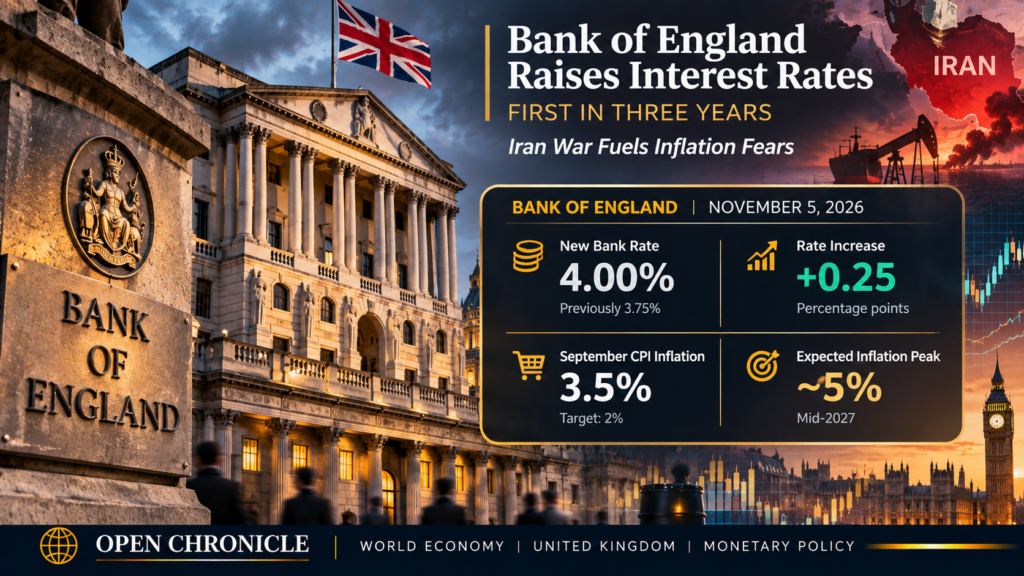
LONDON, November 5, 2026. The Bank of England raised interest rates on Thursday for the first time in more than three years, reversing its previous direction of monetary policy as the prolonged war involving Iran continues to drive up energy costs and threaten a new period of persistent inflation.
The central bank’s Monetary Policy Committee voted to increase Bank Rate by 0.25 percentage points, from 3.75% to 4%, marking its first increase since August 2023.
The decision reflects growing concern that higher oil and gas prices are no longer merely a temporary external shock but could eventually influence wages, consumer prices and business decisions across the British economy.
Eight of the committee’s nine members supported the quarter-point increase. The remaining member, Catherine Mann, voted for a larger increase of 0.5 percentage points, which would have taken Bank Rate to 4.25%.
No member voted to leave rates unchanged.
The decision comes at a difficult moment for British households, many of which are already facing higher energy bills, elevated borrowing costs and renewed pressure on disposable incomes.
Bank of England Governor Andrew Bailey warned that further increases could be necessary if the Middle East conflict continues to disrupt global energy supplies.
However, he also stressed that the latest decision should not be interpreted as the beginning of an automatic series of rate increases.
For the United Kingdom, the announcement represents a significant shift in the economic outlook.
Only months ago, the central question was how quickly interest rates might fall.
Now, policymakers are debating how much additional tightening may be required to prevent another inflationary surge.
The Key Numbers
Bank of England
Official Bank of England monetary policy decision and inflation outlook, November 5, 2026.
The expected inflation peak is a projection, not an observed inflation reading.
Why the Bank of England Changed Direction
The Bank of England had previously been reducing borrowing costs as inflation retreated from the exceptional levels recorded earlier in the decade.
That process was intended to provide gradual relief to households and businesses while ensuring inflation returned sustainably to the central bank’s 2% target.
The conflict in the Middle East has disrupted those expectations.
Military operations involving Iran have affected oil and gas supplies, maritime transport and international energy markets.
The Strait of Hormuz, one of the world’s most important energy shipping corridors, has experienced serious disruption.
As a result, fuel and energy costs have remained elevated for longer than policymakers initially anticipated.
Higher energy prices affect the economy through several channels.
Motorists face increased petrol and diesel costs. Households pay more for electricity and heating. Manufacturers confront higher production expenses, while transport and logistics companies face more expensive fuel.
Businesses may initially absorb some of those increases by reducing profit margins.
However, if elevated costs persist, companies may eventually pass them on to customers.
The central bank is particularly concerned about this second stage of inflation.
An external energy shock can become a more persistent domestic problem if it changes wage negotiations, price-setting behaviour and expectations about future inflation.
Thursday’s rate increase is intended to reduce that risk.
Inflation Could Approach 5% Next Year
Britain’s annual consumer price inflation reached 3.5% in September, already substantially above the Bank of England’s 2% target.
The central bank now expects inflation to rise to approximately 5% by the middle of 2027.
Its central forecast places the peak at around 4.8% in the second quarter of next year.
That would represent a substantial deterioration in the inflation outlook.
The Bank also examined a more severe scenario in which energy prices remain higher for longer.
Under that scenario, inflation could reach approximately 6.2%.
This is a risk scenario rather than the central forecast, but it demonstrates the uncertainty facing policymakers.
The Bank expects inflation to return to its target only in the third quarter of 2028 under its central projection.
For households, the significance is straightforward.
Even if inflation eventually declines, the price increases experienced during the intervening period will already have raised the cost of everyday goods and services.
A fall in inflation does not mean prices return to their previous levels.
It means they are increasing more slowly.
That distinction is particularly important when families are assessing whether their purchasing power is recovering.
The Iran War Is Now a British Economic Problem
Although the fighting is taking place thousands of kilometres from London, its economic consequences are reaching British households.
The United Kingdom imports energy and remains exposed to global oil and gas prices.
Even domestic energy production does not fully insulate consumers from international markets.
When global supplies become constrained, wholesale prices can rise across multiple regions.
The conflict has also affected expectations about the future availability of oil and gas.
Markets respond not only to actual shortages but also to the possibility of additional disruptions.
Reports of attacks on commercial vessels, threats to maritime navigation and uncertainty surrounding the Strait of Hormuz can increase the perceived risk of transporting energy.
Those risks influence insurance premiums, shipping costs and the prices paid by energy importers.
The Bank of England cannot directly influence military developments or restore disrupted shipping routes.
Its primary tool is monetary policy.
By increasing interest rates, it seeks to moderate domestic demand and reduce the likelihood that an external energy shock develops into sustained inflation across the wider economy.
The difficulty is that this response also places pressure on households and businesses already affected by higher prices.
That creates a challenging trade-off between controlling inflation and supporting economic growth.
What Higher Interest Rates Mean for Mortgages
One of the most immediate questions for British households concerns mortgage payments.
The effect of Thursday’s decision depends on the type of mortgage a borrower holds.
People with tracker mortgages linked directly to Bank Rate may experience an increase in their interest charges.
Borrowers on certain variable-rate products could also face higher payments, although individual lenders determine how and when changes are passed through.
Homeowners with existing fixed-rate mortgages will generally not see their contractual interest rate change immediately.
However, those approaching the end of a fixed-rate agreement may encounter more expensive refinancing conditions.
Mortgage rates also depend on financial market expectations about future interest rates, not simply the current Bank Rate.
Consequently, lenders may adjust their products before or after a central bank announcement.
The wider effect could be significant for households already managing higher food, transport and energy expenses.
An increase in monthly mortgage payments leaves less money available for other purchases.
That reduction in disposable income can also influence consumer spending and the broader economy.
The Impact on Savings and Borrowing
Higher interest rates create different consequences for borrowers and savers.
For borrowers, increased rates can make mortgages, business loans and some forms of consumer credit more expensive.
For savers, higher interest rates can create opportunities to earn better returns on deposits.
However, banks do not necessarily pass on increases in Bank Rate immediately or in full.
Savings rates depend on competition, product conditions and individual financial institutions’ pricing decisions.
The relationship between interest rates and inflation is also important.
A savings account may offer a higher nominal interest rate while still losing purchasing power if inflation exceeds the return.
For example, a deposit earning 4% annually would not fully preserve its purchasing power during a period when consumer prices were rising by approximately 5%.
This helps explain why higher interest rates do not automatically mean households are financially better off.
The outcome depends on their borrowing commitments, savings balances and exposure to rising prices.
A Divided Committee, but Not Over the Direction
The Monetary Policy Committee’s 8 to 1 vote might initially suggest substantial disagreement.
In reality, all nine members supported increasing interest rates.
The disagreement concerned the size of the increase.
Eight members, including Governor Andrew Bailey, supported a quarter-point rise.
Catherine Mann preferred a half-point increase.
Her position reflected concern that inflation expectations and wage-setting behaviour could become more difficult to control if the Bank responded too cautiously.
The majority judged that a smaller increase was appropriate given the available evidence.
Policymakers acknowledged that higher energy prices were creating substantial inflationary pressure.
However, they also noted that evidence of widespread secondary inflation effects remained limited.
This distinction shaped the decision.
The committee was not responding to clear evidence that every sector of the economy had already entered a new inflationary cycle.
It was acting to reduce the risk of such a cycle developing.
Several policymakers indicated that additional increases could become necessary if energy prices remain elevated.
Others emphasised that future decisions should depend on new economic data.
The Bank therefore left open the possibility of further tightening without committing to a predetermined sequence.
Andrew Bailey’s Warning
Governor Andrew Bailey has placed particular emphasis on the duration of the Middle East conflict.
The longer energy prices remain elevated, the greater the risk that businesses and households adjust their expectations.
A temporary increase in fuel costs may be manageable without fundamentally changing wage and pricing decisions.
A prolonged increase is more difficult to absorb.
Businesses eventually need to decide whether to raise prices, reduce investment or accept lower profitability.
Workers may seek higher wages to compensate for lost purchasing power.
If those responses become widespread, inflation can remain elevated even after the original energy shock begins to ease.
Bailey has therefore warned that another rate increase may be required unless conditions improve.
At the same time, he has rejected the idea that the Bank is necessarily beginning a prolonged cycle of increases.
The central bank will continue evaluating energy prices, wage growth, domestic demand and evidence of inflation becoming more persistent.
Its next scheduled monetary policy decision is on December 17, 2026.
Britain’s Economy Is Showing Unexpected Resilience
The Bank of England’s decision was not based exclusively on inflation.
Recent economic activity has been somewhat stronger than policymakers previously expected.
The central bank has raised its growth forecast for 2026 to approximately 1.6% and expects growth of around 1.3% in 2027.
That resilience gives policymakers some room to increase interest rates without immediately assuming the economy will enter recession.
However, stronger headline growth does not necessarily mean households are experiencing improving living standards.
Inflation can erode the purchasing power of wages.
Higher taxes and borrowing costs can further reduce disposable income.
Businesses may also face difficulties even when overall economic output is expanding.
The Bank has noted investment linked to artificial intelligence among the factors supporting economic activity.
Nevertheless, the outlook remains highly dependent on energy markets and international political developments.
A further increase in oil and gas prices could weaken household consumption and business confidence.
Conversely, a sustained reduction in geopolitical tensions could improve the inflation outlook and reduce the need for additional interest-rate increases.
The Political Challenge for the British Government
The rate increase presents another challenge for Prime Minister Andy Burnham’s government.
The administration has sought to address the cost of living and strengthen the country’s economic prospects.
However, monetary policy is determined independently by the Bank of England.
The government cannot directly instruct the Monetary Policy Committee to lower borrowing costs.
Fiscal policy, including taxation and public spending, can nevertheless influence the economic environment in which the Bank operates.
The latest Budget is expected to reduce inflation modestly in 2027, according to the central bank’s assessment.
Even so, the wider inflation outlook remains dominated by the consequences of the Middle East conflict.
The government faces competing pressures.
Households want relief from higher bills and borrowing costs.
Businesses want predictable economic conditions.
Public services require funding, while the government must also consider the sustainability of public finances.
A prolonged period of elevated inflation and interest rates could make those objectives more difficult to reconcile.
A Wider International Shift in Monetary Policy
Britain is not alone in confronting renewed inflationary pressure.
Other major central banks, including the US Federal Reserve and the European Central Bank, have also responded to the economic consequences of higher energy prices.
The situation represents a reversal of the more favourable inflation environment that had allowed policymakers to consider reducing borrowing costs.
For central banks, the challenge is complicated by the international nature of the shock.
Higher interest rates cannot increase oil production or guarantee safe passage through the Strait of Hormuz.
They can, however, influence domestic borrowing, spending and expectations.
The effectiveness of that approach depends partly on whether energy prices stabilise.
If geopolitical conditions improve, inflation may fall more quickly than currently expected.
If the conflict intensifies, central banks may face additional pressure to tighten policy even as economic growth weakens.
This combination of elevated inflation and weak activity is particularly difficult for monetary authorities.
It can force policymakers to choose between competing economic risks.
Three Possible Paths for the British Economy
How energy prices, inflation and monetary policy could shape the United Kingdom’s economic outlook.
Energy Prices Stabilise
Diplomatic progress reduces pressure on global oil and gas markets. Inflation expectations improve, allowing the Bank of England to avoid additional increases and eventually reconsider lower rates.
Inflation Remains Elevated
Energy costs stay high without another major escalation. The Bank maintains restrictive monetary policy for longer, while households and businesses continue facing financial pressure.
Another Energy Shock
Renewed disruption in the Middle East pushes fuel prices higher. Inflation exceeds the central forecast, increasing the likelihood of further rate rises and weaker economic growth.
These scenarios are Open Chronicle editorial assessments, not forecasts of events that have already occurred.
The Next Test Comes in December
The Bank of England’s next interest-rate decision is scheduled for December 17.
Before then, policymakers will examine new evidence on inflation, wages, economic activity and energy markets.
The central question will be whether Thursday’s increase provides sufficient protection against future inflation or whether further action is required.
The answer may depend as much on events in the Middle East as on developments within the British economy.
For millions of households, the consequences are immediate.
Borrowing costs are rising again at a time when essential expenses remain under pressure.
For businesses, uncertainty about energy prices and future interest rates complicates investment decisions.
For the government, the challenge is to support economic stability without undermining the central bank’s efforts to control inflation.
The November decision marks a significant turning point.
Britain has moved from a period of gradually declining interest rates into a new phase of monetary uncertainty, driven in large part by a war far beyond its borders.
Whether the latest increase proves to be a temporary precaution or the beginning of a longer period of tighter monetary policy will depend on how quickly global energy markets recover and whether inflationary pressure spreads through the domestic economy.
Sources and Further Reading
Official monetary policy documentation and independent financial reporting consulted for this article.
1. Bank of England | Monetary Policy Summary and Minutes
Official confirmation of the increase in Bank Rate from 3.75% to 4%, the Monetary Policy Committee’s voting record, inflation projections and the reasoning behind the decision.
2. Bank of England | Interest Rates and Bank Rate
The central bank’s public explanation of the rate increase, current inflation, the effects of higher energy prices and the outlook for future monetary policy.
3. Reuters | Bank of England Raises Rates for First Time Since 2023
Reporting on the monetary policy decision, Andrew Bailey’s comments, inflation forecasts, economic growth projections and the impact of the Middle East conflict.
4. Associated Press | Bank of England Raises Key Interest Rate
Independent reporting on Britain’s first rate increase since August 2023, rising energy costs and the uncertainty surrounding future policy decisions.
5. Euronews | Bank of England Raises Interest Rates to 4%
Coverage of the impact on mortgages, financial markets, inflation and the monetary policy response to the continuing conflict in the Middle East.
Editorial Note
This article was prepared on November 5, 2026, using official Bank of England monetary policy documentation and independent reporting published on the same date.
The increase in Bank Rate to 4%, the 8-to-1 voting division, September CPI inflation of 3.5% and the central bank’s inflation outlook are based on official information.
The projection of inflation approaching 5% in 2027 represents the Bank of England’s forecast, not an observed future outcome. More severe inflation scenarios are conditional assessments and should not be interpreted as inevitable.
Discussion of household finances, the political implications, international monetary policy and possible future economic scenarios includes Open Chronicle editorial analysis. Future interest-rate decisions remain dependent on economic data and geopolitical developments.