
OPEN CHRONICLE | CYBERSECURITY | THREAT INTELLIGENCE
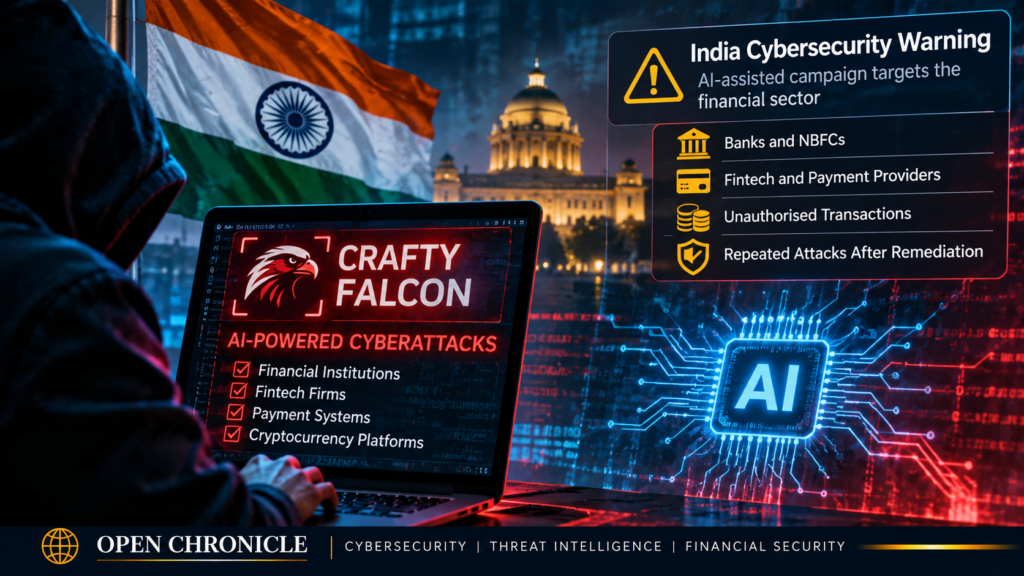
Indian cybersecurity authorities have issued a critical warning about an active campaign using artificial intelligence to compromise financial infrastructure, manipulate payment systems and move money through unauthorised transactions. The attacks reveal how AI-assisted intrusions are becoming a direct threat to the financial sector.
By Open Chronicle | November 5, 2026
NEW DELHI, November 5, 2026. India’s national cybersecurity agency has identified an escalating campaign of artificial intelligence-assisted cyberattacks against financial institutions, warning that attackers are exploiting weaknesses in payment infrastructure to carry out unauthorised transfers at unprecedented speed.
The Indian Computer Emergency Response Team, known as CERT-In, issued a critical advisory on November 4 identifying the threat actor as CRAFTY FALCON, following reports of successful attacks against non-banking financial companies, digital lenders, fintech businesses, payment providers and cryptocurrency exchanges.
According to the agency, the attackers are using publicly available AI-enabled security tools to automate parts of their operations, identify weaknesses in connected systems and exploit the financial institutions’ own payment and disbursement infrastructure.
The warning is particularly significant because some organisations have reportedly been targeted again after attempting to address previously identified vulnerabilities.
CERT-In describes the campaign as active and continuing.
The disclosure raises a broader question for financial regulators and cybersecurity professionals: what happens when automated attackers can identify, exploit and revisit weaknesses faster than institutions can investigate and repair them?
A Critical Warning From India’s Cybersecurity Authorities
The November 4 advisory, designated CIAD-2026-0058, was issued by CERT-In’s Computer Security Incident Response Team for the financial sector, CSIRT-Fin.
It followed an earlier warning published on October 9 concerning attacks against payment and fund-disbursement application programming interfaces, commonly known as APIs.
Those interfaces allow financial institutions to communicate with banking platforms, execute transactions and automate the movement of funds.
They are essential components of modern digital financial services.
However, when an attacker obtains unauthorised access to a vulnerable system or compromised credentials, the same infrastructure can potentially be abused to initiate fraudulent transactions.
CERT-In’s latest investigation indicates that the campaign has escalated beyond isolated attempts to exploit poorly secured financial applications.
The agency reports that attackers have developed the ability to conduct rapid, adaptive operations using AI-assisted tools.
The warning covers several interconnected sectors of India’s financial economy, including lending, payment processing and virtual digital assets.
It also indicates that the threat has persisted despite earlier remediation efforts.
For institutions handling thousands or millions of automated transactions, the implications extend beyond the security of individual servers.
A successful intrusion can undermine the integrity of the systems responsible for transferring money.
Who Is Crafty Falcon?
CRAFTY FALCON is the designation assigned by CERT-In to the threat actor responsible for the campaign.
The name identifies a cluster of malicious activity observed by the agency. It does not, by itself, establish the real-world identity, nationality or government affiliation of the attackers.
CERT-In describes the group as using machine intelligence to investigate potential targets and conduct operations at machine speed.
The central characteristic of the campaign is the exploitation of existing financial infrastructure rather than the creation of an entirely separate payment mechanism.
Instead of simply stealing information, attackers seek to manipulate systems that already possess the authority to transfer money.
This distinction matters.
Traditional cybersecurity discussions often concentrate on stolen passwords, ransomware or data breaches.
CRAFTY FALCON illustrates another danger: the possibility that criminals can gain sufficient control over legitimate transaction systems to make fraudulent activity resemble ordinary financial operations.
The publicly available advisory does not establish the identities of all affected companies or provide a comprehensive figure for losses attributable specifically to the campaign.
It also does not establish that the group is operating under the direction of a foreign government.
Those limitations are important when assessing reports about possible international connections.
The AI Tools Identified by CERT-In
The Indian agency identified several publicly available tools that it says have been used in the campaign.
They include ARTEX, PentAGI, Cairn and CyberStrikeAI.
These technologies are associated with automated security assessment, AI agents and offensive cybersecurity capabilities.
Some were developed for legitimate security research or penetration testing.
Their inclusion in the advisory does not mean that every user or developer of those tools is involved in malicious activity.
Rather, the concern is that attackers can repurpose publicly accessible capabilities to accelerate intrusion attempts.
CERT-In says the tools allow attackers to generate and refine attack scripts, adapt their methods in response to target systems and carry out multiple stages of an operation with limited human intervention.
That can reduce the time between discovering a vulnerability and attempting to exploit it.
It can also increase the number of systems an attacker is able to examine.
The result is a potentially significant imbalance between organisations relying on periodic security reviews and attackers capable of conducting continuous automated reconnaissance.
The use of AI does not eliminate the need for vulnerabilities, access credentials or exploitable weaknesses.
It can, however, make the process of finding and abusing those weaknesses faster and more scalable.
How the Attacks Exploit Financial Infrastructure
The campaign highlights several weaknesses in the architecture of modern financial platforms.
Attackers have reportedly targeted internet-facing applications, cloud management services and environments used for testing software before deployment.
These systems may have legitimate connections to production infrastructure.
When security boundaries are insufficient, an intrusion into a less protected environment can create opportunities to reach more sensitive systems.
Payment and disbursement APIs are particularly attractive because they are designed to execute financial operations automatically.
According to Indian authorities, attackers have exploited weaknesses in these interfaces to initiate unauthorised transfers.
In some cases, investigators have identified small test transactions before larger movements of funds.
Such transactions may be used to determine whether a compromised system will accept an instruction and whether monitoring controls will detect suspicious behaviour.
Authorities have also warned about funds being transferred through accounts used to receive and redistribute illicit proceeds.
These accounts, commonly called mule accounts, can complicate recovery efforts when money is moved rapidly between institutions.
The campaign demonstrates why protecting a financial organisation’s public website is not enough.
Security controls must also cover the systems, credentials and automated processes that operate behind customer-facing applications.
Why Weekends and Holidays Matter
One of the more revealing findings in the advisory concerns the timing of the attacks.
CERT-In says some malicious operations were conducted during weekends, holidays and other periods when security monitoring may be reduced.
Financial platforms increasingly operate continuously, even when their security and administrative teams follow conventional working schedules.
This creates a potential gap between the availability of financial services and the availability of personnel responsible for detecting and investigating unusual activity.
Automated attacks can exploit that gap.
A malicious transaction initiated during a period of reduced monitoring may remain undetected long enough for funds to be transferred through multiple accounts.
The use of AI-assisted tools can increase this pressure by enabling attackers to conduct reconnaissance and attempt exploitation without requiring continuous manual interaction.
The issue is therefore not simply whether an organisation has cybersecurity personnel.
It is whether its security operations are capable of responding to threats at the same speed as the systems they protect.
For financial institutions, continuous monitoring is becoming an operational requirement rather than an optional enhancement.
A Warning About Incomplete Remediation
Perhaps the most concerning element of the November 4 advisory is the finding that some affected organisations were attacked again.
CERT-In says the campaign includes cases involving entities that had already received earlier security warnings and undertaken remediation.
The recurrence suggests that some corrective measures were incomplete or failed to address the underlying exposure.
A company may repair a vulnerable application while leaving related credentials, connected services or other exposed systems insufficiently protected.
Attackers can then return through remaining weaknesses.
The problem is particularly serious in complex financial environments where multiple vendors, payment providers, cloud services and internal applications exchange information.
A vulnerability in one component can affect systems that appear unrelated to it.
The agency’s findings reinforce the importance of validating security repairs rather than assuming that deploying a patch automatically resolves an incident.
They also demonstrate the value of examining whether an attacker retained access after the original intrusion.
In the context of automated attacks, incomplete remediation can create an opportunity for repeated exploitation.
The China Connection: What the Evidence Actually Shows
Reuters reported that security researchers have associated at least two of the tools identified in the campaign with previous China-linked cyber activity.
One of the tools, ARTEX, has reportedly appeared in attacks involving South Korean financial institutions and in activity associated with Chinese cyberespionage operations.
These connections deserve attention, particularly given the international use of AI-assisted offensive security technologies.
However, the use of a tool previously associated with Chinese-linked operations does not establish that Crafty Falcon is a Chinese state-sponsored group.
Cybersecurity tools can be downloaded, modified, shared and reused by unrelated actors.
Infrastructure and software associated with one campaign can also appear in another without proving common control.
CERT-In has not publicly identified the people behind the campaign or attributed it to the Chinese government.
There is therefore insufficient evidence to describe the attacks as a confirmed Chinese state operation.
The distinction between technical overlap and verified attribution is essential to responsible cybersecurity reporting.
India’s Wider Financial Cybersecurity Challenge
The warning comes amid a series of reported security incidents involving Indian financial institutions.
Recent cases have included unauthorised transfers, suspected compromises of payment infrastructure and concerns about exposed customer information.
One reported incident involved microfinance lender Spandana Sphoorty Financial, which disclosed unauthorised transactions worth approximately 78 million rupees on November 1.
The company reported that funds had been transferred to multiple beneficiary accounts and that steps had been taken to stop affected services and seek recovery.
The incident illustrates the financial consequences that unauthorised payment activity can create.
However, the publicly available evidence does not establish that every recent incident involving an Indian financial institution was carried out by Crafty Falcon.
CERT-In’s warning describes a broader campaign, but individual breaches require separate technical investigations before they can be attributed to the same actor.
That distinction prevents unrelated incidents from being incorrectly presented as parts of a single coordinated operation.
India’s rapid expansion of digital lending, online banking and payment services makes the security of connected financial infrastructure especially important.
The country’s financial technology ecosystem depends on high-volume automated transactions and cooperation between banks, technology providers and other intermediaries.
Those connections improve efficiency and access to services, but they also create additional points requiring effective security controls.
The Broader Risk: AI Agents Against Financial Systems
The campaign is significant beyond India because it illustrates a changing relationship between artificial intelligence and cybersecurity.
AI can help defenders analyse suspicious activity, identify anomalies and investigate threats.
The same underlying capabilities can also be misused by attackers.
Automated agents can examine large numbers of potential targets, process technical information and adapt their actions based on the results of previous attempts.
That does not mean cyberattacks have become entirely autonomous or that AI systems can compromise any target without human involvement.
Successful intrusions still depend on exploitable weaknesses and opportunities for unauthorised access.
The concern is that automation can increase the speed, frequency and adaptability of attacks.
This is especially relevant to financial services because many legitimate transactions are already performed automatically.
A malicious instruction that successfully passes through a compromised payment system may be executed rapidly, potentially before investigators recognise that the activity is fraudulent.
The result is a competition between automated financial operations, automated security controls and increasingly automated attackers.
The Crafty Falcon campaign demonstrates why financial cybersecurity strategies must account for this changing operational environment.
What CERT-In Is Asking Financial Institutions to Do
India’s cybersecurity authorities have called for stronger protective measures across the financial sector.
The recommendations include continuous security monitoring, improved controls over payment interfaces and stricter separation between production systems and testing environments.
Institutions have also been advised to investigate unusual transaction patterns and ensure that suspicious activity can trigger rapid intervention.
Five Defensive Priorities
Essential cybersecurity measures for financial institutions facing AI-assisted attacks and threats to payment infrastructure.
Continuous Monitoring
Maintain security coverage during nights, weekends and holidays.
Payment API Protection
Apply strict access controls, transaction limits and anomaly detection.
Environment Separation
Prevent exposed development and testing systems from providing access to production infrastructure.
Verified Remediation
Confirm that vulnerabilities are fully addressed and unauthorised access has been eliminated.
Rapid Incident Response
Isolate affected systems, preserve evidence and notify relevant authorities promptly.
Based on defensive priorities identified in the November 2026 CERT-In and I4C advisories.
Indian authorities have also emphasised incident reporting and cooperation between financial institutions, cybersecurity agencies and law enforcement.
Such cooperation is important because stolen funds can move between multiple financial entities before investigators have sufficient information to intervene.
A rapid response may improve the chances of identifying suspicious accounts and preventing further transfers.
The effectiveness of these measures depends on implementation, not merely on the existence of written security policies.
What Customers Should Know
For individual customers, the immediate implications require careful interpretation.
The Crafty Falcon campaign primarily concerns compromises of institutional systems and payment infrastructure.
It should not automatically be understood as evidence that ordinary customers’ phones or personal banking applications have been compromised.
However, customers can still be affected when fraudulent activity occurs within financial platforms.
Unexpected transfers, unfamiliar account notifications and unusual requests for banking credentials should be investigated promptly.
Customers should contact their financial institution through official channels if they discover unauthorised activity.
They should also avoid sharing one-time passwords, PINs or account access credentials.
These precautions cannot replace institutional cybersecurity, particularly when attackers exploit vulnerabilities inside a financial provider’s own systems.
Responsibility for securing those systems remains with the organisations operating them.
Why This Matters Beyond India
The vulnerabilities described by CERT-In are not unique to Indian financial institutions.
Banks, fintech companies and digital payment providers around the world rely on APIs, cloud infrastructure and automated transaction processing.
Many also maintain complex relationships with technology suppliers and external service providers.
The underlying security challenge is therefore international.
An organisation may invest heavily in protecting customer-facing applications while overlooking weaknesses in internal automation, testing environments or privileged access.
The increased availability of AI-assisted tools can make those weaknesses more attractive to attackers.
There is also a broader regulatory challenge.
Financial authorities must consider how to evaluate cybersecurity resilience when threats can evolve more quickly than conventional inspection and compliance cycles.
Security assessments conducted once or twice a year may provide an incomplete picture of an organisation facing continuous automated probing.
That does not make traditional security standards obsolete.
It increases the importance of combining established controls with continuous monitoring, effective incident response and independent verification.
The Indian warning is therefore relevant to regulators and financial institutions far beyond South Asia.
A New Phase in Financial Cybercrime
Crafty Falcon illustrates how artificial intelligence can change the economics of cybercrime.
Activities that previously required substantial manual effort may become faster and more scalable when supported by automation.
The attackers described by CERT-In are not merely attempting to steal information.
They are seeking to manipulate the systems through which financial institutions move money.
That shift places payment infrastructure at the centre of the threat.
The fact that some organisations were reportedly attacked again after earlier remediation adds another important warning.
Defending against increasingly automated attacks requires more than identifying a vulnerability and applying an initial fix.
It requires understanding how systems interact, confirming that security boundaries remain effective and ensuring that suspicious transactions can be detected quickly.
The precise identity of Crafty Falcon’s operators remains unknown, and the full financial impact of the campaign has not been publicly established.
Those uncertainties should not obscure the significance of the official warning.
India’s latest cybersecurity alert reveals a growing risk for the global financial system: attackers are increasingly using artificial intelligence to exploit the very automation that makes modern banking fast and efficient.
The challenge for financial institutions is to ensure that their defences can operate with comparable speed, visibility and precision.
Sources and Further Reading
Official cybersecurity advisories and independent reporting consulted for this investigation.
1. CERT-In | Advisory CIAD-2026-0058
Escalation of AI-Driven Attacks on BFSI Entities by Threat Actor “CRAFTY FALCON”. The official critical-severity advisory describing the campaign, affected sectors, AI-assisted tools and recommended defensive measures.
2. Reuters | India Flags Chinese-Linked AI Tools in Hacking Campaign
Reporting by Munsif Vengattil and Ashwin Manikandan on Crafty Falcon, the identified AI tools, previous associations with China-linked cyber activity and the limitations of available attribution evidence.
3. Hindustan Times | CERT-In and I4C Warn Financial Firms
Detailed coverage of the November 3 and November 4 advisories, unauthorised fund transfers, payment API vulnerabilities, mule accounts, incident reporting requirements and defensive recommendations.
4. Infosecurity Magazine | India Warns of AI-Driven Cyberattacks
Specialist cybersecurity reporting examining repeated attacks against financial and cryptocurrency businesses, AI-assisted intrusion methods and the wider implications for financial security.
5. Moneycontrol | CERT-In Warns of AI-Driven Attacks on NBFCs and Fintechs
Reporting on exploitation of financial APIs, unauthorised transactions, cryptocurrency wallet risks, repeated intrusions and the use of low-monitoring periods by attackers.
Editorial Note
This article is based primarily on CERT-In Advisory CIAD-2026-0058, dated November 4, 2026, and independent reporting published on November 5, 2026.
CERT-In identifies CRAFTY FALCON as an active AI-assisted financial threat actor. The public advisory does not establish the real-world identity or nationality of the operators, disclose all affected institutions or provide a comprehensive verified total of financial losses.
Previous associations between certain cybersecurity tools and China-linked operations do not constitute independent proof of Chinese government involvement in this campaign.
Broader observations about financial automation, international cybersecurity exposure and the future implications of AI-assisted attacks represent Open Chronicle editorial analysis.