
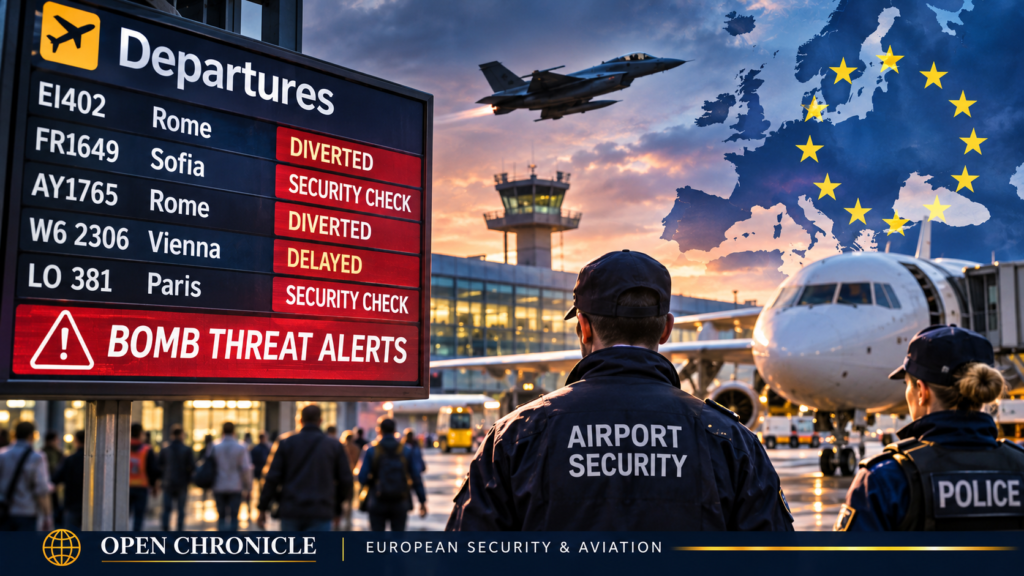
Commercial aircraft diverted to military bases, fighter jets scrambled and passengers evacuated as European authorities investigate a series of apparently false bomb alerts. No explosives have been discovered, but the scale of the disruption is raising questions about aviation security and possible coordinated interference.
By Open Chronicle | November 5, 2026 | World News | Aviation Security
BRUSSELS, November 5, 2026. European aviation authorities are investigating an extraordinary wave of bomb threats that has disrupted dozens of commercial flights across the continent, forcing aircraft to divert, triggering military fighter escorts and prompting extensive security inspections at major airports.
At least 25 flights were reportedly affected on Thursday, bringing the number of incidents recorded since Monday to approximately 32, according to later media tallies. The precise total remains subject to reconciliation as authorities distinguish separate threats, affected aircraft and repeated alerts.
The incidents have involved airlines including Ryanair, Aer Lingus, Finnair, Wizz Air, LOT Polish Airlines, Aegean Airlines and other European carriers.
Despite the widespread disruption, authorities have reported no explosive devices aboard the aircraft inspected, and the affected flights have landed safely.
The origin of the threats remains unknown.
Investigators have not established whether the incidents represent a coordinated campaign or separate acts of malicious interference.
The developments come amid heightened European security concerns, including cyberattacks against critical infrastructure and warnings about the vulnerability of transport networks to disruption.
For passengers and airlines, however, the immediate consequences have been substantial: unexpected landings, security evacuations, delayed journeys and the deployment of military and specialist police resources across several countries.
A Wave of Threats Spreads Across European Airspace
The latest incidents follow several days of disruption that began on November 2.
Initial alerts affected aircraft travelling to Bulgaria, Poland, Spain and Italy, before a much larger series of warnings emerged on Thursday.
By November 5, reported threats had affected flights operating through France, Belgium, Bulgaria, Italy, Austria, the Czech Republic, Romania, Denmark, Greece, Spain and other European countries.
Some aircraft were diverted from their intended destinations. Others continued to their scheduled airports but were isolated on arrival for inspection by security personnel.
In several cases, military aircraft were deployed to escort civilian airliners.
The geographic distribution of the incidents has complicated the investigation.
Rather than concentrating on a single airport or airline, the threats have affected multiple carriers, international routes and aviation authorities.
That pattern has prompted speculation about coordination, although investigators have not publicly established a common perpetrator or operational command.
Aviation security specialists caution that apparent similarities between incidents are not sufficient to establish a connection.
The possibility of copycat threats must also be considered.
Aer Lingus Flight Diverted to French Military Air Base
One of the most significant incidents involved Aer Lingus flight EI402, travelling from Dublin to Rome.
The Airbus A320 was diverted to the Évreux military air base in northern France after authorities received a bomb threat.
The aircraft landed safely, carrying 151 passengers and six crew members.
French authorities arranged for passengers and crew to disembark while specialist teams examined the aircraft.
The diversion represented a substantial operational response, involving military facilities and aviation security personnel.
The decision to use a military airfield also illustrates the importance of having alternative landing locations available when a commercial flight is considered to face a potentially serious security threat.
According to the reporting available on Thursday, no explosives were discovered.
The aircraft’s diversion was precautionary, rather than evidence that an explosive device had actually been placed on board.
For passengers, the distinction is important, but it does not eliminate the disruption caused by an unexpected landing at a military installation
Fighter Jets Escort Aircraft in Bulgaria and Italy
Bulgaria was among the countries most visibly affected by the alerts.
Three Ryanair flights travelling towards Sofia, originating from Madrid, Copenhagen and London Stansted, received bomb threats.
The aircraft from Madrid and Copenhagen landed at Sofia Airport, where security procedures were activated.
The London flight was diverted to Plovdiv Airport.
Bulgarian military aircraft were deployed to escort the affected planes, while police and specialist personnel conducted inspections after landing.
Authorities reported that no explosive devices were found.
The aircraft were subsequently cleared through the relevant security procedures.
In Italy, military aircraft also assisted in responding to the threats.
A Finnair flight from Helsinki to Rome was escorted by Italian fighter jets before landing at Fiumicino Airport.
The aircraft was inspected, and authorities reported no suspicious findings.
Finnair confirmed that another service, travelling from Helsinki to Vienna, had also received a threat.
Both flights landed safely.
The involvement of military aircraft demonstrates how civilian aviation security incidents can require rapid cooperation between airlines, air traffic controllers, national defence authorities and airport police.
It does not, by itself, indicate that authorities identified an actual explosive device or an imminent attack.
Portugal Also Appears Among the Affected Routes
The disruption has also reached flights connected to Portugal.
A Ryanair service travelling from Porto to Milan was reportedly subjected to a bomb threat and underwent security checks after arriving in Italy.
Earlier in the week, a Ryanair flight from Lisbon to Rome was among the services searched following an alert.
Airport authorities in Rome confirmed that the earlier aircraft, passengers, crew and baggage underwent inspections.
No explosive devices were found.
The incidents are relevant to Portugal because of the country’s strong reliance on international aviation for tourism, business travel and connections with other European markets.
They also demonstrate that the threat pattern has not been confined to flights operating in countries geographically close to current military conflicts.
There is no evidence in the available reporting that Portuguese airports or Portuguese nationals were specifically targeted.
Nevertheless, the incidents underline the importance of coordination between Portuguese aviation authorities, European partners and airline security departments when flights are affected by threats received abroad.
Warsaw, Prague and Vienna Activate Security Procedures
Central European airports have also been affected.
In Poland, Warsaw Chopin Airport temporarily closed one of its runways after a bomb threat involving a LOT Polish Airlines aircraft scheduled to depart for Paris.
The aircraft was subjected to security checks, and airport operations subsequently resumed.
In the Czech Republic, four flights arriving at Prague Airport were inspected after receiving threats.
Police reported that the searches produced negative results.
The investigation was referred to the country’s National Centre Against Terrorism, Extremism and Cybercrime.
Austria also experienced disruption when a Wizz Air flight travelling from Milan towards Warsaw diverted to Vienna following a threat.
The aircraft was inspected before continuing its journey.
Additional alerts were reported concerning flights connected to Vienna Airport.
In Belgium, a LOT Polish Airlines service arriving in Brussels was subjected to additional security measures.
The repeated activation of airport security protocols illustrates the operational burden created by threats that ultimately prove unfounded.
Even when a warning is false, authorities must assess its credibility before deciding whether normal operations can safely continue.
Why Airlines Cannot Simply Ignore Bomb Threats
Aviation security procedures are designed around the principle that potentially credible threats must be investigated before they can be dismissed.
When an airline receives a warning, its security department evaluates the available information and coordinates with relevant national authorities.
The assessment can consider the specificity of the threat, the aircraft involved, the information available about the source and whether the warning contains details suggesting genuine knowledge of a planned attack.
Depending on the circumstances, authorities may decide to allow a flight to continue, conduct additional inspections before departure or divert an aircraft already in the air.
Military escorts can be ordered when national authorities consider them necessary.
Once an aircraft lands, security teams may require passengers to disembark and baggage to be removed.
Specialist personnel then inspect the aircraft and its contents.
These procedures are time-consuming and can disrupt airport operations well beyond the flight originally targeted.
The difficulty for aviation authorities is that the consequences of ignoring a genuine warning could be catastrophic.
As a result, even malicious hoaxes can produce a substantial security response.
Reuters reported that aviation experts consider the apparent timing and geographical spread of the latest threats unusual, although false bomb warnings are not uncommon in commercial aviation.
The Economic Cost of a False Alarm
The consequences of the incidents extend beyond the immediate security operations.
When an aircraft is diverted, airlines may face additional fuel costs, landing fees, ground handling expenses and passenger accommodation requirements.
Passengers may miss connecting flights, while aircraft and crew can become unavailable for subsequent scheduled services.
A single diversion can therefore affect multiple flights operating later in the day.
Aircraft inspections also require specialised personnel and coordination with airport authorities.
In some cases, passengers and baggage must be unloaded, searched and reloaded before the aircraft can return to service.
Crew duty-time restrictions can create additional complications.
If a crew exceeds its permitted working hours during an extended delay, an airline may need to arrange replacement personnel or cancel the flight.
The costs can accumulate even when investigators eventually determine that no genuine explosive threat existed.
For airlines already facing pressure from fuel prices, maintenance costs and operational uncertainty, repeated malicious warnings represent another source of financial exposure.
The wider economic impact cannot yet be quantified reliably because the number of affected flights, the duration of disruptions and the costs incurred by individual operators have not been fully established.
Are the Threats Part of a Coordinated Campaign?
The central question facing European investigators is whether the incidents are connected.
The apparent concentration of threats within a short period has prompted speculation about an organised attempt to disrupt commercial aviation.
Some security analysts have raised the possibility of a hybrid operation, a form of interference that can combine intimidation, disinformation, cyber activity and disruption of civilian infrastructure.
Such operations may be designed to impose costs on governments and businesses without requiring a conventional military attack.
However, the available evidence does not establish that the aviation incidents form part of a state-directed campaign.
No government has publicly identified a perpetrator responsible for the wider series of threats.
Nor has a verified connection been established between the bomb alerts and the separate cyberattacks affecting supermarket refrigeration systems in Europe.
Both developments have occurred during a period of heightened security concern, but proximity in time is not proof of common responsibility.
Russia and Iran have been mentioned in broader discussions of possible hybrid threats against Europe.
Both governments have rejected allegations of involvement in such campaigns.
Those geopolitical suspicions should not be confused with verified evidence concerning the bomb threats themselves.
The European Union’s transport commissioner, Apostolos Tzitzikostas, indicated that it was too early to determine whether the incidents were linked.
For investigators, identifying the original communications, their technical origins and any operational similarities between incidents will be essential to establishing whether coordination occurred.
Could False Threats Become a New Form of Aviation Disruption?
The incidents highlight a security problem that does not necessarily require sophisticated weapons or direct access to aircraft.
A malicious actor who sends a sufficiently credible warning may be able to trigger extensive security procedures.
That creates an asymmetry between the resources required to issue a threat and those required to investigate it.
Aviation authorities must protect passengers and crews, while perpetrators of false alerts may seek to exploit the resulting disruption.
The risk is not limited to immediate financial losses.
Repeated false alarms could place additional pressure on security personnel, emergency responders and air traffic management systems.
They may also generate public anxiety about flying.
Another concern is the potential normalisation of repeated warnings.
If false threats become frequent, authorities must continue ensuring that security assessments remain rigorous and that genuine dangers are not overlooked.
This does not mean European aviation is becoming inherently unsafe.
The fact that affected aircraft landed safely and security procedures were activated demonstrates that established protective mechanisms were functioning.
The challenge is maintaining those protections while limiting the operational impact of malicious interference.
What European Authorities Need to Establish
The investigation will need to address several questions.
First, authorities must determine whether the threats originated from common communication channels or individuals.
Second, investigators will need to establish whether the messages contained similar language, timing patterns or operational details.
Third, police and security agencies must assess whether the incidents were intended primarily to cause disruption, generate publicity, intimidate passengers or achieve a broader political objective.
Fourth, governments will need to determine whether existing cross-border information-sharing arrangements are sufficient to identify related threats quickly.
The international character of commercial aviation makes this coordination particularly important.
An aircraft may be registered in one country, operated by an airline based in another, depart from a third and receive a threat while crossing the airspace of a fourth.
The response can involve multiple national authorities within minutes.
European cooperation through aviation security organisations, police networks and national intelligence services will therefore be central to understanding the incidents.
Any future policy changes should be based on the investigation’s findings rather than premature assumptions about the identity or motives of those responsible.
What Passengers Should Know
For travellers, the most important confirmed fact is that the aircraft involved in the reported incidents have landed safely and searches have not identified explosive devices.
Passengers whose flights are affected should follow instructions issued by airline crews and airport security personnel.
Travellers should also check official airline notifications for information about diversions, delays, cancellations and onward connections.
Passenger rights may depend on the route, airline, circumstances and applicable aviation regulations.
Within the European Union, Regulation EC 261/2004 establishes rules concerning assistance and passenger rights when flights are delayed or cancelled.
However, whether financial compensation is payable depends on the circumstances, including whether the disruption qualifies as an extraordinary event outside the airline’s control.
A security threat does not automatically establish entitlement to compensation.
Passengers should retain booking information and receipts for reasonable expenses and consult the airline about applicable assistance arrangements.
There is currently no verified basis for suggesting that passengers should avoid European air travel generally because of the incidents.
A Security Challenge Beyond the Aircraft
The wave of bomb threats has demonstrated how vulnerable modern transport systems can be to disruption even when no physical attack takes place.
Aircraft have been diverted, military resources deployed and airports placed under heightened security procedures.
Yet the searches conducted so far have not revealed explosive devices.
That contrast is central to understanding the events.
The disruption has been real, even though the reported bomb threats have not been substantiated.
For European authorities, the priority is now to identify those responsible and determine whether the incidents form part of a coordinated campaign.
For airlines, the challenge is to maintain passenger safety while managing the financial and operational consequences.
For passengers, the events underline the importance of established aviation security procedures and reliable official information.
The larger lesson is that commercial aviation does not need to experience a successful attack to suffer significant disruption. A sufficiently credible threat can be enough to mobilise military aircraft, interrupt international journeys and test the resilience of Europe’s transport infrastructure.
As investigations continue, the distinction between confirmed facts and speculation about possible perpetrators will remain essential.
Sources and Further Reading
This article draws on reporting published on November 5, 2026, including statements from airlines, airport authorities, police and government officials. The sources distinguish confirmed operational disruptions from unverified allegations concerning responsibility for the threats.
1. Reuters | What Do We Know About the Wave of Bomb Threats Against Flights in Europe?
November 5, 2026 | Reuters | Explainer
Examination of the security response, possible motives, operational costs and the absence of confirmed responsibility for the threats.
2. Reuters | Bomb Alerts Force Flights to Land in France, Bulgaria and Belgium
November 5, 2026 | Reuters
Reporting on the Aer Lingus diversion to a French military base, incidents involving Bulgarian airports and security operations in Belgium and Italy.
3. Reuters | Bomb Threats Cause Flight Disruptions Across Europe
November 5, 2026 | Reuters | Factbox
Airline-by-airline documentation of affected flights, including Ryanair services from Lisbon and Dublin to Rome, Wizz Air flights and other security alerts.
4. Associated Press | Multiple Flights in Europe Diverted Because of Bomb Threats After Earlier Hoaxes
November 5, 2026 | Associated Press
Independent reporting on airport inspections, flight diversions, security procedures and the responses of national aviation authorities.
5. Agence France-Presse | Bomb Threats Hit European Flights for Third Day
November 5, 2026 | AFP
Reporting on the deployment of fighter aircraft, flight diversions and the continuing series of apparently false alerts across Europe.
6. EFE | Wave of Hoax Bomb Threats Disrupts Over 15 Flights Across Europe
November 5, 2026 | Agencia EFE
Detailed coverage of affected routes, passenger numbers, military escorts and airport security inspections across several European countries.
7. Anadolu Agency | At Least 22 Flights Affected by Bomb Threats Across Europe in Four Days
November 5, 2026 | Anadolu Agency
A chronological overview of the incidents reported between November 2 and November 5, documenting the evolving number of affected flights.
Editorial Note
This article was prepared on November 5, 2026, using reporting from Reuters, Associated Press, Agence France-Presse, EFE and other international news organisations, together with statements attributed to aviation authorities, airlines and national governments.
The number of affected flights has changed as additional incidents have been reported. Different news organisations have published different totals depending on the time of reporting and the incidents included. The figures cited in this article should therefore be understood as provisional.
No explosive devices had been confirmed aboard the affected aircraft in the reporting reviewed. The absence of explosives does not diminish the seriousness of the threats or the necessity of aviation security procedures.
No verified attribution to a particular state, organisation or individual had been established. References to possible coordination or hybrid interference are presented as investigative questions and expert assessments, not confirmed findings.
The discussion of aviation resilience, operational costs and wider security implications represents Open Chronicle’s editorial analysis.