
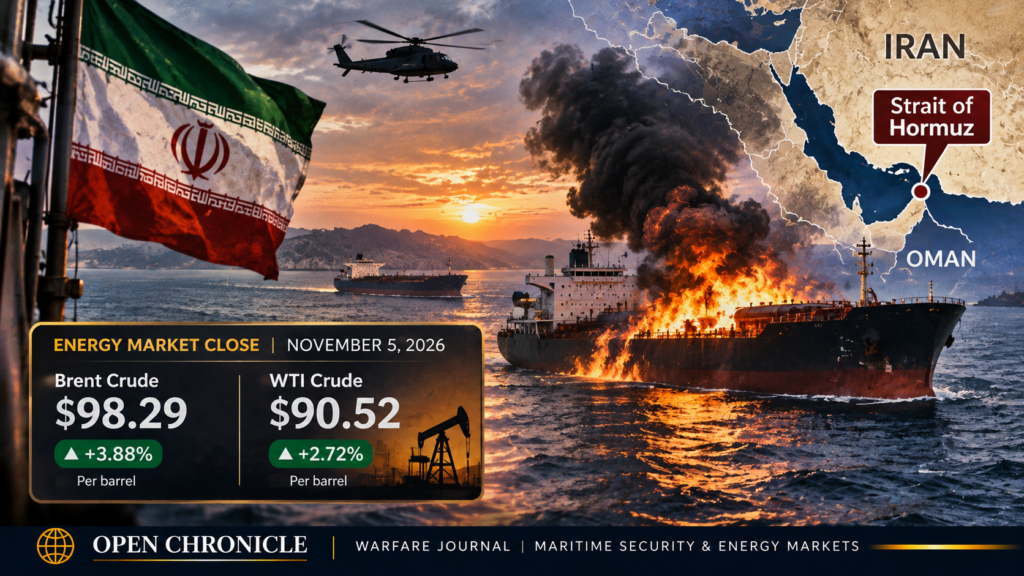
Iranian military authorities say naval mines struck several oil tankers in one of the world’s most important shipping corridors. Independent confirmation remains limited, but renewed maritime incidents are already unsettling energy markets and increasing pressure on Washington and Tehran.
By Open Chronicle | November 5, 2026 | Warfare Journal | Maritime Security
DUBAI, November 5, 2026. The security crisis in the Strait of Hormuz intensified on Thursday as Iranian military authorities reported that five oil tankers and a tugboat had caught fire in a series of incidents involving vessels attempting to navigate waters that Tehran considers restricted or unsafe.
The latest reports came amid growing fears that the conflict involving Iran, the United States and Israel could trigger another escalation in one of the world’s most strategically important maritime corridors.
Iran’s Islamic Revolutionary Guard Corps initially reported that two tankers and a tugboat had caught fire in separate incidents overnight.
Later on Thursday, Iran’s regular navy reported three additional tanker incidents, alleging that the vessels had struck naval mines while navigating through restricted areas east of the strait.
The claims were reported by Reuters, Associated Press and regional news organisations, but the full circumstances could not be independently verified.
The Iranian authorities did not initially provide comprehensive information about the identities of the vessels, their nationalities, possible casualties or the extent of the damage.
Nevertheless, the latest developments have heightened concerns among shipping operators and energy traders already confronting months of disruption in the Persian Gulf.
By Thursday’s market close, Brent crude had climbed sharply as fears of further attacks threatened to reverse recent optimism about diplomatic efforts to contain the conflict.
Iran Reports a New Series of Maritime Incidents
The first announcement came from the Islamic Revolutionary Guard Corps, which said that a large tanker had struck a naval mine while attempting to use a passage south of the Strait of Hormuz on Wednesday night.
According to the IRGC, the vessel caught fire and was forced to stop.
In a separate incident, the force said another supertanker had suffered a major fire while leaving a shipping route in the eastern part of the waterway.
A tugboat approaching the second vessel to assist with firefighting operations also caught fire, Iranian authorities said.
Later on Thursday, Iran’s regular navy announced that three additional tankers had reportedly struck mines.
One incident was described as occurring earlier in the morning, while two others were reported around midday.
Iranian officials said the vessels had entered waters they considered unsafe without the required coordination.
They also alleged that some ships had disabled identification or navigation equipment.
Those allegations have not been independently established.
The accounts suggest that several separate incidents may have occurred over a relatively short period, although the possibility of overlapping reports cannot be completely excluded without independent vessel identification.
The distinction is important because Iranian military statements provide the primary basis for several of the reported incidents.
Reuters subsequently reported that Iran had announced three additional damaged tankers on Thursday, while the Associated Press continued to emphasise that key Iranian claims remained unverified.
What Is Confirmed and What Remains Unverified?
The available reporting establishes that Iranian military authorities issued multiple statements describing fires and alleged mine strikes.
It does not establish independently that every incident occurred exactly as described.
Supported by identifiable reporting
Iranian military authorities publicly reported the incidents. Reuters documented the announcements, while independent maritime monitoring recorded additional security incidents in the wider region. Energy prices rose substantially on Thursday.
The identity and condition of every tanker, the precise number of distinct mine strikes, responsibility for individual explosions, casualties, and whether the ships deliberately ignored navigation warnings.
The United Kingdom Maritime Trade Operations organisation, known as UKMTO, separately reported a vessel struck by two projectiles approximately 50 nautical miles north of Qatar’s Madinat ash-Shamal.
That incident provides an additional indication of maritime insecurity in the region.
However, the available evidence does not establish that the UKMTO report refers to any of the tankers identified in Iranian statements.
It would therefore be premature to combine all reported incidents into a single confirmed casualty total.
A Strategic Waterway Under Pressure
The Strait of Hormuz connects the Persian Gulf with the Gulf of Oman and the Arabian Sea.
Situated between Iran to the north and Oman to the south, the narrow passage provides a vital maritime outlet for several of the world’s largest oil and gas exporters.
Saudi Arabia, Iraq, Kuwait, Qatar and the United Arab Emirates depend to varying degrees on the wider Gulf shipping network to reach international markets.
Under normal conditions, approximately one fifth of global petroleum liquids consumption passes through the strait.
That historical benchmark illustrates the waterway’s importance, although it should not be confused with the substantially reduced shipping volumes recorded during the present conflict.
Any serious interruption to Hormuz affects far more than the countries directly involved in the fighting.
Energy importers in Asia, European industrial economies and global shipping companies all face potential consequences.
Even countries that do not purchase large volumes of Gulf crude directly can experience higher prices because oil is traded in an interconnected international market.
This makes Hormuz a strategic pressure point with consequences extending well beyond the Middle East.
Shipping Volumes Have Already Fallen Sharply
The latest incidents occurred against a background of severe disruption to Gulf energy exports.
According to reporting by the Financial Times, oil exports passing through Hormuz averaged approximately 8.7 million barrels per day during the week ending October 29.
That represented a decline of about 51% compared with levels before the conflict.
The figures illustrate how dramatically maritime traffic has changed since hostilities involving Iran intensified earlier in 2026.
Reduced traffic does not necessarily mean every vessel has been physically prevented from passing.
Shipowners may avoid a route because of security warnings, insurance restrictions, chartering difficulties or uncertainty about whether a vessel can complete its voyage safely.
Others may delay departures while awaiting new instructions or information about navigation conditions.
These commercial decisions can reduce available supply even without a formal blockade.
For energy markets, the consequences can be similar: fewer cargoes reaching their destinations on schedule and greater uncertainty about future deliveries.
The latest reports of naval mines add another potential obstacle.
Unlike some other maritime threats, mines may remain dangerous after the immediate military confrontation has ended.
That possibility complicates efforts to restore confidence in the shipping corridor.
Oil Prices Jump as Traders Reassess the Risk
Energy Market Close
Reuters market closing figures, November 5, 2026.
Oil prices reversed earlier declines on Thursday as traders responded to the renewed reports of tanker attacks and uncertainty surrounding American policy towards Iran.
Brent crude futures rose $3.67 to settle at $98.29 a barrel, while US West Texas Intermediate gained $2.40 to close at $90.52.
The increase followed a sharp fall in prices on Wednesday, when hopes of reduced military escalation had temporarily eased concerns about energy supplies.
The reversal demonstrates the sensitivity of international oil markets to developments in the Gulf.
A diplomatic statement suggesting progress towards negotiations can lower perceived supply risks.
A reported attack on a tanker can quickly restore them.
Energy traders are not simply assessing how much oil is available today.
They are also estimating the probability that future shipments could be delayed, damaged or prevented from reaching international markets.
Those expectations influence futures prices, shipping costs and decisions by companies purchasing fuel.
Analysts at Eurasia Group outlined scenarios in which a renewed military escalation could push Brent crude towards $110 to $125 a barrel.
That range represents a conditional risk scenario, not a confirmed price forecast or an inevitable outcome.
The direction of prices will depend on whether shipping disruptions intensify, whether diplomacy progresses and how quickly producers can respond to supply shortages.
Why Naval Mines Represent a Particular Threat
Naval mines are among the most disruptive weapons that can be employed against commercial shipping.
They can threaten vessels without requiring the attacking force to remain physically present at the location.
Depending on their design, mines may be activated through physical contact or by detecting changes in the surrounding environment.
For commercial vessels, the challenge is that the absence of visible hostile forces does not guarantee safe passage.
A tanker can encounter a mine even when no warship, aircraft or missile launcher is immediately visible.
The resulting uncertainty may be enough to discourage transit through a shipping lane.
Mine countermeasure operations also require specialised capabilities.
Naval forces must identify potentially dangerous objects, distinguish actual mines from debris and conduct clearance operations while protecting personnel and civilian traffic.
These procedures can take time, particularly in heavily trafficked waters.
The Strait of Hormuz presents additional complications because of its geography and the concentration of large commercial vessels.
The use of mines can therefore have consequences disproportionate to the immediate physical damage caused.
However, it is essential to distinguish between Iran’s claims that ships struck naval mines and independent technical confirmation of those strikes.
Without verified inspection findings, the exact mechanisms responsible for Thursday’s reported fires remain uncertain.
The Insurance Problem: When Shipping Becomes Too Expensive
One of the most immediate economic consequences of maritime insecurity is the cost of insurance.
Commercial vessels operating in areas considered especially dangerous may require additional war risk coverage.
Insurance premiums can rise when underwriters judge that a voyage exposes a ship to increased risks of attack, seizure or physical damage.
The consequences are particularly significant for oil tankers.
A large tanker can carry cargo worth tens or hundreds of millions of dollars, depending on its capacity and prevailing crude prices.
The vessel itself also represents a substantial investment.
A serious incident can expose shipowners, charterers and insurers to costs involving repairs, cargo losses, environmental damage and potential liability.
When insurance becomes unavailable or prohibitively expensive, shipping companies may postpone voyages even if the waterway remains technically navigable.
Iran’s Revolutionary Guard explicitly referred to insurance costs in its November 5 statement, arguing that attempts to use routes it considers prohibited would impose additional financial burdens.
That statement should be understood as Iran’s political and military position, not as independent confirmation that the vessels involved had violated internationally recognised navigation rules.
The wider commercial problem is clear.
The economic consequences of insecurity can extend to vessels that are never directly attacked.
Washington’s Political Crisis Complicates the Response
The maritime incidents have coincided with a significant political setback for President Donald Trump.
Democrats secured control of both chambers of Congress in the November 3 midterm elections, increasing pressure on the administration over its handling of the Iran conflict.
Vice President JD Vance publicly identified the war as a central reason for the Republican Party’s defeat.
His intervention exposed disagreements over the political costs of continued military operations.
Trump has acknowledged that the conflict affected Republican electoral prospects but has defended his decisions.
For Tehran, the election results have created an opportunity to increase political pressure on Washington.
Iranian Parliament Speaker Mohammad Baqer Qalibaf criticised Vance on Thursday, suggesting that the vice president should persuade Trump to end the conflict rather than merely explain its political consequences.
The exchange illustrates how the Strait of Hormuz has become both a military and political instrument.
Iran can use its influence over the waterway to increase pressure on global energy markets.
The United States must consider how to protect maritime navigation without triggering a broader escalation.
At the same time, the White House faces a domestic political environment in which the costs of the war are receiving greater scrutiny.
These pressures do not necessarily make a diplomatic settlement more likely.
They may also encourage competing demonstrations of military resolve.
Diplomacy Continues Despite the Escalation
Diplomatic activity has continued alongside the maritime incidents.
Iranian Foreign Minister Abbas Araghchi held discussions with regional officials concerning security, de-escalation and freedom of maritime navigation.
The contacts involved countries including Saudi Arabia, Qatar, Oman, Kuwait and Turkey.
Regional governments have strong incentives to prevent a prolonged disruption of Gulf shipping.
Even states that are not direct participants in the conflict face economic consequences when the strait becomes unsafe.
Oman and Qatar are particularly important because of their previous roles in regional diplomatic engagement.
The involvement of neighbouring governments also reflects concern that incidents at sea could produce unintended military escalation.
A collision, explosion or misidentified threat could generate competing accusations before investigators establish what happened.
The danger increases when military forces are operating close to commercial shipping.
For diplomacy to produce lasting improvements in maritime security, negotiations would likely need to address both the wider conflict and the immediate conditions governing safe passage.
A temporary reduction in military activity would not necessarily eliminate the risks posed by mines or other unexploded devices.
The restoration of normal shipping would require credible security assurances and confidence among commercial operators.
The Environmental Danger of a Tanker Fire
Beyond military and economic considerations, tanker incidents can create serious environmental risks.
Large oil tankers carry substantial quantities of petroleum products or crude oil.
A fire aboard such a vessel can threaten crew members, damage propulsion and electrical systems, and potentially compromise cargo containment.
If a tanker loses power or steering capability in a congested maritime corridor, it may create additional hazards for nearby shipping.
An oil spill could affect coastal ecosystems, fisheries, desalination facilities and commercial ports.
The Persian Gulf’s relatively enclosed geography makes marine pollution a particular concern.
However, there is currently insufficient verified information to determine whether Thursday’s reported incidents caused significant oil spills.
Iranian military statements did not provide comprehensive independent assessments of environmental damage.
It would therefore be premature to describe a major ecological disaster as an established consequence of these events.
The risk nevertheless reinforces the importance of emergency response capabilities, including firefighting vessels, salvage teams and pollution containment equipment.
The reported involvement of a tugboat in one of the fires also highlights the dangers faced by crews attempting to assist damaged commercial ships.
Three Scenarios for the Strait of Hormuz
The immediate future of the waterway depends on developments that remain highly uncertain.
Three Possible Scenarios for the Strait of Hormuz
Three potential developments that could shape maritime security, energy markets and regional stability.
Diplomatic De-escalation
Negotiations reduce the risk of renewed military strikes. Maritime incidents decline, insurers regain confidence and commercial traffic gradually recovers. A lasting improvement would still depend on safe navigation and any necessary clearance operations.
Prolonged Maritime Standoff
Shipping continues at reduced levels under heightened security restrictions. Energy prices remain volatile, insurers charge higher premiums and Gulf exporters face continuing uncertainty.
Renewed Military Escalation
Additional attacks or a major confrontation further disrupt shipping. Energy prices could rise sharply, regional military deployments could expand and the risk of environmental damage would increase.
These scenarios are editorial assessments, not predictions of events that have already occurred.
A Global Economic Vulnerability Exposed
The latest reports from the Strait of Hormuz demonstrate how a relatively narrow maritime corridor can influence economic conditions across the world.
Iranian authorities have reported multiple tanker fires and alleged mine strikes, but essential details remain unverified.
Independent maritime monitoring confirms a wider environment of serious insecurity.
Oil markets have already responded.
For shipping companies, the immediate concern is whether vessels can navigate safely.
For energy importers, the concern is whether supplies will arrive on time and at predictable prices.
For governments, the challenge is preventing commercial disruption from becoming a broader military confrontation.
The situation also reveals the limits of viewing energy security solely through production figures.
A country may possess sufficient oil reserves and production capacity, yet still face shortages or price increases if transport routes become unreliable.
The same principle applies to global supply chains more broadly.
The security of maritime infrastructure is inseparable from the security of international trade.
The central danger is not simply that individual tankers may be damaged. It is that repeated incidents could make one of the world’s most important energy corridors increasingly difficult, expensive and dangerous to use.
Until the latest incidents are independently investigated and credible arrangements for safe navigation are established, the Strait of Hormuz will remain a major source of uncertainty for global energy markets.
Sources and Further Reading
The following reporting, maritime security information and official statements were consulted for this article. Iranian military claims are distinguished from independently documented developments and market data.
1. Reuters | Iran’s IRGC Says Two Tankers and Tugboat Caught Fire in Strait of Hormuz
November 5, 2026 | Reuters
Initial reporting on Iranian Revolutionary Guard statements concerning tanker fires, alleged mine strikes and the involvement of a tugboat.
2. Reuters | Brent Crude Jumps as Tanker Attacks Renew Supply Concerns
November 5, 2026 | Reuters | Energy Markets
Reporting on Brent and WTI closing prices, shipping incidents, diplomatic uncertainty and energy market assessments.
3. Reuters | Tankers Hit in Hormuz as Iran Keeps Up Pressure After US Vote
November 5, 2026 | Reuters
Updated coverage of additional Iranian tanker claims and the political tensions between Washington and Tehran following the US midterm elections.
4. Associated Press | Iran’s Top Diplomat Speaks With Gulf Leaders About Tensions
November 5, 2026 | Associated Press
Coverage of regional diplomatic contacts, maritime navigation concerns and Iranian military claims that remained independently unverified.
5. Financial Times | Iran Hits Hormuz Tanker With Limpet Mines in Apparent Tactical Shift
October 2026 | Financial Times
Background reporting on maritime attacks, mine-related threats and the reduction in oil exports through the Strait of Hormuz.
6. Anadolu Agency | Iran Reports Five Oil Tankers and a Tugboat Caught Fire in Strait of Hormuz
November 5, 2026 | Anadolu Agency
Reporting on the successive announcements by Iran’s Revolutionary Guard and regular navy, including three additional tanker incidents reported later on Thursday.
Editorial Note
This article was prepared on November 5, 2026, using reporting from Reuters, Associated Press, Financial Times and Anadolu Agency, together with statements attributed to Iranian military authorities.
The reported fires involving five oil tankers and a tugboat originate primarily from statements issued by Iran’s Islamic Revolutionary Guard Corps and regular navy. The identities of the vessels, the exact number of distinct incidents, the extent of the damage and the causes of individual fires had not been independently established in the reporting reviewed.
The oil price figures represent reported market closing values for November 5, 2026. Historical and pre-conflict shipping benchmarks should not be interpreted as current traffic volumes.
Statements by Iranian officials concerning navigation restrictions, responsibility for maritime incidents and alleged violations are attributed claims rather than independent legal or technical findings.
The discussion of energy security, maritime insurance, military escalation and possible diplomatic outcomes represents Open Chronicle’s editorial analysis.