
OPEN CHRONICLE | SCIENCE & ENVIRONMENT | NUCLEAR SAFETY
Nearly two years after a drone strike damaged the protective structure over the site of the world’s worst nuclear power plant disaster, international donors are racing to restore its safety functions. The G7 has pledged €260 million, but substantial additional financing is still required before a critical 2030 deadline.
By Open Chronicle | November 5, 2026
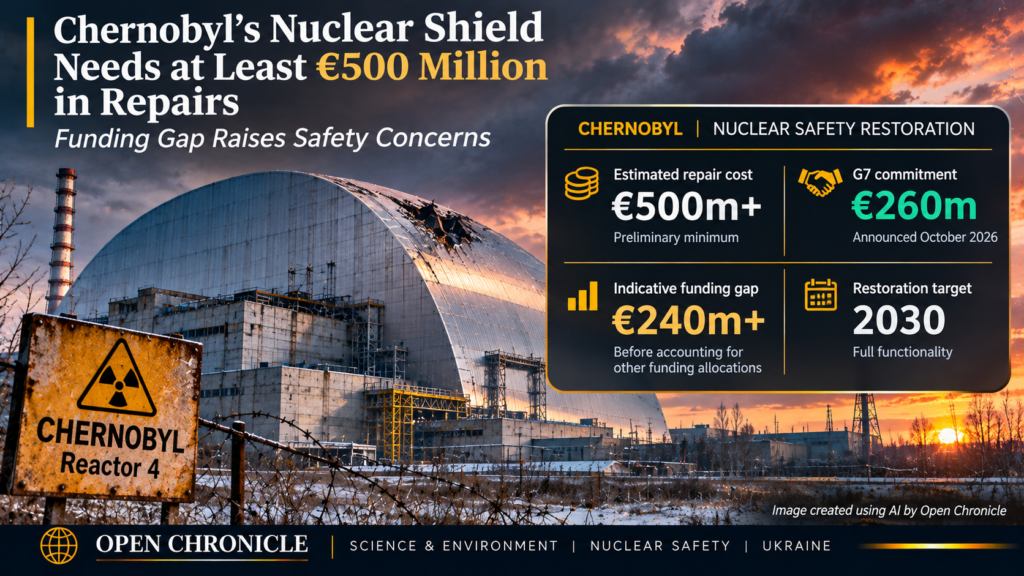
KYIV, November 5, 2026. The international effort to secure the remains of Chernobyl’s destroyed nuclear reactor faces a new financial and engineering challenge, with at least €500 million required to repair the enormous protective structure damaged by a Russian drone strike in February 2025.
The European Bank for Reconstruction and Development (EBRD), which coordinates international nuclear safety projects at the site, is seeking additional contributions ahead of a donor conference scheduled for November 9 in Paris.
The Group of Seven industrialised nations announced €260 million in support in October, but that commitment covers only slightly more than half of the preliminary restoration estimate.
The shortfall comes at a critical moment for the New Safe Confinement, the giant steel arch constructed over the remains of Reactor 4, which exploded in April 1986.
The structure was designed to contain radioactive material, protect the damaged reactor from the environment and allow the eventual dismantling of the original Soviet-era sarcophagus.
Its protective systems were seriously compromised by the February 2025 attack.
Although radiation monitoring has not indicated an immediate radiological emergency, engineers warn that prolonged exposure to moisture could cause corrosion and undermine the structure’s long-term integrity.
The EBRD wants the restoration completed by 2030, before deterioration becomes substantially more difficult and expensive to address.
The challenge is no longer simply repairing a damaged roof.
It is preserving one of the world’s most important nuclear safety projects while Ukraine remains at war.
The Key Figures
Chernobyl | Nuclear Safety Restoration
EBRD estimates and G7 commitments available as of November 5, 2026.
The indicative gap is not an audited total of outstanding financing.
What Happened to Chernobyl’s Protective Shield?
On February 14, 2025, a drone carrying explosives struck the New Safe Confinement at the Chernobyl Nuclear Power Plant in northern Ukraine.
The impact caused a fire and damaged the structure’s external and internal protective layers.
According to the EBRD, the strike created a breach measuring approximately 15 square metres and damaged around 200 square metres of panels.
The attack also affected systems responsible for maintaining the internal environment and supporting operations beneath the steel arch.
Among the damaged or disrupted components were ventilation, climate-control equipment and the internal crane system used to support future dismantling operations.
These are not minor auxiliary installations.
They are central to the structure’s purpose.
The New Safe Confinement was engineered to create a controlled environment around the unstable remains of Reactor 4.
It also provides the infrastructure necessary for workers to eventually dismantle the ageing original sarcophagus without exposing the surrounding environment to unacceptable radiological risks.
The strike compromised both functions.
Ukrainian authorities attributed the attack to Russia, and the EBRD describes the damage as resulting from a Russian drone strike.
The full technical consequences became clearer through subsequent inspections and engineering assessments.
Those findings have transformed the restoration into a major international project.
Why the Structure Is So Important
The Chernobyl disaster began on April 26, 1986, when an explosion and fire destroyed Reactor 4 during a failed safety test.
The accident released radioactive material across parts of Ukraine, Belarus, Russia and wider Europe.
Soviet authorities constructed an emergency containment structure around the destroyed reactor in the months following the accident.
That original sarcophagus was built under extraordinary conditions and was never intended to serve as a permanent solution.
Over time, its structural deterioration created concerns about the possibility of collapse and the release of radioactive dust.
The international community eventually financed a much larger containment system.
The New Safe Confinement, an enormous steel arch, was assembled near the reactor and moved into position over the original sarcophagus in 2016.
It was designed for a service life of approximately 100 years.
The structure was intended to do more than isolate radioactive material.
It was also designed to create the conditions for safely dismantling unstable components inside the reactor building.
The engineering challenge is considerable.
Radioactive debris, damaged structural materials and contaminated equipment remain inside the site.
Managing these materials requires specialised systems, carefully planned operations and continuous radiological monitoring.
The New Safe Confinement therefore represents an essential part of the long-term process of transforming Chernobyl from a damaged nuclear installation into a more stable and manageable environmental legacy.
The Hidden Danger: Corrosion
One of the most serious consequences of the drone strike is the loss of the structure’s airtightness.
The New Safe Confinement was designed with systems that help control humidity and reduce corrosion of its steel components.
Damage to its protective layers allows moisture to enter areas that were intended to remain environmentally controlled.
Over time, humidity can accelerate corrosion.
For an enormous steel structure designed to remain operational for a century, that represents a significant engineering concern.
Corrosion may weaken components, increase maintenance requirements and complicate future restoration.
The danger is cumulative.
A damaged protective system may not produce an immediate structural failure, but deterioration can become more difficult to reverse as time passes.
This is why the EBRD has identified 2030 as an important deadline.
The objective is to restore the structure’s full functionality before prolonged exposure causes damage that would require more extensive intervention.
The urgency should not be confused with evidence that the arch is currently collapsing.
The available assessments describe a serious long-term safety problem requiring major repairs, not an imminent structural catastrophe.
That distinction is essential when communicating nuclear risks to the public.
Is There an Immediate Radiation Danger?
The available official information does not indicate an immediate radiological emergency resulting from the damaged confinement.
Following the February 2025 strike, monitoring at the plant recorded radiation levels within acceptable limits.
International assessments subsequently confirmed that important safety functions had been compromised, but that did not mean a new large-scale release of radioactive material had occurred.
The distinction between structural damage and radiological release is fundamental.
A containment structure can lose part of its protective capability without immediately releasing dangerous quantities of radioactive material into the environment.
However, reduced containment performance increases the importance of continued monitoring, maintenance and timely repairs.
Chernobyl remains a complex nuclear site containing hazardous materials that require long-term management.
The concern is therefore not that another 1986-scale disaster is already underway.
It is that damage to critical protective infrastructure could increase future risks if left unresolved.
The EBRD and Ukrainian authorities have continued temporary stabilisation measures while planning the full restoration programme.
Those measures help maintain acceptable operating conditions but are not a substitute for permanent repairs.
The €500 Million Challenge
The estimated cost of restoring the New Safe Confinement is at least €500 million.
That figure is preliminary and may change as detailed engineering work progresses.
The G7 announced €260 million in additional support in October, providing a substantial foundation for the international fundraising effort.
Nevertheless, the restoration programme remains incompletely financed.
A simple comparison between the minimum repair estimate and the G7 commitment produces a difference of approximately €240 million.
That figure illustrates the scale of the remaining challenge.
It should not be interpreted as a definitive accounting statement, because some earlier contributions have been allocated to preparatory engineering, temporary measures and related safety activities.
The precise outstanding financing requirement depends on how different funding commitments are allocated and on the final cost of the project.
The EBRD is coordinating efforts to secure additional support from international partners.
The bank’s president, Odile Renaud-Basso, has argued that Chernobyl’s restoration should be regarded as a global nuclear safety responsibility rather than solely a Ukrainian national problem.
The reasoning reflects the international consequences of the original disaster.
Radioactive contamination does not respect political borders.
Protecting the site therefore serves the interests of countries far beyond Ukraine.
Paris Conference Could Determine the Next Phase
A donor conference scheduled for November 9 in Paris will bring together international partners to discuss financing for the restoration.
The event is being organised with the participation of France, Ukraine and the EBRD.
The objective is to mobilise additional financial commitments and create a credible path towards completing the project.
The EBRD has indicated that it hopes to secure sufficient financing commitments to allow major restoration contracts and construction work to begin in 2028.
The work is expected to continue towards the 2030 completion target.
However, there is no guarantee that the Paris conference will close the entire financing gap.
Renaud-Basso has acknowledged that securing the remaining money will be difficult.
Potential contributors include European governments and other international partners with an interest in nuclear safety.
The funding effort also takes place amid competing demands for international assistance.
Ukraine requires extensive support for military defence, energy infrastructure, reconstruction and humanitarian needs.
Other governments face domestic budgetary pressures.
Nuclear safety projects can therefore struggle to attract attention despite their long-term importance.
The challenge for the EBRD is to demonstrate that early investment in repairs is likely to be less costly and less risky than allowing the structure to deteriorate.
Restoration Work Has Already Begun
Although the full financing package remains incomplete, preparatory work is underway.
On September 16, 2026, the Chernobyl Nuclear Power Plant and the NOVARKA 2 consortium signed a contract for the first stage of engineering activities.
The agreement was concluded in Vienna during the International Atomic Energy Agency’s General Conference.
NOVARKA 2 brings together companies associated with the original construction of the New Safe Confinement.
The initial work includes consolidating technical information, conducting targeted investigations and developing preliminary restoration concepts.
The first stage is expected to take approximately seven and a half months.
It forms part of a broader engineering and procurement programme supported by €30 million in funding.
That programme is intended to establish the technical and regulatory foundations for the subsequent restoration.
The distinction matters.
The initial engineering contract does not mean the entire €500 million repair programme has been financed or that full reconstruction is already underway.
It means the project has entered an important preparatory phase.
Detailed engineering is essential because repairs must be conducted around a heavily contaminated nuclear facility.
Workers cannot simply replace damaged components using ordinary industrial construction procedures.
The project requires careful assessment of radiation exposure, structural loads, environmental conditions and operational safety.
Engineering decisions must also be compatible with the existing structure and its remaining service life.
The Engineering Challenge Behind the Repairs
Restoring the New Safe Confinement will require more than replacing damaged roof panels.
The structure must recover its ability to maintain a controlled internal environment while preserving the safety of the radioactive materials beneath it.
Engineers will need to address damaged cladding, environmental control systems and equipment used for operations inside the arch.
They must also determine whether exposure to moisture has already affected structural components.
Any repairs will need to account for the structure’s enormous dimensions and the limitations imposed by the contaminated site.
The work will involve coordination between engineers, radiation protection specialists, construction contractors and Ukraine’s nuclear regulator.
The restoration strategy must also minimise the risk of disrupting existing safety systems.
A repair method that would be straightforward at a conventional industrial building may be unsuitable at Chernobyl because of the need to control contamination and protect personnel.
For this reason, the current engineering programme includes inspections, technical studies and the preparation of detailed implementation plans.
The EBRD’s approach is intended to reduce the risk of expensive redesigns or premature construction commitments.
The objective is to establish a technically credible programme before proceeding with the most demanding restoration work.
Four Decades of International Cooperation at Chernobyl
The new funding campaign builds on decades of international involvement in securing the site.
Since the mid-1990s, the EBRD has played a central role in coordinating financial assistance for Chernobyl’s nuclear safety projects.
International contributions have exceeded €2.5 billion, while the bank has provided more than €700 million of its own resources for nuclear safety and decommissioning activities connected to the site.
The Shelter Implementation Plan, which included the New Safe Confinement, became one of the most ambitious nuclear remediation programmes ever undertaken.
It brought together governments, international institutions, engineering companies and nuclear safety specialists.
The programme also demonstrated that managing the consequences of a major nuclear accident can require financial commitments extending across generations.
The construction of the New Safe Confinement was a major achievement, but it was never intended to eliminate all remaining hazards immediately.
Its purpose was to provide the controlled conditions needed for continued decommissioning and waste management.
The February 2025 strike has placed that long-term strategy under renewed pressure.
The international community must now finance the restoration of infrastructure that was built specifically to prevent the consequences of the 1986 accident from becoming more difficult to manage.
Nuclear Safety During Wartime
The damage to Chernobyl also raises wider questions about protecting nuclear infrastructure during armed conflict.
Nuclear facilities depend on physical protection, electricity, monitoring equipment, trained personnel and reliable maintenance.
Military operations can threaten each of these requirements.
Even a nuclear plant that is no longer generating electricity may contain radioactive material requiring continued management.
Chernobyl illustrates this problem particularly clearly.
Its reactors have been shut down, but the site remains an active nuclear decommissioning and waste management complex.
The destroyed Reactor 4 continues to require specialised containment.
Other facilities at the site are involved in managing spent nuclear fuel and radioactive waste.
Damage to protective infrastructure can therefore create safety concerns long after electricity production has ceased.
The European Court of Auditors has also warned that Russia’s war against Ukraine threatens the long-term sustainability of investments in nuclear safety infrastructure.
Its 2026 assessment identified the damaged New Safe Confinement as an example of how military action can undermine years of international investment.
The implications extend beyond Chernobyl.
The protection of nuclear installations during armed conflict is a matter of international concern because radiological consequences can extend beyond national borders.
What Happens If the Repairs Are Delayed?
The most immediate consequence of a prolonged delay would be continued exposure of damaged protective systems to environmental conditions.
Moisture could accelerate corrosion of the steel arch and increase the complexity of future repairs.
A delayed restoration could also postpone operations intended to dismantle unstable components of the original sarcophagus.
That would extend the period during which hazardous materials remain inside ageing structures.
The financial consequences could become significant.
An initial repair programme estimated at €500 million may become more expensive if deterioration continues or additional structural work becomes necessary.
However, there is no verified basis for calculating precisely how much delays would increase the final cost.
The principal risk is the accumulation of technical and financial problems over time.
A prolonged funding shortfall could also affect the planning of future decommissioning activities.
The New Safe Confinement was designed to support a programme extending over many decades.
Restoring its full functionality is therefore essential to the site’s long-term management.
Three Possible Paths for Chernobyl’s Restoration
How international financing, engineering progress and continued wartime risks could shape the restoration of the New Safe Confinement.
Funding Secured on Schedule
International donors provide sufficient commitments, allowing engineering preparations to progress and major restoration work to begin around 2028. The project remains on course for completion by 2030.
Partial Financing and Delays
Additional funding arrives gradually, but not quickly enough to support the full construction programme. Temporary measures continue while the restoration timetable faces increasing pressure.
Prolonged Deterioration
Funding shortages or further wartime damage delay permanent repairs. Corrosion and equipment degradation increase restoration complexity and potentially raise long-term costs.
These scenarios are Open Chronicle editorial assessments, not predictions of confirmed future outcomes.
Why the World Cannot Afford to Ignore Chernobyl
Chernobyl remains a reminder that the consequences of a nuclear accident do not end when the initial emergency is over.
Forty years after the 1986 disaster, the site still requires specialised infrastructure, international cooperation and sustained financial support.
The New Safe Confinement was built to make that long-term responsibility more manageable.
Its damage during the war in Ukraine has created a new challenge for governments and international institutions.
The available evidence does not indicate an immediate radiological emergency.
Nevertheless, the loss of important containment functions and the risk of corrosion mean that permanent restoration cannot be postponed indefinitely without increasing uncertainty.
The EBRD’s minimum €500 million estimate demonstrates the scale of the task.
The G7’s €260 million commitment provides a substantial starting point, but further international support remains necessary.
The November 9 Paris conference will be an important test of whether governments are prepared to turn expressions of concern into financial commitments.
For Ukraine, the project is part of maintaining nuclear safety during wartime.
For Europe, it concerns the security of infrastructure whose failure could have consequences beyond Ukraine’s borders.
For the wider international community, it raises a fundamental question about the protection of nuclear facilities during armed conflict.
Chernobyl’s greatest immediate challenge is not a new nuclear disaster, but the possibility that insufficient funding and prolonged deterioration could weaken the systems built to prevent future radiological harm.
The next four years will determine whether the international community can restore the protective shield before its condition becomes substantially more difficult to manage.
Sources and Further Reading
Official nuclear safety documentation, international financial assessments and independent reporting consulted for this article.
1. EBRD | Making Chornobyl Safe
Official technical overview of the New Safe Confinement, the damage caused by the February 2025 drone strike, the preliminary repair estimate of at least EUR 500 million and the international restoration programme.
2. EBRD | G7 Commitment to Finance Urgent Repairs
Confirmation of the EUR 260 million G7 commitment, the remaining financing requirements, the restoration deadline and the donor conference scheduled for November 9, 2026, in Paris.
3. Chornobyl Nuclear Power Plant | NOVARKA 2 Engineering Contract
Official announcement of the initial engineering contract signed on September 16, 2026, including technical studies, inspections, procurement preparations and the restoration objective for 2030.
4. European Court of Auditors | International Nuclear Safety Cooperation
Special Report 08/2026 examining international nuclear safety investments, cost pressures and the impact of the war on nuclear infrastructure in Ukraine, including the damaged Chernobyl confinement.
5. Hromadske | Chernobyl Shelter Repairs Face Funding Shortfall
Reporting on EBRD President Odile Renaud-Basso’s warning, the remaining financing challenge, the Paris donor conference and the risks associated with delaying repairs beyond 2030.
Editorial Note
This article was prepared on November 5, 2026, using official documentation from the European Bank for Reconstruction and Development, Chornobyl Nuclear Power Plant, the European Court of Auditors and contemporary independent reporting.
The estimated restoration cost of at least EUR 500 million is preliminary. The G7 commitment of EUR 260 million does not necessarily represent the total amount of financing available from all sources. The indicative EUR 240 million difference should not be treated as an audited funding shortfall.
Available official monitoring information does not indicate an immediate radiological emergency following the damage to the New Safe Confinement. The loss of containment functions and the risk of corrosion nevertheless represent significant long-term nuclear safety concerns.
The 2030 restoration objective is a planning target, not a guaranteed completion date. Discussion of possible funding outcomes, project delays and international implications includes Open Chronicle editorial analysis.
The Grand Strategy Institute
Continue Exploring Strategic Analysis
Return to The Grand Strategy Institute for strategic assessments, long-form analysis and research examining geopolitics, military affairs, international security, emerging technologies and the changing international order.
← Back to The Grand Strategy Institute