
OPEN CHRONICLE SCIENCE | SPACE & TIME | ASTROPHYSICS
The pioneering NASA spacecraft that transformed the study of gamma ray bursts has reentered Earth’s atmosphere over Indonesia, ending nearly 22 years of discoveries and a failed attempt to save one of astronomy’s most influential rapid response observatories.
By Open Chronicle | 5 November 2026
On the morning of 4 November 2026, a spacecraft that had spent almost 22 years watching some of the most violent events in the Universe made its final journey.
At 12:39 UTC, NASA’s Neil Gehrels Swift Observatory reentered Earth’s atmosphere over northern Sumatra, Indonesia. Travelling at orbital velocity, the spacecraft encountered increasingly dense atmospheric layers, experiencing extreme aerodynamic heating and mechanical stresses that caused it to break apart.
Most of the observatory was expected to burn up during its descent, although NASA acknowledged that some components might survive the journey to the surface.
There was no scientific instrument waiting to record another cosmic explosion, no new burst of gamma rays to investigate and no opportunity for the spacecraft to turn its telescopes toward a distant galaxy.
Swift’s mission had ended.
Yet the significance of its disappearance extends far beyond the loss of a single satellite.
For nearly 22 years, Swift helped astronomers investigate the deaths of massive stars, the collisions of extraordinarily dense stellar remnants, the behaviour of supermassive black holes and the brief flashes of radiation that illuminate some of the most extreme physical environments in existence.
Originally designed for a two year primary mission, the observatory remained scientifically productive for more than ten times that period.
It also helped establish a new way of conducting astronomy: detecting a transient event, rapidly determining its location and coordinating observations across multiple telescopes before the phenomenon faded.
Its final months brought another scientific and technological drama. NASA attempted to extend the observatory’s life through an ambitious commercial servicing mission intended to raise its declining orbit.
The rescue failed.
The spacecraft’s descent accelerated, its scientific operations ceased, and one of the most productive observatories in the history of high energy astrophysics disappeared into Earth’s atmosphere.
But the extraordinary scientific record it leaves behind will continue to shape astronomy for decades.
1. A spacecraft built to chase the Universe’s most violent explosions
When Swift launched on 20 November 2004 aboard a Delta II rocket from Cape Canaveral, Florida, astronomers were still struggling to answer fundamental questions about gamma ray bursts.
These extraordinary flashes of electromagnetic radiation, known as GRBs, can release enormous amounts of energy over remarkably short periods.
Some last only fractions of a second. Others continue for minutes, while rare events exhibit even more unusual durations and complex emission histories.
Their apparent brightness can briefly exceed that of entire galaxies, although the precise energy involved depends on the geometry of the emission and the physical processes producing it.
Gamma ray bursts had first been discovered in the late 1960s by American Vela satellites, which were designed to monitor nuclear explosions rather than study distant astrophysical phenomena.
Their detection presented an immediate mystery.
What could produce such intense flashes of high energy radiation?
Were the sources located within the Milky Way, or did they originate much farther away?
What physical mechanism could release so much energy in such a short interval?
By the time Swift was launched, observations from earlier missions had established that many gamma ray bursts originated in distant galaxies. Nevertheless, their physical origins and subsequent evolution remained major subjects of investigation.
Swift was designed to answer those questions through speed, precision and coordinated observations across different wavelengths.
Unlike a conventional telescope that spends long periods observing a predetermined target, Swift was built to respond automatically to unpredictable events.
Its name reflected that capability.
The spacecraft could detect a gamma ray burst, calculate its approximate position and rapidly turn its instruments toward the source.
This made it possible to investigate the radiation that remained after the initial explosion, known as the afterglow.
Such observations were essential because the initial gamma ray flash often disappeared before conventional telescopes could respond.
2. Three instruments working as one observatory
Swift’s scientific strength came from the integration of three complementary instruments, each designed to investigate a different part of the electromagnetic spectrum.
Burst Alert Telescope: detecting the explosion
The Burst Alert Telescope, or BAT, was responsible for detecting gamma ray bursts across a large region of the sky.
Instead of relying on conventional focusing optics, which are difficult to implement for energetic gamma rays, BAT used a coded aperture imaging system.
A patterned mask positioned above an array of detectors produced a distinctive shadow pattern when gamma rays arrived from a particular direction.
By analysing that pattern, onboard software could estimate the position of the source.
The instrument was designed to monitor a substantial fraction of the sky at any given moment, increasing the probability of detecting unpredictable cosmic explosions.
When a burst was identified, the spacecraft could automatically initiate a sequence of observations and distribute alerts to astronomers.
X Ray Telescope: following the fading radiation
The X Ray Telescope, or XRT, was designed to observe the X ray emission that frequently follows the initial gamma ray flash.
These observations allowed researchers to measure how the radiation changed over time.
The resulting light curves revealed complex behaviour, including rapid declines, flares, plateaus and transitions between different phases of emission.
Such patterns provided evidence about the physical processes operating after the initial explosion.
They also helped scientists investigate relativistic jets, interactions with surrounding gas and the evolution of the central engine powering the burst.
Ultraviolet/Optical Telescope: connecting explosions to their environments
The Ultraviolet/Optical Telescope, or UVOT, extended the investigation into ultraviolet and visible wavelengths.
Its observations helped astronomers identify optical counterparts, improve source positions and investigate the galaxies in which bursts occurred.
When combined with X ray observations, optical and ultraviolet measurements also provided information about the distribution of dust, the properties of the emitting material and the evolution of the afterglow.
Together, the three instruments created a powerful observational system.
Swift could detect an explosion in gamma rays and then investigate its aftermath across multiple wavelengths.
The spacecraft was typically capable of beginning follow up observations within approximately 20 to 100 seconds of detecting a burst.
That rapid response was one of its most revolutionary features.
3. What gamma ray bursts reveal about stellar death
Gamma ray bursts are not all produced by the same astrophysical mechanism.
One of Swift’s most important scientific contributions was helping researchers distinguish different populations of bursts and investigate their physical origins.
Long duration bursts: the collapse of massive stars
Many long gamma ray bursts are associated with the deaths of massive stars.
When a sufficiently massive star exhausts the nuclear fuel supporting its core, gravitational collapse can produce a black hole or another compact remnant.
Under suitable conditions, material falling toward the central object can form an accretion disk.
Powerful magnetic fields and rotational energy may then help launch narrow, relativistic jets along the rotational axis.
If one of these jets points approximately toward Earth, astronomers may observe an intense burst of gamma radiation.
The jet travels through surrounding stellar material before escaping into space.
As it interacts with the external environment, it can generate afterglow radiation that persists long after the initial burst.
Some long gamma ray bursts are associated with particularly energetic supernovae, providing direct evidence connecting these explosions to the deaths of massive stars.
However, burst duration is not a perfect indicator of physical origin.
Unusual events have challenged the traditional division between short and long bursts, demonstrating that classification requires information about the source environment, emission properties and possible accompanying supernova or kilonova signatures.
Short duration bursts: collisions between compact objects
Short gamma ray bursts are frequently associated with mergers involving neutron stars.
Neutron stars are the extraordinarily dense remnants of certain massive stars.
A typical neutron star contains a mass comparable to that of the Sun compressed into a sphere only a few tens of kilometres across.
When two neutron stars orbit one another, they gradually lose orbital energy through gravitational wave emission.
Their separation decreases until they eventually merge.
The collision can produce a rapidly evolving central remnant, an accretion structure, relativistic outflows and a short gamma ray burst.
It can also eject neutron rich material into space.
Within this material, rapid neutron capture nucleosynthesis, known as the r process, can produce heavy elements.
The radioactive decay of newly synthesized nuclei can power an optical and infrared transient called a kilonova.
The combination of gamma rays, gravitational waves and electromagnetic afterglows makes neutron star mergers especially important for modern astrophysics.
Swift’s observations contributed to the development of the scientific framework that made these connections possible.
4. The discoveries that defined Swift’s scientific legacy
Over more than two decades, Swift observed a remarkable variety of astronomical phenomena.
Its achievements extended far beyond the original objective of investigating gamma ray bursts.
Swift’s observations of GRB 221009A revealed X ray scattering rings produced by interstellar dust in the Milky Way.
2005: new evidence about short gamma ray bursts
One of Swift’s earliest major achievements involved GRB 050509B, detected on 9 May 2005.
The initial burst lasted only about 30 milliseconds.
Swift’s rapid response allowed astronomers to detect its fading X ray afterglow and improve its position.
The observations helped establish a connection between at least some short gamma ray bursts and environments containing older stellar populations.
This strengthened the case for compact object mergers as a major source of short bursts.
It also demonstrated the value of rapid, multiwavelength follow up observations.
2011: a star torn apart by a massive black hole
Swift also played an important role in investigating tidal disruption events.
These occur when a star passes sufficiently close to a massive black hole for tidal gravitational forces to overcome the star’s self gravity.
The star can be stretched, disrupted and partially consumed.
Some of the resulting material forms an accretion flow around the black hole, producing intense radiation.
In March 2011, Swift detected an extraordinary high energy transient later designated Swift J1644+57.
Subsequent investigations indicated that the event was associated with a star being disrupted by a supermassive black hole, accompanied by a powerful relativistic jet.
The discovery provided important evidence that stellar disruption events can produce highly energetic, jet driven emission.
It opened a new observational window into the behaviour of black holes that are otherwise difficult to study.
2016: investigating the extreme magnetism of neutron stars
Swift also contributed to the investigation of magnetars, neutron stars possessing extraordinarily strong magnetic fields.
The magnetic fields of these objects can exceed those generated by conventional pulsars by several orders of magnitude.
Their magnetic energy can power intense X ray and gamma ray activity.
Observations of Swift J1834.9–0846 helped astronomers investigate a possible wind nebula associated with a magnetar.
The result offered insights into the relationship between magnetic activity, energetic particles and the surrounding environment.
2019 and 2020: water escaping from an interstellar comet
One of Swift’s more unexpected contributions concerned the interstellar comet 2I/Borisov.
Discovered in 2019, the object followed a trajectory demonstrating that it originated beyond the Solar System.
Swift’s ultraviolet observations allowed astronomers to investigate the production of hydroxyl molecules, which can form when solar radiation breaks apart water molecules released from cometary ice.
These measurements provided information about water activity in material formed around another star.
The observations demonstrated that a spacecraft designed primarily to study cosmic explosions could also contribute to planetary science.
2022: the brightest gamma ray burst of its kind
On 9 October 2022, astronomers detected GRB 221009A, an exceptionally luminous gamma ray burst.
The event became widely known as BOAT, an abbreviation for Brightest of All Time.
It was so intense that it affected instruments across the global astronomical observing network.
Swift’s X Ray Telescope recorded an extraordinary series of expanding rings surrounding the burst’s position.
These rings were not physical shells expanding around the distant explosion.
They were produced by X rays from the burst scattering off dust clouds at different distances within the Milky Way.
Because the scattered photons followed longer paths to reach Earth, they arrived later than the direct radiation.
The resulting time delays produced apparent expanding rings.
By studying their geometry and evolution, astronomers could investigate the distribution of interstellar dust along the line of sight.
The observation illustrated how a single cosmic explosion could simultaneously reveal information about a distant astrophysical catastrophe and the structure of our own galaxy.
5. The numbers behind an extraordinary mission
Two Decades of Scientific Discovery
By its twentieth anniversary in 2024, Swift had
already established an exceptional scientific record.
Data Note:
Figures reported around Swift’s twentieth anniversary
in 2024, rather than final mission totals.
NEIL GEHRELS SWIFT OBSERVATORY | 2004–2026
These figures illustrate an important principle of space science.
The value of a scientific observatory is not necessarily determined by the duration originally planned for its mission.
Long lived spacecraft can become more scientifically valuable as new discoveries, instruments and research questions emerge.
Swift’s instruments were developed to answer the astrophysical questions of the early 2000s.
By the 2020s, the same spacecraft was contributing to an astronomical landscape that increasingly included gravitational wave detections, interstellar objects, tidal disruption events and coordinated observations across the electromagnetic spectrum.
Its longevity allowed researchers to compare events separated by many years, construct statistical samples and investigate rare phenomena that short missions might never encounter.
6. Why Swift eventually fell back to Earth
The end of Swift’s mission was not caused by the sudden failure of its astronomical instruments.
Instead, the spacecraft gradually lost the orbital altitude required to continue operating.
Swift occupied low Earth orbit, where the upper atmosphere remains sufficiently dense to exert a small but persistent drag force on satellites.
Although the atmosphere at these altitudes is extremely tenuous, spacecraft travel at velocities of several kilometres per second.
Even a small amount of atmospheric resistance can therefore produce a measurable loss of orbital energy over time.
As the spacecraft loses energy, its orbit gradually contracts.
This brings it into denser atmospheric layers, where the drag becomes stronger, accelerating the descent.
The Sun’s unexpected role
Solar activity contributed significantly to Swift’s declining orbit.
When the Sun releases intense ultraviolet and extreme ultraviolet radiation, energy is absorbed by Earth’s upper atmosphere.
The thermosphere heats and expands, increasing atmospheric density at altitudes occupied by low Earth orbit satellites.
Geomagnetic disturbances associated with solar activity can further influence the density and circulation of the upper atmosphere.
For a spacecraft without the propulsion capability needed to raise its orbit, these changes can substantially shorten its remaining orbital lifetime.
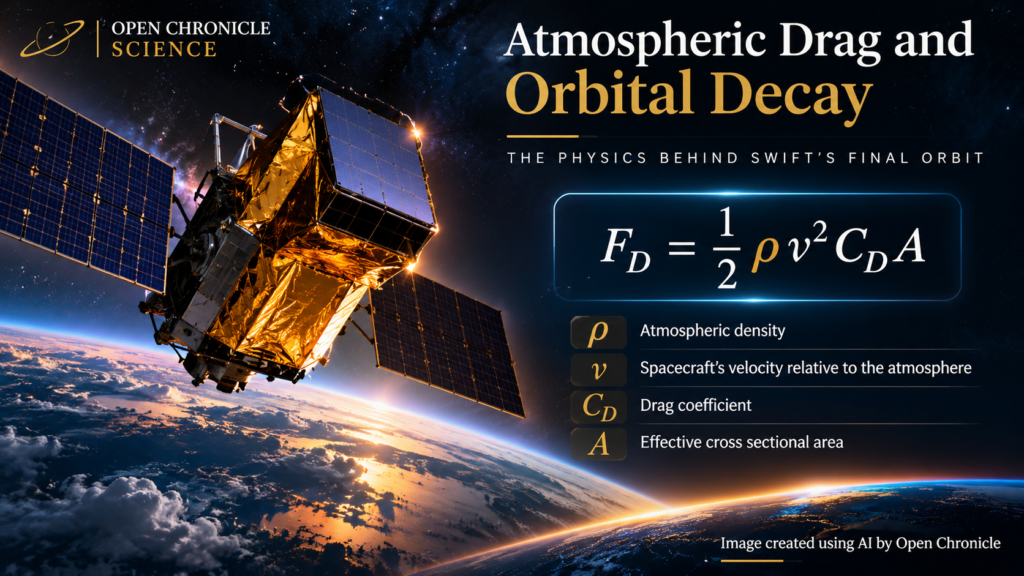
The drag force can be approximated by:


The equation illustrates why atmospheric density and spacecraft orientation are important.
Even small changes in density can affect orbital decay, while adjusting a satellite’s orientation may reduce its exposure to atmospheric resistance.
NASA attempted to exploit this principle during Swift’s final year.
The final scientific observations
In February 2026, mission controllers suspended much of Swift’s observing programme and maintained an orientation intended to reduce atmospheric drag.
The objective was to preserve sufficient orbital altitude for a proposed rescue operation.
Following the failure of that attempt, Swift resumed scientific observations in August, although not all instruments returned to full operation.
This decision allowed the spacecraft to continue contributing to astronomy, but the observing orientations also increased atmospheric drag.
By 20 October 2026, Swift had descended to approximately 275 kilometres above Earth’s surface.
At that altitude, the growing aerodynamic forces made stable astronomical pointing increasingly difficult.
The spacecraft entered safe mode, and its operations team at Pennsylvania State University subsequently issued the command that effectively ended the mission.
The observatory had made its final scientific observation.
7. The failed rescue: an ambitious experiment in orbital servicing
Swift’s final months were marked by an unusual effort to prevent its loss.
Rather than simply allowing the observatory to reenter the atmosphere, NASA commissioned a commercial mission to intercept the spacecraft and raise its orbit.
The project involved Katalyst Space, an American company developing robotic technologies for spacecraft servicing.
Its LINK vehicle was intended to rendezvous with Swift, capture the observatory and use its own propulsion system to increase Swift’s orbital altitude.
If successful, the operation could have extended the scientific life of a spacecraft that was never originally designed for this kind of intervention.
A race against orbital decay
The project operated under an unusually demanding timetable.
NASA awarded the servicing contract in September 2025.
LINK launched on 3 July 2026 aboard a Northrop Grumman Pegasus XL rocket from the Kwajalein region of the Pacific Ocean.
The spacecraft was developed and launched in approximately nine months, an exceptionally short schedule for a mission involving autonomous rendezvous and robotic interaction with another satellite.
But shortly after entering orbit, LINK experienced problems with its attitude control system.
The difficulties prevented the vehicle from reliably maintaining the orientation needed to perform the planned capture and boost operation.
On 19 August, NASA and Katalyst announced that LINK would not attempt to capture or raise Swift.
What the unsuccessful mission still achieved
Although the primary objective was abandoned, the mission provided operational experience involving rendezvous planning, proximity operations and the development of rapid commercial spacecraft servicing capabilities.
NASA subsequently examined the lessons that could be applied to future missions.
Katalyst reported that LINK itself reentered Earth’s atmosphere on 25 September 2026, concluding the servicing experiment before Swift’s own descent.
The distinction between scientific success and technological experimentation is important.
LINK did not save Swift.
However, the attempt illustrated both the promise and the difficulty of maintaining spacecraft that were not designed for servicing.
Future missions may benefit from standardized docking interfaces, improved autonomous navigation, more robust attitude control systems and spacecraft architectures that accommodate orbital maintenance from the outset.
Swift’s failed rescue could therefore contribute indirectly to a new generation of satellite servicing technologies.
8. The final descent over Indonesia
By early November, Swift’s remaining orbital lifetime was measured in days rather than months.
NASA and the United States Space Force monitored its trajectory, updating estimates as atmospheric drag accelerated the descent.
Predicting the exact reentry time of an uncontrolled satellite is difficult because upper atmospheric density changes continuously.
Uncertainty in the timing translates into uncertainty in the geographical location of reentry.
At orbital velocity, a spacecraft can travel thousands of kilometres in only a few minutes.
On 4 November, the uncertainty ended.
Tracking data placed Swift’s atmospheric reentry at approximately 12:39 UTC, corresponding to 07:39 Eastern Standard Time and 19:39 local time over northern Sumatra.
The Aerospace Corporation confirmed that the observatory broke apart over the region.
The spacecraft, weighing approximately 1,450 kilograms, encountered aerodynamic heating and forces sufficient to destroy most of its structure.
Some dense components may have survived the descent, but their survival and impact locations should not be assumed without physical confirmation.
NASA had estimated the overall risk of injury to anyone on Earth at approximately one in 2,100.
That figure represented a global casualty risk assessment, not the probability that any particular individual would be struck.
No injuries or damage had been reported in the immediate aftermath.
The event also illustrated the growing importance of monitoring uncontrolled spacecraft reentries as human activity in low Earth orbit expands.
9. What astronomy loses without Swift
The disappearance of Swift creates a challenge for astronomers studying rapidly changing phenomena.
The spacecraft’s importance was not limited to the sensitivity of its individual instruments.
Its greatest strength was the integration of detection, automatic pointing and rapid communication with the wider astronomical community.
A gamma ray burst could trigger a coordinated observational campaign involving telescopes on Earth and in space.
Researchers could then collect data during the crucial early stages of an event, when the radiation was changing most rapidly.
This capability was particularly valuable for rare and unpredictable phenomena.
The loss of Swift does not mean that gamma ray burst astronomy has ended.
Other spacecraft continue to detect high energy transients, while ground based telescopes and international networks provide essential follow up observations.
Nevertheless, replacing Swift’s particular combination of capabilities is more complicated than substituting a single instrument.
It requires coordination between detection systems, rapid alert networks, observatories operating at different wavelengths and increasingly sophisticated automated scheduling.
The age of multimessenger astronomy
Modern astronomy is also moving beyond electromagnetic radiation alone.
Gravitational wave observatories can detect disturbances in spacetime produced by mergers of compact objects.
Neutrino detectors provide another means of investigating extreme astrophysical environments.
Combining these signals with gamma rays, X rays, ultraviolet radiation, visible light and radio observations allows scientists to reconstruct cosmic events in greater detail.
The merger of neutron stars, for example, can produce gravitational waves and electromagnetic radiation that reveal different aspects of the same physical process.
Future observatories will increasingly need to respond to alerts originating from multiple kinds of detectors.
Swift helped establish the rapid response culture on which this approach depends.
Its operational legacy is therefore likely to remain important even as the technologies used to investigate the transient Universe continue to evolve.
10. An archive that will outlive the spacecraft
Although Swift no longer exists in orbit, its scientific observations remain available.
The mission generated a vast collection of measurements covering gamma ray bursts, supernovae, active galaxies, stellar flares, comets and other astronomical phenomena.
These observations form a long term scientific resource.
Astronomers can use them to investigate individual events, construct population studies, test theoretical models and compare historical observations with data from newer facilities.
Future advances in computational methods may also reveal information that was not apparent when the observations were first collected.
For example, improved statistical techniques could help identify weak signals, investigate correlations between different classes of transients or refine models of relativistic jets and accretion processes.
Machine learning methods may assist in classifying unusual events and searching extensive archives for previously overlooked behaviour.
Such work requires careful validation, particularly when algorithms identify signals close to instrumental detection limits.
Nevertheless, the scientific value of archival observations can continue increasing long after the instruments that produced them have ceased operating.
This is one of the defining characteristics of modern astronomical research.
A spacecraft may have a finite operational lifetime, but its data can remain scientifically productive for generations.
11. A lasting transformation in how humanity observes the Universe
Swift’s story began with a mystery.
Astronomers knew that the Universe produced extraordinary flashes of gamma radiation, but they needed better tools to understand where those explosions occurred and what physical processes generated them.
The observatory was designed to respond before the evidence disappeared.
It succeeded far beyond its original operational expectations.
During almost 22 years in orbit, Swift helped researchers investigate the deaths of massive stars, the mergers of compact objects, the behaviour of black holes and the complex environments surrounding some of the most energetic events in existence.
It demonstrated that speed could be as scientifically important as collecting area or angular resolution.
A telescope capable of responding within seconds could reveal information that a larger instrument might miss if it arrived too late.
Swift also showed the importance of collaboration.
Its observations were frequently most valuable when combined with measurements from other facilities, transforming isolated detections into coordinated investigations.
In its final months, the observatory became part of another experiment, this time in the engineering of spacecraft maintenance.
The attempt to rescue it failed, but the experience may influence how future satellites are designed, operated and serviced.
And its eventual reentry offered a reminder that even sophisticated scientific observatories remain subject to the physical environment of Earth orbit.
The spacecraft is gone.
Its instruments will never again turn toward a newly detected cosmic explosion.
But the discoveries it enabled, the methods it established and the archive it leaves behind remain part of the scientific infrastructure of modern astronomy.
For almost 22 years, Swift watched the Universe change.
In doing so, it permanently changed the way humanity watches the Universe.
Sources and Further Reading
The following official mission reports, scientific
documentation and independent tracking assessments
provide the research foundation for this article
on the Neil Gehrels Swift Observatory.
NASA | Swift Mission Ends, Leaves Behind Scientific Bonanza
Published: 23 October 2026
Official NASA scientific retrospective covering
the observatory’s discoveries, operational
achievements and long term contribution to
high energy astrophysics.
NASA | Swift Observatory Reentry
Published: 2 November 2026
Official preentry assessment detailing spacecraft
mass, atmospheric reentry predictions and the
evaluation of possible surviving debris.
The Aerospace Corporation | Swift Reenters Atmosphere
Published: 4 November 2026
Independent orbital tracking report confirming
the breakup over northern Sumatra and explaining
the role of space debris monitoring.
NASA | Swift Mission Ends Ahead of Reentry
Published: 23 October 2026
Mission operations update describing atmospheric
drag, the final scientific observations and
the end of spacecraft operations.
NASA | Updates Next Steps for Commercial Swift Boost Mission
Published: 19 August 2026
Official announcement explaining why the planned
LINK capture and orbital boost operation could
not proceed.
NASA | Lessons Learned From Swift Boost Mission
Published: 28 September 2026
Technical and operational assessment of the
servicing mission, including implications for
future robotic spacecraft operations.
Katalyst Space | LINK Mission Conclusion
Published: 25 September 2026
Company report on the robotic servicing experiment,
its operational achievements and the end of
the LINK spacecraft’s mission.
NASA Goddard | Neil Gehrels Swift Observatory
Official mission website providing scientific
documentation, gamma ray burst catalogues,
mission updates and access to archival resources.