
OPEN CHRONICLE | WARFARE JOURNAL | MILITARY INTELLIGENCE & ANALYSIS
An extensive investigation into Iranian missile and drone attacks across the Middle East reveals damage to American radar systems, aircraft, hangars and military infrastructure. The findings raise difficult questions about the vulnerability of US bases, the cost of modern warfare and the future of American military power in the Gulf.
By Open Chronicle News Desk
November 6, 2026 | Warfare Journal | Middle East Defense & Military Intelligence
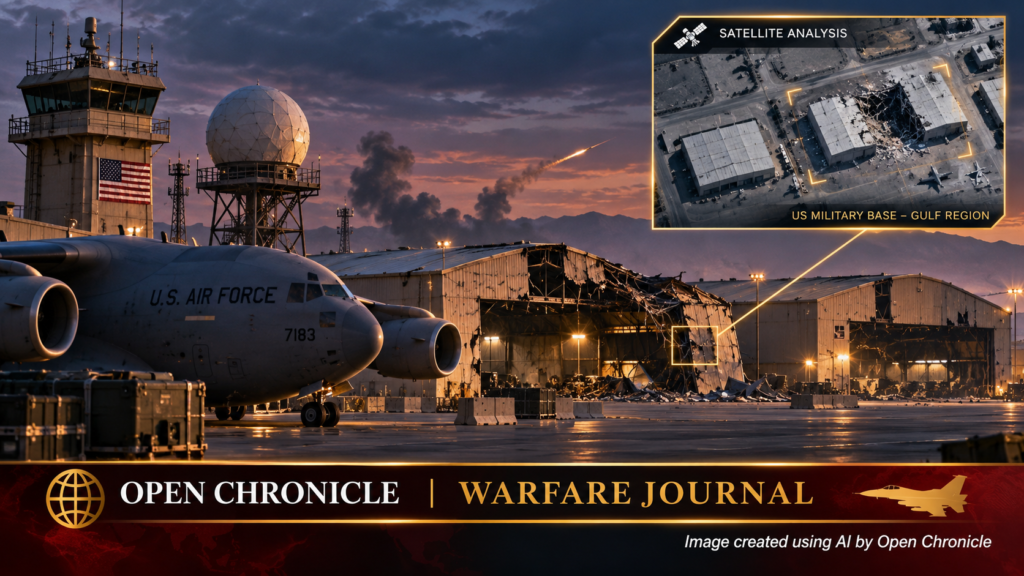
WASHINGTON, November 6, 2026. Satellite imagery and independent investigations have revealed extensive damage to American military installations across the Middle East following months of Iranian missile and drone attacks, providing one of the clearest assessments yet of the material costs of the conflict.
An Associated Press investigation published on October 31 identified more than 115 missile and drone strikes attributed to Iran or Iranian-backed groups that damaged or destroyed structures at 26 military bases and other sites housing American equipment through August 2026.
The findings indicate that Iran’s campaign was more systematic than a series of isolated retaliatory attacks.
According to the investigation, early strikes concentrated on radar installations, warning systems and aircraft infrastructure before expanding to warehouses, communications facilities, fuel installations and accommodation for military personnel.
The attacks caused extensive physical damage across multiple countries, including Kuwait, Bahrain, Saudi Arabia, Qatar, Jordan and the United Arab Emirates.
The financial implications are substantial.
The Associated Press reported equipment losses amounting to billions of dollars, although a complete, independently audited assessment of the destruction has not been made public.
For Washington, the findings present a strategic challenge extending beyond the immediate conflict with Tehran.
They raise questions about whether large, permanent military installations can remain adequately protected against sustained attacks involving increasingly sophisticated missiles and relatively inexpensive drones.
The Scale of the Damage
Investigation Snapshot
AP Findings Through August 2026
Figures reflect the Associated Press investigation, not a comprehensive Pentagon inventory. The 115+ figure refers to reported strikes associated with documented damage, not every projectile launched or intercepted.
OPEN CHRONICLE | WARFARE JOURNAL
Military Intelligence & Analysis | November 2026
The investigation relied on commercial satellite imagery from multiple providers, supplemented by interviews with four regional officials familiar with the damage.
Journalists examined approximately 40 military installations, comparing imagery from different dates to identify damaged buildings, destroyed equipment and changes to infrastructure.
The research documented hundreds of damaged or destroyed structures during the period from April through June.
The findings also demonstrate the limitations of publicly available military information.
The United States has not released a complete public inventory of damage sustained by its regional installations.
US Central Command declined to provide a detailed assessment to the Associated Press, citing operational security considerations.
Pentagon spokesman Sean Parnell maintained that American forces and installations remained adequately protected and capable of continuing their missions.
These positions are not necessarily contradictory.
A military force may retain substantial operational capability while simultaneously sustaining expensive losses at individual installations.
Nevertheless, the absence of a comprehensive official assessment makes independent satellite investigations particularly important.
Iran’s First Priority: Disrupting the Eyes of American Air Defences
One of the most consequential findings concerns the apparent sequence of Iranian attacks.
Rather than focusing exclusively on aircraft and troop facilities, Iranian forces initially targeted equipment responsible for detecting incoming threats.
These included radar installations, early warning systems and associated infrastructure.
Such systems are essential components of modern integrated air defence networks.
They provide information about approaching aircraft, drones and ballistic missiles, allowing commanders to identify threats and coordinate interception.
If radar coverage is degraded, defenders may face reduced warning times, incomplete situational awareness or greater dependence on alternative sensors.
The Associated Press identified damage to radar-related infrastructure at several installations, including Camp Arifjan in Kuwait, Naval Support Activity Bahrain, Prince Sultan Air Base in Saudi Arabia and Muwaffaq Salti Air Base in Jordan.
A particularly significant loss involved a specialised radar system in Jordan.
According to the investigation, the system was destroyed and represented an asset valued at approximately $500 million.
Another radar installation in Qatar sustained substantial damage, although investigators could not establish whether it had been completely destroyed.
The distinction matters.
Damage to an expensive military system does not automatically mean that every component is beyond repair.
However, even temporary disruption can have operational consequences if replacement equipment is scarce or difficult to deploy.
The pattern identified by investigators is consistent with an attempt to weaken defensive coverage before subsequent attacks.
It does not prove that every strike was successful or that Iran achieved comprehensive control over the regional airspace.
Kuwait: The Most Heavily Affected American Military Presence
Kuwait emerged as one of the principal locations affected by the attacks.
American forces maintain important installations in the country, which serves as a logistical and operational centre for military activities across the Middle East.
Two locations stand out in the investigation: Ali Al Salem Air Base and Camp Buehring.
Ali Al Salem Air Base
The Associated Press identified at least 30 strikes against Ali Al Salem Air Base.
The damage included at least 15 aircraft hangars, numerous warehouses and approximately 10 buildings near a residential area of the installation.
Satellite imagery from July showed widespread destruction across sections of the base.
Hangars are particularly important military facilities because they protect aircraft from environmental conditions, support maintenance and can provide shelter against certain threats.
Their destruction can complicate aircraft servicing, reduce operational flexibility and require the relocation of equipment.
However, a destroyed hangar does not necessarily mean that an aircraft inside it was also destroyed.
Satellite imagery must be interpreted carefully, particularly when equipment inventories are unavailable.
Camp Buehring
Camp Buehring sustained extensive damage to accommodation and support infrastructure.
The Associated Press documented more than 30 damaged or destroyed structures between early March and late August.
Affected facilities reportedly included a gymnasium, a dining facility, a garage and other buildings used by military personnel.
Such damage may appear less strategically important than the destruction of radar equipment.
Yet military installations depend on accommodation, maintenance, storage and logistical services to sustain operations.
Damage to these facilities can increase costs, disrupt daily activities and require personnel to be moved elsewhere.
The attacks also demonstrate that infrastructure supporting military personnel can become vulnerable even when it is not directly associated with offensive operations.
Bahrain: Communications and Naval Infrastructure Under Pressure
Bahrain hosts an important American naval presence and has long served as a strategic centre for US maritime operations in the Gulf.
Satellite imagery examined by the Associated Press showed damage to communications infrastructure and warehouses at Naval Support Activity Bahrain.
The installation supports American naval activities in a region central to international energy transportation and maritime security.
Communications systems are essential for coordinating naval movements, maintaining contact with deployed forces and exchanging operational information.
Damage to such infrastructure can create difficulties even when vessels themselves remain operational.
However, the publicly available imagery does not establish that American naval command capabilities were completely disabled.
Military communications networks frequently include redundant systems, alternative facilities and mobile equipment.
The significance of the damage therefore lies in the demonstrated vulnerability of fixed support infrastructure, rather than proof of a complete operational collapse.
Saudi Arabia: Aircraft and High-Value Equipment Targeted
Prince Sultan Air Base in Saudi Arabia was another important target.
The investigation reported damage to aircraft and infrastructure, including a Boeing E-3 Sentry airborne warning and control aircraft.
The E-3 is a specialised aircraft designed to detect and track airborne threats while helping coordinate military operations.
Its radar and communications systems make it significantly more complex than a conventional transport aircraft.
Damage to such equipment can therefore impose costs beyond the physical repair of an airframe.
It may also reduce the availability of specialised surveillance capabilities until repairs are completed or replacement aircraft become available.
The Associated Press reported that an attack damaged the rear section of an E-3 aircraft.
Regional officials also described damage to aerial refuelling aircraft and support facilities.
A Congressional Research Service report updated in October identified 15 American aircraft damaged at regional bases.
That figure provides an important reference point, but it should not be interpreted as the total number of aircraft damaged throughout the entire conflict.
The available assessment has a defined reporting period and may not include every subsequent incident.
Jordan, Qatar and the United Arab Emirates
The geographical distribution of the attacks demonstrates that the conflict’s military consequences extended across much of the Gulf security architecture.
In Jordan, damage to radar equipment and accommodation facilities highlighted the exposure of installations supporting regional air operations.
In Qatar, the reported damage to a major radar system raised concerns about the vulnerability of high-value defensive infrastructure.
The system’s complete operational status was not independently established in the reporting.
In the United Arab Emirates, Al Dhafra Air Base sustained attacks affecting hangars and other facilities.
Regional officials also reported damage to surveillance equipment and early warning infrastructure.
Taken together, these incidents illustrate a wider challenge.
American military power in the Middle East depends on a network of installations distributed across allied countries.
Those facilities provide strategic reach, logistical capacity, surveillance coverage and support for deployed forces.
But their geographical distribution also creates numerous potential targets.
Protecting every installation against repeated missile and drone attacks requires substantial resources and continuous adaptation.
Why Satellite Imagery Has Become Essential to Understanding the War
One of the most revealing aspects of the investigation concerns the difficulty of obtaining satellite photographs.
Commercial satellite imagery has become an important resource for journalists, researchers and independent analysts investigating armed conflicts.
Images captured at different times can reveal destroyed buildings, damaged runways, new defensive structures and changes in military activity.
However, access to imagery of American military installations in the Middle East became increasingly restricted during the conflict.
Several major commercial providers delayed or limited the release of images after requests from US authorities, with national security among the reasons cited.
This created significant obstacles for independent investigations.
Some of the clearest photographs of damaged installations became available only months after the attacks.
The Associated Press used imagery obtained through Airbus’s OneAtlas service to examine facilities that had previously been difficult to assess.
Other investigations adopted different methods.
In May, The Washington Post reported that it had verified 109 satellite images distributed by Iranian state-affiliated media by comparing them with European and commercial satellite data.
Its investigation identified at least 228 damaged structures or pieces of equipment at 15 American military sites.
The newspaper also excluded images when the available evidence was insufficient to establish their reliability.
This distinction is essential.
An image distributed by a party to a conflict is not automatically false, but neither should its accompanying claims be accepted without verification.
Independent analysis requires geolocation, comparison with earlier images and, where possible, confirmation from additional sources.
What Satellite Images Can and Cannot Prove
Satellite photographs provide powerful evidence, but their limitations must be understood.
They can show that a building has been destroyed, that a radar enclosure has disappeared or that an aircraft shelter has sustained visible damage.
They may also help establish an approximate timeframe for destruction.
However, images alone cannot always determine which weapon caused the damage, whether a military system was operational at the time or how quickly damaged equipment can be repaired.
A structure may also have been evacuated before an attack.
Similarly, damage to a building does not necessarily indicate the number of casualties inside it.
The Associated Press strengthened its findings by comparing satellite imagery with official statements, reports of attacks and interviews with regional officials.
Nevertheless, the investigation should not be treated as a complete military battle damage assessment.
The Pentagon retains access to information unavailable to independent investigators, including classified operational reports, equipment inventories and technical evaluations.
Conversely, the absence of a detailed public Pentagon assessment does not invalidate damage that can be independently documented.
Both considerations are important when interpreting the evidence.
The Economics of Modern Missile and Drone Warfare
The attacks also expose a fundamental imbalance in the economics of modern warfare.
Advanced radar systems, specialised aircraft and military communications infrastructure can cost hundreds of millions of dollars.
Some attack drones, by comparison, are considerably cheaper to manufacture and deploy.
This does not mean that every inexpensive drone can destroy a sophisticated military installation.
Successful attacks depend on targeting information, weapon characteristics, defensive coverage and numerous operational factors.
Nevertheless, repeated attacks can impose substantial costs on defenders.
Even when an incoming missile or drone is intercepted, the defending force may consume expensive interceptor ammunition.
If an attack succeeds against a high-value target, the financial consequences can be far greater.
Military planners must therefore consider more than the number of incoming weapons destroyed.
They must also assess the cost of maintaining defensive readiness, replacing damaged equipment and restoring operational infrastructure.
The conflict illustrates how relatively inexpensive attack systems can threaten assets whose replacement requires considerable time and resources.
For the United States, this raises questions about the long-term sustainability of maintaining large concentrations of expensive equipment at fixed regional bases.
The Vulnerability of Permanent Military Installations
For decades, large American military bases have served as the foundation of US power projection in the Middle East.
They provide aircraft maintenance, logistical support, command facilities, accommodation and storage for equipment and supplies.
Their size and permanence make them efficient operational centres.
But they also make them identifiable targets.
Satellite imagery, publicly available mapping and modern intelligence capabilities can provide adversaries with detailed information about fixed infrastructure.
Once an installation’s location and general layout are known, protecting it against sustained attacks becomes a complex and expensive undertaking.
The Iranian strikes demonstrate the dangers of concentrating valuable military assets in locations that cannot easily be moved.
They also highlight the importance of dispersal, hardened shelters, redundant communications and layered air defences.
These measures can reduce vulnerability, although none can guarantee complete protection.
A future American military posture in the region may place greater emphasis on mobile systems, distributed operations and facilities designed to remain functional after suffering damage.
Such changes would require substantial investment and cooperation with regional partners.
They could also affect the political and logistical arrangements that have supported the American military presence in the Gulf for decades.
Did Iran Achieve Its Military Objectives?
The satellite investigations provide evidence of substantial damage, but they do not establish that Iran achieved all its strategic objectives.
Iranian forces demonstrated an ability to strike American installations across a geographically extensive area.
Some attacks damaged expensive equipment and disrupted infrastructure.
However, the United States continued conducting military operations during the conflict.
American and allied air defence systems also intercepted numerous incoming threats.
A comprehensive assessment would therefore need to consider several factors.
These include the damage inflicted, the number of attacks intercepted, the effect on military operations, the losses suffered by Iranian forces and the broader political consequences of the war.
The available evidence supports the conclusion that Iran imposed significant material costs on American military infrastructure.
It does not, by itself, demonstrate that the United States lost its ability to operate militarily in the region.
Nor does it establish that Iran secured a decisive strategic victory.
Those broader conclusions would require information extending well beyond satellite photographs.
A Difficult Question for Washington: Rebuild or Reposition?
The scale of the damage raises an important strategic question.
Should the United States restore its existing installations, or should it reconsider how its forces are positioned across the Middle East?
Rebuilding damaged infrastructure would require substantial funding.
It could also leave the same facilities exposed to future attacks unless their defensive arrangements were significantly improved.
Repositioning forces might reduce exposure at certain installations.
However, moving personnel and equipment farther from potential conflict zones could increase logistical demands and complicate the speed of military responses.
A more distributed military presence could offer greater resilience, but it would also require additional facilities, coordination and investment.
There is no simple solution.
Permanent bases provide capabilities that cannot always be replicated by temporary or mobile deployments.
At the same time, the conflict has demonstrated that their security cannot be assumed.
The future of American military infrastructure in the Gulf may therefore depend on finding a new balance between operational efficiency, survivability and financial sustainability.
The Wider Implications for NATO and Allied Militaries
Although the investigation focuses on American installations in the Middle East, its implications extend beyond the region.
European militaries face similar challenges in protecting airfields, command centres, ammunition depots and other fixed infrastructure.
The war in Ukraine has already demonstrated the importance of drones, electronic warfare and dispersed military operations.
The Iranian attacks reinforce the need to examine how traditional military installations can withstand sustained precision strikes.
For NATO, the lessons may be relevant to air defence planning, logistical resilience and the protection of critical military infrastructure.
However, the operational environment in Europe differs from that of the Gulf.
Geography, military capabilities, alliance arrangements and the nature of potential threats all influence defensive requirements.
The Middle Eastern experience should therefore inform military planning rather than be treated as a universal model.
What Happens if the Conflict Escalates Again?
The possibility of renewed hostilities creates additional uncertainty.
Many of the damaged installations may require extensive repairs before returning to their previous condition.
Some high-value systems may take considerable time to replace.
Further attacks could therefore increase the financial and operational burden on American forces and their regional partners.
At the same time, the United States retains significant military capabilities, including assets that are not permanently stationed at the damaged installations.
Future developments will depend on political decisions in Washington and Tehran, diplomatic negotiations and the military situation.
Three broad outcomes are possible.
First, a sustained diplomatic arrangement could allow repairs and reconstruction to proceed while reducing the immediate threat of additional strikes.
Second, prolonged tension without major renewed fighting could require continued investment in defensive systems and force protection.
Third, renewed large-scale hostilities could expose damaged installations to further attacks and increase the cost of maintaining American military operations.
These are analytical scenarios, not predictions of confirmed future events.
Conclusion | A Warning About the Future of Military Power
The satellite investigations into Iranian attacks on American military bases reveal a conflict whose material consequences are more extensive than previously documented in official public statements.
The damage extends across radar installations, aircraft facilities, communications systems, warehouses and infrastructure supporting military personnel.
The findings also demonstrate that modern military power depends on more than advanced weapons and combat aircraft.
It requires a resilient network of bases, sensors, communications systems and logistical facilities.
When those supporting systems are damaged, the consequences can be expensive and operationally significant.
For Iran, the attacks demonstrated an ability to impose costs on American military infrastructure across several countries.
For the United States, the challenge is determining how to maintain regional military capabilities while reducing exposure to future attacks.
The investigation does not establish the outcome of the wider war.
But it does provide an important warning about the changing character of military conflict.
In an era of increasingly precise missiles, persistent surveillance and inexpensive attack drones, even the world’s most powerful military cannot assume that its permanent bases are beyond reach.
Sources and Further Reading
1. Associated Press | Iran Targeted US Air Defenses Before Hitting Aircraft and Buildings
Principal investigation combining satellite imagery and interviews with regional officials. Documents more than 115 damaging strikes at 26 military sites through August 2026, including attacks against radar systems, aircraft and supporting infrastructure.
2. The Washington Post | Iran Has Hit Far More US Military Assets Than Reported
Independent visual investigation documenting at least 228 damaged structures or pieces of equipment at 15 US military sites. Includes verification of satellite imagery using European Copernicus and commercial data.
3. Associated Press | AP Analysis Reveals Extensive Damage to US Bases
Explanation of the investigative methods used by AP journalists, including the examination of approximately 40 installations, satellite comparisons and cross-checking of official and independent accounts.
4. ABC News | Iran Targeted US Air Defenses, AP Analysis Finds
Republication of the Associated Press investigation with further contextual presentation of the damage at American military installations. This is a secondary publication of the AP reporting, not an independent investigation.
Editorial Note
This article was prepared on November 6, 2026, using independently reported satellite investigations and available official statements.
The principal Associated Press investigation was originally published on October 31, 2026. Its findings concern attacks and damage documented through August, rather than new strikes occurring on the date of this article.
Damage estimates are based on publicly available evidence and do not represent a comprehensive or audited US Department of Defense inventory. Figures from different investigations cover overlapping locations and periods and must not be added together.
Interpretations concerning Iranian targeting strategy, military vulnerability, reconstruction priorities and future US force posture are identified as analysis. Satellite imagery alone cannot establish the complete operational consequences of the attacks.