
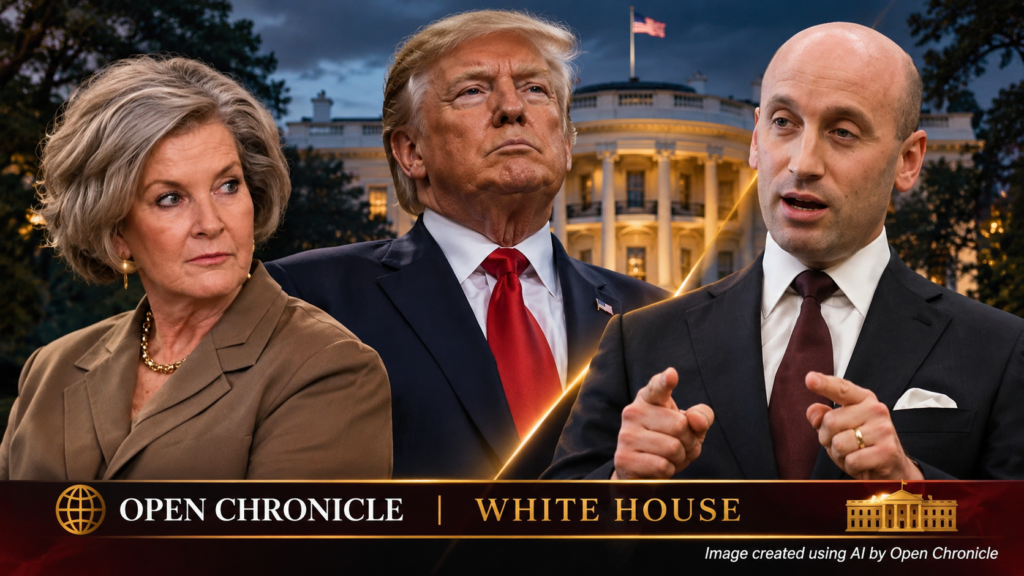
OPEN CHRONICLE | UNITED STATES | POLITICS
The president has selected one of his most influential and ideologically committed advisers to lead the White House staff after Republicans lost control of Congress, raising questions about the direction of his administration during the final two years of his presidency.
By Open Chronicle News Desk
November 6, 2026 | United States | Politics & Government
WASHINGTON, November 6, 2026. President Donald Trump announced Friday that Stephen Miller will replace Susie Wiles as White House chief of staff, marking a major leadership change just days after Republicans suffered a significant defeat in the United States midterm elections.
Miller, currently White House deputy chief of staff and one of Trump’s closest political advisers, is scheduled to assume his new responsibilities on Monday, November 9.
Wiles, who became the first woman to hold the position when Trump returned to the White House in January 2025, will leave the administration but continue working within the president’s political organisation.
The announcement comes at a particularly difficult moment for Trump, whose Republican Party has lost control of Congress following the November 3 elections.
The appointment places one of the administration’s most prominent advocates of restrictive immigration policies at the centre of White House operations.
It also raises broader questions about how Trump intends to govern during the remaining two years of his second term, particularly as relations with congressional Democrats become more confrontational.
Trump Announces a Major Change at the White House
Trump confirmed the decision through his Truth Social platform, describing Miller as one of his most trusted advisers and praising Wiles for her service.
The president said the transition would take effect on November 9 and that Wiles would move into a role supporting his political operation.
The announcement formally ends Wiles’ tenure as White House chief of staff, a position she had held since the beginning of Trump’s second administration.
Her departure follows months of speculation about possible personnel changes within the White House.
In October, reporting by The Washington Post described growing competition among senior administration officials as the Republican Party faced the prospect of substantial electoral losses.
Miller was among the figures discussed as a possible successor.
Nevertheless, the timing of the announcement does not, by itself, establish that the election results were the sole reason for Wiles’ departure.
The administration has not publicly presented a comprehensive explanation of the internal discussions that produced the decision.
Who Is Stephen Miller?
Stephen Miller has been a central figure in Donald Trump’s political movement for approximately a decade.
He joined Trump’s political circle during the 2016 presidential campaign and subsequently became a senior adviser in the president’s first administration.
Miller developed a reputation as one of the strongest advocates of restrictive immigration policies, tighter border enforcement and a more aggressive use of executive authority.
During Trump’s second term, he has served as deputy chief of staff for policy and as a senior adviser on homeland security.
His influence has extended beyond immigration into broader questions of domestic policy and presidential decision-making.
Unlike a chief of staff selected primarily for administrative experience or congressional relationships, Miller is closely identified with the ideological direction of Trump’s political agenda.
His appointment could therefore affect not only the organisation of the White House but also the balance of influence among the president’s advisers.
However, the extent of those changes will depend on how Miller exercises the position and how Trump distributes responsibilities within his senior team.
What Does the White House Chief of Staff Actually Do?
The White House chief of staff is one of the most powerful positions in the American executive branch.
Although the office does not require Senate confirmation, its occupant can exercise considerable influence over the president’s daily schedule, access to senior officials and the coordination of administration priorities.
The chief of staff traditionally oversees the White House’s internal organisation and helps ensure that policy decisions are implemented across different departments.
The position also plays an important role in managing relationships with Congress, federal agencies, political allies and external stakeholders.
A successful chief of staff must balance competing demands.
The president requires access to reliable advice, while senior officials need clear procedures for presenting policy options and resolving disagreements.
The office can therefore become particularly important during periods of political crisis.
With Democrats now controlling Congress, the administration will face a more difficult legislative environment.
Miller’s ability to manage those institutional relationships could become an important test of his leadership.
Susie Wiles: The Strategist Who Brought Discipline to Trump’s Operation
Susie Wiles entered the White House with a reputation as a disciplined political strategist.
She had played a leading role in Trump’s successful 2024 presidential campaign and was widely credited with helping establish a more organised political operation.
Her appointment in January 2025 represented an important departure from the personnel instability that characterised parts of Trump’s first presidency.
Between 2017 and 2021, Trump worked with four White House chiefs of staff.
Wiles became his longest-serving chief of staff and the first woman to occupy the office.
Her political experience extended beyond Trump.
She had previously worked on campaigns involving Florida politicians Rick Scott and Ron DeSantis, building extensive relationships within Republican politics.
Wiles was generally associated with a management style focused on internal coordination, political discipline and controlling access to the president.
Those qualities made her an influential figure in an administration known for strong personalities and competing centres of power.
Her departure therefore represents more than a routine personnel change.
It marks the end of a particular approach to managing the president’s immediate political environment.
A Departure After Months of Speculation
Questions about Wiles’ future had circulated before the midterm elections.
In December 2025, interviews published by Vanity Fair generated controversy after Wiles made candid remarks about Trump and other senior administration figures.
The episode attracted attention because of her unusually influential position within the White House.
More recently, reports suggested that senior officials were preparing for possible leadership changes following the elections.
Wiles also underwent treatment for breast cancer during 2026, a diagnosis she disclosed publicly in March.
Subsequent reporting indicated that she had responded successfully to treatment.
However, there is no established public evidence that her health was the determining factor behind the leadership transition.
It would therefore be inappropriate to present her medical history as the explanation for her departure.
Following Trump’s announcement, Wiles expressed pride in her work for the administration and reaffirmed her commitment to the president’s political movement.
Her continued involvement in Trump’s political organisation suggests that she is not leaving his wider circle of advisers.
The Midterm Elections Change the Political Landscape
The timing of the appointment is particularly significant.
Republicans entered the November 3 midterm elections facing growing political pressure over economic conditions, the administration’s foreign policy and public dissatisfaction with its direction.
The elections produced major Democratic gains and deprived Republicans of control of Congress.
For Trump, the result represents a fundamental change in the political environment.
During the first half of his second term, Republican congressional majorities provided important support for his legislative agenda.
With Democrats taking control, the administration will face stronger institutional opposition.
Congressional committees may intensify oversight of executive actions, government spending and administration decisions.
The president could also encounter greater resistance to new legislation.
These developments increase the importance of the White House’s internal organisation.
Miller will assume the chief of staff position at a moment when coordinating executive priorities and managing political confrontation could become more difficult.
A More Confrontational White House?
Miller’s appointment may signal a preference for maintaining a strongly ideological approach rather than moderating the administration’s agenda after the electoral defeat.
His political career has been closely associated with assertive immigration enforcement and the use of presidential authority to implement policy priorities.
Supporters regard him as a committed advocate of Trump’s political programme who understands the president’s objectives and is willing to defend them.
Critics argue that his policy positions and confrontational approach risk intensifying political polarisation and disputes over executive power.
Both perspectives will shape reactions to his promotion.
However, the appointment alone does not establish that Trump has decided to pursue a specific new policy or confrontation.
A chief of staff can influence the administration’s direction, but major decisions remain with the president.
The practical consequences will become clearer through future personnel appointments, policy announcements and interactions with Congress.
Immigration Policy Could Become an Even Greater Priority
Immigration has been one of the defining issues of Miller’s political career.
He has advocated strict border controls, expanded enforcement measures and significant restrictions on immigration.
His promotion could strengthen the influence of officials who favour maintaining or expanding those policies.
But the chief of staff position also requires attention to matters extending well beyond immigration.
Miller will be expected to help coordinate economic policy, national security, legislative strategy and relations between federal departments.
His ability to manage these responsibilities will be closely watched.
The administration must also operate within legal and constitutional constraints.
Congressional oversight, federal courts and statutory requirements can limit or challenge executive action.
With Democrats controlling Congress, those institutional pressures may become more pronounced.
Implications for Foreign Policy
The leadership change could also influence the way foreign policy decisions are coordinated inside the White House.
The United States faces major international challenges, including Russia’s war against Ukraine, tensions involving Iran, relations with China and the future of American security commitments.
The chief of staff does not replace the secretary of state, national security adviser or secretary of defence.
However, the office can affect which policy options reach the president and how disagreements among senior officials are managed.
Miller’s appointment may therefore influence the administration’s internal decision-making process.
It does not automatically mean that Washington will change its position on Ukraine, NATO, Iran or China.
Any such conclusion would require evidence from subsequent policy decisions.
For European governments, the immediate question will be whether the leadership transition changes the accessibility and coordination of senior White House officials.
With international negotiations already complicated by the changing political environment in Washington, continuity in presidential decision-making will remain important.
Three Questions That Will Define Miller’s Tenure
1. Can he manage a White House facing congressional opposition?
The administration will need to coordinate its response to Democratic oversight and potential legislative deadlock.
Miller’s experience as a policy adviser is extensive, but leading the entire White House staff will require a broader set of management responsibilities.
2. Will the administration change its political strategy?
The Republican defeat has increased pressure on Trump to reconsider how he communicates with voters and prioritises policy objectives.
Miller’s appointment could reinforce the existing agenda, but it remains unclear whether other strategic changes are planned.
3. What happens to Susie Wiles’ influence?
Wiles is leaving the chief of staff position but remaining involved in Trump’s political operation.
Her future responsibilities could determine whether she continues to exercise substantial influence over the president’s political strategy.
The relationship between the White House and Trump’s wider political organisation will therefore be worth monitoring.
A Leadership Change With Consequences Beyond Washington
The appointment is likely to attract attention internationally because of Miller’s prominent role in shaping some of Trump’s most consequential policies.
For American political institutions, the immediate significance lies in the transfer of authority within the president’s senior staff.
For international partners, the question is whether the new arrangement produces greater policy continuity or additional uncertainty.
For Republicans, the decision comes at a moment when the party must assess its electoral defeat and determine how to approach the next two years.
And for Democrats, the appointment provides another indication of the political figures who will shape the administration they now confront from Congress.
The announcement also illustrates the continuing importance of personal loyalty within Trump’s political organisation.
Miller’s long association with the president appears to have been an important factor in his selection.
Whether that loyalty translates into effective White House management remains to be seen.
Conclusion | A New Power Centre in Trump’s White House
Donald Trump’s decision to replace Susie Wiles with Stephen Miller represents one of the most consequential personnel changes of his second administration.
The transition removes a veteran political strategist who helped manage Trump’s return to the presidency and elevates an adviser closely associated with the administration’s ideological priorities.
It comes immediately after a Republican electoral defeat that has transformed the balance of power in Washington.
The appointment is confirmed, and Miller is scheduled to assume the position on November 9.
What remains uncertain is how the new chief of staff will approach the demands of the office and whether the leadership change will produce a broader shift in administration strategy.
For now, one conclusion is clear.
As Trump enters a more difficult phase of his presidency, Stephen Miller is moving from the centre of policy influence to the centre of White House power.
Sources and Further Reading
1. Associated Press | Trump Replaces Susie Wiles With Stephen Miller
Independent reporting confirming the president’s announcement, the leadership transition, Wiles’ departure and the political context following the midterm elections.
2. NPR | Stephen Miller Will Replace Susie Wiles as Trump’s Chief of Staff
Coverage of the appointment, Miller’s previous responsibilities and the political significance of the leadership change.
3. Trump Announcement | Leadership Transition Effective November 9
The president’s announcement on Truth Social, reproduced in contemporary reporting, specifies the date Miller will assume office and confirms Wiles’ move to Trump’s political operation.
4. The Washington Post | Power Struggle Erupts in Trump’s White House
Reporting published before the midterm elections examining internal competition, expectations of personnel changes and the possible succession to Susie Wiles.
Editorial Note
This article reflects information available on November 6, 2026. President Donald Trump has announced Stephen Miller’s appointment as White House chief of staff, effective November 9.
The leadership change follows the Republican Party’s midterm electoral defeat. The timing is confirmed, but the complete internal reasoning behind Susie Wiles’ departure has not been publicly established.
Discussion of possible changes in immigration, foreign policy, congressional relations and White House management constitutes editorial analysis rather than confirmation of future policy decisions.