
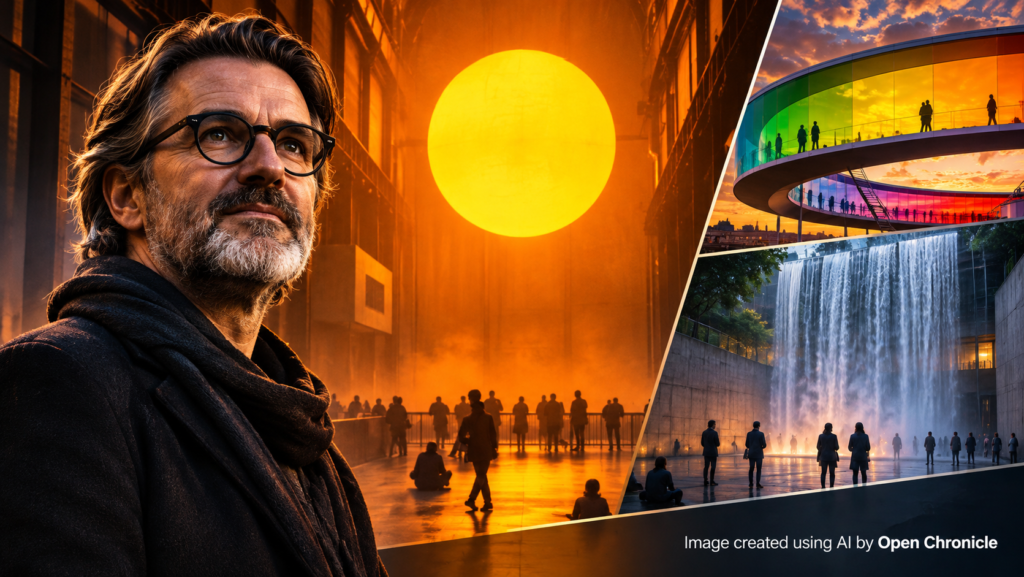
From artificial suns and immersive waterfalls to the architecture of human perception, Olafur Eliasson is redefining what it means to experience art.
10 November 2026 | Contemporary Art · Architecture & Design · Exhibitions & Museums
Introduction: When a Museum Becomes a World of Its Own
Imagine entering a museum and discovering a second sun suspended in the darkness.
It does not rise over a landscape. It does not belong to the sky. Yet its light changes the atmosphere around you, transforming an ordinary architectural space into something that feels almost impossible.
Visitors stop walking. They look upwards. Some remain motionless, while others move closer, trying to understand what they are seeing.
This is the extraordinary territory explored by Olafur Eliasson, the Danish-Icelandic artist whose installations have transformed museums into environments of light, water, colour and perception.
For more than three decades, Eliasson has challenged the traditional relationship between artwork and audience. Rather than asking visitors simply to observe an object, he invites them to experience a phenomenon.
His work can resemble a rainbow, a waterfall, a glacier or an artificial sun. But these are not attempts to reproduce nature perfectly. They are carefully constructed experiences that reveal how human perception shapes our understanding of the world.
On 10 November 2026, a major new chapter in that artistic journey attracted international attention.
ARoS Aarhus Art Museum, in Denmark, announced a long-term partnership with Eliasson, bringing together a monumental luminous sculpture, a major exhibition planned for 2027, a public installation and a research programme.
The initiative, called Shared Futures, suggests a new possibility for contemporary museums.
What if a museum could become more than a place to exhibit art? What if it could also function as a laboratory for understanding perception, the environment and the relationship between people and their surroundings?
1. A New Artificial Sun for Denmark
At the centre of the new partnership is Presence, a monumental installation created in 2025.
The work takes the form of a glowing yellow sphere that appears to float in space.
Its visual language is unmistakably connected to Eliasson’s long-standing fascination with the sun, atmospheric light and the emotional effects of illumination.
ARoS plans to acquire the sculpture for its collection.
The decision is significant because it establishes a permanent institutional relationship with a work that embodies one of the artist’s central concerns: the transformation of a physical environment through carefully controlled sensory experience.
A glowing sphere might appear deceptively simple.
Yet the experience of encountering it depends on several interacting elements.
The intensity and colour of the light influence the surrounding space. The apparent position of the sphere changes the viewer’s sense of distance and scale. The contrast between illumination and darkness can make the object seem less like a sculpture and more like an atmospheric event.
Eliasson’s work frequently draws attention to these relationships.
The viewer is not simply looking at an artwork.
The viewer is becoming aware of the conditions that make seeing possible.
2. Shared Futures: More Than an Exhibition
The partnership between Eliasson and ARoS has been developed over several years.
Its programme includes Thin Ice, a major solo exhibition scheduled to open in autumn 2027.
The exhibition will bring together significant works from different periods of the artist’s career alongside new projects examining climate, ecology and humanity’s relationship with the surrounding world.
A site-specific version of Waterfall is also planned for ARoS Art Square, beginning on 9 October 2027.
Unlike an installation confined to a traditional exhibition gallery, this work is intended to occupy public space, making an artistic experience available beyond the museum’s interior.
The initiative also includes a publicly accessible library dedicated to Eliasson’s artistic production.
The library will be accompanied by access to research materials and the artist’s digital archive, creating opportunities for visitors, students and researchers to explore the ideas behind his work.
In collaboration with Aarhus University, the partnership will support a dedicated postdoctoral research position.
Taken together, these elements represent a model of institutional collaboration that extends beyond a temporary exhibition.
The museum is investing in the artist’s work, but also in the study of his creative processes, his intellectual influences and the broader questions raised by his practice.
3. The Weather Project: The Sun That Transformed Tate Modern
In 2003, Eliasson created one of the most memorable museum installations of the early twenty-first century.
The Weather Project, presented in the Turbine Hall of Tate Modern in London, transformed the vast industrial interior into an environment dominated by a monumental artificial sun.
The installation used a semicircular screen, a mirrored ceiling, artificial mist and approximately 200 monofrequency lights.
The mirror doubled the apparent height of the space and completed the illusion of a circular sun.
The mist diffused the light, filling the hall with a yellow atmosphere that altered the appearance of the surroundings.
Visitors could observe the installation from a distance, walk beneath its reflected light or look upwards and discover their own images in the enormous mirrored ceiling.
The experience was both theatrical and revealing.
Eliasson did not attempt to conceal every part of the mechanism. Visitors could discover how the illusion had been constructed.
That openness was essential to the artwork’s meaning.
The installation invited people to consider not only the beauty of the artificial sunset, but also the relationship between perception, representation and the physical environment.
It transformed the museum into a place where viewers could investigate their own experience of seeing.
The work was presented from October 2003 until March 2004 and remains one of the defining projects of Eliasson’s career.
4. Your Rainbow Panorama: Walking Through Colour
Eliasson’s relationship with ARoS began long before the newly announced partnership.
In 2004, the museum presented Minding the World, his first solo exhibition in Denmark.
Seven years later, the relationship acquired an extraordinary architectural dimension.
In 2011, Your Rainbow Panorama opened on the museum’s roof.
The installation consists of a circular walkway approximately 150 metres long, enclosed by glass panels in different colours.
Visitors can walk around the structure while observing Aarhus through a constantly changing spectrum.
The city becomes red, orange, yellow, green, blue and violet as they move.
The work transforms an ordinary act of looking into an exploration of colour and perception.
The buildings, streets and sky remain physically unchanged.
Yet their appearance shifts dramatically according to the colour of the glass.
The installation demonstrates how perception depends on the conditions through which the world is observed.
It also establishes a relationship between the museum and the city.
Rather than containing an artwork entirely within its galleries, ARoS incorporates art into its architectural identity.
The museum itself becomes an instrument through which visitors experience the surrounding landscape.
5. Waterfalls, Weather and the Art of Recreating Nature
Water has been another recurring element in Eliasson’s artistic practice.
In 2008, he created The New York City Waterfalls, a public art project that introduced monumental artificial waterfalls along the East River.
The installations drew attention to the urban waterfront and encouraged viewers to reconsider the relationship between the built environment and natural processes.
Eliasson’s interest in waterfalls is not simply aesthetic.
Water possesses qualities that make it particularly suitable for exploring perception.
It moves continuously, reflects light, produces sound and changes appearance according to the surrounding environment.
An artificial waterfall can therefore generate an experience that is simultaneously visual, physical and emotional.
The planned installation at ARoS will continue this investigation.
By placing a waterfall in a public square, the artist introduces a phenomenon usually associated with natural landscapes into an urban cultural setting.
The contrast encourages visitors to question the boundaries between nature and construction.
What appears natural may be the result of engineering.
What appears artificial may nevertheless produce an authentic emotional response.
This tension lies at the centre of Eliasson’s artistic philosophy.
6. Why Eliasson’s Art Is About More Than Spectacle
It would be easy to describe Eliasson’s installations as spectacular environments designed to impress visitors.
Their visual impact is undeniable.
A giant artificial sun, a rainbow suspended above a city or a waterfall emerging from an urban structure can produce immediate fascination.
But spectacle alone does not explain their artistic significance.
Eliasson’s work frequently asks visitors to become conscious of their own participation in an experience.
Consider Your Rainbow Panorama.
The artwork does not present a single image that remains unchanged.
Its appearance depends on where the visitor stands, the direction in which they look and the light conditions outside.
Movement becomes part of the artistic process.
Similarly, The Weather Project made the audience’s presence visible through the mirrored ceiling.
The visitors were not simply observing the artificial sun. They could also observe themselves and one another within the environment.
This relationship between the artwork and its audience challenges the idea of art as an autonomous object.
The experience is produced through interaction.
It emerges from the meeting between physical materials, architectural space and human perception.
7. The Artist as an Investigator of Perception
Eliasson’s artistic practice occupies a territory where art, science and philosophy frequently intersect.
Light is a physical phenomenon, but it is also an essential condition of visual experience.
Colour depends on interactions between illumination, materials and the human visual system.
Space is measurable, yet the way people experience distance, scale and orientation can be profoundly subjective.
Eliasson’s installations investigate these relationships.
A coloured glass walkway changes the appearance of a city without changing the city itself.
An artificial sun produces an atmospheric experience using industrial materials and controlled lighting.
A waterfall transforms a familiar urban environment through movement, sound and scale.
These works invite audiences to reconsider the apparent stability of everyday reality.
The world may seem familiar, but perception is constantly being shaped by conditions that often remain unnoticed.
In this sense, Eliasson’s art is not simply about looking at natural phenomena.
It is about discovering how looking works.
8. Climate Change and the Fragility of Nature
Environmental questions have become increasingly important within Eliasson’s artistic practice.
In collaboration with geologist Minik Rosing, he developed Ice Watch, a project that brought blocks of glacial ice into urban public spaces.
The installations allowed people to encounter melting ice directly.
Rather than presenting climate change exclusively through statistics, the project created an immediate physical experience of a changing natural material.
The ice could be seen, touched and heard as it melted.
Its disappearance made the passage of time visible.
This approach demonstrates how art can communicate environmental questions through sensory experience.
Scientific information remains essential to understanding climate change.
But artistic interventions can introduce a different form of engagement, connecting abstract processes with direct observation.
The planned Thin Ice exhibition at ARoS will continue Eliasson’s exploration of ecology and humanity’s relationship with its surroundings.
Its title suggests fragility and instability, although the precise meanings of the exhibition will become clearer as its programme develops.
The connection between environmental awareness and artistic perception remains one of the most compelling aspects of his work.
9. A Museum That Becomes a Research Institution
One of the most significant aspects of Shared Futures may be less visually dramatic than its monumental installations.
The creation of a dedicated library and postdoctoral research position suggests an expanded understanding of what a museum can do.
Museums have traditionally preserved collections, organized exhibitions and supported scholarly research.
But the new partnership places the study of a living artist’s practice at the centre of a long-term institutional relationship.
The library will allow visitors and researchers to investigate the intellectual foundations of Eliasson’s work.
The research position developed with Aarhus University introduces an academic dimension that extends beyond exhibition programming.
Together, these initiatives could encourage new interpretations of the relationship between artistic production, architecture, environmental thinking and public experience.
They also raise an interesting institutional question.
How can museums preserve not only finished artworks, but also the ideas, experiments and collaborative processes that produce them?
For an artist whose work often depends on technical systems, spatial conditions and audience participation, that question is particularly relevant.
10. The Future of Museums: From Observation to Participation
The announcement at ARoS belongs to a broader transformation in museum culture.
Contemporary museums increasingly seek to create experiences that extend beyond the traditional encounter between a visitor and an object displayed on a wall.
Immersive installations, architectural interventions, public artworks and interdisciplinary programmes have expanded the possibilities of exhibition design.
These developments also introduce challenges.
An impressive visual environment does not automatically produce meaningful artistic engagement.
Museums must balance the appeal of spectacular installations with interpretation, historical context and opportunities for critical reflection.
Eliasson’s practice offers an interesting model because the sensory experience is frequently connected to an underlying investigation.
The artificial sun raises questions about perception.
The rainbow walkway reveals the instability of colour.
The waterfall encourages reflection on the relationship between nature and urban construction.
The melting ice introduces environmental change through a direct physical encounter.
In each case, the experience provides an entry point into a larger question.
The museum becomes a place where curiosity can develop into understanding.
11. Why the ARoS Partnership Matters in 2026
The significance of the new agreement lies in its combination of artistic production, public access and research.
The acquisition of Presence strengthens the museum’s collection.
The planned Thin Ice exhibition creates an opportunity to examine Eliasson’s career and recent environmental concerns.
The new Waterfall installation will extend artistic activity into public space.
The library and academic research programme will support longer-term engagement with his work.
These initiatives build upon a relationship that has developed over more than two decades.
They also suggest that a museum’s relationship with an artist need not end when an exhibition closes.
Instead, the institution can become a continuing centre for artistic investigation, education and public discussion.
Whether this model will influence other museums remains to be seen.
But the ambition is clear.
ARoS is seeking to establish a deeper relationship between the artist, the institution and the communities that encounter his work.
Conclusion: The Art of Seeing the World Differently
Olafur Eliasson has spent much of his career creating experiences that appear familiar and extraordinary at the same time.
A sun illuminates a museum.
A rainbow changes the appearance of a city.
A waterfall emerges from an urban structure.
A block of ice slowly disappears before the eyes of its audience.
These works use recognizable natural phenomena to reveal something less obvious.
Our experience of the world is shaped by light, movement, environment and perception.
Art can make those conditions visible.
The new partnership between Eliasson and ARoS suggests that museums can play an important role in this process.
They can become places where artistic experimentation meets scientific curiosity, where public spaces are transformed through creative interventions and where research helps deepen the understanding of contemporary art.
The artificial sun is therefore more than a luminous object.
It is an invitation to reconsider what we see, how we see it and how our surroundings influence our understanding of reality.
And perhaps that is the most enduring achievement of Olafur Eliasson’s work.
He does not simply create extraordinary things to look at.
He creates extraordinary ways of looking.
Artist and Project Information
| Field | Information |
|---|---|
| Artist | Olafur Eliasson |
| Born | 1967, Copenhagen, Denmark |
| Artistic identity | Danish-Icelandic |
| Principal studio | Studio Olafur Eliasson, Berlin |
| New partnership | Olafur Eliasson × ARoS: Shared Futures |
| Museum | ARoS Aarhus Art Museum |
| Location | Aarhus, Denmark |
| Announced | November 2026 |
| New acquisition | Presence (2025) |
| Planned exhibition | Thin Ice, autumn 2027 |
| Planned public installation | Waterfall, from 9 October 2027 |
| Additional initiatives | Public library, digital archive access and postdoctoral research |
| Previous ARoS landmark |
Your Rainbow Panorama (2011) |
Sources and Further Reading
Selected journalism, museum documentation and official
artist resources supporting our examination of Olafur
Eliasson’s work and his new partnership with ARoS.
The Art Newspaper | ARoS Acquires Sun-Like Olafur Eliasson Sculpture
10 November 2026.
Reporting by Gareth Harris on the Shared Futures
partnership, the acquisition of Presence
and the planned 2027 programme.
ARoS Aarhus Art Museum | Official Exhibitions and Collection
Institutional information about the museum,
its permanent installations and its
exhibition programme.
Studio Olafur Eliasson | The Weather Project
Official documentation of the 2003 Tate Modern
installation, including its materials, construction
and conceptual background.
Studio Olafur Eliasson | Your Rainbow Panorama
Official documentation of the permanent
architectural installation completed at
ARoS in 2011.
Ocula | At Aarhus Art Museum, Olafur Eliasson Is Getting His Own Library
9 November 2026.
Additional reporting on the public research
library, digital archive, exhibition and
academic collaboration.
This article is based on reporting published on 9 and 10 November 2026, official documentation from Studio Olafur Eliasson and institutional information from ARoS. The 2027 exhibition and installations are announced plans, not completed events. Interpretations of their potential influence on museum practice are independent editorial analysis.
Open Chronicle Arts Magazine
Explore the world of art, creativity and culture. Discover extraordinary artists, timeless masterpieces, contemporary movements and the stories behind the works that shape our world.
Back to Arts Magazine