
OPEN CHRONICLE | INTERNATIONAL RELATIONS | 10 NOVEMBER 2026
Europe depends on maritime trade, yet its governments are struggling to provide enough warships to protect one of the world’s most important shipping corridors. Italy’s warning over the European Union’s Operation Aspides exposes a widening gap between Europe’s strategic ambitions and the military resources its member states are prepared to commit.
By Open Chronicle International Affairs Desk
In-depth Analysis | Security and Conflict
A warning from Rome that Europe cannot easily ignore
Europe’s ambition to become a more capable security actor is facing a practical test thousands of kilometres from Brussels.
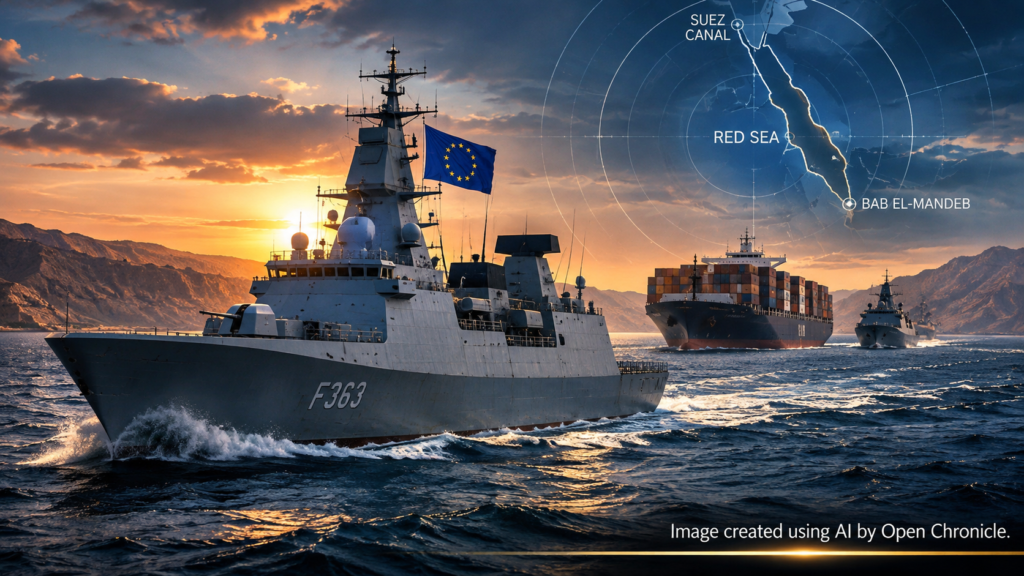
In the Red Sea, one of the world’s most important maritime corridors, European naval forces are attempting to protect commercial vessels from attacks associated with the widening conflict in the Middle East.
But the European Union’s defensive maritime operation, EUNAVFOR Aspides, is struggling to secure the additional warships that officials believe are necessary to carry out its mission effectively.
On 10 November 2026, Italian Defence Minister Guido Crosetto publicly criticised the lack of concrete commitments from European partners, arguing that repeated appeals for reinforcements had not produced the required response.
Crosetto had called for the mission to be strengthened in September. According to Reuters, the EU’s foreign policy chief, Kaja Kallas, subsequently wrote to the bloc’s 27 member states urging them to contribute more naval assets.
Her assessment was significant: more than ten warships would be needed for the mission to operate effectively.
Yet discussions among European governments have failed to produce the additional commitments sought by Rome.
The Italian minister also questioned the distribution of responsibilities among EU members, arguing that Italy was carrying a disproportionate share of European operational commitments.
The dispute is about more than the number of ships available for deployment.
It exposes a recurring weakness in European security policy: the difference between collectively recognising a strategic threat and individually providing the military capabilities needed to address it.
The European Union has extended Aspides until February 2027 and expanded elements of its mandate.
However, political approval of a mission does not automatically guarantee the ships, crews, equipment and logistical support required to sustain it.
The resulting gap has implications for commercial shipping, European economic security and the credibility of the EU’s ambitions to act as a serious geopolitical power.
The immediate development was reported by Reuters on 10 November. The mission’s continuation and revised mandate are independently confirmed by official Council of the European Union decisions.
What is Operation Aspides?
EUNAVFOR Aspides is the European Union’s defensive maritime security operation established in February 2024 in response to attacks against international shipping in and around the Red Sea.
Its name derives from the Greek word for shields, reflecting its principal purpose: protecting commercial navigation rather than conducting a campaign of offensive strikes.
The operation was formally established on 8 February 2024 and launched on 19 February.
Its original tasks included accompanying commercial vessels, maintaining maritime situational awareness and protecting ships against threats in accordance with its mandate and international law.
The distinction between defensive protection and offensive military action is fundamental.
Aspides is not designed as a campaign to destroy the military capabilities of Yemen’s Houthi movement on land.
Instead, it seeks to provide a protective naval presence along maritime routes threatened by missiles, drones and other forms of attack.
This can involve monitoring threats, escorting vulnerable ships and responding defensively when vessels come under attack.
The mission operates across a strategically extensive maritime region, including the Red Sea, the Gulf of Aden and surrounding waters.
Its area of operation also encompasses the Bab el-Mandeb Strait and the Strait of Hormuz, together with other relevant international waters in the wider region.
Its headquarters are located in Larissa, Greece.
The operation is commanded by Rear Admiral Vasileios Gryparis, according to the Council’s February 2026 statement.
In February 2026, the Council extended the mandate until 28 February 2027.
The decision allocated a financial reference amount of almost €15 million for common operational costs covering the period from March 2026 to February 2027.
That figure is not the total cost of deploying European warships.
Individual member states bear substantial national costs associated with ships, personnel, maintenance, equipment and operational readiness.
The distinction is important because the existence of a common EU budget does not mean that Brussels can independently deploy a fleet of warships.
Those vessels remain national military assets, made available through decisions taken by individual governments.
The geography that makes the Red Sea indispensable
The Red Sea connects the Mediterranean with the Indian Ocean through the Suez Canal and the Bab el-Mandeb Strait.
For vessels travelling between Europe and Asia, this corridor offers a much shorter route than sailing around southern Africa.
A ship departing an Asian manufacturing centre for a European port can use the Indian Ocean, pass through Bab el-Mandeb, cross the Red Sea and transit the Suez Canal before entering the Mediterranean.
This route supports the movement of manufactured goods, industrial components, energy supplies and consumer products.
Its importance extends beyond the countries bordering the waterway.
European factories depend on imported components.
Retailers rely on predictable delivery schedules.
Shipping companies organise vessels and container capacity around expected journey times.
Energy markets respond to changes in transport costs and supply risks.
When the corridor becomes unsafe, ships may be diverted around the Cape of Good Hope.
That alternative avoids the threatened waters but generally requires longer voyages, additional fuel and more vessel time.
The consequences can spread through international supply chains.
Longer journeys may reduce the effective capacity of shipping fleets because vessels spend more time completing each round trip.
Insurance costs can rise when the risk of attack increases.
Ports may experience disruptions as arrival schedules change.
Importers and exporters may face higher costs or uncertainty over delivery times.
These effects do not necessarily produce immediate consumer price increases in every market.
Their impact depends on freight contracts, inventory levels, competition, demand and the ability of companies to absorb additional costs.
Nevertheless, prolonged disruption can create inflationary pressure, particularly when it affects both manufactured goods and energy supplies.
For Europe, maritime security is therefore not an abstract foreign policy concern.
It is part of the infrastructure supporting the continent’s economic activity.
Why Italy is particularly concerned
Italy occupies a strategically important position in Mediterranean trade.
Its ports connect European manufacturing regions with international shipping networks, including routes linking the Mediterranean to Asia through the Suez Canal.
For Italian exporters and importers, disruption in the Red Sea can affect delivery times, transport costs and commercial competitiveness.
According to the shipowners’ association Assarmatori, cited by Reuters, approximately 40 percent of Italy’s international trade passes through the Suez Canal.
This is an industry association’s estimate, rather than an independently established figure for every category of Italian trade.
It nevertheless illustrates why Rome regards the security of the route as a national economic priority.
Italy also contributes significantly to European maritime operations.
Crosetto argued on 10 November that approximately one third of European operational commitments depended on Italy’s contribution.
That statement should be understood as the minister’s assessment of Italy’s burden across European operations, not as a verified claim that Italy supplies one third of the ships assigned to Aspides at any particular moment.
His criticism highlights a persistent problem in multinational defence cooperation.
Countries do not necessarily contribute military assets in proportion to their economic size or the benefits they receive from collective security.
Some governments may be more willing to deploy naval forces because they perceive an immediate national interest.
Others may face domestic political constraints, competing military obligations or limited available capabilities.
A country can support a mission politically while remaining reluctant or unable to provide a warship.
For Italy, this creates a difficult imbalance.
Its commercial exposure encourages a strong operational commitment, but the mission’s success depends on contributions from other European states.
Rome cannot independently resolve a shortage of assets within a collective European operation.
Why ten warships may not be enough
Kaja Kallas’s reported assessment that Aspides would need more than ten warships reflects the operational challenges of protecting shipping across an extensive and threatened maritime environment.
A warship cannot be present everywhere simultaneously.
It may accompany a particular commercial vessel or group of vessels while other ships transit different parts of the region.
Naval forces must also account for maintenance, replenishment, crew requirements, transit times and periods when ships are unavailable for operations.
The number of vessels nominally assigned to a mission is therefore not the same as the number available for immediate defensive tasks.
An operation requiring continuous protection may need multiple ships to sustain a smaller number of active patrol positions.
The exact requirement depends on the threat environment, the number of commercial vessels seeking protection, the geographical area and the capabilities of the warships involved.
A modern frigate equipped with advanced radar, electronic warfare systems and air defence missiles may provide important protection against certain threats.
But its defensive capabilities are not unlimited.
Missile inventories are finite.
Sensors have operational limitations.
A warship protecting one vessel cannot necessarily guarantee the safety of another ship operating far beyond its effective defensive coverage.
Naval planners must also consider the possibility of simultaneous or repeated attacks.
An adversary may employ combinations of drones, missiles and other systems to complicate defensive responses.
The resulting challenge is not simply to place ships in the Red Sea.
It is to maintain an effective protective network with sufficient endurance, situational awareness and defensive capacity.
Kallas’s figure is best understood as a reported assessment of operational needs, not a publicly demonstrated guarantee that a particular number of warships would eliminate the threat.
Even a substantially reinforced mission could not promise complete security.
The Houthi threat and the widening regional conflict
The immediate security challenge emerged from attacks by Yemen’s Houthi movement against commercial shipping.
The Houthis, also known as Ansar Allah, control substantial territory in northern Yemen and have developed missile and drone capabilities.
Their attacks against shipping intensified after the outbreak of the Gaza war in October 2023.
The movement has presented its operations as part of its confrontation with Israel and its allies.
However, the impact on international maritime navigation has extended beyond vessels directly connected to Israel.
Commercial shipping involves complex ownership structures, flag registrations, chartering arrangements and cargo destinations.
A vessel’s commercial links may not be immediately apparent, and the risk of attack can influence the decisions of shipping companies regardless of whether their ships are intended targets.
The Houthis have received support from Iran, although this does not mean that every operational decision is necessarily directed by Tehran.
The regional security situation became still more complicated in 2026.
The conflict involving the United States, Israel and Iran has disrupted maritime routes and heightened concerns about security around both Bab el-Mandeb and the Strait of Hormuz.
These waterways serve different geographical functions.
Bab el-Mandeb connects the Red Sea with the Gulf of Aden.
Hormuz connects the Persian Gulf with the Gulf of Oman and is particularly important for energy exports.
Threats affecting both corridors can produce overlapping pressures on maritime trade and energy markets.
Reuters reported on 10 November that Houthi attacks against commercial shipping and strategic infrastructure had intensified, while Saudi Arabia had also conducted strikes against Houthi targets in Yemen.
The wider conflict increases the complexity of maritime security operations.
European naval forces must protect commercial navigation while avoiding unnecessary escalation and operating within their legal and political mandates.
That balance is particularly important for Aspides because the operation was designed as a defensive mission.
Why the European Union cannot simply send more ships
At first glance, the problem appears straightforward.
If European officials believe the mission needs additional warships, member states could agree to deploy them.
In practice, naval force generation is considerably more complicated.
The European Union does not possess a large permanent navy under its independent command.
Its maritime operations depend on ships and personnel contributed by national governments.
Those governments must balance multiple commitments.
European navies may be involved in NATO operations, national maritime security missions, training exercises, maintenance programmes and deployments in other regions.
The war in Ukraine and heightened security concerns in European waters have also increased attention to the continent’s immediate defence requirements.
Naval availability is further constrained by maintenance cycles and personnel requirements.
A frigate may exist within a country’s fleet without being ready for immediate deployment.
Even when a vessel is operational, assigning it to the Red Sea may require withdrawing it from another mission.
Some countries possess only small numbers of major surface combatants.
Others may have larger fleets but face competing priorities.
The result is a familiar collective action problem.
All member states may benefit from secure maritime trade, but each government has an incentive to preserve scarce military assets for its own national requirements.
This does not necessarily indicate indifference to maritime security.
It reflects the fact that political commitments and military capabilities operate under different constraints.
The European Union can establish a mission, extend its mandate and coordinate contributions.
It cannot automatically create the national assets required to fulfil every operational ambition.
That is the structural weakness exposed by the current dispute.
A defensive mission in an increasingly dangerous environment
One of Aspides’ defining characteristics is its defensive mandate.
That approach reflects a deliberate European policy choice.
Rather than pursuing an extensive offensive campaign against Houthi positions, the mission focuses on protecting vessels and maintaining freedom of navigation.
The distinction carries political and operational consequences.
A defensive mission can provide protection without necessarily becoming a direct participant in a broader campaign against the authorities controlling northern Yemen.
It may also make participation more acceptable to European governments concerned about escalation.
However, defensive operations still require substantial military capabilities.
A warship may need to detect incoming threats, determine their nature and respond within a limited period.
Such operations depend on trained personnel, functioning sensors, communications and appropriate defensive weapons.
The cost of maintaining that capability can be considerable.
A further complication is that defensive success does not necessarily remove the underlying threat.
Intercepting an incoming missile may prevent damage to a commercial vessel, but it does not eliminate the organisation’s capacity to launch future attacks.
Consequently, naval protection may need to be sustained for as long as the threat persists.
This makes Aspides a demanding mission even when individual defensive operations are successful.
The question facing European governments is therefore not simply whether to send additional ships for a short deployment.
It is whether they are prepared to sustain a potentially prolonged maritime security commitment.
Europe has expanded the mission, but not necessarily its resources
The European Union has not abandoned Aspides.
On the contrary, the Council extended the operation in February 2026 and subsequently updated its mandate in March.
The March decision introduced additional responsibilities, within the mission’s available means and capabilities.
These include collecting and sharing information about suspicious activities affecting critical submarine infrastructure, supporting the training of Djiboutian maritime forces and cooperating with the Yemeni Coast Guard.
The operation was also directed to strengthen connections with other European maritime security initiatives.
These changes reflect a broader understanding of maritime security.
Protecting commercial navigation involves more than defending ships against missiles.
Submarine cables and other underwater infrastructure are essential to international communications and economic activity.
Regional maritime authorities also require surveillance, training and cooperation to address threats effectively.
But the expansion of responsibilities creates a difficult question.
Can a mission undertake additional tasks while struggling to obtain sufficient warships for its central protective role?
The Council’s decisions repeatedly qualify operational responsibilities by reference to available resources.
This is legally and practically important.
An expanded mandate does not automatically provide the means to implement every task at the desired scale.
Without additional ships, personnel or supporting capabilities, a broader mission may face competing operational demands.
That does not mean the March changes were necessarily misguided.
Some new responsibilities may be performed through existing information networks or cooperation arrangements.
Nevertheless, the contrast between an expanding mandate and disputed naval contributions illustrates the importance of matching political objectives with operational resources.
The Council’s March decision confirms the new responsibilities, while the February extension establishes the mission’s continuation until 2027.
The hidden economics of naval protection
The financial consequences of maritime insecurity extend well beyond the direct cost of operating warships.
When commercial vessels face elevated security risks, shipping companies must assess whether to continue using threatened routes.
That decision involves several variables.
The expected cost of a longer voyage must be compared with the potential costs of travelling through a dangerous area.
Those costs can include additional insurance premiums, protective measures, delays and the possibility of damage or loss.
For shipping companies, the calculation is commercial.
For governments, the consequences are strategic.
A major diversion of maritime traffic can affect the competitiveness of national ports, transport companies and manufacturing industries.
It can also influence the reliability of supply chains connecting European businesses to international markets.
The effects may accumulate gradually.
A manufacturer receiving components later than expected may need to maintain larger inventories.
A retailer may face more unpredictable delivery schedules.
An exporter may become less competitive if transport costs rise.
Shipping companies may require additional vessels to maintain established service frequencies.
These are not necessarily dramatic events individually.
But their combined effects can influence economic performance.
There is also a less visible consequence: uncertainty.
Companies make investment and purchasing decisions based partly on expectations about future transport conditions.
When a major maritime route becomes unreliable, businesses may change suppliers, adjust production locations or reconsider logistics strategies.
Over time, persistent insecurity can alter trade patterns.
This is why the protection of maritime routes should be considered part of economic security policy rather than simply a naval responsibility.
For the European Union, the question is whether the cost of contributing additional naval resources is justified by the economic risks associated with prolonged disruption.
The answer requires more detailed assessment than comparing a warship’s operating costs with the value of individual cargoes.
Maritime security provides a collective benefit that extends across multiple industries and countries.
Strategic autonomy meets operational reality
The dispute over Aspides has wider implications for European defence policy.
For years, European leaders have discussed the need for greater strategic autonomy.
The concept encompasses several ambitions, including stronger defence capabilities, more resilient supply chains and the ability to respond to international crises without excessive dependence on external powers.
But strategic autonomy is not achieved simply by declaring it as a political objective.
It requires capabilities.
In maritime security, those capabilities include warships, surveillance systems, logistics, trained crews, defensive weapons and the ability to maintain deployments over extended periods.
They also require political agreement about when and where those resources should be used.
Aspides demonstrates the difference between possessing military forces collectively and making them available for a common operation.
European states maintain naval capabilities, but those capabilities are distributed among national governments with different priorities.
A common threat assessment does not necessarily produce a common deployment decision.
The result is a gap between Europe’s collective economic interests and its capacity for coordinated military action.
This problem is not unique to the Red Sea.
Similar questions arise in discussions about European air defence, military mobility, ammunition production and support for international security operations.
The central issue is whether national defence planning can generate capabilities that are sufficiently available for collective European missions.
Aspides offers a particularly visible test because its purpose is concrete.
Commercial ships need protection along a defined maritime corridor.
The operational requirement cannot be satisfied through declarations alone.
Burden sharing: an old European argument in a new theatre
Crosetto’s criticism also resembles longstanding disagreements within European and transatlantic defence cooperation.
Governments regularly debate whether the costs of collective security are distributed fairly.
Some countries contribute more personnel.
Others provide specialised capabilities, financial support or logistical infrastructure.
The distribution of responsibilities can vary considerably between operations.
A country that contributes heavily to one mission may provide relatively little to another.
This complicates simple comparisons.
Nevertheless, the political problem remains.
When a small group of governments believes it is carrying a disproportionate burden, support for collective operations may weaken.
Italy’s complaint should therefore be understood in two ways.
First, it concerns an immediate operational shortage affecting the protection of commercial shipping.
Second, it raises a broader question about the willingness of European governments to contribute to security missions from which they collectively benefit.
The issue is especially sensitive because the Red Sea is not a peripheral economic corridor for Europe.
Its security affects the continent’s commercial connections with Asia and the wider Indian Ocean.
Countries may differ in their direct exposure to Suez Canal traffic, but disruptions can spread through interconnected European markets.
This creates a strong argument for collective responsibility.
The challenge is converting that argument into actual deployments.
Maritime security cannot be reduced to military force
Additional warships could strengthen Aspides.
They would not, however, resolve every cause of insecurity in the Red Sea.
The threat to shipping is connected to the wider political and military situation in Yemen and the Middle East.
Yemen’s conflict involves domestic political divisions, regional interests and a humanitarian crisis that predates the latest attacks on commercial navigation.
The Houthis’ confrontation with Israel and other regional actors has added further complexity.
Naval protection addresses the immediate risk faced by vessels.
It does not necessarily create the political conditions required for a durable reduction in attacks.
This distinction matters for European policy.
A sustainable approach may require several complementary elements: defensive naval capabilities, regional diplomacy, engagement with shipping companies and cooperation with coastal states.
Efforts to reduce tensions in Yemen and the wider region may also influence the maritime threat environment.
These approaches are not mutually exclusive.
A credible defensive presence can protect shipping while diplomatic initiatives seek to address underlying tensions.
But relying exclusively on military escorts risks treating the consequences of insecurity without addressing its political causes.
Equally, diplomatic engagement cannot provide immediate protection to a vessel facing an imminent attack.
The European Union must therefore balance short-term defensive requirements with longer-term regional security objectives.
What would a stronger Aspides actually require?
A more effective European contribution would involve more than assigning a nominal number of warships.
It would require a sustainable force-generation plan.
That means identifying which countries can provide ships, how long those ships can remain deployed and what arrangements will replace them when their rotations end.
It would also require sufficient supporting capabilities.
Surveillance and intelligence are essential for identifying threats before they reach commercial vessels.
Logistical arrangements help sustain warships operating far from their home ports.
Defensive equipment must remain available throughout extended deployments.
Communications and coordination with commercial shipping are equally important.
Merchant vessels need reliable information about threats, protective arrangements and procedures for requesting assistance.
There is also a political requirement.
European governments must agree on the level of risk they are willing to accept and the resources they are prepared to allocate.
The following priorities provide an analytical framework for assessing the mission’s future.
Five Priorities for a Stronger European
Maritime Security Mission
Strengthening Operation Aspides requires more than additional warships. Effective maritime protection depends on operational readiness, shared responsibility, commercial coordination and regional diplomacy.
Naval Availability
Secure additional deployable warships and establish predictable rotations rather than relying on occasional contributions.
Defensive Sustainability
Ensure that deployed vessels have appropriate surveillance, air defence, logistics and replenishment support.
Shared Responsibility
Distribute operational commitments more consistently among participating European governments.
Commercial Coordination
Strengthen communication with shipping operators and coordinate protection according to assessed threats and available capabilities.
Regional Diplomacy
Combine defensive maritime protection with efforts to reduce the wider political and military tensions affecting the corridor.
These are editorial recommendations, not an official European Union operational plan.
Three possible futures for Europe’s Red Sea mission
The current dispute suggests three broad scenarios.
Three Possible Futures for Europe’s
Red Sea Mission
The future of Operation Aspides will depend on European naval contributions, the availability of military resources and the evolution of regional security threats.
Three possible scenarios illustrate the choices facing European governments.
European Governments Reinforce Aspides
Member states respond to the appeals from Rome and Brussels by assigning additional warships and supporting capabilities.
This would improve the mission’s ability to maintain a protective presence and could reduce pressure on countries already contributing heavily.
However, reinforcement would not guarantee the elimination of attacks.
The effectiveness of additional assets would still depend on their capabilities, deployment arrangements and the evolution of regional threats.
Aspides Continues with Limited Resources
The mission remains operational under its extended mandate but receives no substantial increase in naval contributions.
European forces continue to provide defensive protection within their available capabilities.
This would preserve a European maritime presence but could limit the number of vessels receiving protection and
the geographical coverage available at any particular time.
The gap between political expectations and operational resources would remain unresolved.
A Broader Regional Security Deterioration
Increases the Pressure
The conflict in the Middle East intensifies, creating additional threats to shipping and raising the demand for maritime protection.
European governments could then face difficult choices between reinforcing Aspides, reallocating naval resources from other missions or accepting
greater commercial disruption.
Such a situation might accelerate collective action. It could also expose deeper limitations in European naval readiness.
These scenarios are analytical possibilities, not predictions.
As of 10 November 2026, there is no confirmed agreement providing the additional warships requested by Italy.
The larger question: can Europe protect its own economic interests?
The Red Sea crisis reveals a fundamental tension in contemporary international relations.
European economies depend on a global trading system whose security cannot be taken for granted.
The movement of goods through maritime chokepoints is vulnerable to regional conflict, military threats and political instability.
Yet the European Union’s ability to respond depends on national governments that retain control over their military resources.
This arrangement can produce effective cooperation when interests align and capabilities are available.
It becomes more difficult when governments face competing commitments or disagree about the distribution of responsibilities.
Aspides is therefore a test of European collective action.
It asks whether the EU can translate its economic weight into the security capabilities necessary to protect the trade routes on which that economic weight depends.
The answer will influence perceptions of European strategic credibility.
A union that describes maritime security as essential but struggles to provide the necessary resources risks appearing less capable than its ambitions suggest.
At the same time, the existence of Aspides demonstrates that European governments have already established a framework for coordinated defensive action.
The challenge is not the complete absence of cooperation.
It is whether that cooperation can be sustained and expanded under increasing pressure.
Conclusion: Europe’s maritime credibility is on the line
Italy’s warning over the Red Sea should not be dismissed as another disagreement about defence spending.
It exposes a practical problem at the centre of Europe’s international role.
The European Union has recognised the strategic importance of protecting commercial shipping.
It has established a defensive naval operation, extended its mandate and expanded its responsibilities.
But the mission’s effectiveness depends on warships and other capabilities that member states must be willing and able to provide.
The shortage identified by Rome reflects broader questions about military readiness, political coordination and the distribution of collective security responsibilities.
It also demonstrates how regional conflicts can affect economic interests far beyond the battlefield.
The Red Sea connects European markets to the wider world.
When that connection becomes insecure, the consequences can reach ports, factories, shipping companies and consumers.
For European governments, protecting maritime navigation is therefore not simply an act of international solidarity.
It is part of protecting their own economic resilience.
The coming months will reveal whether the latest appeals for reinforcements produce a stronger European naval commitment.
Until then, Aspides remains both an important defensive operation and a reminder of the distance between Europe’s geopolitical ambitions and the military resources available to support them.
The question is no longer whether Europe understands the importance of the Red Sea.
It is whether European governments are prepared to provide the means to protect it.
Sources and Further Reading
Verified reporting and official European Union documents
concerning Operation Aspides, European naval contributions,
maritime security and the protection of international
commercial shipping.
Italy Says EU Nations Failed to Commit to Red Sea Security
Primary reporting by Angelo Amante on Italian Defence Minister
Guido Crosetto’s criticism of insufficient European naval
contributions, Kaja Kallas’s appeal for additional warships
and the continuing challenges facing Operation Aspides.
Red Sea: Council Extends the Mandate of Operation Aspides
Official confirmation that EUNAVFOR Aspides will continue
until 28 February 2027. The statement details the operation’s
defensive purpose, geographical responsibilities, command
arrangements and financial reference amount for common costs.
Maritime Security: Council Updates Mandates of Aspides and Atalanta
Official announcement detailing additional responsibilities
for Aspides, including monitoring threats to critical
submarine infrastructure, training cooperation with Djibouti
and engagement with the Yemeni Coast Guard.
Council Decision 2024/583: EUNAVFOR Aspides
Consolidated legal text establishing the operation’s
objectives, area of responsibility and permitted tasks.
The document incorporates amendments adopted through
March 2026 and provides the legal basis for the mission.
This article reflects information available on 10 November 2026. The immediate assessment of insufficient naval contributions is based on statements by Italian Defence Minister Guido Crosetto reported by Reuters. The reported requirement for more than ten warships is attributed to EU foreign policy chief Kaja Kallas.
Official European Union documents independently confirm the mission’s mandate, extension and additional tasks. The precise number of warships currently deployed has not been independently established in this research.
The financial reference amount cited for the mission covers common costs and must not be interpreted as the full cost of national naval deployments.
Future scenarios and strategic recommendations are editorial analysis, not confirmed policy decisions.
Explore International Relations
Discover more reporting and analysis on diplomacy, international security, global governance and the changing balance of power.
Return to International Relations →