
OPEN CHRONICLE | INTERNATIONAL RELATIONS | 16 NOVEMBER 2026
Nearly six kilometres beneath the Pacific Ocean, Japan has recovered mineral-rich mud containing elements essential to advanced technology. A new agreement with the United States could turn the remote island of Minamitorishima into a strategic testing ground for the future of critical mineral supply chains. But engineering costs, environmental risks and China’s dominance in mineral processing remain formidable obstacles.
By Open Chronicle International Affairs Desk
Indo-Pacific | Economic Security | Critical Minerals | Japan | United States | China
A remote island at the centre of a global technological struggle
Far out in the Pacific Ocean, more than 1,800 kilometres southeast of central Tokyo, lies one of Japan’s most strategically interesting territories.
Minamitorishima is a small, isolated island surrounded by an immense expanse of ocean.
It has no large industrial population, no major commercial port and none of the characteristics normally associated with a centre of global economic power.
Yet the waters surrounding it could play an important role in Japan’s effort to reduce its dependence on China for critical minerals.
Thousands of metres below the surface, the seabed contains mud enriched with rare earth elements used in advanced electronics, electric vehicles, industrial equipment and defence technologies.
In February 2026, Japanese researchers achieved an important technical milestone.
Using the scientific drilling vessel Chikyu, they successfully recovered rare earth-bearing mud from a depth approaching six kilometres.
The operation demonstrated that material could be continuously lifted from the deep seabed to a vessel at the surface.
It did not establish that the resources could be mined profitably.
Nevertheless, the achievement attracted strategic attention.
On November 12, Japan and the United States issued a joint statement expanding their cooperation on seabed mineral resource development.
The statement followed bilateral discussions in Toyama, Japan, on November 11 and 12.
Officials discussed Japan’s rare earth mud project near Minamitorishima, alongside other seabed mineral initiatives.
The agreement represents another step in a broader effort to diversify supply chains currently dominated by China.
The central question is whether Japan can transform a remarkable engineering achievement into a commercially viable and environmentally responsible source of critical minerals.
The Story at a Glance
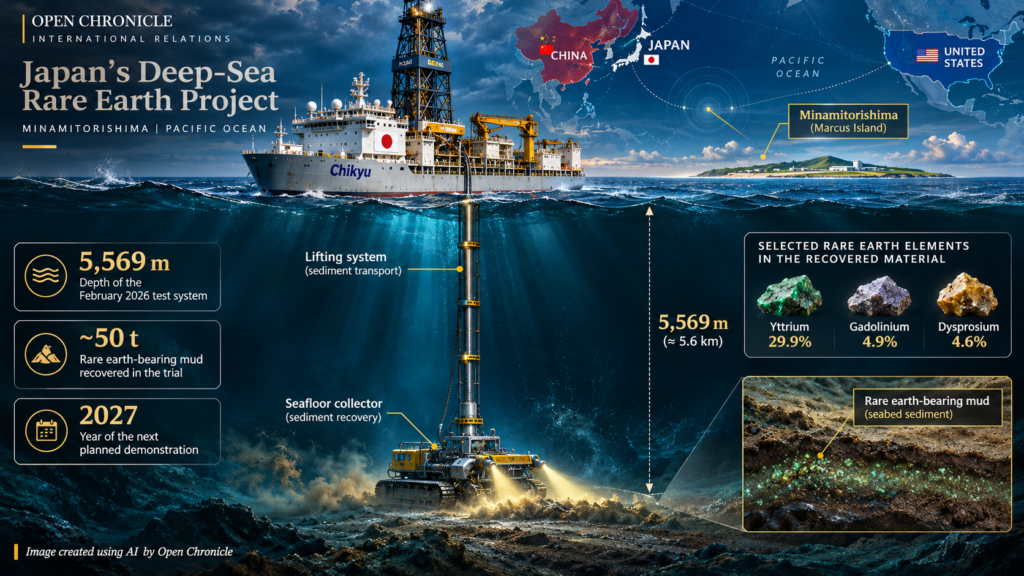
Depth of the February 2026 test system
Rare earth-bearing mud recovered in the trial
Year of the next planned demonstration
Japan’s February 2026 operation demonstrated the technical recovery of rare earth-bearing sediment from the deep Pacific seabed near Minamitorishima. The planned 2027 demonstration is intended to assess larger-scale operations, but commercial feasibility and environmental performance remain subjects of further evaluation.
SOURCES:
JAMSTEC and Science Japan, November 2026.
Figures describe experimental operations, not commercial production.
The extraordinary geography of Minamitorishima
Minamitorishima, also known as Marcus Island, occupies an unusual position in Japan’s geography.
It is the country’s easternmost island, located in the western Pacific.
Administratively, it belongs to Tokyo’s Ogasawara municipality, despite being separated from the Japanese mainland by a vast distance.
The island itself is small.
Its surrounding maritime zone, however, is strategically significant.
Japan’s exclusive economic zone gives it sovereign rights to explore and exploit natural resources in the waters and seabed within the zone, subject to applicable international law.
The seabed around Minamitorishima contains deposits of rare earth-bearing mud that have attracted scientific interest for years.
These resources differ from conventional mineral deposits found in terrestrial mines.
Instead of extracting ore from rock formations, the project seeks to recover sediment from the deep ocean floor.
The material contains rare earth elements dispersed within marine deposits.
The technical challenge is therefore considerable.
Researchers must recover large quantities of sediment from extreme depths, transport the material to the surface and separate valuable elements from the remaining mud.
Every stage requires energy, equipment and infrastructure.
The island’s isolation creates additional logistical difficulties.
Personnel, machinery, fuel and supplies must be transported over long distances.
Large-scale processing facilities cannot simply be assumed to exist near the extraction site.
Consequently, the project involves much more than discovering minerals.
It requires the development of an entire industrial system capable of operating in one of the world’s most challenging environments.
The February breakthrough: Japan reaches the deep seabed
The first major milestone of 2026 came during a scientific expedition aboard Chikyu.
The vessel departed Shimizu Port on January 12 and arrived near Minamitorishima on January 17.
Researchers tested a system designed to recover rare earth-bearing mud from the ocean floor.
The equipment involved a long lifting pipe extending from the vessel to the seabed.
A mining device loosened sediment, which was then transported upward through the system.
The operation reached a depth of approximately 5,569 metres.
During a three-day test between January 31 and February 2, the team recovered approximately 50 tonnes of mud, excluding seawater introduced during the lifting process.
The first successful recovery was confirmed on February 1.
The achievement was significant because it demonstrated the technical possibility of continuously transporting sediment from extreme ocean depths.
Deep-sea engineering presents difficult operating conditions.
Water pressure increases dramatically with depth.
Equipment must withstand mechanical stresses, corrosion and long periods of operation far from repair facilities.
Maintaining a stable lifting system over several kilometres is itself a major challenge.
Researchers must also manage sediment movement, equipment wear and the risk of operational failures.
The February test provided evidence that Japan’s approach could function under real ocean conditions.
But a short experimental operation is not equivalent to a sustainable commercial mining system.
Commercial production would require reliable performance over much longer periods, predictable maintenance costs and sufficient mineral recovery to justify the investment.
The Japanese government has therefore continued to describe the programme as a research and demonstration effort.
What the recovered mud actually contained
The composition of the recovered sediment has strengthened interest in the project.
On July 24, Japanese authorities announced results from an analysis of the material.
According to the findings, medium and heavy rare earth elements represented more than half of the rare earth content.
This matters because certain heavy rare earths are particularly important in advanced industrial applications.
Yttrium accounted for approximately 29.9% of the measured rare earth content.
Gadolinium represented approximately 4.9%.
Dysprosium accounted for approximately 4.6%.
These percentages refer to the distribution of rare earth elements within the analysed material.
They do not mean that nearly 30% of the entire mud sample consisted of yttrium.
That distinction is essential when interpreting the commercial significance of the findings.
OPEN CHRONICLE | MINERAL ANALYSIS
Selected rare earth elements in the recovered material
Selected rare earth elements in the recovered material
Percentages represent shares of total rare earth content, not of the bulk sediment.
Source:
Analysis reported by JAMSTEC and Science Japan, 10 November 2026. Selected elements only.
Dysprosium is particularly relevant to the production of high-performance permanent magnets.
Such magnets are used in electric vehicle motors, industrial machinery and various defence-related applications.
Yttrium has applications in advanced materials, ceramics, electronics and semiconductor manufacturing processes.
Gadolinium is used in specialised industrial and technological applications.
The presence of these elements makes the deposits strategically interesting.
However, concentration alone does not determine commercial value.
The amount of sediment that must be processed, the efficiency of mineral separation and the cost of refining are equally important.
A deposit may contain valuable elements and still be economically unattractive to exploit.
This is one of the central uncertainties surrounding Minamitorishima.
Why China dominates the rare earth debate
The importance of Japan’s deep-sea project cannot be understood without examining China’s position in global rare earth supply chains.
Rare earth elements comprise 17 chemically related elements.
Despite their name, many are not exceptionally rare in the Earth’s crust.
The difficulty lies in finding deposits that can be exploited economically and processing the material into usable industrial products.
China has developed a powerful position across several stages of this industry.
Its influence extends beyond mineral extraction.
Chinese companies possess extensive processing, separation, refining and magnet manufacturing capabilities.
These downstream activities are essential.
A country that extracts rare earth-bearing material does not automatically possess the industrial capacity to turn it into magnets, components or finished products.
This explains why the Minamitorishima project has attracted such attention in Tokyo.
Japan has a sophisticated manufacturing economy.
Its industries depend on advanced materials used in automotive production, electronics, robotics and other high-technology sectors.
Supply disruptions can therefore have consequences far beyond the mineral industry.
Japan experienced the political sensitivity of rare earth supplies during tensions with China in 2010.
The episode encouraged Japanese policymakers and companies to diversify procurement and invest in alternative supply chains.
More recently, Chinese export restrictions affecting selected critical materials have renewed concerns about strategic dependence.
Japan’s response has included international partnerships, recycling initiatives, alternative sourcing and research into domestic resources.
Minamitorishima forms part of that wider strategy.
It is not the only solution under consideration.
Nor is it necessarily the most economical one.
But it offers Japan something politically important: the possibility of obtaining selected critical minerals from within its own maritime jurisdiction.
The November agreement with Washington
The new diplomatic development occurred on November 12, 2026.
Following discussions in Toyama, the governments of Japan and the United States issued a joint statement on seabed mineral resource development.
The statement built upon an earlier memorandum of cooperation signed by the US Department of Commerce and Japan’s Ministry of Economy, Trade and Industry in March 2026.
The November discussions included the second meeting of the bilateral working group established under that framework.
The governments identified several priorities.
These included cooperation with industry, development of trusted processing capacity, protection of sensitive technologies and exchanges of technical expertise.
They also discussed research vessels, autonomous underwater vehicles, environmental assessments and regulatory approaches intended to encourage investment.
The Minamitorishima rare earth mud project was specifically included in the discussions.
So was Japan’s work on polymetallic nodules.
These are distinct types of seabed mineral resources.
Rare earth-bearing mud consists of sediment containing rare earth elements.
Polymetallic nodules are mineral formations found on parts of the deep ocean floor, often containing metals such as manganese, nickel, cobalt and copper.
The projects may share some technological and regulatory challenges, but their resource characteristics and processing requirements differ.
The agreement reflects Washington’s interest in strengthening access to minerals important to its industrial and defence sectors.
It also reflects Tokyo’s desire to accelerate research and attract international cooperation.
Nevertheless, the statement did not announce a completed commercial mining agreement at Minamitorishima.
It did not establish a guaranteed production schedule.
And it did not identify a fully funded industrial operation.
The agreement creates a framework for deeper cooperation, rather than confirming that a new commercial rare earth supply chain already exists.
The nine priorities shaping US-Japan cooperation
The November statement identified a range of activities intended to strengthen bilateral cooperation.
Strategic Cooperation Framework
Nine strategic priorities illustrate the areas of cooperation associated with seabed mineral development, technological security and the diversification of critical mineral supply chains.
Industrial Partnerships
Encouraging cooperation among companies involved in seabed mineral development.
Trusted Processing Capacity
Strengthening the ability to process recovered minerals within reliable supply chains.
Technology Protection
Safeguarding sensitive equipment, technical knowledge and proprietary information.
Scientific and Technical Exchange
Sharing expertise in exploration, mapping, resource assessment and environmental monitoring.
Research Assets
Exploring coordinated use of vessels, autonomous underwater vehicles and other equipment.
Regulatory Cooperation
Exchanging experience on environmental oversight, data management and adaptive regulation.
Investment Conditions
Supporting clearer and more predictable regulatory approaches for private investment.
International Coordination
Working with additional partners where cooperation could support responsible development.
Long-Term Supply Security
Connecting seabed resource development with broader industrial resilience, diversified mineral supply chains and reduced exposure to strategic supply disruptions.
Cooperation between Japan and the United States extends beyond the extraction of minerals from the deep seabed. It also involves scientific capabilities, industrial partnerships, processing infrastructure, investment conditions and regulatory oversight. Together, these areas reflect a wider strategic effort to diversify critical mineral supply chains and reduce vulnerabilities associated with concentrated global production and processing capacity.
EDITORIAL NOTE:
This framework is an editorial synthesis of the cooperation themes associated with the November 2026 Japan-US discussions on seabed mineral resource development. The nine headings are explanatory and should not be interpreted as verbatim provisions of a binding international agreement. The final description of Long-Term Supply Security provides editorial context.
Editorial synthesis of the cooperation themes in the November 12 joint statement. The headings are explanatory rather than verbatim treaty provisions.
The priorities reveal an important strategic calculation.
Extracting minerals is only one part of the problem.
The United States and Japan also want to develop the infrastructure, expertise and investment conditions required to make alternative supply chains commercially viable.
That requires cooperation between governments and private companies.
It may also require new processing facilities and technologies capable of handling mineral resources with different characteristics from conventional terrestrial deposits.
The ambition is therefore broader than a single mining operation.
It concerns the creation of industrial capabilities that could eventually reduce dependence on concentrated global supply chains.
The real obstacle: Mining at nearly six kilometres below sea level
The Minamitorishima project faces a challenge that cannot be solved through diplomacy alone.
The resources lie at extraordinary depths.
Recovering sediment from more than five kilometres below the surface requires specialised equipment, vessels and highly reliable operating systems.
Commercial extraction would involve transporting much larger quantities of material than those recovered during the February experiment.
Japan’s next major demonstration is scheduled for February 2027.
The planned operation is expected to continue for approximately one month.
Its target is to recover around 350 tonnes of rare earth-bearing mud per day.
That would represent a substantial increase over the earlier experimental operation.
The recovered material is expected to undergo initial dewatering on Minamitorishima before being transported for separation, purification and refining trials in Japan.
The demonstration will help determine whether the technology can operate at a scale relevant to industrial development.
But several questions remain unanswered.
Can the equipment operate continuously without excessive maintenance?
How much energy will be required to lift large volumes of sediment?
What proportion of the recovered material can be converted into commercially useful products?
How much will transportation and refining cost?
Can the project compete economically with established suppliers?
These questions are central to the project’s future.
The existence of a large resource does not guarantee profitable extraction.
The cost of recovering each kilogram of usable rare earth material will be a decisive factor.
Why refining may matter more than mining
Even if Japan succeeds in recovering substantial quantities of rare earth-bearing mud, it will face another industrial challenge.
The valuable elements must be separated and refined.
Rare earth elements have similar chemical properties.
Separating them into individual products can involve complex industrial processes.
These processes require specialised equipment, chemical expertise and significant investment.
China’s dominance in rare earth supply chains is partly a consequence of its extensive refining and processing capacity.
Japan cannot eliminate that dependency simply by lifting sediment from the Pacific seabed.
It must also establish a viable route from recovered mud to commercially usable materials.
This is one reason the bilateral agreement with the United States places emphasis on trusted processing capacity.
The objective is not merely to identify new sources.
It is to create a more resilient chain connecting extraction, processing and manufacturing.
That chain may involve multiple countries.
Some partners could provide technology.
Others could supply capital, processing expertise or industrial facilities.
The resulting system might be more expensive than existing supply arrangements.
But governments may still consider it strategically valuable if it reduces exposure to severe disruptions.
This introduces a fundamental distinction between commercial efficiency and economic security.
The cheapest supply chain is not always the most resilient.
Conversely, a strategically desirable project is not automatically financially sustainable.
Minamitorishima sits at the intersection of these competing priorities.
The environmental question beneath the Pacific
Deep-sea mineral extraction remains controversial.
The deep ocean contains ecosystems that scientists are still working to understand.
Many species are adapted to environments characterised by darkness, high pressure, low temperatures and limited food availability.
Some organisms live directly on or within seabed sediments.
Others depend on ecological relationships that may be difficult to observe or reconstruct.
Mining activities could disturb these environments.
Potential impacts include sediment disruption, noise, changes in water quality and effects on organisms living near the extraction area.
The scale and duration of such impacts depend on the extraction technology, operating conditions and local ecosystem.
They cannot be reliably assessed from the existence of mineral deposits alone.
Japan’s project involves a system intended to limit the uncontrolled dispersal of sediment during recovery.
However, the environmental performance of that system will require continued evaluation.
The planned demonstrations are therefore important not only for engineering and economic reasons.
They should also provide opportunities to assess environmental effects.
Environmental Risk Framework
Deep-sea mineral extraction raises important environmental questions. Understanding potential disturbances, ecological uncertainty and monitoring requirements is essential when evaluating the development of seabed resources.
Seabed Disturbance
Sediment removal may alter habitats used by organisms living on or beneath the ocean floor.
Sediment Movement
Mining and material handling could generate sediment movement requiring careful monitoring.
Noise and Vibration
Industrial equipment and vessel operations may introduce disturbances into deep-ocean environments.
Ecosystem Uncertainty
Limited baseline knowledge can make long-term environmental consequences difficult to predict.
Monitoring and Oversight
Independent assessment, environmental data and adaptive operational safeguards will be essential.
The development of deep-sea mineral resources requires careful consideration of potential ecological consequences. Disturbance of seabed habitats, sediment movement and operational noise may affect environments that remain incompletely understood. Scientific monitoring, transparent environmental assessments and adaptable safeguards are therefore important elements in evaluating whether future extraction activities can proceed responsibly.
EDITORIAL NOTE:
This framework identifies potential environmental considerations associated with deep-sea mineral extraction. It does not establish that all the impacts described have occurred during Japan’s experimental operations near Minamitorishima. The nature and extent of any environmental effects require site-specific scientific assessment.
These are potential environmental considerations, not findings that all listed impacts have occurred at Minamitorishima.
The environmental debate also has an international dimension.
Deep-sea mining in areas beyond national jurisdiction is subject to a different legal framework from resource activities within a country’s exclusive economic zone.
Minamitorishima’s location within Japan’s maritime jurisdiction is therefore legally significant.
It does not eliminate Japan’s environmental responsibilities.
But it means the project’s legal circumstances differ from those of commercial mining proposals in international seabed areas.
As Japan and the United States expand cooperation, regulatory questions will remain central to the industry’s development.
The strategic significance of 2027 and 2028
The next two years could determine whether Minamitorishima becomes an important industrial project or remains primarily a scientific achievement.
The February 2027 demonstration is intended to test operations at a substantially larger scale.
The results should provide information about equipment performance, extraction efficiency and the practical requirements of a more integrated production system.
A broader assessment of economic feasibility is expected by March 2028.
That evaluation will be important because the project still lacks a demonstrated commercial cost structure.
The timeline should not be confused with a guaranteed production launch.
Even if the demonstration succeeds, further investment and technical development may be required.
Environmental evaluation, processing capacity and industrial partnerships could also influence the schedule.
For policymakers, the temptation will be to present each successful trial as evidence that Japan is approaching mineral independence.
The reality is more complicated.
A successful test is an important achievement.
A reliable industrial supply chain requires much more.
The geopolitical stakes for Japan, China and the United States
Minamitorishima is not simply a mining project.
It is becoming part of a wider contest over economic security in the Indo-Pacific.
For Japan, the objective is to reduce vulnerability.
For the United States, the project offers an opportunity to strengthen cooperation with a major ally and explore additional sources of critical minerals.
For China, the development of alternative supply chains could eventually reduce some of the leverage associated with its established industrial position.
But the scale of that potential change remains uncertain.
China’s advantages are substantial.
They include established production networks, processing capacity, industrial expertise and manufacturing ecosystems developed over many years.
A single deep-sea mining project is unlikely to overturn those advantages in the near term.
Its significance may instead lie in diversification.
If Japan can demonstrate that deep-sea rare earth resources can be recovered and processed economically, it could encourage further research and investment.
Other countries might become more interested in similar resources.
Technology companies and manufacturers could begin evaluating new supply options.
Governments could gain additional flexibility in their critical mineral strategies.
However, none of these developments is inevitable.
The economic case must still be demonstrated.
Environmental questions must be addressed.
And commercial investors must be convinced that the project offers a viable return.
Three possible futures for Minamitorishima
Three Possible Futures for Minamitorishima
Japan’s deep-sea rare earth programme faces several possible development paths. Technical performance, commercial viability, environmental assessments and investment decisions will help determine its future.
Japan Establishes a Viable Deep-Sea Supply Chain
The 2027 demonstration confirms reliable extraction performance. Processing technologies improve, costs become manageable and investment supports gradual industrial development.
Japan gains an additional source of selected rare earth elements, strengthening its supply chain resilience.
Extraction Works, but Costs Remain Too High
Researchers demonstrate that large quantities of sediment can be recovered, but energy, equipment, transportation and refining costs prevent competitive commercial production.
The project continues as a research programme while Japan relies on other diversification strategies.
The Project Advances More Slowly Than Expected
Environmental assessments, technical uncertainties or investment concerns delay expansion.
Japan and the United States maintain scientific cooperation, but commercial development requires additional safeguards and research.
The future of Minamitorishima may not follow a single development path. Technical breakthroughs could coexist with high operating costs, environmental safeguards or prolonged investment negotiations. The project may therefore evolve through a combination of these scenarios rather than one clearly defined outcome.
EDITORIAL NOTE:
These scenarios are editorial assessments of possible outcomes, not predictions. They illustrate uncertainties surrounding technological performance, economic viability, environmental oversight and future industrial development. No probability is assigned to any scenario.
Why this story matters beyond Japan
The Minamitorishima project illustrates a wider transformation in international relations.
Mineral resources that once attracted primarily scientific or industrial interest are increasingly being discussed in terms of national security.
Rare earth elements are now central to debates about technological sovereignty, economic resilience and geopolitical competition.
Governments are investing in new extraction methods, processing facilities and international partnerships.
The result is a changing geography of strategic resources.
Remote islands, deep-ocean deposits and previously uneconomic mineral sources are receiving greater attention.
This does not mean that all such projects will succeed.
Many may prove technically difficult, environmentally problematic or commercially unattractive.
But the willingness of governments to investigate them demonstrates how seriously they regard supply chain vulnerability.
The Japan-US partnership is particularly important because it combines technological cooperation with a shared concern about concentrated mineral supply chains.
Its future may help establish whether deep-sea resource development can become a credible part of national economic security strategies.
Conclusion: A strategic opportunity, not yet a mineral revolution
Japan has achieved something remarkable near Minamitorishima.
It has demonstrated the ability to recover rare earth-bearing mud from one of the deepest environments ever targeted for this type of continuous extraction.
The recovered material contains elements of significant technological importance.
And the United States has now strengthened its cooperation with Japan over seabed mineral development.
These developments deserve attention.
But they should not be mistaken for the creation of a commercially operational rare earth industry.
The project still faces major challenges involving cost, engineering reliability, processing and environmental protection.
China’s established position in global rare earth supply chains will not disappear because Japan has successfully recovered experimental quantities of seabed mud.
The real strategic significance lies in the possibility of creating alternatives.
For Japan, Minamitorishima represents a potential source of greater economic independence.
For Washington, it offers another avenue for strengthening critical mineral cooperation.
For the wider international economy, it raises a question that could become increasingly important.
Can the deep ocean provide new sources of critical minerals without creating economic and environmental costs that outweigh their strategic value?
The answer will depend less on the excitement surrounding the discovery than on what Japan can demonstrate in the years ahead.
Sources and Further Reading
Official bilateral documentation, scientific reporting and independent analysis of Japan’s deep-sea rare earth programme.
Joint Statement on U.S.-Japan Seabed Mineral Resource Development
Official bilateral statement describing the November 11 and 12 working group discussions in Toyama, the Minamitorishima rare earth project and priorities for future cooperation.
Rare Earths off Minamitorishima: Over Half Are Precious Elements, Numerous Issues Remain for Domestic Production
Scientific reporting on the February 2026 extraction trial, recovered sediment composition, engineering challenges and preparations for the 2027 demonstration.
Japan, US Bolster Cooperation on Seabed Mining to Counter China
Independent industry reporting examining bilateral cooperation, mineral processing, investment, regulatory priorities and China’s influence over rare earth supply chains.
Japan: Mining Deep-Sea Critical Minerals
US government market intelligence describing Japan’s seabed mineral development programme, its cooperation with the United States and the commercial opportunities and challenges associated with future production.
On a Remote Island, Japan Puts Its Deep-Sea Mining Ambitions on Display
Regional analysis exploring the political and strategic importance of Minamitorishima, including questions about economic viability and the symbolic value of Japan’s resource development programme.
Editorial Transparency
This article combines official Japanese and United States government documentation, scientific reporting and independent analysis. The February 2026 recovery of rare earth-bearing mud was an experimental technical achievement, not the beginning of commercial production. The November bilateral statement outlines cooperation priorities but does not establish a completed commercial mining agreement. Mineral composition figures refer to shares of measured rare earth content, not the total mass of recovered sediment. Environmental risks and future strategic scenarios are presented as analytical considerations rather than established outcomes or predictions.
Explore International Relations
Discover more reporting and analysis on diplomacy, international security, global governance and the changing balance of power.
Return to International Relations →