
OPEN CHRONICLE | INTERNATIONAL RELATIONS | 16 NOVEMBER 2026
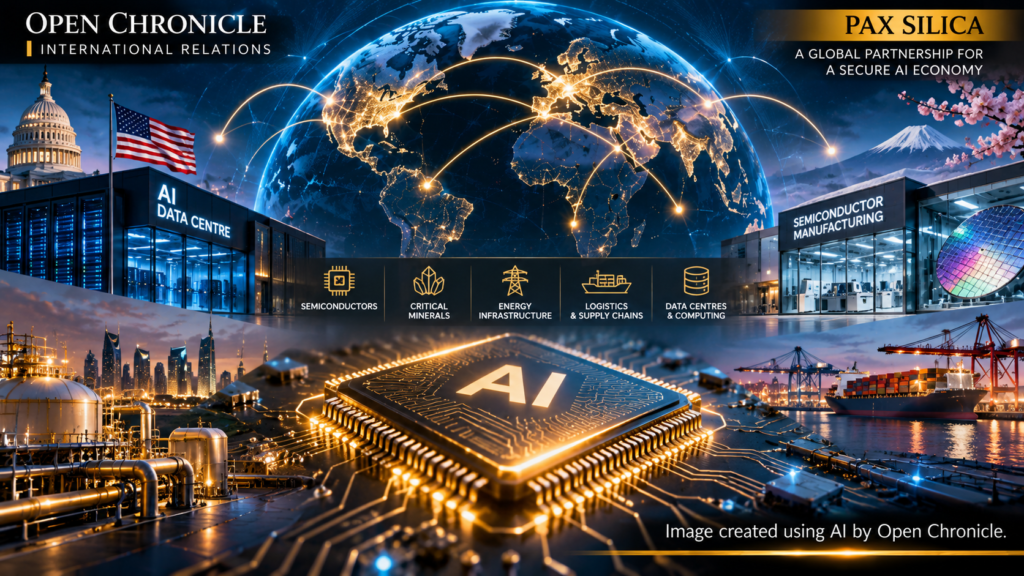
Ten governments have signed a new declaration to protect the technologies and infrastructure behind artificial intelligence. From semiconductor factories and rare earth minerals to energy grids and global shipping networks, Washington is assembling a strategic partnership that could reshape economic power in the age of advanced AI.
By Open Chronicle International Affairs Desk
International Relations | Technology Diplomacy | Economic Security | Global Power
A new alliance for the age of artificial intelligence
In San Francisco, a diplomatic gathering on November 15, 2026, produced an agreement that could have consequences far beyond the technology industry.
The United States and nine international partners signed the San Francisco Declaration on the Secure Foundations of Enduring Prosperity, committing themselves to closer cooperation over the technologies and critical infrastructure underpinning advanced artificial intelligence.
The agreement forms part of Pax Silica, a United States-led initiative launched in 2025 to strengthen strategic technology supply chains.
Its immediate objective is to reduce vulnerabilities in the systems that make advanced AI possible.
Its broader significance is geopolitical.
The initiative reflects Washington’s growing determination to organise a network of trusted economic and technological partners at a time when competition with China increasingly influences trade, industrial investment and national security policy.
The declaration was signed at the Pax Silica Founders Retreat, convened by Jacob Helberg, the US Under Secretary of State for Economic Affairs.
According to the State Department, the initiative is moving from a set of shared principles toward more structured cooperation.
But the declaration is not a defence treaty, and it does not itself establish a comprehensive system of binding export controls or investment restrictions.
Its importance lies in the strategic direction it signals.
The United States is attempting to make technological supply chains a central instrument of international economic security.
The ten governments behind the declaration
The November 15 declaration was issued by ten governments.
The Story at a Glance
Governments listed as signatories
Proposed working groups
Year Pax Silica was launched
SOURCE:
US Department of State, 15 November 2026.
The Participating Governments
Ten governments were listed as signatories to the San Francisco Declaration of 15 November 2026.
The composition is revealing. The participating governments bring together complementary capabilities in semiconductor technology, advanced research, critical materials, energy, investment and international logistics. Their cooperation reflects a broader effort to strengthen the industrial foundations of artificial intelligence while addressing vulnerabilities in strategically important supply chains.
EDITORIAL NOTE:
The ten governments listed above are the signatories identified in the San Francisco Declaration dated 15 November 2026. This list should not be interpreted as the complete membership or participation structure of the wider Pax Silica initiative. The five working groups are proposed areas of cooperation, not necessarily fully operational institutions.
The participants include major semiconductor economies, important technological research centres, energy producers, financial hubs and countries occupying strategically significant positions in international trade.
Japan and South Korea are essential participants in advanced semiconductor supply chains.
Singapore is a major logistics, financial and technology hub.
India represents a growing market for digital infrastructure, manufacturing and advanced technology investment.
Australia is strategically relevant to critical minerals and regional economic security.
Qatar and the United Arab Emirates bring energy resources, investment capacity and ambitions to expand their roles in advanced computing.
Israel, the United Kingdom and the United States contribute significant research, technology and security capabilities.
These roles are not interchangeable.
The coalition’s potential advantage is that its members possess different capabilities across the infrastructure required to develop, deploy and sustain advanced AI.
The November 15 signatories should not, however, be confused with the entire membership or participation structure of the wider Pax Silica initiative.
Other governments and institutions have been involved in earlier discussions or declarations.
That distinction is particularly important when assessing Europe’s position.
Why artificial intelligence has become a national security issue
For much of the digital era, artificial intelligence was discussed primarily as a matter of software, algorithms and computing performance.
That perspective is increasingly incomplete.
Modern AI depends on a vast physical and industrial system.
Advanced chips must be designed, manufactured, packaged and delivered.
Data centres require electrical power, cooling equipment, telecommunications connectivity and specialised hardware.
Semiconductor production depends on sophisticated machinery, chemicals, materials and highly specialised expertise.
The infrastructure behind AI is distributed across numerous countries.
This creates vulnerabilities.
A disruption affecting one critical supplier can influence industries and governments thousands of kilometres away.
Restrictions on advanced manufacturing equipment can constrain semiconductor production.
A shortage of essential minerals can affect the manufacture of electronic components and energy technologies.
Interruptions to electricity supplies can limit data centre operations.
Political pressure over ports, shipping routes or technology transfers can also affect the movement of strategically important goods.
Pax Silica is an attempt to address these vulnerabilities through international coordination.
The declaration presents economic security as inseparable from national security.
This reflects a broader transformation in strategic thinking.
In an economy increasingly dependent on advanced computing, control over technological infrastructure can provide political and economic leverage.
The question is no longer simply which country develops the most capable AI models.
It is also which countries control the industrial foundations that make those models possible.
The five pillars of the new partnership
The San Francisco Declaration identifies five proposed working groups intended to translate diplomatic principles into practical cooperation.
The Pax Silica Framework
Five proposed areas of cooperation aim to strengthen technological innovation, accelerate AI adoption and improve the security and resilience of critical international supply chains.
Pro-Innovation Policy Frameworks
Coordinating approaches intended to support technological development and investment.
AI Adoption in Key Sectors
Exploring how advanced AI can be deployed across economically and strategically important industries.
Supply Chain Cooperation
Strengthening coordination across the technologies, materials and infrastructure supporting advanced AI.
Safe Harbors and Security Hubs
Developing concepts for trusted investment environments and more secure supply chain networks.
Security and Resilience
Addressing vulnerabilities, disruptions and risks affecting sensitive technologies and infrastructure.
The Pax Silica framework reflects an effort to coordinate technological development and economic security among international partners. Its proposed working groups address innovation, AI deployment, supply chain cooperation, trusted investment environments and resilience. Their practical impact will depend on future agreements, implementation mechanisms and the commitments undertaken by participating governments.
EDITORIAL NOTE:
These five areas represent proposed cooperation mechanisms associated with the Pax Silica initiative. Their inclusion in the framework does not establish that every working group is already operational or that binding international commitments have been adopted.
These are proposed areas of cooperation. The declaration does not establish that all five groups are already operational.
The structure demonstrates that Pax Silica is not intended to function solely as a semiconductor partnership.
It seeks to address a wider industrial ecosystem.
This could eventually include investment coordination, supply chain diversification, information sharing and common approaches to protecting strategically sensitive technologies.
However, the declaration does not provide detailed operational arrangements for every proposed group.
It does not announce a single common budget, a fully developed investment mechanism or a comprehensive list of protected technologies.
Those details will determine how much practical influence the partnership eventually acquires.
China is central to the strategic calculation
Although the declaration does not simply establish a formal anti-China bloc, competition with Beijing is central to the initiative’s geopolitical context.
China occupies an important position in several industrial supply chains relevant to advanced technology.
Its influence over rare earth processing and other critical materials has become a major concern for Western governments.
At the same time, the United States and its partners are attempting to preserve advantages in advanced semiconductor technologies, AI development and strategically sensitive equipment.
These competing priorities have produced an increasingly complex international environment.
Washington seeks to reduce dependence on supply chains that could become vulnerable to political coercion.
Beijing seeks to strengthen its own technological capabilities and reduce exposure to foreign restrictions.
Both objectives encourage governments to treat industrial policy as an element of national strategy.
Pax Silica adds a diplomatic dimension to this competition.
Rather than relying exclusively on domestic investment and unilateral export controls, Washington is attempting to coordinate a wider group of countries.
The potential significance lies in combining capabilities that no single participating economy possesses independently.
The United States may be influential in AI software and chip design.
Other partners possess critical manufacturing capacity, industrial equipment, minerals, energy or infrastructure.
A coordinated network could, in principle, reduce dependence on vulnerable suppliers and make technology restrictions more effective.
But such outcomes are not automatic.
The participants have different economic relationships with China.
Several maintain extensive commercial ties with Beijing.
Some also seek to preserve flexibility in their foreign policies rather than participate in rigid geopolitical blocs.
The effectiveness of Pax Silica will therefore depend on whether cooperation can accommodate these different national interests.
Why the Middle East matters
The inclusion of Qatar and the United Arab Emirates is particularly noteworthy.
Neither country is generally regarded as a dominant global manufacturer of advanced semiconductors.
Their importance lies elsewhere.
The development of large AI infrastructure requires enormous investment and reliable energy supplies.
Gulf economies possess financial resources, energy-sector experience and ambitions to become international centres for advanced computing.
The United Arab Emirates has already pursued major AI infrastructure initiatives, including plans for a large computing campus developed through cooperation with the United States.
Qatar has also sought to expand its role in advanced technology investment and digital infrastructure.
Their participation illustrates a broader change in the geography of technological power.
The next phase of AI development may not be concentrated exclusively in countries that design or manufacture chips.
It may also depend on states capable of financing and hosting the infrastructure required to operate them.
This creates new opportunities for economic diplomacy.
Energy producers and investment centres can become strategically important partners in advanced computing networks.
For Washington, cooperation with Gulf states may help mobilise capital and expand trusted infrastructure.
For the Gulf participants, such partnerships may support economic diversification and strengthen their positions in the emerging AI economy.
Nevertheless, participation in Pax Silica does not guarantee access to every advanced technology or remove existing national export-control requirements.
The details of future agreements will remain decisive.
Europe’s complicated position
One of the most interesting aspects of the San Francisco Declaration is the relationship between Pax Silica and Europe.
The United Kingdom signed the November 15 declaration.
Several European Union countries and institutions have also been involved in the wider Pax Silica initiative.
But the European response to the latest declaration has not been entirely straightforward.
Before the signing, European officials raised concerns about the initiative’s terminology and potential implications for regulatory autonomy.
A report published by Euronews on November 12 described reservations within the European Union concerning the expanded American proposal.
The concerns included the breadth of the proposed definitions, the use of the term superintelligence and the possibility that economic security cooperation could influence domestic regulatory choices.
These questions matter because the European Union has developed its own approach to digital regulation, industrial policy and technological sovereignty.
European governments may share Washington’s concerns about excessive dependence on vulnerable supply chains.
But they do not necessarily agree that the United States should determine the rules governing every aspect of international AI cooperation.
There is also an important industrial dimension.
The Netherlands is home to ASML, a company of major importance to advanced semiconductor manufacturing equipment.
Germany possesses extensive industrial capabilities.
Other European economies contribute specialised materials, machinery, research and technology.
A global effort to secure advanced semiconductor supply chains would therefore be incomplete without meaningful European participation.
According to reporting on November 16, Germany, Sweden, the Netherlands and the European Commission were expected to join the new declaration subsequently.
At the time of this article, those anticipated signatures should not be treated as completed.
Europe’s response will help determine whether Pax Silica develops into a broad partnership or remains more closely associated with Washington’s preferred economic security framework.
The hidden infrastructure of AI power
The declaration also reveals something important about the changing nature of geopolitical influence.
Artificial intelligence is often presented as a competition between companies developing increasingly sophisticated models.
But the underlying infrastructure is far more complex.
The AI Supply Chain
Advanced artificial intelligence depends on an interconnected industrial ecosystem. From critical raw materials to computing infrastructure and software, each component contributes to the technological foundations of the global AI economy.
Critical Minerals and Materials
Inputs required for semiconductor manufacturing, electronics and supporting energy systems.
Semiconductor Design and Equipment
Intellectual property, manufacturing tools and specialised industrial capabilities.
Chip Manufacturing and Packaging
Facilities and processes required to produce and integrate advanced processors.
Energy and Data Centres
Electricity, cooling, servers and facilities needed to train and deploy AI systems.
Logistics and Communications
Ports, transport routes, digital networks and systems connecting suppliers and users.
Software and AI Applications
Models, computing platforms and services built upon the physical infrastructure.
The AI supply chain extends far beyond semiconductor production. Access to critical materials, advanced manufacturing equipment, reliable energy, secure logistics and computing infrastructure increasingly influences technological competitiveness and national economic security. International partnerships such as Pax Silica seek to address vulnerabilities across this interconnected system.
EDITORIAL NOTE:
This framework illustrates major components of the AI industrial ecosystem. The numbered stages are an explanatory structure, not a strictly linear manufacturing sequence or an official Pax Silica operational model.
Editorial overview of the industrial dependencies relevant to the declaration.
Every stage can become a source of strategic leverage.
A country does not need to control the entire system to exercise influence.
Dominance in one indispensable component may be sufficient to create a critical dependency.
This is why the declaration’s definition of infrastructure extends beyond computer chips.
It includes transport, communications, logistics, energy and the digital systems used to coordinate economic activity.
The agreement recognises that technological security depends on the resilience of an entire network.
That represents a significant expansion of the traditional debate about technology competition.
Economic security or technological fragmentation?
Pax Silica presents an important strategic dilemma.
Greater cooperation among trusted partners could strengthen resilience.
Diversifying suppliers may reduce the risk that a disruption in one country affects an entire industry.
Shared investment could accelerate infrastructure development.
Common security practices could make sensitive technologies more difficult to steal or misuse.
However, a more politically divided technology economy also carries risks.
If countries increasingly organise supply chains according to strategic alignment, companies may face higher costs and more complex regulations.
International research partnerships could become harder to maintain.
Countries outside major technology partnerships might face greater difficulty obtaining advanced computing resources.
The development of competing technological ecosystems could also reduce interoperability.
This tension is particularly important for developing economies.
Many countries want access to AI technologies without being forced into exclusive relationships with Washington or Beijing.
They may depend on Chinese manufacturing, American software, European equipment and investment from multiple international partners.
A more fragmented global economy could complicate that balance.
The question is whether Pax Silica can strengthen supply chain security without creating unnecessary barriers to legitimate international cooperation.
Its future policies will matter more than the declaration’s diplomatic language.
What the declaration does not establish
The distinction between political ambition and operational reality is essential.
The November 15 agreement establishes a shared framework for cooperation.
It does not prove that the participants have already created a unified technology market.
It does not announce that all members have adopted identical export controls.
It does not establish a common military alliance.
Nor does it demonstrate that existing dependence on Chinese supply chains has already been reduced.
The five working groups are proposed mechanisms for future cooperation.
Their effectiveness will depend on subsequent decisions.
Those decisions may involve national governments, regulators, technology companies and infrastructure investors.
They may also encounter political disagreements.
Some participating countries will prioritise national security.
Others may place greater emphasis on commercial opportunities, technological access or economic diversification.
The challenge will be to convert broad principles into policies that participating governments are willing and able to implement.
That process could take years.
It may also produce uneven results across different sectors.
Three possible futures for Pax Silica
The declaration opens several plausible strategic paths.
Scenario 1: A functioning technology security network
The participants establish practical cooperation mechanisms, identify critical supply chain vulnerabilities and coordinate investment in strategically important infrastructure.
Additional partners join.
The initiative develops into a durable framework for economic security cooperation.
In this scenario, Pax Silica could strengthen the ability of participating economies to manage disruptions and reduce selected dependencies.
Scenario 2: A diplomatic framework with limited implementation
The declaration generates regular meetings and policy discussions, but national priorities prevent deeper coordination.
Governments continue to pursue separate industrial strategies.
Export controls and investment policies remain largely national.
Pax Silica retains diplomatic value but produces fewer tangible changes than its supporters anticipate.
Scenario 3: A catalyst for competing technology blocs
The initiative becomes part of a broader international division over access to advanced technology.
Countries face increasing pressure to align with particular technological ecosystems.
Investment, research and trade become more closely connected to geopolitical relationships.
Such a development could strengthen selected strategic partnerships while increasing costs and reducing opportunities for cooperation elsewhere.
These scenarios are analytical possibilities, not predictions.
The declaration itself does not determine which outcome will emerge.
Why this story deserves more attention
The most consequential international developments do not always involve military confrontations, elections or dramatic diplomatic disputes.
Sometimes they begin with agreements that appear technical.
Pax Silica belongs to that category.
Its immediate provisions concern working groups, infrastructure protection and supply chain coordination.
But the underlying question is much larger.
Who will control the technologies, materials and infrastructure upon which future economic power depends?
The answer will influence the distribution of industrial investment.
It may affect access to advanced computing.
It could reshape relationships between energy producers, semiconductor manufacturers, technology companies and national governments.
And it may influence how states balance economic opportunity against national security concerns.
For smaller countries, the emergence of such partnerships could create both opportunities and pressures.
Participation might improve access to investment and trusted supply chains.
Exclusion could create new disadvantages.
For major powers, the issue is even more fundamental.
The ability to develop advanced AI may increasingly depend on maintaining reliable access to a global industrial network.
Pax Silica represents an attempt to organise part of that network around shared economic security objectives.
Whether it succeeds remains uncertain.
Conclusion: The next struggle for power may be fought through supply chains
The San Francisco Declaration is not the creation of a new NATO for artificial intelligence.
Nor is it proof that the United States and its partners have established control over the global AI economy.
It is an early institutional step in a much larger strategic transformation.
Washington is seeking to bring together countries with complementary technological, industrial, financial and infrastructure capabilities.
The objective is to strengthen economic resilience while reducing vulnerabilities in strategically important supply chains.
The initiative reflects a world in which semiconductors, critical minerals, energy infrastructure and digital networks have become central instruments of geopolitical power.
Its success will depend on implementation, investment, international cooperation and the willingness of participating governments to reconcile competing interests.
The most important question is not how many countries signed the declaration.
It is whether they can translate shared principles into an effective and sustainable system of technological cooperation.
In the emerging AI economy, the countries that control the foundations of technology may exercise as much influence as those that develop the technology itself.
Sources and Further Reading
Official diplomatic documentation and independent reporting on Pax Silica, economic security and international technology cooperation.
The San Francisco Declaration on the Secure Foundations of Enduring Prosperity
Official declaration identifying the ten participating governments, the economic security principles and the five proposed areas of cooperation.
US, Allies Team Up to Protect AI Tech and Infrastructure Amid China Rivalry
Independent reporting on the declaration, the strategic competition with China and the effort to coordinate technology and infrastructure security among international partners.
Trump’s Upgrade of US-Led AI Alliance Runs Into European Resistance
Reporting on European concerns about the expanded Pax Silica framework, including regulatory autonomy, terminology and the implications for EU technology policy.
UAE Signs San Francisco Declaration for Safeguarding Sensitive AI Technology
Reporting on the United Arab Emirates’ participation and the Gulf region’s growing involvement in international AI infrastructure and technology security partnerships.
Editorial Transparency
This article combines official diplomatic documentation with independent reporting and editorial geopolitical analysis. The San Francisco Declaration is a statement of shared principles and intended cooperation, not a comprehensive binding treaty. Proposed working groups, future participation by additional governments and potential economic consequences are distinguished from confirmed measures. Strategic scenarios presented in the article are analytical possibilities rather than predictions or official policy commitments.
Explore International Relations
Discover more reporting and analysis on diplomacy, international security, global governance and the changing balance of power.
Return to International Relations →