
OPEN CHRONICLE | HISTORY MAGAZINE | ARCHAEOLOGY & ANCIENT CIVILIZATIONS
16 November 2026 | Liangzhu, China | Neolithic Civilizations | Archaeological Research
In one of East Asia’s earliest urban societies, human skulls were transformed into bowls and mask-like objects, while other bones were cut, polished and perforated. Many of these objects were never completed. The discovery is forcing archaeologists to reconsider how the growth of ancient cities may have transformed relationships between the living and the dead.
By Open Chronicle History Desk
A disturbing discovery beneath an ancient city
Approximately 5,000 years ago, the inhabitants of an extraordinary city in eastern China were building monumental structures, managing complex water systems and developing a sophisticated society.
They were also doing something that archaeologists are still struggling to explain.
Some human bones were being deliberately modified.
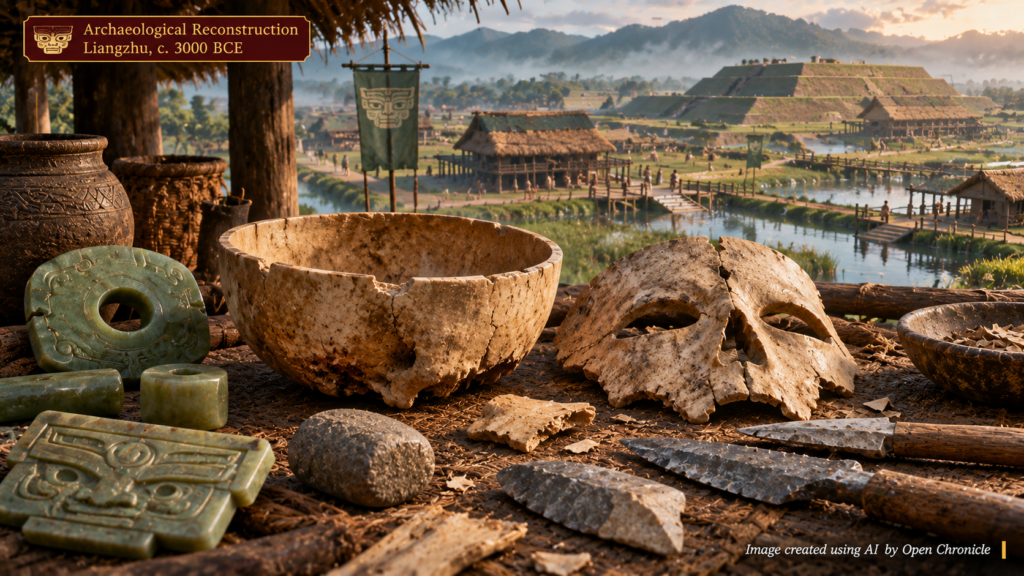
Skulls were split and shaped into bowl-like objects. Facial sections were separated to produce mask-like forms. Other bones were ground, perforated or polished.
Many of these objects were left unfinished.
Rather than being recovered from elaborate tombs, numerous examples were found in canals and moats, mixed with other archaeological material.
The discovery comes from the ancient Liangzhu cultural complex in the Yangtze River Delta, near modern Hangzhou.
A scientific investigation published in Scientific Reports in August 2025 examined 183 human bones recovered from archaeological contexts associated with the Liangzhu culture.
Of those, 52 showed evidence of deliberate modification.
The researchers identified skull cups, mask-like facial skulls, modified jawbones, worked limb bones and other unusual objects.
What makes the discovery especially significant is not simply the treatment of human remains.
It is the setting.
Liangzhu was one of East Asia’s earliest major urban societies, with elaborate water management, social differentiation, specialised production and complex religious traditions.
The researchers propose that the emergence of urban life may have changed how people understood death, ancestry and relationships with individuals outside their immediate communities.
The findings therefore raise a much larger question.
Could the development of one of the world’s earliest cities have transformed the meaning of the human body after death?
The Story at a Glance
Archaeological research into deliberately modified human remains from the ancient Liangzhu culture reveals evidence of bone working, unfinished objects and complex practices surrounding the dead.
Human bones examined
Bones showing deliberate modification
Modified objects classified as unfinished
Researchers examined 183 human bones associated with the Liangzhu culture and identified deliberate modification on 52 specimens. Of those modified objects, 80.8% were classified as unfinished. The findings suggest repeated bone-working procedures, although the intended functions of many objects and the circumstances of their deposition remain uncertain.
SOURCE:
Sawada and colleagues, Scientific Reports, 26 August 2025.
The figures describe the archaeological assemblage examined in the study, not the Liangzhu population. The 80.8% figure refers specifically to the modified objects, not to all 183 bones.
Liangzhu: One of the earliest great cities of East Asia
Its archaeological remains, dating broadly from around 3300 to 2300 BCE, reveal a society that achieved remarkable levels of organisation long before the emergence of China’s later imperial dynasties.
The ancient city was supported by rice agriculture, extensive water management and a political system capable of mobilising substantial labour.
Its inhabitants constructed earthen monuments, ceremonial spaces, residential areas and hydraulic infrastructure.
They also produced sophisticated jade objects, some associated with high-status burials and religious practices.
The Archaeological Ruins of Liangzhu City were inscribed on the UNESCO World Heritage List in 2019.
UNESCO recognises the site as evidence of an early regional state with a complex social hierarchy, a developed system of beliefs and an extraordinary capacity for environmental management.
This is the world in which the modified human bones were found.
It was not a small, isolated settlement.
It was a society undergoing processes of urbanisation, specialisation and increasing social complexity.
Those developments matter because the researchers argue that they may help explain why human remains were treated in unfamiliar ways.
In a small community, the dead might be closely connected to living relatives and collective ancestry.
In a larger urban society, however, people could encounter individuals from different families, settlements or social groups.
The researchers suggest that this changing social environment may have affected the symbolic value attached to human remains.
The proposal remains a hypothesis.
But it provides a framework for understanding why a practice absent from earlier documented Neolithic Chinese contexts emerged at Liangzhu.
The skull cups: Human remains transformed into vessels
Among the 52 modified bones, researchers identified four skull cups.
These were made from the upper portions of human skulls.
The skulls had been cut or split horizontally, producing bowl-like forms.
All four belonged to adults, according to the researchers’ assessment of their size and skeletal characteristics.
One example was finished, with a carefully shaped and polished rim.
The remaining three showed evidence of incomplete manufacture.
Their edges had not been fully adjusted, and some retained traces of splitting and grinding.
The distinction between completed and unfinished objects is important.
It demonstrates that the modification of skulls involved deliberate manufacturing procedures.
The objects were not simply skull fragments produced by accidental breakage.
They had been selected, altered and shaped.
But their intended function remains uncertain.
Were they used in rituals?
Skull cups are known from other archaeological contexts around the world.
In some societies, modified human skulls have been associated with ancestor veneration, ceremonial practices or the display of power.
At Liangzhu, there is evidence that skull cups could possess special significance.
Comparable objects have been recovered as grave goods from high-status Liangzhu cultural burials at Fuquanshan, in the Shanghai area, and Jiangzhuang, in Jiangsu Province.
This association suggests that some skull cups may have held religious, ritual or prestigious meanings.
However, the objects studied in the new research came largely from different contexts.
Many were recovered from canals and moats rather than elite tombs.
The researchers therefore caution against assuming that all modified human bones were created for the same purpose.
The evidence supports deliberate manufacture.
It does not establish that the skull cups were used for drinking, sacrifice or any specific ceremony.
Their precise function remains unknown.
The mask-like skulls: Objects without an obvious parallel
The researchers also identified four facial skulls that had been deliberately separated from the rest of the cranium.
Three came from adults.
One belonged to an adolescent.
Their appearance led researchers to classify them as mask-like facial skulls.
But the term requires an important qualification.
There is no evidence establishing that these objects were worn as masks.
The description refers to their shape, not a confirmed practical function.
The facial portions had been split along anatomical structures, and their edges showed relatively rough modification.
The researchers considered them unfinished.
Unlike the skull cups, these objects did not have clear parallels among other known Liangzhu artefacts.
Their intended use is therefore especially difficult to reconstruct.
They may have been symbolic objects.
They may have been part of an unfamiliar form of ritual activity.
They may have served purposes that modern archaeologists have not yet identified.
The study does not establish which explanation is correct.
Their significance lies in demonstrating that human bones were modified into several distinct forms, apparently following recurring procedures.
This suggests a practice more complex than a single isolated incident.
A workshop where human bones were treated as materials
One of the most revealing aspects of the research is where many of the objects were discovered.
The modified bones were recovered from canals and moats at several archaeological locations associated with Liangzhu.
A particularly important concentration came from the Zhongjiagang area, where workshop activity has been identified.
The bones were found in contexts associated with the production and disposal of other materials.
Some were mixed with pottery and animal remains.
This setting differs sharply from the carefully arranged deposits found in high-status burials.
The researchers argue that the concentration of unfinished objects may indicate that human bones were being worked in a relatively systematic manner.
Different categories of modified bone show repeated patterns of cutting, splitting and shaping.
That suggests the existence of recognisable procedures.
Yet the evidence does not establish a dedicated workshop exclusively for human bone objects.
Nor does it identify the people who carried out the modifications.
The archaeological record reveals the activity, but not the individual craftsmen or their motivations.
The importance of unfinished objects
Of the 52 modified human bones, 42 were classified as unfinished.
That represents approximately 80.8% of the modified assemblage.
It is an unusually high proportion.
The researchers considered several possible explanations.
Some objects may have been abandoned because the manufacturing process failed.
Others may have been left incomplete intentionally.
Production may also have been interrupted or the objects discarded after losing their intended value.
The evidence cannot currently distinguish these possibilities.
However, the high proportion of unfinished pieces is central to the study’s interpretation.
It raises the possibility that some human bones were treated as materials that could be selected, worked and discarded.
That would represent a different relationship with the dead from one in which every human remain was necessarily preserved as a sacred ancestral object.
But the researchers do not conclude that Liangzhu society as a whole lacked respect for the dead.
The city’s elaborate cemeteries and differentiated burial practices demonstrate that funerary traditions remained important.
The archaeological evidence instead suggests that different human remains could be treated in different ways.
What the bones reveal about violence
The discovery might initially suggest executions, violent deaths or the dismemberment of bodies.
The scientific evidence does not support those conclusions.
Researchers examined the bones for traces of violence and other forms of modification.
They identified marks associated with manufacture, including splitting, grinding, perforation and polishing.
However, they did not find evidence of violent injuries or cut marks that could be confidently interpreted as the deliberate disarticulation of fresh bodies.
Nor did they identify evidence of burning.
There were no signs of bone healing around the modifications, indicating that the alterations were not injuries that had healed during life.
The researchers suggested that some bones may have been collected after the soft tissues had decomposed.
This is consistent with the absence of certain types of disarticulation marks.
Nevertheless, the precise circumstances of death remain unknown.
The study does not establish whether the individuals died naturally, were buried before their bones were recovered or experienced other forms of treatment after death.
It also provides no evidence that the objects were connected to cannibalism.
The discovery is evidence of the deliberate modification of human remains, not proof of human sacrifice, ritual killing or cannibalism.
Who were the people whose bones were used?
The researchers examined skeletal characteristics to investigate whether particular categories of individuals were selected.
The modified remains included bones from adults and younger individuals.
The available evidence did not indicate a consistent preference based on age or sex.
That finding is important.
It suggests that the selection of bones may not have been limited to one clearly defined demographic group.
The researchers also identified some skeletal indicators associated with physiological stress.
Certain teeth showed enamel defects consistent with periods of disrupted growth during childhood.
Some bones displayed changes that may be associated with nutritional stress or other health conditions.
However, the study did not establish a statistically significant difference in the examined pathological indicators between modified and unmodified bones.
This limits attempts to interpret the objects as remains belonging specifically to marginalised, unhealthy or socially excluded individuals.
The social identities of the people remain unknown.
Researchers cannot establish whether they were residents of Liangzhu, migrants, captives, ancestors or members of particular social groups.
These possibilities require evidence that is not currently available.
A practice that lasted for generations
Radiocarbon dating indicates that the modified bones span a substantial period.
The study places the material broadly between approximately 5,000 and 4,550 calibrated years before present, with a concentration around 4,800 to 4,600 years before present.
Statistical modelling suggested that the activity may have extended over roughly two to four centuries.
This means the practice was unlikely to have been a single extraordinary episode.
It appears to have persisted across generations.
That duration strengthens the argument that modifying human bones formed part of a recurring cultural practice.
It does not, however, establish that every generation understood the objects in the same way.
Meanings can change over time.
A form initially associated with ritual activity might later acquire another significance.
Different groups within the same society might also have interpreted similar objects differently.
The archaeological evidence cannot yet reconstruct those changes.
What it can establish is that the modification of human bones was repeated over a long period within the Liangzhu cultural environment.
Did urbanisation change the meaning of death?
This is the most ambitious question raised by the study.
The researchers suggest that Liangzhu’s development into a major urban centre may have altered social relationships.
In smaller communities, individuals may have shared more direct connections through kinship, residence and collective ancestry.
Urbanisation introduced greater population concentrations, specialised activities and potentially more encounters between people who did not share those relationships.
The study proposes that these developments could have changed how some human remains were perceived.
Bones belonging to unfamiliar individuals might have acquired different meanings from those of recognised ancestors.
This could help explain why human bones were sometimes worked into objects and why so many unfinished examples were discarded.
But the hypothesis remains difficult to test.
Archaeologists do not know whose bones were modified.
They cannot establish whether the individuals were socially familiar or unfamiliar to the people handling their remains.
They also cannot demonstrate that urbanisation directly caused the practice.
Other explanations remain possible.
The objects could reflect changes in religious traditions, funerary customs, craft activities or social relationships.
The importance of the research is that it places these practices within the wider transformation of an early urban society.
Rather than treating the objects as an isolated curiosity, it asks how the growth of cities may have affected fundamental human ideas about identity and death.
Three possible explanations for the modified bones
Three Possible Interpretations of the Liangzhu Discoveries
The deliberate modification of human bones at Liangzhu raises questions about religious traditions, material production and the changing social relationships of an early urban civilisation.
Objects with Religious or Ceremonial Significance
Some modified skulls may have been connected with ritual activity, ancestor veneration or displays of prestige.
The presence of skull cups in other high-status Liangzhu burials supports considering this possibility, but it does not establish the function of every object.
Human Bones Used as Workable Materials
The repeated manufacturing traces and large number of unfinished pieces suggest that some bones were selected and shaped through recognisable procedures.
This interpretation raises questions about whether certain human remains had become available for uses unrelated to conventional ancestor worship.
A Changing Relationship Between Communities and the Dead
Population growth and increasing social complexity may have altered how individuals understood human remains, especially those belonging to people outside familiar social networks.
This is a broader explanatory hypothesis, not a demonstrated cause of the practice.
The Liangzhu assemblage includes deliberately modified human bones recovered from different archaeological contexts. Ritual significance, material production and broader social change may represent overlapping dimensions of the same practice. The available evidence does not establish whether every object served the same purpose or whether the people whose remains were modified belonged to particular social groups.
EDITORIAL NOTE:
These interpretations may overlap. None establishes the identity of the individuals or the precise purpose of the objects. The scenarios are presented as archaeological possibilities, without assigning probabilities or treating any explanation as a confirmed conclusion.
Why the discovery matters beyond ancient China
The deliberate modification of human remains is not unique to Liangzhu.
Archaeologists have documented worked human bones in different prehistoric societies across Europe, Asia and the Americas.
Some examples have been associated with funerary practices, ceremonial activities or the treatment of enemies.
Others remain difficult to interpret.
The Liangzhu assemblage is distinctive because of its combination of characteristics.
The objects include several different forms of modified bone.
Many appear unfinished.
They were recovered largely from canals and moats rather than formal graves.
And they belong to a society undergoing major urban development.
This combination provides an unusual opportunity to investigate the relationship between material culture and changing social structures.
It also challenges the assumption that ancient societies necessarily treated all human remains according to one consistent set of beliefs.
Different individuals, social groups and archaeological contexts may have involved different practices.
The discovery therefore contributes to broader debates about the origins of cities, the organisation of early societies and the ways communities understood death.
What archaeologists still need to discover
Several questions remain unanswered.
The most important concerns the identity of the people whose bones were modified.
Without clearer information about their origins and social relationships, it is difficult to evaluate whether the practice involved ancestors, outsiders or other categories of individuals.
Another question concerns the intended function of the objects.
The skull cups have some archaeological parallels, but the mask-like facial skulls and other modified bones are harder to interpret.
Researchers must also determine why so many pieces were unfinished.
Was the process technically difficult?
Were the objects discarded because they failed to meet particular requirements?
Or did incompleteness itself have cultural significance?
Finally, the relationship between the practice and urbanisation requires further investigation.
The study offers a plausible framework, but a direct causal connection has not been demonstrated.
Future comparative research, more detailed contextual analysis and additional scientific investigation may help narrow these uncertainties.
Conclusion: The unsettling complexity of the first cities
Liangzhu is celebrated for its monumental architecture, hydraulic engineering, sophisticated jade craftsmanship and contribution to the early history of Chinese civilisation.
The modified human bones reveal another dimension of that society.
They show that some inhabitants deliberately transformed human remains into objects.
They also show that many of those objects were abandoned before completion.
The discovery does not provide a simple explanation.
It does not prove that Liangzhu’s inhabitants practised human sacrifice, cannibalism or systematic violence.
Nor does it establish that the objects were universally sacred or universally ordinary.
Instead, the evidence points towards a society in which relationships between the living, the dead and the material world may have been more varied than previously understood.
The most important contribution of the research may therefore lie beyond the objects themselves.
It invites historians to examine how urbanisation changes not only the physical organisation of society, but also its beliefs, relationships and understanding of human identity.
Five thousand years after these bones were modified, Liangzhu is reminding archaeologists that the history of civilisation is also a history of changing ideas about what it means to be human, even after death.
Historical Sources and Further Reading
Peer-reviewed archaeological research, UNESCO documentation and specialist reporting on the modified human bones of ancient Liangzhu.
Worked Human Bones and the Rise of Urban Society in the Neolithic Liangzhu Culture, East Asia
Original peer-reviewed study examining 183 human bones, including 52 modified specimens, their manufacturing traces, archaeological contexts and possible relationship with early urbanisation.
Archaeological Ruins of Liangzhu City
Official heritage documentation describing Liangzhu’s urban planning, hydraulic infrastructure, rice agriculture, social hierarchy and archaeological importance.
Modifications Identified on Neolithic Human Bones from China
Specialist archaeological coverage of the study, including the variety of modified remains and their recovery from canals, moats and workshop contexts.
5,000-Year-Old Skeleton Masks and Skull Cups Made from Human Bones Discovered in China
Independent science reporting featuring the researchers’ explanations of the unusual artefacts, their unfinished condition and the uncertainties surrounding their original purposes.
Editorial Transparency
This article is based primarily on a peer-reviewed archaeological study published in Scientific Reports on 26 August 2025, supplemented by UNESCO documentation and specialist archaeological reporting. The research was discussed again in November 2026, but the original scientific publication is not new. The study establishes deliberate modification of human remains at Liangzhu, including skull cups and mask-like facial skulls. However, the precise functions of many objects, the identities of the individuals and the relationship between these practices and urbanisation remain uncertain. Explanations involving ritual activity, material production and social transformation are presented as archaeological interpretations rather than confirmed historical facts.