
OPEN CHRONICLE | HISTORY MAGAZINE | ARCHAEOLOGY & DISCOVERIES
16 November 2026 | Isle of Man | Viking Age | Archaeology
An extraordinary collection of Viking Age objects, including rare women’s jewellery, a decorated sword and sophisticated trading equipment, is challenging what archaeologists know about the earliest Scandinavian communities on the Isle of Man. The discovery may contain evidence of the island’s earliest known female Viking burial, but the disturbed archaeological context leaves a crucial question unanswered: who was buried here, and what was their place in the Viking world?
By Open Chronicle History Desk
A discovery that reaches back more than eleven centuries
A collection of objects buried on the Isle of Man more than 1,100 years ago is offering archaeologists a rare opportunity to investigate the people who helped establish Scandinavian communities in the Irish Sea.
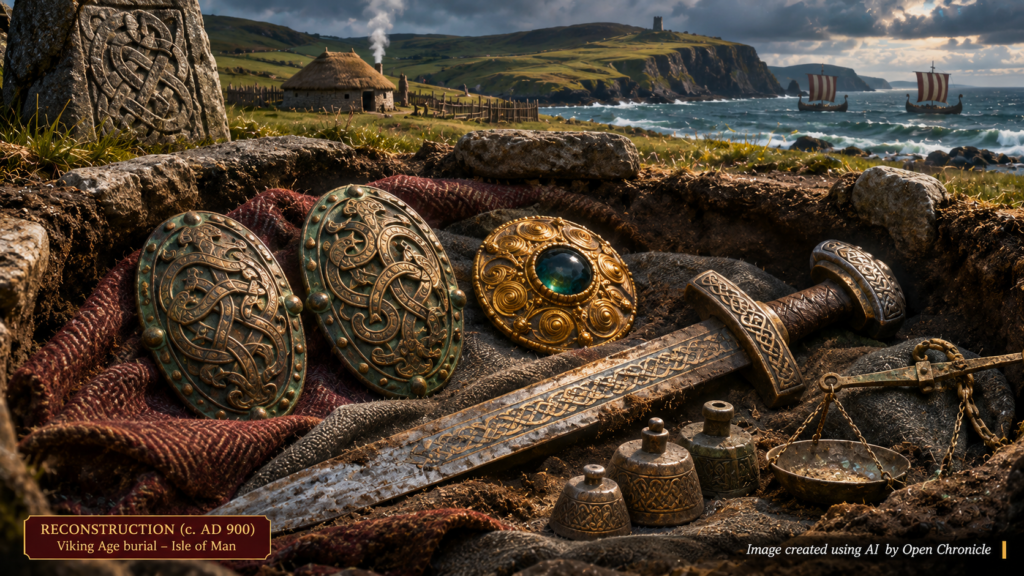
The discovery includes a decorated Viking sword, three bronze brooches, trading weights, fragments of balance scales, a bronze ladle and an axehead.
Individually, these objects would be historically interesting.
Together, they may tell a much more important story.
Archaeologists believe the artefacts could have belonged to a man and a woman buried around AD 900, during a period when Scandinavian settlers were transforming the political and cultural landscape of the British Isles.
The interpretation is not yet definitive.
The original burial context has been disturbed, making it difficult to establish whether the objects came from a single double burial or two separate graves.
Nevertheless, the discovery is significant.
Two of the bronze brooches may be approximately 50 years older than the previously known comparable examples from the island.
If their dating and burial interpretation are confirmed, they could provide evidence of the earliest known female Viking Age burial on the Isle of Man.
On 9 November 2026, Manx National Heritage announced that the collection had been formally declared Treasure by the Isle of Man Coroner for Inquests.
The announcement placed the discovery among the island’s most important recent archaeological finds.
But its significance extends beyond the objects themselves.
It raises questions about migration, family relationships, commerce, cultural identity and the role of women in the Scandinavian settlement of the Irish Sea.
The central historical question is not simply what was buried, but what these objects reveal about the people who carried Scandinavian culture into the western British Isles.
The Story at a Glance
Approximate date of the burial objects
Decorated bronze brooches
Viking sword recorded on the island
Dating to approximately AD 900, the objects include three decorated bronze brooches and a Viking sword, together with other artefacts associated with Scandinavian cultural traditions. The discovery offers new evidence for studying Viking Age settlement on the Isle of Man, although the original burial arrangement remains uncertain because the archaeological context was disturbed.
SOURCE:
Manx National Heritage, 9 November 2026.
The burial arrangement remains uncertain. The figures describe the reported archaeological assemblage and should not be interpreted as confirmation of a single double burial.
The discovery: A field, a metal detector and an unexpected glimpse of the past
The artefacts were recovered in February 2026 by metal detectorists Daniel Crowe and Rhett Britton.
Their discovery was announced publicly in November, following archaeological assessment and the formal Treasure declaration.
The objects were found in an area where the original burial deposits had already been disturbed.
That detail is important.
In archaeology, the location of an object relative to other material can be as significant as the object itself.
A sword discovered beside human remains may support a different interpretation from a sword recovered from displaced soil.
Similarly, jewellery found in its original position on a body can provide evidence about clothing and burial customs.
When a site has been disturbed, some of those relationships may be lost.
The Manx discovery therefore presents archaeologists with a combination of unusually rich material evidence and important interpretive limitations.
Researchers can study the artefacts, their decoration, their manufacture and their similarities to objects found elsewhere.
But they must be more cautious when reconstructing the precise arrangement of the original burial.
The collection includes objects associated with Scandinavian dress, weaponry and commercial activity.
Their combination suggests connections with several aspects of Viking Age society.
Rather than revealing a simple image of warriors and raiders, the discovery points towards a more complex world of households, exchange networks, personal identity and migration.
The brooches: Why the jewellery may be the most important discovery
Among the objects, the three bronze brooches have attracted particular attention.
Two are oval brooches decorated with intricate interlocking animal designs.
This type of ornament is strongly associated with Scandinavian women’s dress during the Viking Age.
Oval brooches, sometimes called tortoise brooches because of their shape, were commonly worn as a pair.
They helped fasten the straps of garments worn over an underdress.
Their design could also communicate aspects of cultural identity, personal status and fashion.
In Scandinavian burial archaeology, paired oval brooches are important because they provide evidence about clothing traditions and the movement of people and cultural practices.
The newly discovered Manx examples appear to be earlier than the previously known comparable pair from the island.
Researchers have suggested a difference of approximately 50 years.
That could push back the archaeological evidence for women buried with Scandinavian dress accessories on the Isle of Man.
However, the interpretation requires care.
Brooches associated with women’s clothing do not, by themselves, establish the biological sex or personal identity of an individual.
Objects can be exchanged, inherited, reused or deposited in ways that do not correspond neatly to modern assumptions.
The strongest conclusions emerge when artefacts can be considered alongside skeletal evidence, burial context and other scientific information.
In this case, the disturbed context means that the jewellery offers compelling clues rather than a complete reconstruction.
A third brooch unlike anything previously found on the island
The collection also contains a third bronze brooch.
Originally gilded, it features spiral decoration and a glass centre.
According to the initial announcement, this type had not previously been recorded on the Isle of Man.
Its unusual character may help researchers investigate connections between the island and other regions of the Viking world.
The ornament could provide information about manufacturing traditions, artistic influences and the circulation of personal possessions.
Whether it was made locally, imported or acquired through exchange requires further investigation.
Its presence demonstrates that the collection was not simply a group of ordinary utilitarian objects.
It included carefully decorated possessions that may have held considerable personal and social significance.
A Viking sword and the question of status
The sword is another remarkable component of the discovery.
It is described as an elaborately decorated Viking weapon, with evidence of ornamental metalwork.
The newly recovered sword is reported to be the thirteenth Viking sword found on the Isle of Man.
Weapons frequently attract attention in Viking archaeology because they can provide evidence about warfare, status, craftsmanship and burial traditions.
But a sword in a grave does not automatically identify its owner as a professional warrior.
Weapons could function as symbols of authority, social identity or family prestige.
Their inclusion in a burial may have reflected beliefs about death and the afterlife, as well as the position of the deceased within the community.
The Manx sword may therefore help researchers understand how Scandinavian settlers expressed identity and status during the early Viking settlement period.
Its decoration also offers opportunities for comparison with other weapons from Scandinavia, Ireland and Britain.
Such comparisons may help establish its approximate date and stylistic connections.
There is also the question of whether the sword was intentionally damaged before burial.
Reports have raised this possibility, but the evidence requires further conservation and study.
In Viking Age archaeology, deliberately altered or broken weapons are known from some burial contexts.
However, damage can also result from corrosion, later disturbance or post-depositional processes.
The Manx sword should not be assigned a ritual explanation until the relevant evidence has been established.
The trading weights: A different picture of Viking society
Perhaps the most revealing objects are not the sword or the jewellery.
They are the trading equipment.
The collection includes decorated weights and fragments of balance scales.
These objects belong to a world of exchange, measurement and commercial relationships.
The Viking Age was not defined solely by raiding.
Scandinavian communities participated in extensive trading networks connecting northern Europe, the British Isles, the Baltic, the North Atlantic and territories much farther east.
Goods, silver, personal ornaments, tools and other commodities moved through these networks.
Portable scales and weights allowed traders to measure valuable materials, particularly in economies where silver could be exchanged by weight.
The presence of such equipment in a burial assemblage can therefore suggest connections with commerce and the circulation of wealth.
On the Isle of Man, this is especially significant.
The island occupied a strategic position between Ireland, Britain and the wider maritime routes of the Irish Sea.
Communities established there could participate in regional networks linking Scandinavian settlers with existing populations.
The newly discovered weights have been described by Manx National Heritage as exceptionally elaborately decorated examples.
Their craftsmanship may indicate that these were valued possessions rather than merely functional tools.
However, their presence does not prove that a particular buried individual was a merchant.
Trading equipment could also communicate wealth, social relationships or participation in an exchange economy.
The most useful interpretation considers the objects within the wider assemblage.
Together with the sword and jewellery, they suggest that the individuals associated with the burial occupied a world in which trade, status and cultural identity were closely connected.
Why the Isle of Man mattered to the Vikings
The Isle of Man sits near the geographical centre of the Irish Sea.
Its position made it important for movement between Ireland, western Britain, Scotland and the wider North Atlantic.
During the Viking Age, maritime routes were essential to political influence and economic activity.
Ships connected settlements, trading centres and coastal communities.
Control over strategic islands could provide access to harbours, resources and routes used by merchants and military expeditions.
Scandinavian activity in the Irish Sea developed over several generations.
Viking settlements emerged in Ireland, including Dublin, while Scandinavian influence also became important in parts of northern and western Britain.
The Isle of Man formed part of this interconnected maritime environment.
Over time, Scandinavian traditions interacted with existing cultural and political structures.
The island eventually developed a distinctive Norse-Gaelic heritage.
This history remains visible in aspects of its archaeology, place names and cultural traditions.
The newly discovered burial objects belong to an earlier phase of that long process.
Dating to around AD 900, they provide material evidence relevant to the establishment and consolidation of Scandinavian communities.
The presence of objects associated with women’s clothing is especially important.
It raises questions about whether migration involved families and communities rather than only mobile groups of men engaged in warfare or commerce.
This possibility fits a broader archaeological understanding of Viking settlement as a process involving varied forms of migration, exchange and cultural interaction.
Nevertheless, one burial assemblage cannot establish the demographic composition of an entire settlement population.
The discovery adds evidence to the discussion rather than resolving it.
A woman in the Viking world: What the evidence can and cannot tell us
The possibility of an early female Viking Age burial is the discovery’s most compelling historical dimension.
Popular representations of the Viking Age often concentrate on kings, warriors, longships and military expeditions.
Archaeological evidence provides a broader picture.
Women participated in Scandinavian societies through household management, agriculture, craft production, economic exchange and family networks.
Their social positions varied considerably according to region, wealth, legal status and historical circumstances.
Some women possessed valuable jewellery and other objects that could indicate access to wealth and established cultural traditions.
Burials containing distinctive dress accessories can provide evidence of how identity was expressed within communities.
The Manx brooches may offer an important contribution to this research.
If they came from an early female burial, they could indicate that Scandinavian dress traditions were present on the island earlier than previously demonstrated by comparable grave finds.
This would have implications for how historians understand the chronology of Scandinavian settlement.
It could also strengthen the case for examining the role of women in the formation of early Norse communities in the Irish Sea.
But the archaeological evidence must not be pushed beyond what it supports.
There is currently no established personal identity for the individual or individuals associated with these objects.
The discovery does not identify a Viking queen, a named merchant or a particular historical family.
Nor does the combination of male-associated and female-associated grave goods prove that a married couple was buried together.
The objects may represent two individuals.
They may also come from separate graves disturbed at a later date.
The importance of the discovery lies precisely in the questions it allows researchers to investigate, not in a definitive story that has already been established.
Double burial or two separate graves?
This is one of the central unresolved questions.
The collection has been interpreted as potentially representing a double burial.
That would mean two individuals were interred within the same burial context.
The sword and other objects might then be associated with one individual, while the brooches could have belonged to another.
However, the original site has been disturbed.
This prevents archaeologists from confidently reconstructing the original arrangement.
It is therefore possible that the objects came from two separate burials located close together.
The distinction matters.
A confirmed double burial might provide evidence about burial practices and relationships between individuals.
Separate graves would raise different questions about the use of a cemetery, the chronology of burial activity and the composition of the local community.
Without sufficiently preserved contextual evidence, researchers cannot establish which interpretation is correct.
OPEN CHRONICLE | ARCHAEOLOGICAL INTERPRETATION
Three Questions the Discovery Raises
The Viking Age artefacts discovered on the Isle of Man offer important clues about early Scandinavian settlement, while leaving several fundamental archaeological questions unresolved.
Who Was Buried?
The objects suggest Scandinavian cultural connections, but the identities and biological characteristics of the people associated with them remain uncertain.
Was This One Burial or Two?
The disturbed archaeological context prevents a definitive reconstruction of the original grave arrangement.
What Can the Objects Reveal About Settlement?
The jewellery, weapons and trading equipment may help researchers understand migration, cultural identity and exchange networks around AD 900.
Archaeological interpretation depends not only on the objects recovered but also on their original positions and relationships. Although the Isle of Man discovery includes distinctive Viking Age artefacts, the disturbed burial context limits what researchers can establish about individual identities, burial practices and the precise circumstances of deposition.
EDITORIAL NOTE:
These questions reflect the current interpretative limitations of the archaeological evidence. The presence of Scandinavian-style objects does not independently establish the identities, biological sex or personal relationships of the individuals potentially associated with the burial. Further conservation and archaeological research may refine these interpretations.
What future conservation and research could reveal
The discovery is not the end of the investigation.
It is the beginning of a new phase of research.
The objects offer several opportunities for further study.
1. Metalwork and manufacturing techniques
Detailed examination of the sword, brooches and weights may reveal how they were made.
Researchers can investigate decorative techniques, metal composition and evidence of repairs or alterations.
Comparisons with objects from other regions may help establish stylistic relationships and refine the chronology.
2. Traces preserved within the brooches
Archaeologists may be able to examine material trapped within or around the brooches.
Corrosion products and adhering soil can sometimes preserve traces of textiles or other organic materials.
Such evidence could provide information about clothing and the circumstances in which the objects were deposited.
Whether useful material survives in this particular assemblage remains to be established.
3. The sword’s original appearance
Conservation may reveal further details of the weapon’s decoration and construction.
It may also help researchers distinguish deliberate modification from damage caused by corrosion or disturbance.
4. The trading equipment
The weights and balance fragments could be compared with examples from other Viking Age trading centres.
Their forms and decorative features may offer clues about connections between the Isle of Man and wider exchange networks.
5. Reconstructing the archaeological context
Any surviving records of the discovery, associated deposits and nearby finds could help clarify the original setting.
However, information lost through disturbance cannot always be recovered.
The quality of future interpretation will depend on the evidence that remains available.
The objects enter the Manx national collections
Following the Treasure declaration, the collection has entered the care of Manx National Heritage.
A selection of the objects went on public display in the Viking Gallery at the Manx Museum in Douglas on 11 November 2026.
This gives visitors an opportunity to see material associated with the island’s early Scandinavian history.
Public display also serves a wider purpose.
Archaeological discoveries are most valuable when their evidence can be preserved, studied and made accessible.
The conservation of the artefacts will help protect them for future research.
Their interpretation may evolve as additional scientific work is completed.
Museum displays can therefore communicate both what archaeologists know and what remains uncertain.
That distinction is particularly important in a discovery where the objects are extraordinary but the original burial context is incomplete.
Why this discovery matters beyond the Isle of Man
The Manx burial assemblage contributes to a wider reconsideration of the Viking Age.
For generations, public understanding of Viking history was shaped by accounts of raids, conquest and military expansion.
These events were important.
But they were only part of a much larger historical transformation.
Scandinavian communities travelled, traded, settled and interacted with populations across northern Europe and the North Atlantic.
Their influence developed through multiple processes, including warfare, commerce, migration, marriage and cultural exchange.
Archaeology helps reveal these dimensions because everyday objects often preserve evidence absent from written sources.
A brooch can illuminate clothing traditions.
A balance weight can suggest participation in commercial networks.
A sword can provide information about technology and the expression of status.
Together, these objects offer a more complex picture of the people who lived during the Viking Age.
The Isle of Man discovery is particularly valuable because it brings these categories of evidence together.
It suggests a community connected to Scandinavian traditions, maritime exchange and the social structures of the early medieval Irish Sea.
The possible evidence of an early female burial adds another dimension.
It encourages historians to examine who participated in the settlement process and how cultural traditions were maintained across generations.
Three Possible Interpretations of the Discovery
The disturbed archaeological context leaves several possible explanations for the arrangement of the Viking Age artefacts discovered on the Isle of Man.
Two Individuals Buried Together
The artefacts may have belonged to two people interred within a single burial context.
This interpretation could offer insights into burial customs and social relationships, but the disturbed site prevents confirmation.
Separate Burials from the Same Period
The objects may have originated in two graves located near one another.
If supported by future evidence, this could contribute to understanding burial activity within an early Scandinavian community.
Objects Displaced from Their Original Contexts
Later disturbance may have brought together artefacts that were not originally deposited in the same arrangement.
This possibility underlines the importance of conservation, careful documentation and restraint when reconstructing individual lives.
The original burial arrangement remains uncertain. A shared grave, neighbouring burials or the displacement of objects from different contexts could produce different historical interpretations. Further conservation, comparative analysis and examination of the surviving archaeological evidence may help researchers evaluate these possibilities, although some information lost through disturbance may never be recovered.
EDITORIAL NOTE:
These are archaeological interpretations to be evaluated against the surviving evidence, not established conclusions. The three possibilities are not mutually exclusive in every respect, and no probability or ranking is assigned to them.
Conclusion: The people behind the Viking objects
The discovery on the Isle of Man is remarkable not simply because it includes a Viking sword or rare jewellery.
Its importance comes from the combination of objects and the historical questions they raise.
The brooches may provide evidence of an earlier female Viking Age burial than previously recognised on the island.
The sword offers another example of the weaponry and craftsmanship associated with Scandinavian settlement.
The weights and scales point towards a society connected to exchange and commerce.
Together, they illuminate a period when the Isle of Man was becoming part of a changing cultural and political world.
But the discovery also demonstrates the limits of archaeological interpretation.
The original burial arrangement remains uncertain.
The identities of the individuals are unknown.
The relationships between the objects cannot yet be fully reconstructed.
Future research may answer some of these questions.
Others may remain unresolved.
That uncertainty does not diminish the discovery.
It makes the evidence more important.
More than eleven centuries after these objects were buried, they are offering a new opportunity to understand the people who helped shape the Viking world of the Irish Sea, including women whose lives rarely appear in the written historical record.
Historical Sources and Further Reading
Official archaeological documentation, museum reporting and independent coverage of the newly declared Viking Age Treasure from the Isle of Man.
Rare 1,100-Year-Old Viking Double Burial Sheds New Light on the Viking Age Across the British Isles
Primary institutional announcement detailing the archaeological objects, their approximate dating, the Treasure declaration and the possible early female Viking Age burial.
1,100-Year-Old Viking Burial Discovered by Metal Detectorist on the Isle of Man
Reporting on the discovery, the decorated brooches, sword and trading equipment, including comments from Manx National Heritage’s archaeology curator.
Extraordinary Viking Treasure Discovered on Isle of Man Reveals Secrets of 1,100-Year-Old Burial
Local reporting on the significance of the archaeological assemblage, the Treasure declaration and the questions surrounding the burial interpretation.
Viking Age Discovery Offers a Glimpse into the Isle of Man’s Past
Archaeological reporting examining the decorated artefacts and the uncertainty surrounding the original burial arrangement.
Editorial Transparency
This article draws on the official announcement by Manx National Heritage and contemporary archaeological reporting published in November 2026. The objects date to approximately AD 900 and may represent an early female Viking Age burial alongside another individual. However, the original burial context was disturbed, and researchers have not established whether the artefacts came from a single double burial or separate graves. Interpretations concerning personal identity, social status, migration and commercial activity are discussed as historical possibilities rather than confirmed individual biographies. Future conservation and research may refine these conclusions.