
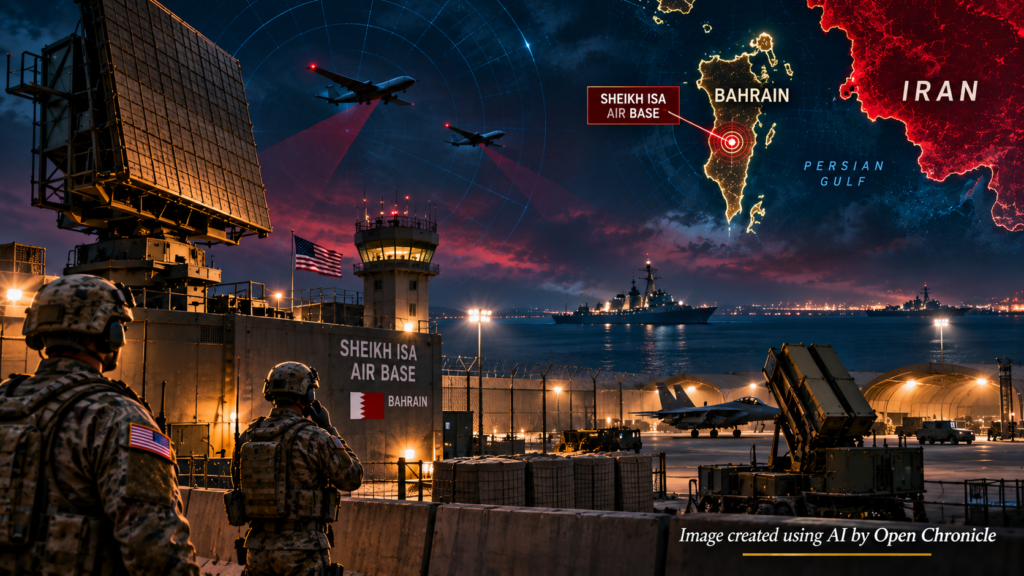
Iran’s Revolutionary Guards claim a precision drone operation against an American radar installation at Sheikh Isa Air Base. Bahrain says its air defences intercepted the attack, while US Central Command reports no damage or casualties. The confrontation exposes the growing importance of military surveillance systems and the vulnerability of Gulf security infrastructure.
OPEN CHRONICLE | WARFARE JOURNAL
MIDDLE EAST DEFENSE | DRONES | MILITARY STRATEGY
17 November 2026 | By Open Chronicle Warfare Journal
A new confrontation over Bahrain
Iran’s Islamic Revolutionary Guard Corps launched another drone attack towards Bahrain on 17 November 2026, claiming to have targeted an American military radar system at Sheikh Isa Air Base.
The incident represents the latest escalation in a series of attacks against military installations associated with the United States in the Gulf.
According to Iranian statements, combat drones conducted an operation against a radar system operated by American forces.
Bahrain’s armed forces reported intercepting Iranian aerial attacks before they reached their intended targets.
US Central Command subsequently rejected the Iranian account of a successful strike, stating that multiple attack drones had been intercepted without damage to American equipment or injuries to US personnel.
The competing accounts illustrate a central difficulty in reporting on the conflict.
An attack can be launched against a military installation without successfully damaging its intended target.
The existence of an attempted strike does not establish that the attacking force achieved its objective.
As of the reporting available on 17 November, there was no independently verified evidence that the radar installation at Sheikh Isa had been destroyed or disabled.
Nevertheless, the incident carries considerable strategic significance.
Bahrain hosts important American military facilities, including the headquarters of the US Navy’s Fifth Fleet.
Attacks against surveillance and air defence infrastructure in the kingdom therefore have implications extending beyond Bahrain’s national security.
They affect the wider military competition between Iran and the United States, the security of American forces stationed in the Gulf and the stability of maritime routes essential to international trade.
What happened on 17 November?
The confrontation unfolded during the early hours of Tuesday.
Bahrain’s Interior Ministry issued a security warning advising residents to remain calm and move to a safe location.
The country’s air defence forces subsequently reported intercepting Iranian aerial attacks.
Bahraini authorities later announced that the immediate threat had passed.
At approximately the same time, the Islamic Revolutionary Guard Corps issued a statement claiming that its combat drones had targeted a US military radar system at Sheikh Isa Air Base.
The Iranian statement described the operation as retaliation for what Tehran alleged were repeated American military drone incursions into Iranian airspace.
These allegations have not been independently established by Open Chronicle.
The IRGC presented the attack as part of its response to American military activities in the region.
However, US Central Command disputed the Iranian account.
The American military said its forces had intercepted the incoming drones and reported no damage to US equipment or injuries to American personnel.
Bahrain’s account was consistent with the broader conclusion that the attack had been intercepted.
The publicly available reports did not establish that the intended radar target had been struck.
The most reliable conclusion is therefore that Iranian drones were launched towards Bahrain and that Bahraini and American authorities reported successful defensive action.
The operational effectiveness of the Iranian attack remains a separate question from the fact that it occurred.
The third attack in five days
The incident did not occur in isolation.
It followed two earlier Iranian claims of attacks against American radar installations in Bahrain.
On 13 November, the Revolutionary Guards claimed to have targeted a US early warning radar facility.
American military authorities rejected the claim of a successful strike and reported that two Iranian drones had been intercepted without casualties or damage.
Two days later, on 15 November, Tehran announced another operation involving six drones.
This time, the IRGC identified an American air defence radar system at the Al-Riffa helicopter base as its intended target.
Bahrain reported intercepting Iranian aerial attacks before they reached their objectives.
The 17 November operation against Sheikh Isa therefore represented the third publicly reported Iranian attack claim involving military radar installations in Bahrain within five days.
The pattern is important.
The attacks appear to focus on military systems associated with surveillance, warning and defensive coordination.
However, the precise radar equipment involved has not been independently identified in the available reporting.
Nor has it been established that any of the attacks successfully disabled the systems Iran claimed to target.
The repeated choice of radar installations nevertheless suggests that Tehran regards these facilities as strategically significant.
Why military radar systems matter
Radar installations are central to modern air defence.
They can detect and track aircraft, missiles and other airborne objects, depending on the equipment involved and its operating conditions.
Radar information may be combined with other sensors to build a broader picture of activity in the surrounding airspace.
That information can support decisions about warnings, interceptions and defensive responses.
In an integrated air defence system, radar is one part of a wider network that may include command centres, communications equipment, aircraft and missile batteries.
The effectiveness of the network depends on how these components work together.
A successful attack against an important radar could potentially reduce surveillance coverage or complicate defensive coordination.
However, the consequences would depend on the specific system affected and the availability of alternative sensors.
Modern military forces often use overlapping surveillance capabilities to reduce dependence on individual installations.
It would therefore be misleading to assume that the loss of one radar automatically disables an entire air defence network.
In the Bahrain incident, there is no verified evidence that such a loss occurred.
The strategic relevance of the target lies in its potential role within the regional defensive architecture, not in any demonstrated destruction.
Sheikh Isa Air Base and the American military presence
Sheikh Isa Air Base is an important military installation in Bahrain.
The kingdom’s location in the Persian Gulf gives it strategic significance for American and Allied military operations.
Bahrain also hosts the headquarters of the US Navy’s Fifth Fleet, which supports American naval operations across a broad maritime region.
The Fifth Fleet’s area of responsibility includes strategically important waters such as the Persian Gulf, the Gulf of Oman and the Red Sea.
These waters connect major energy-producing states with international shipping routes.
The presence of American military facilities in Bahrain reflects a longstanding security relationship between Washington and Manama.
For the United States, the kingdom provides a regional military position from which forces can support maritime security, operational coordination and other missions.
For Bahrain, American military cooperation forms part of its wider national defence arrangements.
This relationship also creates potential exposure during confrontations between Washington and Tehran.
Military installations associated with American forces can become targets in regional hostilities even when the host country is not the principal party to the confrontation.
The November attacks demonstrate the security challenges facing states that host foreign military facilities during a wider conflict.
Iran’s stated justification
The Islamic Revolutionary Guard Corps described the 17 November attack as a response to alleged violations of Iranian airspace by American military drones.
Iranian statements have also referred to operations intended to counter US reconnaissance and surveillance activities.
These claims form part of Tehran’s public justification for the attacks.
However, the Iranian allegations concerning specific American drone incursions have not been independently verified in the reporting examined for this article.
Nor does the existence of a disputed airspace incident establish the legality or military necessity of an attack against installations located in another country.
Bahrain is a sovereign state.
Military operations conducted against targets on its territory raise questions concerning national sovereignty, the protection of civilians and the wider rules governing the use of force.
Iran has presented its actions as retaliation against American military activity.
Bahrain has described the attacks as threats requiring defensive interception.
The competing positions reflect the broader political and military confrontation between Tehran and Washington.
They also illustrate the risks faced by smaller Gulf states when disputes involving larger military powers extend across national borders.
The wider war: Nine months of regional confrontation
The latest attacks come against the background of the war that began on 28 February 2026 with US and Israeli military operations against Iran.
The conflict subsequently expanded across the region.
Iran responded with attacks directed at Israel and facilities it associated with American military operations in neighbouring countries.
Although diplomatic initiatives have periodically attempted to reduce hostilities, the conflict has remained unresolved.
By November, the confrontation had continued for nearly nine months.
Bahrain experienced attacks earlier in the war before a period of relative calm.
The renewed incidents in mid-November ended that quieter period and returned the kingdom to a heightened state of military alert.
The renewed attacks also coincide with diplomatic efforts involving Oman and Qatar.
These initiatives have focused partly on reducing tensions and protecting maritime routes.
The simultaneous continuation of military operations and diplomatic engagement reflects the unstable nature of the regional security environment.
Negotiations can proceed while armed incidents continue.
The existence of diplomatic contacts does not necessarily mean that the parties have agreed to suspend military action.
Drones as instruments of regional pressure
Unmanned aerial vehicles have become prominent instruments of military pressure during the conflict.
They can be used for reconnaissance, surveillance and attack missions.
Their capabilities vary substantially depending on design, payload, guidance and operating environment.
One-way attack drones are intended to strike a target rather than return to their launch point.
Compared with some traditional military aircraft and precision weapons, certain drone systems can be produced at relatively low cost.
However, the cost and sophistication of individual systems vary widely.
Drones also present challenges for air defence networks.
Defenders must detect, identify and respond to potentially hostile objects while avoiding unnecessary risks to civilian aircraft and surrounding populations.
The interception of drones may require a combination of radar, electronic systems and defensive weapons.
The repeated attacks against Bahrain demonstrate the importance of maintaining an effective defensive posture.
They also illustrate the operational burden created by recurring alerts.
Even when incoming aircraft are intercepted, military forces must maintain surveillance, prepare defensive systems and respond to potential threats.
For civilian populations, the consequences can include shelter warnings, disrupted activity and uncertainty about further attacks.
A successful interception therefore does not mean that the incident has no security or economic consequences.
The battle over military claims
One of the most important features of the Bahrain incidents is the difference between Iranian statements and American and Bahraini reporting.
Iran has repeatedly identified American radar systems as targets.
Its statements have presented the operations as military responses to American activity.
The United States has disputed claims that its radar equipment was damaged.
Bahrain has reported defensive interceptions.
These accounts do not necessarily contradict one another on every point.
An attacking force may launch drones towards a military installation, while the defending force intercepts them before impact.
The disagreement concerns whether the attack achieved its intended result.
That distinction should remain central to any assessment.
There is no publicly verified basis for concluding that the 17 November operation destroyed a radar system.
Similarly, the available reporting does not establish the exact technical characteristics of the drones involved or the defensive systems responsible for every interception.
Claims about the destruction of military equipment should be supported by reliable evidence rather than inferred from statements announcing an attack.
The information environment surrounding modern warfare frequently contains incomplete accounts, conflicting claims and deliberate attempts to influence public perceptions.
Careful attribution is therefore essential.
Why Bahrain matters to Gulf security
Bahrain’s strategic importance is closely connected to its geographical position and defence relationships.
The kingdom is situated near major Gulf shipping routes and hosts American naval infrastructure.
Its security is therefore linked to wider questions involving maritime traffic, regional military deployments and the ability of international forces to operate in the Gulf.
The Strait of Hormuz is particularly important.
The waterway connects the Persian Gulf with the Gulf of Oman and international sea routes.
Disruption to navigation in the area can affect commercial shipping and energy markets far beyond the Middle East.
On 17 November, Reuters also reported renewed concerns about maritime security, including an incident involving a tanker and its missing crew near the Strait of Hormuz.
That incident should not be assumed to be directly connected to the drone attack in Bahrain.
Nevertheless, the two developments illustrate the range of security pressures affecting the region.
Military attacks against installations and threats to commercial shipping can reinforce perceptions of instability.
For Gulf governments, the challenge is to protect national territory, maintain economic activity and avoid further escalation.
For the United States, the challenge is to protect deployed forces and military infrastructure while supporting maritime security.
For Iran, continued attacks risk increasing regional opposition and complicating diplomatic efforts.
Oman and Qatar attempt to contain the crisis
The renewed military activity coincides with diplomatic contacts involving Iran, Oman and Qatar.
Oman has played an important role in regional diplomatic initiatives, including discussions concerning maritime security.
On 17 November, Iranian and Omani officials discussed the protection of shipping corridors in the Strait of Hormuz.
Qatar was also expected to host discussions involving Iranian representatives as part of efforts to mediate an end to the conflict.
The timing underscores the difficulties facing regional diplomacy.
The parties involved must address immediate military incidents while attempting to establish broader arrangements capable of reducing hostilities.
Questions concerning navigation, military deployments and the use of regional bases remain particularly sensitive.
An agreement on one issue may not resolve disputes in other areas.
For example, improved maritime coordination would not automatically settle disagreements over American military operations or Iranian drone activity.
Similarly, a reduction in attacks against military installations would not necessarily resolve the broader political conflict.
The challenge is to establish mechanisms that can reduce the risk of miscalculation while longer-term negotiations continue.
Strategic analysis: What is Iran trying to achieve?
The repeated attacks against radar installations can be examined through several possible strategic objectives.
These are analytical interpretations rather than verified statements of Iranian operational planning.
1. Demonstrating continued military reach
By launching drones towards facilities associated with American forces, Iran may be seeking to demonstrate that it retains the ability to threaten military infrastructure across the Gulf.
Such demonstrations can have political value even when attacks are intercepted.
2. Challenging the perception of defensive security
Repeated alerts can create uncertainty about the security of military installations.
However, successful interceptions can also demonstrate the effectiveness of existing defensive arrangements.
The political impact therefore depends partly on how events are perceived.
3. Signalling opposition to American reconnaissance
Iran has explicitly linked its attacks to alleged US drone activity.
This suggests that surveillance operations are an important part of Tehran’s stated justification.
The underlying allegations remain unverified.
4. Increasing pressure during negotiations
Military operations conducted alongside diplomatic contacts can be interpreted as attempts to influence the broader negotiating environment.
However, there is insufficient public evidence to establish that the 17 November attack was directly coordinated with a specific diplomatic objective.
5. Testing regional political cohesion
Attacks involving states that host American military facilities can create pressure on regional governments.
Such incidents may influence public debate about foreign military deployments and national security.
They can also strengthen cooperation between threatened states and their security partners.
None of these potential objectives demonstrates that Iran achieved a military success at Sheikh Isa.
Five critical questions after the attack
The incident leaves several important questions unanswered.
Was the intended radar system actually damaged?
US Central Command reports that no American equipment was damaged. No independently verified evidence of a successful strike has emerged in the reporting examined.
How many drones were launched on 17 November?
The available reports refer to multiple Iranian attack drones, but do not establish a comprehensive, independently verified number.
Which defensive systems intercepted the aircraft?
Bahrain reported successful air defence operations. The publicly available accounts do not provide a complete technical reconstruction of every interception.
Will Iran continue targeting American installations in the Gulf?
The sequence of attacks demonstrates a recent pattern, but does not establish future operational decisions.
Can diplomatic efforts reduce the risk of further escalation?
Talks involving Oman and Qatar continue, although the conflict remains unresolved and renewed military incidents could complicate negotiations.
The risk of a wider confrontation
The principal danger associated with repeated attacks is escalation.
Even an unsuccessful drone strike can create pressure for a military response.
If future attacks cause casualties or significant damage, the political and operational consequences could be more severe.
A cycle of retaliation may develop in which each side presents its actions as defensive responses to the other.
This can make de-escalation more difficult.
The risks are particularly significant in the Gulf because military installations, commercial infrastructure and major shipping routes are located within a relatively concentrated geographical area.
An incident involving one military facility can affect perceptions of security across neighbouring states.
The potential consequences extend beyond the immediate military participants.
Shipping operators, energy markets and civilian populations may all be affected by prolonged instability.
The November incidents therefore illustrate how limited military operations can carry wider regional implications.
Conclusion: An intercepted attack with strategic consequences
The Iranian drone attack directed towards Sheikh Isa Air Base on 17 November 2026 adds another episode to the continuing confrontation between Tehran and Washington.
The Islamic Revolutionary Guard Corps claimed to have targeted an American radar system.
Bahrain reported intercepting Iranian aerial attacks.
US Central Command stated that the incoming drones were intercepted without damage to American equipment or injuries to US personnel.
The available evidence does not establish that Iran successfully destroyed or disabled the intended radar installation.
That distinction is essential.
Nevertheless, the attack demonstrates the continuing exposure of Gulf military infrastructure to unmanned aerial threats.
It also highlights the importance of surveillance networks, air defence readiness and regional military cooperation.
The renewed attacks occur as diplomatic efforts attempt to contain a conflict that has already destabilised the Middle East for months.
For Bahrain, the immediate priority is the protection of its territory and population.
For Washington, it is the security of American personnel and military facilities.
For Iran, continued military operations carry the risk of further confrontation and diplomatic isolation.
The wider strategic question is whether the parties can prevent recurring drone attacks from becoming the trigger for another major escalation.
The events of 17 November demonstrate that even an intercepted attack can become a significant test of regional security.
Sources and Further Reading
This report draws on five journalistic sources covering the reported Iranian drone attacks against military installations in Bahrain on 17 November 2026. The references include Reuters, Euronews and Anadolu Agency, providing accounts of Iranian military claims, Bahraini air defence operations, statements attributed to US Central Command and the wider diplomatic and security situation in the Persian Gulf.
Bahrain Says It Intercepts Iranian Air Attacks, IRGC Says It Targeted US Radar
Reuters reporting on the Iranian drone attack claimed against an American military radar installation in Bahrain. The article presents the Bahraini authorities’ account of successful air defence interceptions, the Islamic Revolutionary Guard Corps’ statement identifying the intended target and the response attributed to US Central Command, which reported no damage to American military equipment or injuries to US personnel.
Iran Attacks US Military Radar System in Bahrain Despite Talks with Mediators
Reporting by Nayera Abdallah and Jana Choukeir examining the wider regional context of the attack. The investigation addresses diplomatic contacts involving Iran, Oman and Qatar, discussions concerning the protection of maritime corridors in the Strait of Hormuz and the security implications of continued military incidents during efforts to reduce tensions across the Gulf.
Iran Claims Drone Attack on US Radar System at Sheikh Isa Air Base in Bahrain
Euronews coverage reconstructing the sequence of reported Iranian drone attacks against military radar installations in Bahrain beginning on 13 November 2026. The report distinguishes Iranian claims concerning intended targets from the defensive interceptions reported by Bahraini authorities and the absence of independently verified evidence confirming the destruction of American radar equipment.
Bahrain Says Air Defenses Intercept Aerial Iranian Attacks
Anadolu Agency reporting on statements issued by Bahraini authorities following the aerial attacks. The coverage includes the reported interception of incoming threats by Bahrain’s air defence forces, official security warnings issued to the population and subsequent announcements concerning the immediate security situation.
Iran Claims Drone Attack on US Radar System at Bahrain Air Base
Anadolu Agency coverage of statements attributed to the Islamic Revolutionary Guard Corps concerning the claimed drone operation against an American radar installation at Sheikh Isa Air Base. The report documents Tehran’s stated justification for the attack, including allegations of American drone activity, and provides context concerning earlier reported operations against military installations in Bahrain.
This article was prepared by Open Chronicle Warfare Journal using Reuters reporting published on 17 November 2026, supplementary reporting from Euronews and Anadolu Agency, and publicly reported statements attributed to Bahrain’s armed forces, the Islamic Revolutionary Guard Corps and US Central Command. Iranian claims concerning the targeting and alleged effectiveness of drone operations are distinguished from confirmed defensive interceptions and American statements denying damage or casualties. No independently verified evidence establishing the destruction or disabling of the radar installation at Sheikh Isa Air Base was identified in the sources examined. Technical discussion of radar systems, unmanned aircraft and air defence networks is general military analysis and does not imply knowledge of classified operational capabilities. Interpretations concerning Iranian strategic objectives and potential escalation scenarios are independent editorial assessments, not verified intelligence findings.