
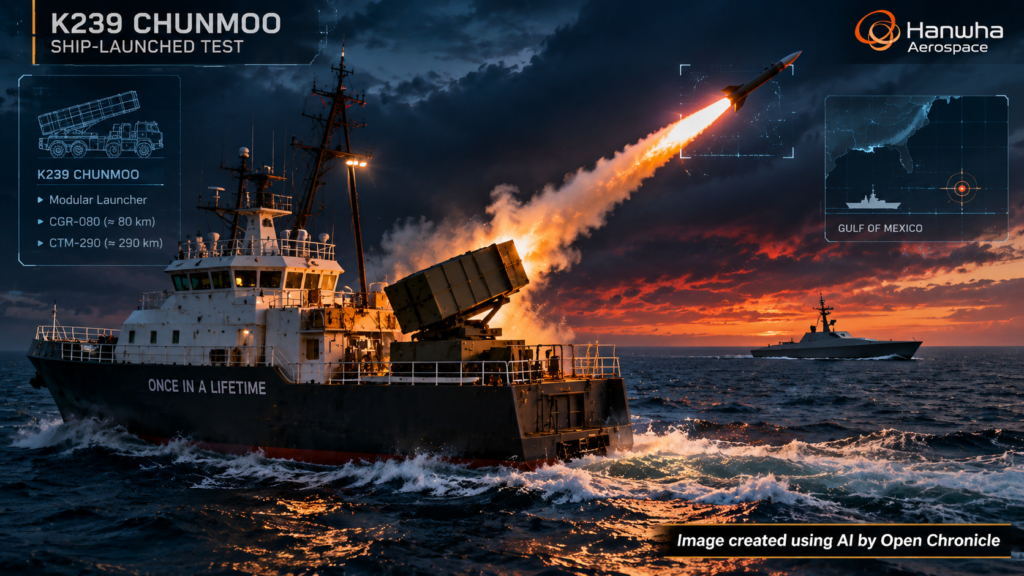
South Korea’s Hanwha has successfully demonstrated the launch of a Chunmoo missile from a vessel off the American coast. The experiment could open a new market for modular naval weapons, but turning a land-based rocket system into a reliable shipboard capability presents major engineering, operational and procurement challenges.
OPEN CHRONICLE | WARFARE JOURNAL
SEA | WEAPONS & SYSTEMS | MILITARY INDUSTRY
17 November 2026 | By Open Chronicle Warfare Journal
A land weapon goes to sea
A missile launcher originally developed for ground forces has taken an important step towards a potential new role in naval warfare.
South Korea’s Hanwha Aerospace and its American subsidiary, Hanwha Defense USA, conducted a maritime firing test of a Chunmoo missile from a vessel operating off the Mississippi coast on 15 November 2026.
The experiment, reported by Axios on 17 November, involved a modular launcher installed aboard the Once in a Lifetime, a vessel operated by The Spaceport Company.
Photographs examined by Axios showed a launcher module with four missile positions mounted towards the stern of the vessel.
Additional imagery documented a missile leaving the launcher and travelling over the Gulf of Mexico.
The demonstration is significant because the Chunmoo is primarily known as a ground-based multiple rocket launcher system.
Its traditional role is to provide land forces with precision fires against targets at different distances.
Moving such a system onto a vessel introduces an entirely different operational environment.
A ship is subject to movement, vibration, corrosion, changing sea conditions and limitations on deck space.
Its weapons must also be integrated with maritime communications, navigation, fire control and safety procedures.
The November demonstration indicates that Hanwha has begun addressing some of these challenges through practical testing.
It does not, however, establish that the system is ready for operational deployment aboard a naval warship.
Nor does it demonstrate that the US Navy has selected Chunmoo as a future shipboard weapon.
The distinction is fundamental.
A successful experimental launch is a milestone in development, not proof of completed military integration.
What happened during the Mississippi test?
The test took place aboard the Once in a Lifetime, a vessel associated with The Spaceport Company.
According to the Axios investigation, Hanwha’s missile team had been preparing the experiment for approximately eleven months.
The company sought to understand how its launcher would perform when installed on a relatively small maritime platform.
The test provided opportunities to examine the practical effects of firing from a moving vessel and the requirements for modular launcher installation.
Kevin Schoonover, Hanwha’s executive vice president for missiles, described the company’s development approach as a gradual process focused on learning from each experiment.
He also acknowledged the difficulty of launching missiles from a vessel operating in Sea State 2 conditions.
Sea State 2 generally describes a relatively calm sea with small waves.
Even under those conditions, a floating platform presents engineering challenges absent from a stationary land installation.
A research vessel operated by Magnet Defense helped observe and evaluate the launch.
Magnet Defense is also involved in Hanwha’s separate effort to develop medium unmanned surface vessels.
The involvement of these companies illustrates that the demonstration was more than a simple experiment involving a missile and a ship.
It formed part of a broader effort to understand how modular weapons could eventually be incorporated into new maritime platforms.
Nevertheless, the available public reporting does not provide a complete technical test report.
It does not establish the exact missile variant fired, its flight distance, the nature of the intended target or the full set of performance measurements collected.
There is also no publicly confirmed evidence that the experiment constituted a complete naval weapons qualification programme.
The demonstrated achievement is therefore specific: a Chunmoo missile was launched from a vessel during an experimental maritime trial.
The Chunmoo system: From Korean artillery to international defence markets
The K239 Chunmoo is a South Korean multiple rocket launcher system developed to provide mobile, precision-guided firepower.
The ground-based system uses a wheeled military vehicle carrying modular launch pods.
Its architecture allows operators to employ different types of ammunition according to mission requirements and national configurations.
Hanwha describes the system as a flexible platform designed to support precision strikes at different ranges.
Among its publicly documented weapons are 239 mm guided rockets with a range of up to approximately 80 kilometres.
The wider Chunmoo family also includes longer-range tactical missiles.
Hanwha has identified the CTM-290 as a missile with a stated range of up to approximately 290 kilometres.
These figures describe specific ammunition types associated with the land-based system.
They should not be interpreted as confirmed performance figures for the missile fired during the November maritime experiment.
The exact munition used in the Mississippi test has not been publicly established in the sources examined.
The distinction matters because the Chunmoo family is not a single missile.
It is a launcher architecture capable of accommodating different weapons.
The performance of an individual configuration depends on its ammunition, fire-control integration and operational conditions.
For a potential naval customer, this flexibility may be attractive.
However, each new combination of launcher, missile and maritime platform would require appropriate technical evaluation.
The technical figures above are based on publicly released Hanwha information concerning the broader Chunmoo family.
They do not constitute a verified specification sheet for the experimental naval launcher.
Why modular naval weapons are attracting attention
Traditional warships are generally designed around integrated weapons and combat systems.
Missile launchers, sensors, power supplies, communications and fire-control equipment are incorporated into the vessel’s design.
This approach can produce highly capable warships, but it can also make major changes expensive and time-consuming.
A modular approach seeks to provide greater flexibility.
Instead of permanently integrating every weapon into the ship’s structure, certain systems may be installed as self-contained or semi-independent packages.
In principle, such packages could be moved between suitable vessels or replaced as mission requirements change.
For navies operating a mixture of large combatants, patrol vessels, auxiliary ships and unmanned platforms, this concept offers potential advantages.
It may allow some vessels to carry additional weapons without requiring a completely new ship design.
It may also provide a way to experiment with emerging capabilities before committing to permanent integration.
However, modularity does not eliminate the need for engineering.
A missile launcher must remain secure during maritime operations.
Its installation must account for the ship’s structure, stability and safe operation.
The weapon must also communicate with appropriate command and control systems.
These requirements can be substantial.
A launcher that can be physically placed on a deck is not necessarily ready to function as part of an operational naval combat system.
The Mississippi test is important because it begins to examine the gap between those two conditions.
The engineering challenge of launching missiles from ships
Launching a missile from a land vehicle and launching one from a vessel involve different physical conditions.
On land, the launch platform can normally be stabilised within a relatively predictable environment.
At sea, the vessel is affected by wave motion and changing weather.
The ship may roll, pitch or experience other movements while preparing for launch.
These conditions affect the operating environment of the launcher and its supporting equipment.
Missile exhaust, structural loads and equipment protection also require careful assessment.
The November experiment reportedly examined the effects of firing from a smaller vessel.
This is particularly relevant to the development of modular launchers for ships that were not originally designed to carry heavy missile systems.
Engineering requirements may differ considerably between a large naval combatant and a smaller unmanned vessel.
Larger ships may provide more deck space, electrical capacity and structural margins.
Smaller platforms may offer advantages in cost and deployment flexibility but impose tighter design constraints.
The challenge is not simply to prove that a missile can leave a launcher.
It is to demonstrate that the complete system can operate safely, reliably and effectively under the conditions expected in military service.
That would require further testing beyond the publicly documented November demonstration.
The four-position launcher
One of the most interesting details in the Axios reporting concerns the launcher configuration.
Photographs reviewed by the publication showed a module with four missile positions installed on the experimental vessel.
This differs from the commonly illustrated land-based Chunmoo configuration, which uses two modular launch pods.
The maritime arrangement therefore deserves separate technical consideration.
However, the visible number of launcher positions does not establish the complete ammunition capacity of a future operational system.
It also does not establish that four missiles were fired during the test.
The public reporting documents a missile launch and the configuration visible in the test imagery.
It does not provide a complete account of all ammunition carried aboard the vessel.
Nor does it confirm whether the demonstrated module represents the final design intended for unmanned platforms.
The significance of the configuration lies in its experimental role.
Hanwha is exploring how the launcher architecture might be adapted to maritime space and installation constraints.
Future configurations could differ from the equipment used during this demonstration.
Magnet Defense and the unmanned vessel connection
Hanwha’s maritime ambitions extend beyond the experimental vessel used in November.
In April 2026, Hanwha Defense USA and Magnet Defense announced a strategic partnership involving medium unmanned surface vessels.
The companies identified the development of approximately 38-metre unmanned platforms as an area of cooperation.
Subsequent Hanwha reporting described plans to explore a container-mounted Chunmoo launcher for an H38 medium unmanned surface vessel.
This is a separate development effort from the Mississippi firing test.
The Once in a Lifetime was the vessel used for the demonstrated launch.
It should not be confused with a completed H38 combat prototype.
The partnership seeks to examine whether modular missile systems can eventually be integrated into unmanned maritime platforms.
Such vessels could potentially support surveillance, logistics or other military missions, depending on their configuration.
An armed version would introduce additional requirements involving command authority, communications reliability, navigation, safety and weapons control.
The public partnership announcements do not establish that an armed H38 has entered service.
Nor do they confirm that the US Navy has placed an order for a Chunmoo-equipped H38.
The concept remains developmental.
Could an unmanned vessel carry significant missile firepower?
The prospect of combining unmanned surface vessels with modular missiles is strategically important.
Unmanned maritime systems are being investigated by several navies because they may provide additional operational flexibility.
Depending on their design, such vessels could conduct surveillance, support logistics or carry mission equipment without requiring a conventional crew aboard.
A modular missile launcher could potentially expand the range of missions available to some platforms.
However, an armed unmanned vessel is not automatically an autonomous weapons system.
A vessel may navigate remotely or autonomously while still requiring human authorisation for the use of weapons.
The degree of automation can differ between navigation, target identification, mission planning and engagement decisions.
These functions should not be treated as interchangeable.
The public information concerning Hanwha’s proposed naval Chunmoo configuration does not establish the level of autonomy that would govern future weapons employment.
Any operational integration would require appropriate procedures for command responsibility and control over the use of force.
For naval commanders, the attraction of unmanned missile platforms must therefore be balanced against the need for reliable communications, operational oversight and compliance with applicable rules of engagement.
A possible role in distributed naval operations
The US Navy has increasingly explored concepts involving distributed maritime operations.
Broadly, these approaches seek to reduce dependence on a small number of highly concentrated military assets.
They involve the coordination of forces operating across wider geographical areas.
Unmanned platforms may contribute to this approach by providing additional sensors, support functions or other capabilities.
Modular missile systems could become relevant if they offer useful firepower without requiring every weapon to be permanently installed aboard a major warship.
However, the potential contribution of Chunmoo remains hypothetical.
The November test did not establish how a naval Chunmoo would be employed in an operational fleet.
It did not demonstrate integration with US Navy combat management systems.
Nor did it confirm compatibility with existing American naval targeting networks.
Those would be significant steps in any future procurement programme.
A successful demonstration of launch feasibility is therefore best understood as an initial technical achievement.
Its wider military significance depends on future development, evaluation and customer decisions.
The ammunition question
One of the most important unanswered questions concerns the missile used during the test.
Hanwha’s Chunmoo family includes several types of guided ammunition.
Different weapons are intended for different ranges and operational requirements.
A naval version could theoretically use elements of this modular ammunition architecture.
However, the precise ammunition selected would influence the system’s capabilities.
It would also affect its cost, integration requirements and potential military role.
A guided rocket designed for land targets is not automatically an anti-ship missile.
Engaging a moving vessel at sea can require different targeting and guidance capabilities from engaging a fixed land target.
The November reporting does not establish that the tested missile possessed a demonstrated capability against moving maritime targets.
It would therefore be inaccurate to describe the experiment as proof of a new operational anti-ship weapon.
The verified achievement is the shipboard launch of a Chunmoo missile.
Any claims about anti-ship performance, operational range at sea or engagement of moving targets would require additional evidence.
Hanwha’s growing international Chunmoo business
The maritime demonstration comes during a period of substantial international expansion for the Chunmoo programme.
European customers have increasingly selected the system as part of their artillery modernisation efforts.
Poland has developed a major relationship with Hanwha through the Homar-K programme.
The Polish configuration incorporates Chunmoo technology within a national defence procurement and industrial framework.
In December 2025, Hanwha announced an approximately $4 billion agreement for CGR-080 guided rockets associated with Poland’s programme.
Estonia has also ordered Chunmoo systems.
In May 2026, Hanwha announced an additional order for three launchers following an earlier six-launcher agreement.
Norway signed a contract in February 2026 covering 16 Chunmoo launch vehicles, guided missiles and support services.
The contract was valued at approximately $922 million, although the wider Norwegian acquisition programme had a larger overall budget.
Croatia followed in September 2026 with a contract for 18 launchers and associated equipment valued at approximately €411.8 million.
These are confirmed land-based procurement programmes.
They should not be interpreted as evidence that the same countries have ordered a maritime version.
Nevertheless, they demonstrate that Hanwha has established a substantial international customer base for the underlying launcher family.
That industrial experience may be relevant as the company explores new markets.
Hanwha’s wider American maritime strategy
The Chunmoo experiment also forms part of Hanwha’s broader expansion into the United States defence market.
The company has pursued opportunities involving shipbuilding, unmanned vessels and military equipment.
Hanwha’s acquisition of Philly Shipyard in 2024 established a significant industrial presence in American shipbuilding.
In 2026, the company also reported a contract associated with construction of a medium landing ship for the US Navy and Marine Corps.
Separately, Hanwha has explored the potential acquisition of Austal USA.
As of the reporting examined for this article, those discussions remained negotiations rather than a completed acquisition.
These developments are relevant because the company is seeking to offer a wider portfolio of defence capabilities.
Its interests include land systems, ammunition, shipbuilding and unmanned maritime platforms.
The ability to combine industrial capabilities across these sectors could strengthen its position in future competitions.
However, corporate expansion and weapons procurement are separate matters.
A shipbuilding contract does not establish that the US Navy has selected Chunmoo missiles.
Likewise, a strategic partnership with a maritime technology company does not constitute a production order for an armed unmanned vessel.
The distinction between industrial positioning and confirmed military procurement is essential.
How does Chunmoo compare with traditional naval missiles?
The experimental naval Chunmoo concept differs from many established naval missile systems.
Traditional naval missiles are generally developed around particular maritime missions and integrated into shipboard combat systems.
Depending on the weapon, these missions may include air defence, land attack or engagement of surface vessels.
Chunmoo originated as a land-based precision fires system.
Its potential maritime adaptation seeks to exploit an existing modular launcher and ammunition family.
The attraction is not necessarily that Chunmoo would replace established naval missile systems.
It may instead provide another option for vessels that could benefit from modular firepower.
However, the comparison must remain limited.
No verified public evidence from the November test establishes that a naval Chunmoo configuration offers equivalent capabilities to a dedicated naval missile system.
The experimental launcher has not been shown to possess the full integration, targeting and operational characteristics required for every naval mission.
A meaningful comparison would require information about the intended mission, ammunition, combat system and operational testing.
Until those details become available, the most useful assessment concerns the development concept rather than claims of superiority.
Five technical questions the programme must answer
1. Can the launcher operate reliably across a wider range of sea conditions?
The November test provides evidence of launch feasibility under the reported conditions. Additional trials would be needed to establish a broader operating envelope.
2. How will the system integrate with naval fire control?
Operational deployment would require reliable coordination between the launcher, navigation systems and appropriate command structures.
3. Which missiles will be qualified for maritime use?
The Chunmoo family includes several ammunition types, but the November reporting does not establish a complete naval ammunition configuration.
4. Can the launcher be installed on unmanned vessels without compromising platform performance?
Future integration would require assessment of vessel stability, structural capacity, safety and mission requirements.
5. Will a military customer fund further development or procurement?
The experiment demonstrates industrial initiative. It does not confirm a US Navy acquisition decision.
Strategic assessment: Why the experiment matters
The most important implication of the Mississippi demonstration is the possibility of transferring an established land weapons architecture into a maritime environment.
That approach could offer opportunities for defence manufacturers seeking to develop modular capabilities without designing every component from the beginning.
For Hanwha, the experiment may create a new avenue for expanding the Chunmoo family.
For potential naval customers, it introduces another concept for adding firepower to suitable platforms.
For the defence industry, it illustrates the growing overlap between traditional land weapons, naval engineering and unmanned systems.
However, several obstacles remain.
The system must be assessed under realistic maritime conditions.
Its weapons must be integrated with appropriate command and control arrangements.
The intended missions must be clearly defined.
And a customer must determine whether the capability provides sufficient operational value to justify its costs.
There is also a wider industrial question.
Can modular weapons reduce the time and expense of adapting vessels to new military requirements?
The answer will depend on the actual engineering and integration costs, not simply on the apparent simplicity of placing a launcher aboard a ship.
A modular system may offer flexibility while still requiring substantial testing and support.
The November demonstration is therefore best viewed as a promising technical experiment rather than a completed transformation in naval warfare.
What happens next?
Hanwha announced on 9 November that it intended to conduct two maritime firing tests during the month.
The Axios report published on 17 November documented one completed launch.
The public evidence examined for this article does not establish that both planned tests had been completed.
Future reporting should therefore distinguish between the announced test programme and the launch already demonstrated.
Further developments may include additional firing trials, refinements to the launcher module and continued work on unmanned vessel integration.
The H38 concept may also provide an opportunity to explore a more purpose-built maritime configuration.
However, no confirmed operational deployment timetable has been established.
Nor has a production contract for a naval Chunmoo configuration been verified.
The programme’s next milestones will depend on technical progress, industrial investment and potential customer requirements.
Conclusion: A demonstration, not yet a naval revolution
Hanwha’s shipboard Chunmoo launch represents a meaningful step in the development of modular naval weapons.
The experiment demonstrated that a missile from a system traditionally associated with land warfare could be launched from a maritime platform.
It also provided practical experience relevant to launcher installation and shipboard firing conditions.
The result supports Hanwha’s broader ambition to explore military capabilities that can operate across different environments.
But the achievement should not be overstated.
The test did not establish an operational naval missile system.
It did not demonstrate every capability required for combat employment.
And it did not confirm procurement by the United States Navy.
What it did establish is that Hanwha has moved beyond conceptual proposals and into practical maritime testing.
That is a development worth watching.
The future of naval firepower may involve a wider range of vessels carrying adaptable weapons, including unmanned platforms.
Whether Chunmoo becomes part of that future will depend on the results of further engineering, testing and procurement decisions.
For now, the Mississippi launch marks the beginning of a potentially important naval weapons development programme, not its completion.
Sources and Further Reading
This technical investigation draws on seven sources, prioritising official documentation from Hanwha Aerospace and Hanwha Defense USA, original reporting on the maritime Chunmoo missile test and independent defence industry coverage. The references distinguish the experimental shipboard launch from established land-based Chunmoo capabilities, industrial partnerships and confirmed international procurement contracts.
Exclusive: Hanwha Tests Chunmoo Missile From Ship Off Mississippi
An investigation by Colin Demarest documenting Hanwha’s experimental maritime launch of a Chunmoo missile from a vessel operating off the Mississippi coast. The report includes photographs of the launch, identifies the experimental vessel and presents statements from Kevin Schoonover concerning the engineering challenges associated with adapting a land-based missile launcher for maritime operations.
Maritime Chunmoo Firing Tests in the United States
Official Hanwha Group announcement outlining plans for two maritime firing tests involving the Chunmoo missile system in the United States. The document describes the company’s efforts to adapt its modular launcher architecture for naval platforms and provides context concerning cooperation with Magnet Defense on future unmanned surface vessel applications. The original announcement was published in Korean.
Hanwha and Magnet Defense Formalize MUSV Strategic Partnership
Official documentation confirming the strategic partnership between Hanwha and Magnet Defense in the development of medium unmanned surface vessels. The announcement identifies areas of industrial cooperation, future maritime platform concepts and opportunities to integrate modular military capabilities into unmanned naval systems.
Chunmoo Multiple Rocket Launcher System, Estonia Programme
Hanwha Aerospace documentation concerning Estonia’s additional Chunmoo procurement and the technical characteristics of the land-based multiple rocket launcher family. The announcement provides information about the modular launcher architecture, 239 mm guided rockets and the CTM-290 tactical missile, including manufacturer-published range figures. These specifications describe documented land-based configurations and do not establish the performance of the experimental naval system.
Chunmoo MRLS Contract With Croatia
Official Hanwha Aerospace announcement documenting Croatia’s procurement of 18 Chunmoo multiple rocket launcher systems and associated equipment. The release provides additional information concerning modular ammunition configurations, command and control integration and the international expansion of the Chunmoo programme. The Croatian agreement concerns land-based systems and is separate from the experimental maritime development.
First Chunmoo Contract With Norway
Hanwha Aerospace’s official announcement confirming a contract valued at approximately USD 922 million for the supply of 16 Chunmoo launch vehicles, guided missiles and associated support services to Norway. The agreement demonstrates the international expansion of the land-based Chunmoo system and should not be interpreted as procurement of a naval variant.
Hanwha Aerospace to Conduct Ship-Based Chunmoo Missile Tests in US
Yonhap News Agency reporting on Hanwha Aerospace’s announced maritime Chunmoo firing tests in the United States. The article examines the company’s naval development ambitions, the potential integration of missile systems with unmanned vessels and the wider expansion of South Korean defence industry activities in the American market. The report concerns the announced test programme rather than independent confirmation of all planned launches.
This article was prepared by Open Chronicle Warfare Journal using original reporting published by Axios on 17 November 2026, official announcements and technical documentation issued by Hanwha Aerospace and Hanwha Defense USA, and supplementary reporting from Yonhap News Agency. The shipboard Chunmoo firing reported on 17 November is distinguished from the two maritime tests announced by Hanwha on 9 November. Public reporting confirms an experimental launch from a vessel off Mississippi but does not establish the exact missile variant, complete performance results or operational qualification of the system. Published ranges for Chunmoo ammunition refer to documented land-based configurations and must not be interpreted as verified naval test performance. The partnership with Magnet Defense, negotiations concerning Austal USA and confirmed land-based Chunmoo procurement contracts are treated as separate industrial and contractual developments. No US Navy selection, acquisition or operational deployment of a naval Chunmoo system has been independently confirmed. Strategic and technical assessments are editorial analysis based on publicly available information.