
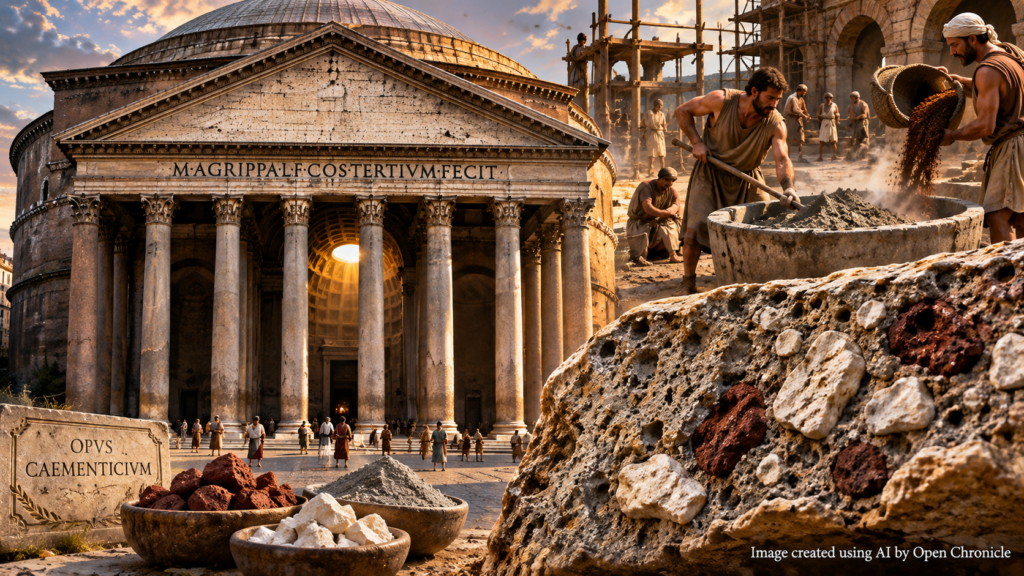
From the Pantheon in Rome to a construction site buried beneath Pompeii, modern science is uncovering how ancient builders created remarkably durable materials, and why their methods could help transform the future of construction.
By Open Chronicle History Desk
In the heart of Rome stands one of the most extraordinary engineering achievements in human history.
The Pantheon has survived for almost nineteen centuries. Its immense concrete dome, completed during the reign of Emperor Hadrian in the second century AD, remains the largest unreinforced concrete dome in the world.
It has witnessed the decline of the Roman Empire, the transformation of ancient Rome into medieval Rome, the Renaissance, the rise of modern Italy and nearly two thousand years of changing civilisation.
Yet the dome still stands.
Across the modern world, meanwhile, concrete structures can develop cracks, suffer corrosion and require expensive repairs within decades of construction.
The contrast raises an irresistible question.
How did Roman builders create concrete capable of surviving for centuries when modern structures sometimes deteriorate so much faster?
For generations, historians and engineers searched for the answer in volcanic ash, lime, ancient construction methods and the extraordinary skill of Roman builders.
Now, scientific investigations conducted in the twenty-first century are revealing something even more remarkable.
Some ancient Roman concrete mixtures may have possessed a limited capacity to repair their own cracks.
And in December 2025, researchers studying an unfinished construction site in Pompeii uncovered unusually direct archaeological evidence of how Roman workers prepared one of these sophisticated materials.
The discovery has brought modern science closer to understanding an ancient technology that helped build an empire.
The Concrete That Built an Empire
The Romans did not invent the basic idea of combining mineral binders and aggregates to create construction materials.
Earlier civilisations had already developed mortars and other forms of artificial stone.
What Roman engineers achieved was the refinement and widespread application of a material that transformed the possibilities of architecture.
Known today as opus caementicium, Roman concrete generally consisted of a lime-based mortar combined with pieces of stone, rubble or other aggregates.
Depending on location and purpose, builders incorporated volcanic materials capable of reacting chemically with lime.
The result was a versatile construction material.
Instead of relying exclusively on carefully cut stone blocks, Roman engineers could construct substantial walls, foundations, vaults, arches and domes using concrete cores enclosed within different forms of masonry facing.
This helped make ambitious projects more practical.
Roman concrete supported aqueducts carrying water across valleys, bridges spanning rivers, public baths with enormous vaulted interiors, harbour installations exposed to seawater and monumental buildings that projected imperial power.
Its importance extended beyond engineering.
Concrete helped shape the Roman city itself.
Large public buildings became architectural expressions of political authority, religious identity and civic ambition.
The material was therefore not simply a technological innovation.
It became one of the physical foundations of Roman civilisation.
The Pantheon: An Engineering Achievement That Defied Time
The Pantheon provides perhaps the most dramatic surviving demonstration of Roman concrete construction.
The present building was completed around AD 125 to 128, during the reign of Hadrian.
Its interior is dominated by an immense hemispherical dome, approximately 43 metres in diameter.
At its summit is the oculus, a circular opening that allows daylight to enter the building.
The structure achieves its monumental scale without modern steel reinforcement.
But its survival cannot be explained by the composition of its concrete alone.
Roman engineers carefully controlled the building’s geometry, structural mass and distribution of materials.
The concrete becomes progressively lighter toward the upper sections of the dome.
The massive supporting walls absorb and distribute the forces generated by the structure.
The dome’s thickness also decreases toward the top.
These decisions reduced weight while preserving structural stability.
The Pantheon is therefore a reminder that durable construction depends on more than a remarkable recipe.
It depends on intelligent design.
The building’s continued use, maintenance and adaptation over centuries have also contributed to its preservation.
The Pantheon does not prove that all Roman concrete was capable of self-repair. Indeed, the modern experiments associated with that mechanism were conducted on other ancient materials.
What it demonstrates is the extraordinary sophistication of Roman structural engineering.
The Volcanic Ingredient
For much of the twentieth century, scientific explanations of Roman concrete durability concentrated on the importance of volcanic materials.
Roman builders used natural volcanic ash, particularly material associated with the region around Pozzuoli near the Bay of Naples.
Such materials are known as pozzolans.
When suitable pozzolanic substances react with lime and water, they can form cementitious compounds that improve the performance of the resulting mortar.
These reactions help explain why some Roman concretes could harden in wet environments and why particular mixtures proved effective in maritime construction.
The Romans recognised the practical value of these materials even though they lacked modern chemical theory.
Their knowledge was empirical.
Builders learned through experience which combinations worked best for different structures and environmental conditions.
Volcanic ash was especially valuable for projects involving water.
Roman harbours, breakwaters and coastal installations provide important evidence of how builders adapted their materials to difficult environments.
But volcanic ash was only part of the story.
Researchers began to suspect that another component, long visible within Roman concrete samples, had been misunderstood.
The White Fragments Nobody Fully Understood
When scientists examine some ancient Roman mortars under magnification, they encounter small, bright mineral fragments.
These are commonly called lime clasts.
For many years, such inclusions were sometimes interpreted as evidence of imperfect mixing or insufficiently refined construction practices.
The assumption was understandable.
Modern concrete production generally seeks controlled, consistent mixtures.
Visible fragments of unreacted material might appear to represent a manufacturing defect.
But what if the fragments were not simply mistakes?
What if they were evidence of a deliberate construction method?
And what if their presence helped certain Roman concretes resist deterioration?
Those questions became central to research conducted by scientists at the Massachusetts Institute of Technology and collaborating institutions.
In January 2023, a study published in Science Advances proposed a new explanation for the role of lime clasts in ancient Roman concrete.
The research suggested that a process known as hot mixing could create reactive mineral inclusions capable of contributing to the material’s long-term durability.
The idea challenged the assumption that the most important features of Roman concrete had already been identified.
The Secret of Hot Mixing
To understand the discovery, it is necessary to examine how lime behaves.
Lime production begins with limestone, which is heated to produce quicklime, primarily calcium oxide.
When quicklime comes into contact with water, it undergoes a chemical reaction that releases heat.
This process can produce slaked lime, calcium hydroxide.
Ancient builders could incorporate lime into mortar using different preparation methods.
In conventional interpretations of Roman construction, lime was often assumed to have been slaked before being combined with other ingredients.
But the MIT-led research suggested that some Roman builders added quicklime directly to mixtures containing aggregates and pozzolanic materials.
Water was then introduced.
The resulting chemical reaction generated considerable heat within the mixture.
This is the process researchers describe as hot mixing.
The elevated temperatures could alter the chemistry and microstructure of the material.
Crucially, the process could leave behind reactive lime-rich fragments.
These fragments were not necessarily evidence of poor workmanship.
They could be part of the reason certain Roman mortars remained durable for so long.
Concrete That Can Repair Itself
The most intriguing implication of the 2023 research concerned what happens when cracks develop.
Concrete is strong in compression, but cracking remains a major challenge in many cementitious materials.
Temperature changes, structural movement, moisture and other environmental stresses can contribute to the formation of fractures.
Once water enters these cracks, deterioration may accelerate.
In the Roman-inspired materials investigated by the research team, lime clasts offered a possible mechanism for limiting that damage.
When a crack intersects a reactive lime-rich fragment and water enters the material, calcium-bearing compounds can dissolve.
The resulting calcium-rich solution may then participate in reactions that produce new mineral deposits, including calcium carbonate.
These deposits can fill small cracks.
In laboratory experiments, researchers created modern mixtures inspired by the ancient process and deliberately introduced fractures.
Some cracks measuring up to approximately half a millimetre were effectively sealed under the experimental conditions.
Comparable control samples without the relevant quicklime additions did not exhibit the same behaviour.
The results suggested that a material initially considered imperfect could possess a useful form of autonomous crack sealing.
This did not mean Roman concrete was indestructible.
Nor did it establish that every Roman building possessed the same capacity.
But it demonstrated that a manufacturing technique used in antiquity could produce properties of considerable interest to modern engineers.
Pompeii: A Construction Site Frozen in Time
The next major development came from one of archaeology’s most extraordinary sites.
Pompeii was buried during the eruption of Mount Vesuvius in AD 79.
The catastrophe destroyed lives and buildings, but it also preserved an unusually detailed record of Roman urban life.
Homes, shops, streets, paintings, tools and everyday objects survived beneath volcanic deposits.
In some locations, the eruption interrupted activities that were still in progress.
That circumstance has proved especially valuable for understanding Roman construction.
In excavations at Regio IX, archaeologists identified an unfinished building site containing construction materials and partially completed structures.
Researchers could examine not merely the finished concrete but the ingredients and working environment associated with its production.
This offered something rare.
A glimpse of the construction process itself.
In December 2025, an international research team published its findings in Nature Communications.
The investigators analysed raw materials, partially completed walls and previously constructed masonry.
Their results provided strong archaeological evidence that workers in Pompeii were using hot mixing.
The researchers identified quicklime that had been combined with dry pozzolanic materials before water was introduced.
The discovery directly supported an important aspect of the manufacturing process proposed in earlier scientific research.
Pompeii had preserved evidence of Roman builders preparing their materials nearly two thousand years ago.
Modern laboratory techniques could now investigate those materials at a microscopic level.
What the Pompeii Discovery Actually Proved
The importance of the 2025 study lies in the connection between archaeology and materials science.
The researchers did not merely discover another ancient wall.
They found evidence of ingredients and construction practices at a site where work had been interrupted.
Chemical and microstructural analyses helped establish how those ingredients had been combined.
The findings strengthened the case that hot mixing was a genuine Roman construction technique rather than simply a modern explanation inferred from finished concrete samples.
They also revealed chemical processes involving calcium migration and mineral formation within the material.
These observations are consistent with mechanisms that may contribute to crack sealing and long-term durability.
But an important distinction remains.
The Pompeii evidence does not prove that all Roman concrete was manufactured using precisely the same method.
Nor does it demonstrate that every surviving Roman monument owes its longevity primarily to lime-clast reactions.
Roman construction varied across regions, periods and building types.
Different materials were available in different places.
Builders adapted their methods to local conditions.
The scientific discovery is therefore significant precisely because it adds detail to a complex technological history rather than reducing Roman engineering to one secret ingredient.
Did the Romans Understand the Chemistry?
The Romans did not possess modern knowledge of calcium chemistry, mineral microstructures or the molecular processes involved in cementitious reactions.
Yet they could recognise practical outcomes.
A mortar that hardened effectively, resisted water or performed reliably in a particular environment was valuable.
Roman builders accumulated experience over generations.
They learned how to prepare lime, select aggregates and adapt mixtures for different purposes.
The Roman architect and engineer Vitruvius, writing in the first century BC, described construction materials and methods in his treatise De Architectura.
His work provides an important record of Roman technical knowledge.
But written sources are incomplete.
They do not necessarily describe every practice used throughout the empire.
Nor do they capture all the methods developed by working builders.
The Pompeii discoveries are particularly valuable because they provide material evidence that can be compared with ancient written descriptions.
The results suggest that Roman construction knowledge was more varied than a single surviving technical treatise might indicate.
The builders may not have understood the chemistry in modern terms.
They did, however, understand enough about material behaviour to produce structures of extraordinary sophistication.
Why Does Modern Concrete Crack?
The comparison between ancient and modern concrete is compelling, but it can also be misleading.
Modern concrete is not simply an inferior version of Roman concrete.
It is a family of engineered materials designed for an enormous range of applications.
Contemporary buildings, bridges, dams, tunnels and transport infrastructure face demands that differ substantially from those of many surviving Roman monuments.
Modern reinforced concrete can support slender structures, long spans and complex architectural forms that ancient builders could not achieve in the same way.
Steel reinforcement allows concrete to resist tensile forces much more effectively.
However, steel introduces additional durability challenges.
When moisture and aggressive substances penetrate concrete, reinforcement may corrode.
Corrosion products can expand, causing cracking and damage to the surrounding material.
Other forms of deterioration may result from chemical reactions, freeze-thaw cycles, environmental exposure, poor workmanship or structural overloading.
Cracking does not automatically mean a concrete structure is unsafe.
Some cracks are expected and controlled through engineering design.
The real challenge is preventing deterioration from compromising a structure’s performance over its intended service life.
It is also worth remembering that many ancient Roman structures did not survive.
The monuments visible today represent a selective historical record, shaped by original construction quality, environmental conditions, later maintenance and centuries of rebuilding.
Comparing the Pantheon with a poorly maintained modern structure does not establish that Roman concrete was universally superior.
It does, however, encourage engineers to investigate why certain ancient materials have performed so well.
Could Roman Concrete Change Modern Construction?
One of the most promising implications of the research concerns the environmental cost of construction.
Modern cement production requires substantial energy and generates significant carbon dioxide emissions.
Concrete is also used on an enormous global scale.
Extending the useful life of concrete structures could therefore have important economic and environmental benefits.
If materials can seal small cracks before serious deterioration develops, they may require fewer repairs and replacements.
That could reduce maintenance costs and the consumption of additional construction materials.
Researchers are investigating whether principles inspired by Roman hot mixing can be incorporated into modern cementitious systems.
The objective is not necessarily to reproduce ancient Roman concrete exactly.
Modern engineering must satisfy contemporary structural, safety and performance standards.
Instead, the goal is to understand useful mechanisms and adapt them to present-day needs.
A material capable of responding chemically to early damage could become part of a new generation of more resilient construction products.
The promise is substantial.
But laboratory demonstrations are not equivalent to proven performance over decades in full-scale buildings.
Long-term testing, manufacturing consistency, economic feasibility and regulatory acceptance remain essential.
The ancient method offers a research direction, not a ready-made replacement for modern concrete.
The Empire’s Knowledge Was Never Entirely Lost
There is another misconception worth addressing.
The story is sometimes presented as though the Romans possessed a miraculous concrete formula that disappeared completely after the fall of the Western Roman Empire.
The historical reality is more complicated.
Lime mortars and related construction traditions continued to be used after antiquity.
Knowledge of building materials persisted in different forms across the Mediterranean and beyond.
What changed were the political systems, economic resources, construction demands and institutions that supported large-scale Roman engineering.
The collapse of imperial structures affected the organisation of labour, the availability of resources and the commissioning of monumental projects.
Some specialised practices became less common or disappeared from particular regions.
Others evolved.
The history of Roman concrete is therefore not simply a story of forgotten knowledge.
It is a story of technological adaptation, changing societies and the difficulty of reconstructing ancient practices from incomplete evidence.
Modern scientists are not rediscovering an entirely vanished substance.
They are identifying the chemical mechanisms behind materials whose physical remains have survived for centuries.
When Archaeology Meets Modern Science
The investigation of Roman concrete demonstrates how historical research has changed.
Archaeologists once depended heavily upon written records, architectural analysis and the visible remains of ancient structures.
Those methods remain indispensable.
But modern scientific instruments can now examine materials at scales unavailable to earlier generations.
Microscopy, spectroscopy, chemical mapping and mineralogical analysis can reveal information about manufacturing techniques and long-term reactions.
In Pompeii, these methods have transformed abandoned construction materials into evidence of ancient industrial practice.
In laboratories, researchers can recreate proposed processes and test their effects.
Historical interpretation and experimental science can therefore inform one another.
An archaeological discovery raises a technical question.
A laboratory experiment proposes an explanation.
Further excavation provides evidence that supports, challenges or refines the hypothesis.
This combination is especially powerful when investigating technologies that ancient writers described only partially.
It allows researchers to move beyond admiration for Roman engineering toward a more detailed understanding of how it worked.
The Lesson of Two Thousand Years
The Pantheon remains standing in Rome.
The ruins of Pompeii continue to reveal the ordinary activities of a civilisation destroyed by volcanic catastrophe.
And small white fragments embedded in ancient concrete have become the subject of sophisticated scientific investigation.
Together, they tell a story that stretches across nearly two millennia.
Roman builders combined practical experience, available materials and ambitious engineering to create structures that transformed the ancient world.
Modern researchers are beginning to understand some of the chemical processes that helped particular Roman materials endure.
The discoveries of 2023 and 2025 have provided important evidence for hot mixing and its potential contribution to concrete durability.
Yet the most important conclusion is not that the Romans possessed a single secret capable of solving every modern engineering problem.
It is that ancient construction methods may contain principles that remain scientifically valuable.
The builders of Rome did not know the molecular chemistry of their materials.
They did not possess electron microscopes, digital modelling or modern testing laboratories.
But through experimentation, observation and accumulated knowledge, they developed techniques whose consequences are still being investigated today.
And perhaps that is the most remarkable part of the story.
Two thousand years after Roman workers mixed lime, volcanic materials and stone, their concrete is still teaching us how to build for the future.
Historical Sources and Further Reading
This article draws on peer-reviewed scientific research, archaeological investigations and architectural history to examine the durability of Roman concrete and the significance of recent discoveries.
Science Advances | Hot Mixing and Roman Concrete Durability
Seymour and colleagues, 2023. Peer-reviewed investigation of lime clasts, hot mixing and the potential for autonomous crack sealing in Roman-inspired cementitious materials.
Nature Communications | An Unfinished Pompeian Construction Site
Vaserman and colleagues, 9 December 2025. Archaeological and chemical evidence from Pompeii documenting the preparation of Roman construction materials using quicklime and dry pozzolanic ingredients.
Massachusetts Institute of Technology | Pompeii Offers Insights into Roman Building Technology
MIT News, 9 December 2025. Explanation of the Pompeii discoveries, hot mixing and the potential implications for more durable modern construction materials.
Pantheon Museum | The Pantheon in Rome
Architectural overview of the Pantheon’s construction, structural design, unreinforced concrete dome and long-term preservation.
This article distinguishes established archaeological evidence from scientific interpretations and experimental results. Research on self-healing mechanisms does not establish that every Roman concrete structure possessed identical properties. Comparisons with modern concrete must account for differences in design, reinforcement, environmental exposure, maintenance and intended performance.