
SOUTH AMERICA | BRAZIL | NOVEMBER 20, 2026
By Open Chronicle News Desk
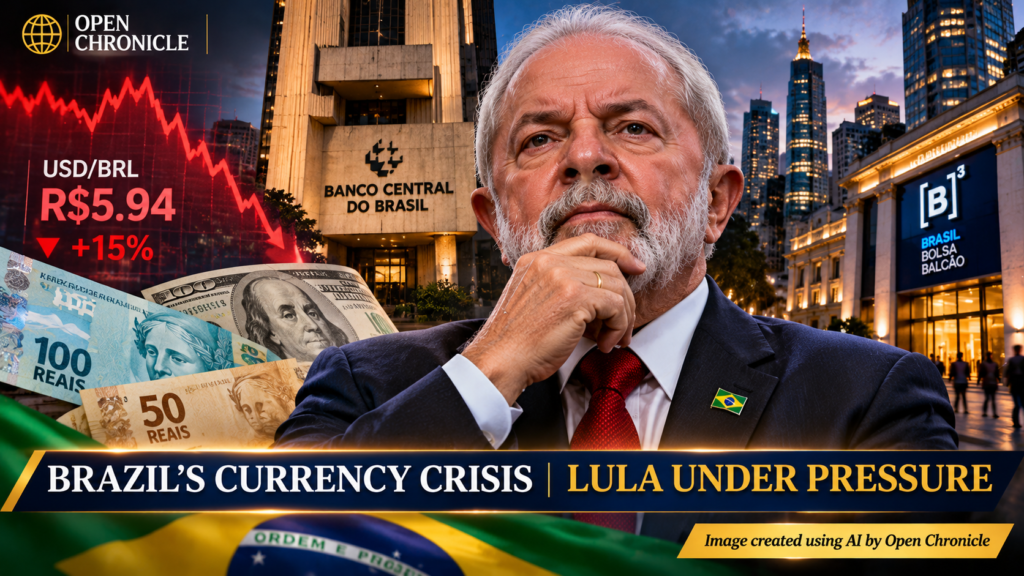
Brazil’s central bank has intervened in currency markets after the real suffered a sharp decline following President Luiz Inácio Lula da Silva’s re-election. With investors questioning the government’s fiscal strategy, the country’s economic outlook is becoming a test of political credibility, monetary stability and the balance between social commitments and public finances.
BRASÍLIA, Brazil. Brazil’s central bank sold $1 billion in the foreign exchange market on November 19 in an attempt to contain mounting pressure on the national currency, as investors grew increasingly concerned about the direction of economic policy following President Luiz Inácio Lula da Silva’s re-election.
The intervention, the central bank’s first outright spot-dollar sale since December 2024, briefly slowed the real’s decline. But the relief proved temporary.
The Brazilian currency ended Thursday’s session near R$5.94 against the US dollar, after weakening by approximately 15% since Lula’s electoral victory in October, according to financial market reporting.
The depreciation reflects a combination of domestic fiscal uncertainty, questions over the composition of the next economic team and an increasingly challenging international financial environment.
For Latin America’s largest economy, the immediate challenge is not simply stabilising an exchange rate.
It is restoring confidence that Brazil can finance its public commitments, control inflation and maintain economic growth without allowing public debt to follow an increasingly difficult trajectory.
A $1 billion intervention that failed to reverse the trend
Brazil’s central bank entered the spot foreign exchange market on Thursday, selling $1 billion in an extraordinary auction.
The objective was to provide dollar liquidity and contain excessive volatility as demand for the American currency intensified.
Initially, the intervention produced some relief.
The dollar briefly retreated as additional liquidity entered the market. But the movement was short-lived, and the real resumed its decline before the trading session ended.
The episode demonstrated the limitations of monetary intervention when investors believe that the underlying problems are political and fiscal rather than purely technical.
Currency interventions can reduce disorderly trading conditions and provide liquidity during periods of market stress.
They cannot, by themselves, resolve doubts about future government spending, debt sustainability or the credibility of economic policy.
That distinction is central to understanding the current Brazilian situation.
The central bank can influence short-term market conditions, but confidence in the country’s fiscal trajectory ultimately depends on decisions made by the government and Congress.
Brazil’s economic warning signs
Brazil | Market Snapshot
Outright dollar sale
Approximately, per US dollar
Since October’s election, FT estimate
Selic policy rate
Figures are rounded and reflect reporting available on November 20, 2026. Exchange rates fluctuate, and percentage estimates vary by measurement period.
The fiscal problem behind the currency crisis
At the centre of investor concerns is Brazil’s fiscal outlook.
The government faces pressure to maintain social spending, support economic activity and fulfil political commitments while preventing public debt from rising too quickly.
Brazil’s gross public debt is estimated at approximately 83% of gross domestic product.
That level does not automatically imply an imminent sovereign debt crisis, but it increases the importance of credible budget planning, particularly when borrowing costs are elevated.
The government has proposed measures intended to improve the fiscal balance in 2027.
A package recently approved by the Senate is expected to generate approximately R$50 billion in fiscal improvements, according to domestic financial reporting, although its final impact will depend on legislation and implementation.
Critics argue that the measures rely heavily on additional revenue rather than durable reductions in expenditure.
Supporters of the government’s approach contend that abrupt spending cuts could undermine public services, investment and programmes intended to reduce inequality.
This disagreement reflects a persistent tension in Brazilian economic policy.
The country needs fiscal credibility, but it also faces significant social and developmental needs.
Finding a sustainable balance between those objectives is one of the defining challenges of Lula’s next presidential term.
Lula’s political decisions are moving financial markets
The latest currency pressure intensified after Lula indicated that he was in no hurry to announce his next finance minister and other senior government appointments.
Financial markets are closely watching the composition of the economic team because those appointments will influence expectations about fiscal discipline, taxation, spending and relations with Congress.
Investors generally look for a finance minister capable of presenting a coherent economic strategy and negotiating the legislative measures necessary to implement it.
The delay in naming the new team has contributed to uncertainty at a time when the currency is already under pressure.
However, the situation should not be reduced to a dispute between the president and financial markets.
Lula must balance several political constituencies.
His supporters expect the government to protect social programmes, employment and public investment.
Business leaders want predictable taxation, manageable financing costs and stronger economic growth.
Financial institutions are seeking credible evidence that the government can stabilise public debt.
Congress will also play a decisive role, because fiscal legislation requires parliamentary approval.
The president’s challenge is therefore both economic and political.
Why the real’s decline matters to ordinary Brazilians
Currency depreciation can appear to be a technical financial issue, but its consequences extend directly into everyday life.
A weaker real makes imported goods more expensive when their prices are denominated in dollars or other foreign currencies.
Brazilian companies purchasing machinery, electronics, chemicals, pharmaceuticals and industrial components from abroad may face higher costs.
Those costs can eventually be passed on to consumers.
Energy prices may also be affected through international fuel markets, although the final impact depends on domestic pricing policies and other factors.
Food prices present a more complicated picture.
Brazil is a major agricultural exporter, and a weaker currency can improve the local-currency earnings of exporters.
However, it can also increase the cost of imported fertilisers, agricultural machinery and other production inputs.
The result is a mixture of benefits and disadvantages across different sectors of the economy.
For households already dealing with high borrowing costs, any renewed inflationary pressure would be particularly unwelcome.
Inflation and interest rates: A difficult combination
Brazil’s benchmark Selic interest rate stands at 13.75%, reflecting the central bank’s continuing effort to contain inflation.
High interest rates can help support the currency by making local financial assets more attractive.
They also reduce demand by increasing borrowing costs.
But maintaining elevated interest rates for a prolonged period carries economic consequences.
Businesses face more expensive credit.
Consumers pay more for loans and financing.
Investment projects become harder to justify.
Government borrowing costs can also increase, adding pressure to public finances.
This creates a potentially damaging cycle.
Fiscal uncertainty weakens the currency. Currency depreciation increases inflation risks. Higher inflation expectations make it harder for the central bank to reduce interest rates. Elevated rates then weigh on investment and growth.
Breaking that cycle requires coordination between fiscal and monetary policy, even though Brazil’s central bank operates independently.
The international dimension: Brazil is not facing pressure alone
Brazil’s currency problems are also influenced by global financial conditions.
Expectations of higher interest rates in the United States can strengthen the dollar and reduce investor appetite for emerging-market assets.
When American government bonds offer attractive returns, investors may become less willing to hold currencies and securities considered riskier.
That pressure can affect several Latin American economies simultaneously.
However, Brazil’s recent depreciation has been intensified by domestic factors, particularly uncertainty surrounding the government’s fiscal plans.
The distinction matters because external financial conditions are largely beyond Brasília’s control.
Domestic fiscal credibility, by contrast, is an area where government decisions can influence investor expectations.
Brazil’s experience therefore illustrates how international financial pressures can expose weaknesses in national economic policy.
Brazil’s financial markets are sending a warning
The pressure on the real has been accompanied by weakness in Brazilian equities and rising expectations for longer-term interest rates.
On November 19, the Ibovespa declined as investors reassessed the government’s fiscal outlook and the implications of a weaker currency.
Financial institutions have also become more cautious about Brazilian assets.
The Financial Times reported that Brazil’s principal equity index had fallen approximately 13% in dollar terms since Lula’s re-election.
This does not mean every sector of the economy is experiencing the same difficulties.
Export-oriented companies may benefit from currency depreciation, while businesses dependent on imports can face higher costs.
Financial institutions, industrial companies and consumer-oriented businesses are also affected differently by interest rates, exchange rates and domestic demand.
Nevertheless, the broader market reaction indicates growing concern about the predictability of Brazil’s economic policies.
Can confidence return?
There are reasons to distinguish the present market turmoil from an unavoidable long-term economic crisis.
Brazil retains a large domestic economy, substantial agricultural and mineral exports, established financial institutions and significant international reserves.
Its central bank has demonstrated that it is prepared to intervene when foreign exchange markets become disorderly.
The country also has opportunities to attract investment in infrastructure, renewable energy, industrial development and agricultural technology.
The central question is whether policymakers can establish conditions that encourage investors to commit capital over the longer term.
Bank of America economists have suggested that international investment could return if Brazil strengthens its fiscal position.
The institution also indicated that a substantial part of the recent market correction might already have occurred, although the outlook remains uncertain.
That assessment provides an important counterpoint to more pessimistic forecasts.
A loss of market confidence is not necessarily permanent.
But rebuilding credibility generally requires consistent policy, realistic fiscal targets and clear communication.
Why It Matters
Brazil’s economic difficulties have implications beyond its financial markets.
As Latin America’s largest economy, Brazil plays a central role in regional trade, investment, agricultural production and diplomatic cooperation.
A prolonged period of currency instability could weaken business confidence and complicate investment decisions across the region.
For Brazilian households, the most immediate concerns are inflation, employment and the cost of credit.
For the government, the challenge is maintaining its social and development priorities without undermining confidence in public finances.
For international investors, the central question is whether Brazil can establish a predictable fiscal framework while preserving economic growth.
The present turmoil is therefore a test of the country’s capacity to reconcile political commitments with financial stability.
The Bigger Picture | Brazil’s economic credibility is now a political test
The real’s sharp depreciation demonstrates how quickly uncertainty can become an economic problem.
Currency markets respond not only to current economic conditions, but also to expectations about future government decisions.
In Brazil’s case, those expectations are being shaped by three closely connected questions.
Will the government introduce fiscal measures strong enough to stabilise public debt?
Will Lula appoint an economic team capable of restoring confidence?
And can the central bank contain inflation without imposing excessive costs on growth?
The answers will influence the direction of Brazil’s economy well beyond the current episode of currency volatility.
The country is not without economic strengths, and the present situation should not automatically be described as a systemic financial collapse.
But the intervention on November 19 demonstrated that markets are demanding greater clarity.
Brazil’s challenge is no longer simply to defend the real. It is to convince households, businesses and investors that its economic strategy is sustainable.
What to Watch Next
Brazil | Upcoming Economic Developments
Brazilian Financial Markets Reopen
Brazilian financial markets are scheduled to reopen after the November 20 national holiday, providing the next major domestic test of sentiment.
Fiscal Adjustment Package
The Chamber of Deputies is expected to consider the fiscal adjustment package approved by the Senate.
Central Bank Dollar Auction Settlement
Settlement of the central bank’s November 19 spot-dollar auction.
Monetary Policy Committee Meeting
The central bank’s Monetary Policy Committee is scheduled to meet to determine the next Selic rate decision.
Lula’s Economic Team and Fiscal Strategy
Investors will closely monitor Lula’s appointments to the incoming economic team and any additional fiscal proposals.
Dates reflect the timetable reported on November 20, 2026, and may change. Scheduled policy meetings, legislative proceedings and financial market developments remain subject to official confirmation.
Sources and Further Reading
International financial reporting and Brazilian economic journalism supporting the analysis of currency volatility, central bank intervention, fiscal policy and investor confidence in Latin America’s largest economy.
Financial Times | Brazil’s Central Bank Steps In to Stem Real’s Slide Since Lula’s Re-election
November 20, 2026. Currency intervention, public finances, market confidence and fiscal concerns.
Bloomberg Línea | Central Bank Intervenes as Dollar Reaches R$5.94
November 19, 2026. Details of the $1 billion foreign exchange auction and market reaction.
Reuters | Bank of America Sees Path for Capital to Return to Brazil
November 19, 2026. Investor confidence, fiscal adjustment and prospects for renewed capital inflows.
UOL Economia | Dollar Rises Despite Central Bank Intervention
November 19, 2026. Exchange rate, Ibovespa performance and legislative developments.
Folha de S.Paulo | Debate Over the Central Bank’s Currency Intervention
November 20, 2026. Expert criticism and competing interpretations of the intervention.
OPEN CHRONICLE NEWS DESK | SOUTH AMERICA | NOVEMBER 20, 2026
Editorial Transparency
This article was prepared by Open Chronicle News Desk using financial reporting from the Financial Times, Bloomberg Línea, Reuters, UOL Economia and Folha de S.Paulo. Exchange rates, market movements, fiscal projections and public debt estimates are attributed to the reporting available on November 19 and 20, 2026. The article distinguishes confirmed central bank operations from investor expectations, economic forecasts and political interpretations. Assessments concerning fiscal credibility, monetary policy, currency depreciation and the broader consequences for Brazil and Latin America represent independent editorial analysis. Market data may be revised as additional information becomes available.