
OPEN CHRONICLE NEWS DESK | CENTRAL AMERICA | NOVEMBER 20, 2026
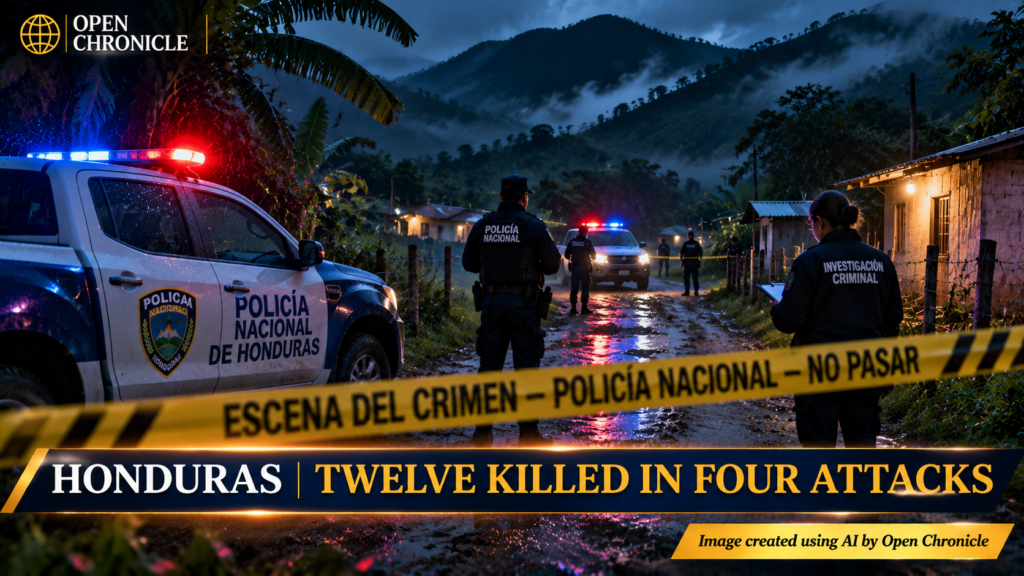
Four coordinated-looking attacks in rural Honduras have left 12 people dead, including children and an Indigenous municipal official. The killings have triggered an emergency security response and renewed questions about organised crime, territorial control and the state’s ability to protect vulnerable communities.
By Open Chronicle News Desk
TEGUCIGALPA, Honduras, November 20, 2026. A series of four deadly attacks in northern Honduras has left at least 12 people dead, exposing the continuing vulnerability of rural communities to organised violence and placing renewed pressure on the country’s security institutions.
The killings occurred during the early hours of Wednesday, November 18, in the municipality of Yorito, in the department of Yoro.
According to Honduran police, three attacks took place in the village of Vallecillos, while a fourth occurred in nearby Pacayales. Each incident left three people dead.
Among the victims were women, children and a municipal official, turning an already devastating episode of criminal violence into a national political and human rights concern.
Police spokesperson Edgardo Barahona said investigators were examining the possible involvement of organised criminal groups. However, the authorities had not publicly established a definitive motive or identified all those responsible in the initial reports.
The government responded by announcing additional security measures, while human rights organisations demanded an independent and thorough investigation.
The violence has reopened a fundamental question for Honduras.
Can the state guarantee security in communities where criminal organisations, territorial disputes and weak institutional protection continue to intersect?
Four attacks, one night of violence
The attacks unfolded across several locations in Yorito, a mountainous municipality in northern Honduras.
Three separate incidents occurred in Vallecillos, including an attack near a football field and two attacks at residential properties.
Nine people were killed in those three incidents.
A fourth attack in Pacayales left another three people dead.
The distribution of the killings across four locations has raised questions about whether the violence was connected and whether the perpetrators acted according to a common plan.
Investigators have not yet established those conclusions.
What is confirmed is the scale of the attacks and their impact on several families.
Local reporting identified the deaths of multiple relatives in individual incidents, indicating that entire households were among those targeted.
The victims included three minors, according to subsequent reporting by Honduran media and the United Nations human rights office in the country.
Police and forensic teams were deployed to the affected communities to secure the scenes, recover evidence and begin identifying the victims.
For residents, the immediate consequences extended beyond the loss of life.
The attacks created fear across communities where access to emergency services and security personnel can be limited by geography and infrastructure.
Honduras | The Yorito Attacks
Including women and children
Three in Vallecillos, one in Pacayales
Yoro department, Honduras
Early morning, local time
Based on police statements and reporting available through November 20, 2026. Investigations remain ongoing.
The killing of an Indigenous municipal official
Among the victims was Delma Yolanda Olvera Pérez, a municipal councillor and member of the Indigenous Tolupán community.
According to the United Nations human rights office in Honduras, Olvera Pérez was also a former president of the Mina Honda Tribal Council.
Her death has added a further dimension to the investigation.
The killings are not only being examined as a serious criminal incident. They have also raised concerns about the protection of Indigenous communities and local representatives.
The UN human rights office condemned the attacks on November 19, expressing solidarity with the victims’ families and calling on the Honduran state to ensure accountability.
It also highlighted the particular vulnerability of the Tolupán people to violence and violations of their rights.
The National Commissioner for Human Rights, CONADEH, separately condemned the killings.
In an official statement, the institution called for a serious, objective and rigorous investigation to identify both those who carried out the attacks and those who may have ordered them.
The commissioner also pointed to a broader context of social conflict, territorial disputes, armed actors and recurring human rights violations in the affected area.
The killing of a local official does not, by itself, establish that the attacks were politically motivated.
That distinction matters.
Investigators must determine whether the victims were selected because of their public roles, family relationships, territorial disputes or other circumstances.
Until those findings are established, political motives and criminal responsibility remain matters for investigation.
Organised crime under investigation
The Honduran National Police has identified organised crime as its principal initial hypothesis.
That assessment is consistent with longstanding security challenges in parts of Honduras, where criminal organisations have competed for influence over communities, transport corridors and illicit markets.
However, a working hypothesis is not proof.
The authorities have not established in the initial reporting that one particular organisation carried out all four attacks.
Local media reported that a group known as the Cartel del Diablo claimed responsibility through videos circulated after the killings.
Such claims require independent verification.
A declaration of responsibility by an alleged criminal group does not establish the authenticity of the material, the identity of the perpetrators or the motive behind the violence.
The investigation therefore faces several questions.
Were the attacks carried out by the same armed group?
Were the victims connected by family relationships, local disputes or other circumstances?
Was the violence intended to intimidate a wider community?
And did the perpetrators exploit weaknesses in the local security presence?
These questions will determine whether the killings are understood primarily as a series of targeted crimes, an episode of territorial intimidation or part of a broader pattern of organised violence.
The government’s emergency response
President Nasry Asfura condemned the killings and ordered additional security operations in the affected region.
He also convened an emergency meeting of the National Defence and Security Council to coordinate the government response.
The administration pledged to pursue those responsible and reinforce the presence of security forces in the area.
The immediate response may help restore a sense of security.
But the longer-term challenge is more complex.
Security deployments can increase patrols, support investigations and reduce the freedom of movement of armed groups.
Their effectiveness, however, depends on whether they produce arrests, reliable evidence, prosecutions and sustained protection for residents.
Temporary operations may disrupt criminal activity without necessarily eliminating the structures that sustain it.
A durable response requires cooperation among the police, prosecutors, courts and institutions responsible for protecting victims and witnesses.
The government will also face scrutiny over whether its response addresses the specific vulnerabilities of rural and Indigenous communities.
Yoro’s worsening security challenge
The attacks have focused attention on Yoro, a department where the concentration of multiple-victim killings has become a growing concern.
According to figures reported by Honduran media and attributed to the Violence Observatory at the National Autonomous University of Honduras, the country had recorded 33 multiple-victim killing incidents involving 138 deaths during 2026, including the Yorito attacks.
The same reporting identified Yoro as a particularly affected department, with 12 such incidents and 44 victims during the year.
These figures require careful interpretation.
Different institutions may use different definitions of a massacre or multiple homicide, and preliminary totals can change as investigations progress.
Nevertheless, the reported concentration of violence in Yoro points to a serious regional security problem.
An analysis published by El Heraldo, using police statistics for January through October, estimated Yoro’s homicide rate at 37.1 deaths per 100,000 inhabitants.
That estimate placed the department among the country’s most dangerous areas and illustrated the uneven geographical distribution of lethal violence.
The distinction between national and local security conditions is important.
A country may experience an overall decline in homicides while particular municipalities or departments continue to suffer exceptionally high levels of violence.
National averages can therefore conceal serious differences in the security experienced by individual communities.
The wider Central American security problem
Honduras is part of Central America’s Northern Triangle, alongside Guatemala and El Salvador.
The three countries have experienced different patterns of criminal violence, institutional responses and security reform.
For decades, organised crime, illicit trafficking, corruption, weak institutions and socioeconomic inequalities have contributed to insecurity in parts of the region.
However, the security conditions of the three countries should not be treated as identical.
El Salvador has pursued an extensive security crackdown accompanied by serious international debate over detention practices and civil liberties.
Guatemala continues to confront organised criminal activity, political violence and challenges involving the justice system.
Honduras faces its own combination of organised crime, local territorial disputes and difficulties in extending effective state protection to remote communities.
In November 2026, Guatemala also declared emergency measures in two eastern departments following deadly attacks involving a politician and police officers, according to the Council on Foreign Relations’ conflict monitoring.
These developments do not establish a direct operational connection between the attacks in Guatemala and Honduras.
They do, however, illustrate the continuing regional importance of public security and the protection of local institutions.
Why rural communities remain vulnerable
Rural insecurity presents challenges that differ from those of major cities.
Remote communities may have limited police coverage, difficult road access and fewer institutional resources.
Residents may also face greater obstacles when reporting crimes or seeking protection.
Where armed organisations exercise influence, witnesses can fear retaliation.
The result can be a cycle in which violence undermines public confidence, weakens cooperation with authorities and makes investigations more difficult.
The killing of a municipal representative can intensify that effect.
Local officials often serve as intermediaries between residents and the state.
When they become victims of violence, the consequences can affect community representation, access to services and confidence in public institutions.
For Indigenous communities, security concerns may also intersect with longstanding disputes over land, natural resources and territorial rights.
The Honduran human rights commission’s statement regarding Yorito specifically referred to this wider context.
That does not establish the motive for the November 18 killings, but it identifies important issues that investigators and policymakers cannot ignore.
Why It Matters
The killings in Yorito matter for reasons extending beyond the immediate crime scenes.
First, the attacks demonstrate the capacity of armed perpetrators to inflict devastating losses across several locations within a short period.
Second, they expose the particular vulnerability of families and communities where emergency protection may be difficult to obtain.
Third, the death of an Indigenous municipal official raises questions about the safety of local representatives and the protection of communities already exposed to territorial conflict.
Finally, the government’s response will test the effectiveness of Honduras’ security institutions.
The central measure of success will not be the number of personnel deployed immediately after the attacks.
It will be whether investigators establish responsibility, prosecutors can pursue credible cases and residents receive lasting protection.
The Bigger Picture | Security is also a question of state legitimacy
The ability of a government to protect its population is among the most fundamental responsibilities of the state.
When communities experience repeated violence, the consequences extend beyond physical insecurity.
Businesses may hesitate to invest.
Families may relocate.
Schools and public services can become harder to maintain.
Local authorities may struggle to operate effectively.
And residents may lose confidence in institutions intended to protect them.
This is why organised violence represents more than a policing problem.
It can become an obstacle to economic development, democratic participation and social stability.
In Honduras, the challenge is particularly acute where criminal influence intersects with limited institutional presence.
The Yorito killings have therefore become a test of whether emergency measures can translate into sustained accountability.
The question is not only whether the authorities can capture those responsible for 12 deaths, but whether they can prevent the next community from experiencing the same violence.
What to Watch Next
Honduras | Developing Situation
Establishing Responsibility
Police and prosecutors must establish whether the four attacks were linked and identify those responsible.
Security Deployments
The government is expected to continue operations intended to restore security in Yoro.
Protection of Indigenous Communities
Human rights institutions will monitor the response to the killing of a Tolupán municipal representative and other community members.
Victim Identification and Support
Authorities and local institutions face the task of assisting affected families and documenting the full consequences of the attacks.
Accountability
Arrests, evidence and eventual judicial proceedings will be crucial in determining whether the investigation produces meaningful results.
These are issues to monitor, not confirmed future outcomes. The investigation remains ongoing as of November 20, 2026.
Sources and Further Reading
International reporting, Honduran investigative journalism, official human rights statements and regional security analysis supporting coverage of the November 2026 attacks in Yorito, Honduras.
Reuters | At Least 12 Dead in Organised Crime Attacks in Honduras, Police Spokesman Says
November 18, 2026. International reporting on the four attacks, the number of victims and the initial police hypothesis.
CONADEH | Statement No. 18/2026 on the Violence in Vallecillo and Pacayales
November 2026. Official condemnation of the killings and a call for a rigorous investigation and protection of human rights.
Proceso Digital | UN Human Rights Office Condemns the Yoro Killings
November 19, 2026. Coverage of the United Nations human rights office’s response, including concerns for Indigenous Tolupán communities.
El Heraldo | The Sequence of the Four Attacks in Yorito
November 19, 2026. Local investigative reporting on the victims, attack locations and community impact.
Diario Nacional de Honduras | Violence in Yoro and the National Security Debate
November 19, 2026. Analysis of the regional concentration of multiple homicides and the government’s response.
Council on Foreign Relations | Instability in the Northern Triangle
November 2026. Regional conflict monitoring, including the Honduras killings and recent security developments in Guatemala.
OPEN CHRONICLE NEWS DESK | CENTRAL AMERICA | HONDURAS | NOVEMBER 20, 2026
Editorial Transparency
This article was prepared by Open Chronicle News Desk using reporting from Reuters, El Heraldo, Diario Nacional de Honduras and Proceso Digital, together with statements from the Honduran National Commissioner for Human Rights and regional security monitoring by the Council on Foreign Relations. The article distinguishes confirmed deaths and reported government measures from police hypotheses, alleged claims of responsibility and interpretations of the wider security situation. Statistics concerning multiple homicides and departmental violence are attributed to the institutions and publications reporting them. Discussion of organised crime, institutional capacity, Indigenous rights and regional security represents independent editorial analysis. Information may be revised as criminal investigations and official reporting develop.