
OPEN CHRONICLE NEWS DESK | PACIFIC | NOVEMBER 20, 2026
By Open Chronicle News Desk
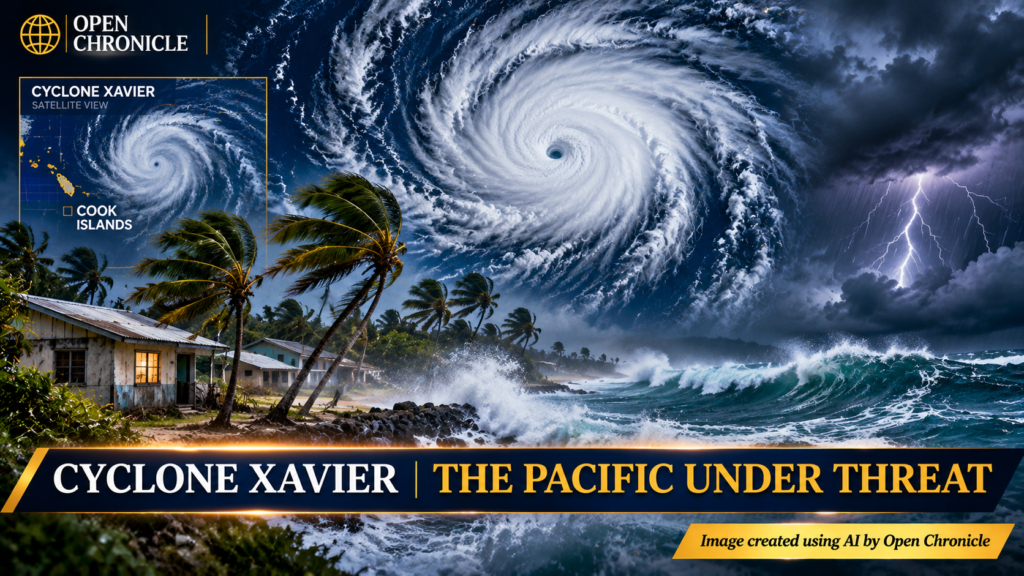
One of the South Pacific’s most powerful November cyclones in decades has triggered emergency measures in the northern Cook Islands. Although Xavier is weakening, its rapid intensification and proximity to remote island communities expose the challenges of disaster preparedness, climate resilience and emergency response across the Pacific.
RAROTONGA, Cook Islands, November 20, 2026. Severe Tropical Cyclone Xavier has placed communities across the northern Cook Islands on high alert, prompting emergency measures as authorities confront a powerful storm that rapidly intensified over the tropical Pacific.
The cyclone, which reached Category 5 intensity earlier this week according to regional reporting, was classified as a Category 3 system by the Fiji Meteorological Service on Friday morning.
At 06:00 UTC on November 20, Xavier was located near 11.4 degrees south and 162.9 degrees west, with estimated sustained winds of 80 knots, approximately 148 kilometres per hour, and a central pressure of 958 hectopascals.
The latest advisory indicated that the storm was weakening, although dangerous winds, heavy rainfall, high seas and coastal flooding risks remained significant for nearby islands.
The government of the Cook Islands has declared a state of emergency for Nassau, a remote island whose limited emergency response capacity makes it particularly vulnerable to severe weather.
The declaration was announced by Prime Minister Mark Brown after emergency management authorities identified the island’s exposure to the cyclone and the need for coordinated preparations.
As of late Thursday, no casualties or damage had been reported on Nassau, according to regional reporting. That preliminary assessment did not establish the full consequences of the storm across the northern Cook Islands.
The immediate priority is protecting residents and maintaining communications with communities separated by vast distances of ocean.
But Xavier also raises a broader question.
How can small Pacific island societies prepare for increasingly dangerous weather when their geography, infrastructure and financial resources make emergency response exceptionally difficult?
From tropical disturbance to an exceptionally powerful cyclone
Xavier developed during the opening weeks of the South Pacific cyclone season.
The Fiji Meteorological Service began issuing updates on a developing tropical disturbance on November 15.
Within days, the system had strengthened dramatically.
According to NASA’s Earth Observatory, Xavier became one of the most intense November tropical cyclones observed in the region in decades.
The storm developed over ocean waters with temperatures around 29°C, while relatively weak vertical wind shear allowed its circulation to organise and intensify.
These conditions are particularly favourable for tropical cyclone development.
Warm ocean water provides energy to the storm through evaporation and the release of latent heat as water vapour condenses.
Low wind shear helps preserve the cyclone’s vertical structure, allowing thunderstorms to remain organised around its centre.
Together, those factors can support rapid intensification.
Xavier’s evolution demonstrates how quickly a developing tropical disturbance can become a major threat, sometimes leaving remote communities with limited time to prepare.
On November 18, FBC News reported that Xavier had reached Category 5 intensity, with sustained winds estimated at 215 to 220 kilometres per hour.
It was the first Category 5 cyclone monitored by the Regional Specialized Meteorological Centre in Nadi since Cyclone Lola in 2023.
By November 20, the storm had weakened, but its circulation continued to generate dangerous conditions.
For island communities, a reduction in cyclone category does not necessarily mean that the danger has passed.
Xavier | Storm Situation
Cyclone Xavier | Official Storm Advisory
Severe tropical cyclone
Approximately 148 km/h
Estimated atmospheric pressure
162.9°W longitude
Storm estimates are subject to revision. The advisory reported a weakening cyclone and uncertainty in its exact centre position. Source: Fiji Meteorological Service.
Nassau declares an emergency
The most immediate humanitarian concern is the vulnerability of communities in the northern Cook Islands.
Nassau, a small and isolated island, faces particular logistical difficulties during severe weather.
Emergency supplies, medical assistance, communications equipment and repair crews cannot necessarily be deployed as quickly as they could in a large continental country.
The government declared a state of emergency to strengthen coordination and provide authorities with additional powers to respond.
The decision reflects a precautionary approach rather than confirmation of widespread destruction.
Other northern islands have also faced weather warnings.
According to the Fiji Meteorological Service’s November 20 bulletin, gale warnings were in force for Nassau and Suwarrow, while strong wind warnings covered Manihiki, Rakahanga and Pukapuka.
Storm alerts and warnings were being adjusted as Xavier moved through the region.
Authorities warned of heavy rainfall, thunderstorms, dangerous seas and the possibility of coastal inundation during high tides.
For communities living on low-lying islands, these hazards can be serious even when the centre of a cyclone remains offshore.
High waves and storm-driven water can affect coastal roads, buildings, freshwater supplies and essential infrastructure.
Marine conditions may also prevent vessels from reaching affected communities.
That isolation can persist after the strongest winds have passed.
The geography of vulnerability
The Pacific is home to some of the world’s most geographically dispersed countries and territories.
Many island communities are separated by hundreds of kilometres of open ocean.
Their populations may be relatively small, but the infrastructure required to maintain essential services can be expensive.
Airstrips, ports, telecommunications networks, electricity systems and water facilities must operate in environments exposed to tropical storms, saltwater corrosion and coastal erosion.
When a cyclone damages even one of these systems, the consequences can extend across an entire community.
A damaged airstrip can delay medical evacuations.
A disrupted communications network can prevent emergency authorities from assessing conditions.
Contaminated freshwater supplies can create health risks.
And the loss of a small number of buildings may represent a significant share of a community’s housing or public facilities.
The economic cost of disaster is therefore not determined solely by the size of the storm or the number of people affected.
It is also shaped by the concentration of essential infrastructure and the difficulty of replacing it.
For remote Pacific islands, resilience depends on maintaining critical services before, during and after severe weather.
The first reports of damage and disruption
Although Xavier’s centre remained offshore, the storm has already caused disruption in parts of the northern Cook Islands.
On Manihiki, residents reported damage to coastal infrastructure, including the wharf, as well as limited damage to walls and roofing.
Local preparations helped protect homes, but electricity remained a concern.
According to Pacific Media Network, the island’s diesel generator had been out of service for more than a year, leaving residents dependent on solar energy.
Prolonged cloud cover and heavy rain reduced the ability to generate electricity, highlighting how existing infrastructure problems can become more serious during a natural disaster.
On Pukapuka, more than 300 residents had been staying overnight in a cyclone shelter.
Local reporting also documented the destruction of a traditional community structure, while emergency authorities worked to organise supplies and maintain readiness.
The Cook Islands government has been preparing logistical support, including essential equipment and potential aerial assessments.
New Zealand assistance was also being prepared, subject to conditions and requests from Cook Islands authorities.
These early reports do not yet provide a complete damage assessment.
However, they illustrate the importance of local preparedness and the challenges of delivering assistance across widely dispersed islands.
Climate change and the intensification question
Xavier’s rapid intensification raises questions about the relationship between tropical cyclones and a warming climate.
Scientists understand that warmer oceans can provide additional energy for tropical cyclones.
A warmer atmosphere can also hold more moisture, increasing the potential for intense rainfall.
However, the relationship between climate change and cyclone activity is complex.
The number of tropical cyclones in a particular region does not necessarily increase as temperatures rise.
Changes in atmospheric circulation, wind shear, ocean conditions and other factors also influence cyclone formation.
The scientific concern is that the proportion of the most intense tropical cyclones and the rainfall associated with them may increase in a warming world, even where total cyclone frequency does not.
Sea level rise adds another dimension to the danger.
Higher baseline sea levels can make coastal flooding more damaging when storm surges and large waves occur.
For low-lying Pacific islands, this combination is particularly important.
A cyclone does not need to make direct landfall to cause destructive coastal conditions.
At the same time, it would be scientifically inappropriate to attribute Xavier’s formation or its exact intensity to climate change without a dedicated attribution study.
The immediate meteorological evidence identifies warm ocean waters and favourable atmospheric conditions as contributors to the storm’s development.
The longer-term climate context helps explain why resilience planning is becoming increasingly important.
The financial burden of resilience
For small Pacific island economies, preparing for severe weather requires sustained investment.
Cyclone-resistant buildings, reliable emergency shelters, backup electricity systems, communications networks and protected freshwater supplies can substantially reduce vulnerability.
Yet these investments are expensive.
Many island governments have limited tax bases and face high transportation and construction costs.
The same geographic isolation that makes emergency response difficult also raises the cost of infrastructure development.
Climate adaptation financing is therefore not simply an environmental issue.
It is a question of economic security and public administration.
Governments must decide how to allocate scarce resources among education, healthcare, housing, transportation and disaster preparedness.
International financial assistance can help, but the effectiveness of that support depends on whether projects are suited to local conditions and can be maintained over time.
Xavier demonstrates why resilience cannot be measured only by the availability of emergency funds after a disaster.
The ability to withstand a cyclone depends heavily on investments made years before the storm arrives.
Why It Matters
Cyclone Xavier is a reminder that the consequences of extreme weather are shaped by more than meteorological intensity.
For the northern Cook Islands, the immediate concern is the safety of residents and the restoration of essential services.
For the wider Pacific, the storm highlights three persistent vulnerabilities.
Geographic isolation: Emergency assistance may take considerable time to reach remote islands.
Infrastructure dependence: Damage to a single port, airstrip, generator or communications facility can disrupt an entire community.
Financial constraints: Building resilient infrastructure requires resources that many small island economies struggle to mobilise independently.
The regional implications extend to disaster cooperation, climate adaptation and the relationship between Pacific island governments and international partners.
The Bigger Picture | A changing definition of security
Traditional discussions of security often focus on military threats, territorial disputes and political instability.
For many Pacific communities, however, security also means access to clean water, functioning communications, reliable electricity, medical assistance and safe shelter during extreme weather.
A severe cyclone can threaten all of these at once.
Xavier’s progression from a developing tropical disturbance to an exceptionally powerful storm demonstrates the importance of forecasting systems.
But accurate forecasts are only one part of disaster preparedness.
Communities must also have the infrastructure, supplies and institutional capacity to act on warnings.
The distinction is especially important in remote islands where evacuation may be difficult or impossible.
For those communities, the safest response often depends on effective local shelters and the ability to remain self-sufficient until outside assistance arrives.
The central lesson of Xavier is that resilience must be built before a storm develops, not improvised after it strikes.
What to Watch Next
Cyclone Xavier | Developing Situation
Storm Trajectory
Further advisories from RSMC Nadi will clarify Xavier’s weakening trend and its movement through the region.
Nassau Emergency Response
Authorities will assess whether the state of emergency remains necessary as conditions change.
Damage Assessments
Reports from Manihiki, Pukapuka and other northern islands will help establish the extent of infrastructure damage.
Transport and Supplies
Maritime conditions will determine when additional equipment, fuel and humanitarian supplies can safely reach affected communities.
Regional Assistance
The Cook Islands may request further technical or logistical support from New Zealand and other regional partners.
Forecasts and emergency measures are subject to change. Residents and travellers should follow official meteorological and emergency management guidance.
Sources and Further Reading
Official meteorological advisories, satellite observations and regional journalism supporting the reporting on Cyclone Xavier, emergency measures in the Cook Islands and the wider challenges of disaster preparedness and climate resilience across the Pacific.
Fiji Meteorological Service | Tropical Cyclone Xavier Warnings and Advisories
November 20, 2026. Official storm position, intensity, wind estimates and warnings for the northern Cook Islands.
NASA Earth Observatory | The Stormy Southwest Pacific
November 20, 2026. Satellite observations and analysis of Xavier’s rapid intensification and favourable oceanic conditions.
Cook Islands News | Nassau on Storm Alert as Category 4 Cyclone Xavier Slows
November 19, 2026. Local preparations, shelters, emergency supplies and conditions across the northern Cook Islands.
Pacific Media Network | Nassau Placed Under State of Emergency
November 20, 2026. Government emergency measures, official statements and reports from affected communities.
1News New Zealand | Cyclone Xavier Slowly Weakens as It Tracks Through Cook Islands
November 19, 2026. Eyewitness accounts, infrastructure damage and storm conditions in Manihiki.
FBC News | Tropical Cyclone Xavier Reaches Category 5 Intensity
November 18, 2026. Regional reporting on the cyclone’s peak intensity and associated warnings.
OPEN CHRONICLE NEWS DESK | PACIFIC | NOVEMBER 20, 2026
Editorial Transparency
This article was prepared by Open Chronicle News Desk using official meteorological information from the Fiji Meteorological Service, satellite analysis published by NASA Earth Observatory and reporting from Cook Islands News, Pacific Media Network, 1News New Zealand and FBC News. Storm intensity, geographical position, emergency declarations and reported damage are attributed to information available on November 19 and 20, 2026. The article distinguishes confirmed developments from forecasts, preliminary damage reports and broader assessments of disaster vulnerability. Discussion of climate change, infrastructure resilience and regional security represents independent editorial analysis. No direct scientific attribution of Cyclone Xavier to human-caused climate change is asserted. Information may change as additional meteorological and emergency management reports become available.