
EUROPE | NOVEMBER 20, 2026
By Open Chronicle News Desk
The Brussels summit places trade, energy security, youth mobility and European cooperation at the centre of a renewed diplomatic effort. Yet rebuilding relations between London and Brussels remains a complex process shaped by economic interests, domestic political pressures and the unresolved consequences of Brexit.
BRUSSELS, Belgium. The United Kingdom and the European Union are seeking to establish a more constructive relationship, with their November 20 summit in Brussels offering an opportunity to move beyond years of political confrontation and address the practical challenges facing both sides.
The stakes extend far beyond the technical details of trade agreements.
Europe faces persistent economic pressures, growing competition from the United States and China, continuing security challenges associated with Russia’s war against Ukraine and an increasingly urgent need to strengthen energy resilience.
For Britain, closer cooperation with its largest neighbouring economic bloc offers potential advantages in investment, trade and economic stability.
For the European Union, rebuilding ties with London could reinforce Europe’s collective economic and strategic capabilities.
But the central question remains unresolved: how far can Britain and the EU deepen cooperation without reopening the fundamental political debate over Brexit?
A relationship entering a new phase
The United Kingdom formally left the European Union on January 31, 2020, ending more than four decades of membership in the European integration project.
The transition that followed transformed the legal and economic relationship between the two sides.
Britain left the EU single market and customs union, introducing new administrative requirements and regulatory barriers affecting businesses, workers and consumers.
The Trade and Cooperation Agreement established the principal framework for post-Brexit relations, preserving tariff-free and quota-free trade in qualifying goods while leaving important restrictions on services and mobility.
Although the agreement prevented a complete rupture in economic relations, it did not reproduce the commercial freedoms previously available through EU membership.
Businesses have had to adapt to customs procedures, rules of origin, regulatory differences and additional administrative costs.
The consequences have been particularly significant for smaller companies with limited capacity to manage complex cross-border requirements.
The renewed diplomatic engagement reflects a growing recognition that economic geography continues to matter.
Britain may have left the European Union, but its economic future remains closely connected to developments across the continent.
Trade: The economic argument for closer cooperation
Trade is one of the most consequential areas of discussion.
The EU remains a major destination for British exports and an essential source of imports, investment and industrial components.
For British manufacturers, access to European supply chains can determine production costs, investment decisions and international competitiveness.
For European companies, the British market remains important in sectors ranging from pharmaceuticals and automotive manufacturing to financial and professional services.
THE ECONOMIC CHALLENGE
Goods trade
Customs procedures, product standards and supply-chain efficiency.
Services
Professional qualifications, market access and regulatory recognition.
Investment
Business confidence, regulatory predictability and long-term capital flows.
Industrial competitiveness
Cooperation in advanced manufacturing, energy and strategic technologies.
Reducing trade friction could benefit businesses on both sides of the Channel.
However, the potential gains depend on the legal and regulatory arrangements that governments are willing to negotiate.
The EU has consistently maintained that access to its single market is linked to common obligations.
Britain, meanwhile, faces domestic political constraints surrounding sovereignty, regulatory autonomy and freedom of movement.
These competing priorities make a comprehensive economic reset difficult.
More targeted agreements may therefore offer a politically realistic route towards closer cooperation.
Youth mobility: A test of political flexibility
One of the most politically sensitive areas is youth mobility.
Before Brexit, British and EU citizens benefited from freedom of movement, allowing them to live, work and study across participating countries under EU rules.
The end of those arrangements created new restrictions affecting employment, education and cultural exchange.
A potential youth mobility agreement could establish a structured framework allowing eligible younger people to spend limited periods living, working or studying in participating countries.
Supporters argue that such arrangements would strengthen educational opportunities, cultural ties and economic exchange.
Businesses in sectors dependent on international recruitment could also benefit.
Critics, however, may regard expanded mobility arrangements as a partial reversal of the immigration controls associated with Brexit.
The distinction between a limited reciprocal mobility scheme and the restoration of unrestricted freedom of movement is therefore central to the negotiations.
A successful agreement would need to balance reciprocal opportunities, immigration rules, eligibility conditions and domestic political concerns.
The issue illustrates a broader challenge: restoring practical cooperation without recreating the institutional arrangements Britain chose to leave.
Energy security: A shared strategic vulnerability
Energy cooperation has acquired renewed importance as European governments confront geopolitical instability, infrastructure vulnerabilities and the costs of transitioning towards lower-carbon energy systems.
Britain and continental Europe are connected through electricity interconnectors, gas infrastructure and overlapping energy markets.
These connections make cooperation valuable during periods of supply disruption or price volatility.
Greater coordination could improve infrastructure planning, electricity trading and the development of offshore renewable energy.
The North Sea is particularly important.
Its offshore wind resources, existing energy infrastructure and proximity to major industrial centres create opportunities for joint investment and long-term energy development.
Yet cooperation also requires agreement on regulatory rules, investment frameworks and market arrangements.
Energy policy is therefore both an economic and a strategic issue.
A more integrated approach could strengthen resilience, but governments must reconcile the benefits of cooperation with their respective commitments to regulatory independence.
European security: Britain remains a major military power
Brexit changed Britain’s institutional relationship with the EU, but it did not remove the country from Europe’s security architecture.
The United Kingdom remains a nuclear-armed state, a permanent member of the United Nations Security Council and a major contributor to NATO.
Its armed forces, intelligence capabilities and defence industry continue to play an important role in European security.
Russia’s war against Ukraine has reinforced the importance of cooperation between London and European capitals.
Military assistance, intelligence sharing, sanctions coordination and defence-industrial production all require sustained international collaboration.
Closer EU–UK cooperation could strengthen Europe’s ability to respond to security threats, particularly in areas where national capabilities remain fragmented.
Nevertheless, important institutional distinctions remain.
NATO continues to provide the central framework for collective defence among its members, while the EU has developed separate mechanisms for defence coordination, industrial policy and security cooperation.
Any expansion of EU–UK security cooperation must therefore complement existing alliances rather than duplicate their responsibilities.
Why Brussels matters beyond Brexit
The summit also takes place within a changing international environment.
European governments are increasingly concerned about their economic dependence on external powers, their technological competitiveness and the resilience of critical infrastructure.
The United States remains Europe’s principal security partner, but disagreements over trade, industrial policy and strategic priorities have encouraged European leaders to examine their own capacity for action.
China’s economic influence presents additional challenges, particularly in advanced manufacturing, critical minerals and strategic technologies.
Russia’s military activities continue to shape European defence planning.
Against this background, the relationship between Britain and the EU has implications that extend beyond bilateral diplomacy.
Fragmentation can weaken Europe’s collective economic and strategic position.
Cooperation, even outside formal EU membership, can strengthen the continent’s ability to respond to external pressures.
The challenge is determining how much coordination can be achieved without reopening the institutional questions settled by Brexit.
The Brussels summit: What is on the negotiating table?
The most immediate focus is a package of practical agreements intended to reduce some of the economic and social barriers created by Brexit.
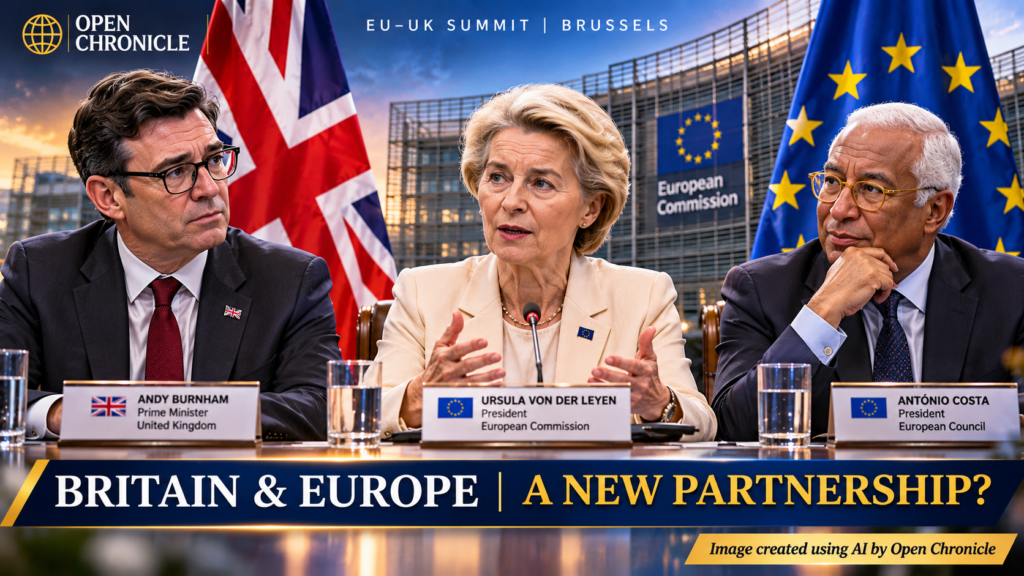
British Prime Minister Andy Burnham is meeting European Commission President Ursula von der Leyen and European Council President António Costa at the second EU–UK summit, following the first meeting in London in May 2025.
According to the official European Council agenda, the summit is scheduled to begin at approximately 10:30 local time. At the time of this morning’s reporting, the final joint declaration had not yet been issued.
BRUSSELS SUMMIT | EXPECTED AGREEMENTS
| Agrifood trade | Reduce certificates, border checks and administrative costs for food and agricultural products. |
| Youth mobility | Establish reciprocal opportunities for up to 100,000 young people to work or study abroad for as long as three years. |
| Carbon markets | Link emissions trading systems to reduce trade friction for carbon-intensive industries. |
| Education | Advance Erasmus+ participation while continuing negotiations over university tuition fees. |
| Security | Deepen cooperation on defence, Ukraine, migration and shared geopolitical challenges. |
Expected measures reported ahead of the summit. Final provisions remain subject to confirmation.
The economic numbers behind the negotiations
The British government estimates that a proposed agreement reducing barriers to food and agricultural trade could eventually add as much as £5.1 billion annually to the economy.
It also estimates that linking British and European carbon markets could generate up to £3.8 billion annually in economic benefits.
These are government projections, not gains already realised. Their eventual impact will depend on the agreements’ final terms, implementation and business response.
The Economic Potential of Closer EU and UK Cooperation
Potential annual economic benefit, UK government estimate.
Potential annual economic benefit, UK government estimate.
These figures represent potential annual economic benefits projected by the UK government. They are estimates rather than realised gains. Actual outcomes will depend on the final agreements, their implementation and the response of businesses and markets.
UK Government, EU and UK Summit Package Factsheet.
The political obstacle: Sovereignty versus economic integration
The most difficult question may not be whether closer cooperation is economically desirable, but what Britain must accept in return.
Reducing regulatory barriers generally requires common standards, mutual recognition or alignment with European rules.
For the EU, regulatory consistency protects the integrity of the single market.
For Britain, accepting rules developed in Brussels without participating fully in their creation raises questions about democratic accountability and sovereignty.
This creates a difficult political equation.
The closer Britain moves towards European economic structures, the greater the potential benefits of integration. Yet the same process can revive arguments about the independence that Brexit was intended to secure.
Burnham has acknowledged that Brexit imposed substantial economic costs and has opened discussion about possible longer-term relationships, including eventual EU membership.
However, rejoining would require a separate political process, public support and agreement from EU member states. It is not an immediate outcome of the Brussels summit.
Why It Matters
The summit represents an important test of whether Europe can rebuild economic cooperation across political divisions.
For British households, the potential consequences include food prices, employment opportunities and access to educational exchanges.
For businesses, the main issues are administrative costs, regulatory certainty and the ability to compete across borders.
For European governments, stronger ties with Britain could improve collective resilience in a period of heightened geopolitical uncertainty.
The summit is therefore about more than repairing relations damaged by Brexit.
It is about determining whether countries with different institutional arrangements can develop an effective strategic partnership when their economic and security interests remain closely connected.
The Bigger Picture | Europe cannot afford permanent fragmentation
The international environment has changed substantially since the Brexit referendum in 2016.
Russia’s war against Ukraine has reinforced the importance of European security cooperation.
Trade tensions and technological competition have increased pressure on European industries.
Energy security, critical infrastructure and defence production have become central strategic priorities.
These developments have made the economic and security costs of fragmentation more visible.
For Britain, the challenge is preserving political autonomy while rebuilding access to valuable forms of cooperation.
For the European Union, the challenge is developing a partnership that offers mutual benefits without undermining the principles governing membership.
The Brussels summit will not settle every question surrounding Britain’s relationship with Europe.
But it could establish a more practical framework for cooperation, one in which economic interests and shared security challenges increasingly outweigh the political hostility of the Brexit years.
The central question is no longer simply whether Brexit can be reversed. It is whether Britain and the European Union can construct a durable partnership without reversing it.
What to Watch Next
The next developments will determine whether the summit produces a lasting improvement in relations.
Particular attention should focus on the final wording of the joint declaration, the implementation timetable for agrifood and carbon-market agreements, the eligibility and numerical limits of the youth mobility scheme, and progress towards resolving university tuition-fee disputes.
Further negotiations over regulatory alignment, industrial competitiveness and European defence cooperation will also indicate how ambitious the new relationship may become.
The political response in Britain will be equally important, particularly if closer integration generates renewed debate about sovereignty and the country’s long-term relationship with the European Union.
Sources and Further Reading
Official European and British institutional documents, government assessments and independent international reporting supporting the analysis of the November 20, 2026 EU and United Kingdom summit in Brussels.
European Council | EU – United Kingdom Summit, 20 November 2026
Official summit programme, bilateral priorities and strategic partnership.
UK Government | Summit Package Factsheet
November 17, updated November 18, 2026. Government projections and proposed agreements.
Reuters | Britain, EU Set to Agree to Reset but Divisions Persist
November 20, 2026. Negotiations on trade, mobility, emissions and outstanding political disagreements.
Associated Press | UK and EU Seek to Strengthen Ties
November 20, 2026. Political context and expected agreements.
European External Action Service | EU – UK Summit in Brussels
November 19, 2026. Official EU diplomatic statement on the meeting’s objectives.
OPEN CHRONICLE NEWS DESK | EUROPE | NOVEMBER 20, 2026
Editorial Transparency
This article was prepared by Open Chronicle News Desk using official information from the European Council, the European External Action Service and the United Kingdom government, supplemented by independent reporting from Reuters and Associated Press. Expected agreements, economic projections and negotiating positions are distinguished from measures formally adopted or implemented. Assessments concerning Brexit, European security, economic integration and the strategic relationship between Britain and the European Union represent independent editorial analysis. This article reflects information available during the morning of November 20, 2026, before publication of the summit’s final conclusions.
Explore International Relations
Discover more reporting and analysis on diplomacy, international security, global governance and the changing balance of power.
Return to International Relations →