
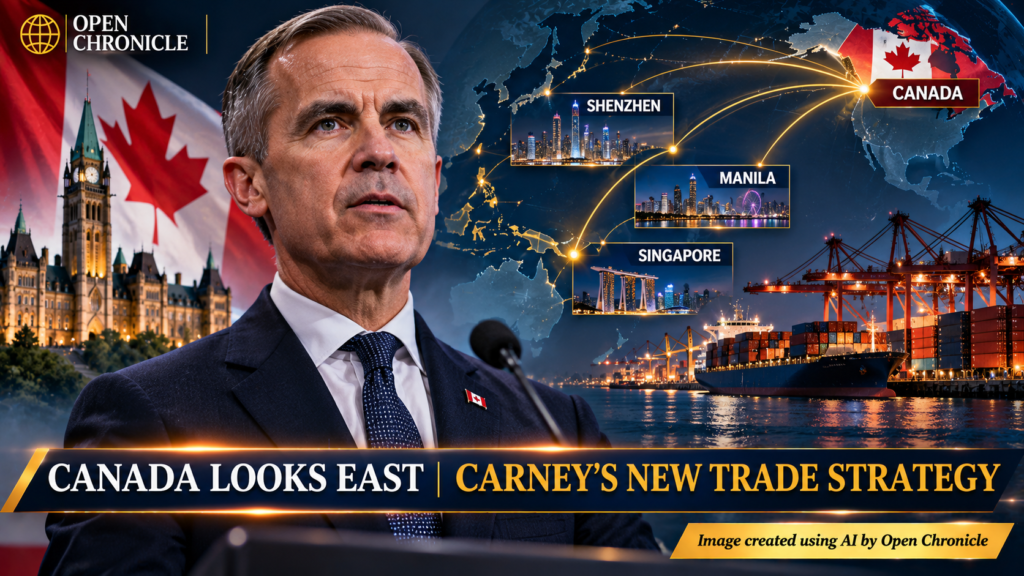
OPEN CHRONICLE NEWS DESK | NORTH AMERICA | NOVEMBER 20, 2026
With negotiations concluded on a free trade agreement with the Philippines and substantially completed with ASEAN, Prime Minister Mark Carney is accelerating Canada’s economic diversification. The ambition is clear: reduce dependence on the United States, strengthen access to Asian markets and build a more resilient Canadian economy. But transforming trade agreements into lasting economic independence will take more than diplomatic announcements.
By Open Chronicle News Desk
OTTAWA, Canada, November 20, 2026. Canada is entering a new phase of its international economic strategy after Prime Minister Mark Carney secured major advances in trade negotiations with Southeast Asian partners during a diplomatic tour that concluded in China this week.
On November 14, in Manila, Carney announced that Canada and the Philippines had concluded negotiations on a bilateral free trade agreement.
At the same time, Ottawa confirmed the substantial conclusion of negotiations for a broader agreement with the Association of Southeast Asian Nations, known as ASEAN.
Both agreements are intended to be signed in 2027, although their entry into force will depend on the remaining legal and domestic approval processes.
The announcements represent one of the most significant steps yet in Carney’s effort to expand Canada’s commercial relationships beyond its traditional North American markets.
The strategy is driven by a structural reality.
Canada’s economy has long been deeply integrated with that of the United States. Geographic proximity, industrial supply chains, energy infrastructure and decades of trade agreements have made the American market central to Canadian prosperity.
But that concentration also creates vulnerability.
Changes in American trade policy, tariffs or political priorities can quickly affect Canadian manufacturers, exporters and investors.
Carney’s response is not to abandon the United States.
It is to give Canada more alternatives.
And increasingly, those alternatives lie across the Pacific.
A diplomatic breakthrough in Manila
The centrepiece of Canada’s latest trade offensive emerged at the ASEAN Summit in the Philippine capital.
Carney met Philippine President Ferdinand Marcos Jr. and announced the conclusion of negotiations for a bilateral free trade agreement.
The two governments had established a strategic partnership earlier in 2026 and made trade liberalisation a priority.
According to the Canadian government, the proposed agreement could help Canadian exports to the Philippines increase as much as threefold by 2035.
The opportunity is substantial.
The Philippines has a population exceeding 110 million and a rapidly developing economy with growing demand for agricultural products, energy, infrastructure, advanced technology and industrial services.
Canadian businesses could benefit from improved access to these markets, particularly in agriculture, forestry and related industries.
The second announcement was potentially even more consequential.
Canada and ASEAN substantially completed negotiations toward a regional free trade agreement that would connect Canadian exporters with a market of nearly 700 million people.
ASEAN’s combined economy is valued at approximately $6 trillion, according to figures presented by the Canadian government.
The agreement is intended to reduce trade barriers, strengthen supply chain integration and provide more predictable commercial conditions.
But the distinction between a negotiated agreement and an operational trade framework remains important.
The ASEAN agreement has not yet entered into force.
Its economic benefits remain projections rather than realised gains.
Canada | The Asian Trade Strategy
Potential consumers across the region
Combined economic output, as cited by Ottawa
Expected Canadian GDP increase from the ASEAN agreement
Estimated Canadian employment supported
Government projections, not realised economic outcomes. Both trade agreements are targeted for signature in 2027.
Why the United States remains central to the story
Canada’s trade diversification strategy cannot be understood without examining its relationship with Washington.
For decades, Canadian economic development has been shaped by access to the American market.
Automotive manufacturing, energy exports, agricultural trade and industrial production are closely integrated across the border.
Many Canadian businesses depend on supply chains that move components and finished products between the two countries.
This integration has generated substantial economic benefits.
It has also limited Canada’s ability to insulate itself from changes in American policy.
Recent disputes over tariffs and industrial trade have reinforced the risks associated with excessive dependence on a single destination.
In November, Carney acknowledged progress in discussions with US President Donald Trump, but a comprehensive resolution of their trade disagreements had not been reached.
The automotive sector remained a particularly sensitive issue.
For Ottawa, the strategic calculation is increasingly straightforward.
The United States will remain indispensable.
But Canada’s economic security may improve if a larger proportion of its future export growth comes from other regions.
Diversification therefore becomes a form of risk management.
It gives businesses additional customers, reduces exposure to particular policy shocks and potentially increases Canada’s negotiating flexibility.
Yet it cannot eliminate the economic importance of the American market.
Geography, existing investment and deeply integrated manufacturing systems cannot be replaced simply by signing new agreements.
The Philippines as a strategic gateway
The Philippines offers Canada more than a promising export destination.
It also provides an opportunity to deepen relationships in an increasingly important geopolitical region.
The country occupies a strategic position in Southeast Asia, with extensive maritime connections and significant economic links across the Pacific.
Its infrastructure needs, energy requirements and expanding consumer market create opportunities for foreign suppliers.
For Canada, the relationship offers potential growth in several sectors.
Agriculture and food exports are important because of Canada’s established production capacity and the Philippines’ demand for imported goods.
Forestry and construction materials could benefit from infrastructure development.
Advanced technology, aerospace, mining services and energy cooperation also feature in the bilateral economic agenda.
The two governments have additionally announced cooperation involving drone technology, ocean innovation and renewable energy investment.
The challenge will be converting these opportunities into commercial activity.
Businesses will need to navigate regulatory requirements, transportation costs, competition from established regional suppliers and differences in market conditions.
A free trade agreement can reduce obstacles.
It cannot guarantee sales.
ASEAN and the architecture of a new trading network
The broader ASEAN agreement is particularly important because of its regional scope.
Rather than relying exclusively on separate bilateral arrangements, Canada is seeking access to an interconnected network of Southeast Asian economies.
This approach could improve opportunities for companies operating across multiple countries.
Modern production often depends on supply chains that extend through several jurisdictions.
Raw materials, components, manufacturing services and final assembly may be located in different markets.
A regional agreement can make these relationships easier to manage by improving trade rules and reducing administrative barriers.
For Canadian exporters, that could create opportunities beyond traditional commodity sales.
Manufacturers may find new industrial partners.
Technology companies may gain access to growing business markets.
Agricultural producers may diversify their customer base.
And investors may identify opportunities in infrastructure, clean energy and logistics.
Canada already maintains trade relationships with several Asian economies through existing arrangements, including the Comprehensive and Progressive Agreement for Trans-Pacific Partnership.
The proposed ASEAN agreement would add another layer to this network.
Its eventual value will depend on the final provisions, implementation and the extent to which Canadian businesses take advantage of the new access.
China: engagement without abandoning diversification
Carney’s diplomatic tour also included the Asia-Pacific Economic Cooperation summit in Shenzhen, China.
The visit reflected another dimension of Canada’s strategy.
Ottawa is seeking to strengthen economic relationships across Asia, including with major powers whose political and security interests do not always align with Canada’s.
China remains a significant global trading partner and a major force in manufacturing, supply chains and demand for natural resources.
For Canada, engagement offers commercial opportunities.
But it also creates questions about strategic dependence, industrial competition and economic security.
In remarks delivered at the APEC CEO Summit on November 18, Carney emphasised Canada’s position as a Pacific nation and highlighted opportunities in energy, critical minerals and international investment.
He also pointed to efforts to restore market access for Canadian agricultural and seafood exports.
The strategic challenge is to distinguish diversification from the simple replacement of one dependency with another.
A more resilient Canadian economy would not merely shift its concentration from the United States toward China.
It would develop a broader portfolio of markets and partnerships.
That is one reason ASEAN matters.
Its member economies offer a range of commercial relationships that can complement trade with larger powers.
Trade agreements are not the same as economic transformation
The Canadian government’s projections are ambitious.
Ottawa estimates that the ASEAN agreement could add nearly C$2 billion to Canadian GDP and support approximately 14,000 jobs.
It also expects the Philippines agreement to create opportunities for substantial export growth.
These estimates provide an indication of potential benefits.
They should not be interpreted as guaranteed outcomes.
The impact of a trade agreement depends on factors that extend beyond its formal provisions.
Businesses must identify customers, invest in market development and establish reliable logistics.
Exporters may need to adapt products to local standards and consumer preferences.
Smaller firms can face particular challenges because international expansion requires capital, expertise and sustained commercial relationships.
There is also competition.
Canada will be entering markets where regional producers, multinational companies and other trading partners already have established positions.
A successful diversification strategy therefore requires more than diplomacy.
It needs transportation infrastructure, trade financing, commercial intelligence, regulatory cooperation and investment in the industries most capable of competing internationally.
The government’s role is to create access.
The private sector must convert that access into economic activity.
The geopolitical dimension of economic independence
Trade diversification also carries implications for Canadian foreign policy.
Economic dependence can affect how governments respond to international disputes.
Countries with highly concentrated export markets may face greater economic consequences when political relations deteriorate.
Broader commercial relationships can provide additional flexibility.
For Canada, that flexibility is particularly important in an international environment characterised by trade tensions, technological competition and uncertainty over supply chains.
The partnership with the Philippines illustrates how commercial and strategic objectives can reinforce one another.
Alongside the trade negotiations, Ottawa announced closer defence cooperation, a cybersecurity dialogue and continued support for maritime monitoring.
Canada also committed to extending its Dark Vessel Detection programme until 2033, using satellite technology to help identify vessels operating without active location signals.
These initiatives connect economic policy with maritime security, technological cooperation and regional stability.
However, stronger commercial engagement does not automatically produce political alignment.
Canada’s Asian partners have different national interests, diplomatic relationships and strategic priorities.
Maintaining productive partnerships will require a pragmatic approach that recognises those differences.
Why It Matters
Canada’s latest agreements matter because they address one of the country’s most persistent economic vulnerabilities: its dependence on a highly concentrated export market.
The immediate significance is diplomatic.
Ottawa has advanced two major negotiations within a region that offers considerable long-term economic potential.
The medium-term significance is commercial.
If the agreements are signed, approved and implemented, Canadian businesses could gain more predictable access to customers and supply chains across Southeast Asia.
The longer-term significance is strategic.
A more diversified export economy could give Canada greater resilience when international trade conditions change.
But the outcome is not predetermined.
Success will depend on implementation, investment, business participation and the ability to sustain relationships across different political and economic environments.
The Bigger Picture | Canada is redefining economic sovereignty
For much of its modern history, Canada’s economic geography has encouraged close integration with the United States.
That relationship remains a fundamental advantage.
But the changing international environment is forcing Ottawa to reconsider how economic security should be defined.
Carney’s approach suggests that sovereignty increasingly involves the ability to maintain multiple commercial relationships rather than relying too heavily on one.
In this framework, trade agreements become instruments of economic resilience.
Infrastructure becomes a strategic asset.
Energy and critical minerals become tools of international economic engagement.
And diplomatic relationships become part of a wider effort to protect national prosperity.
The ASEAN and Philippines agreements represent an important step in that direction.
They do not mark the end of Canada’s dependence on the United States.
They mark an attempt to ensure that dependence becomes less decisive over time.
Canada is not turning away from North America. It is trying to ensure that its economic future is no longer defined by North America alone.
What to Watch Next
Canada | Developing Situation
ASEAN Agreement Finalisation
Remaining technical and legal work will determine when the regional agreement is ready for signature.
Canada & Philippines Trade Agreement
Both governments are targeting signature in 2027, followed by the necessary approval and implementation procedures.
Canada & US Negotiations
The direction of tariff discussions and industrial trade disputes will influence the urgency of Ottawa’s diversification strategy.
Canadian Business Investment
Export contracts, new supply chains and commercial partnerships will provide evidence of whether improved market access is translating into economic activity.
China and Wider Asian Relations
Further developments in market access, energy exports and critical minerals cooperation will help determine the balance of Canada’s Asian engagement.
These developments remain subject to diplomatic negotiations, legal procedures, government decisions and commercial implementation. Proposed trade agreements should not be interpreted as agreements already in force, and projected economic benefits are not guaranteed outcomes. Information reflects the situation described as of November 20, 2026.
These are developments to monitor as of November 20, 2026. Proposed trade agreements and economic projections should not be treated as completed implementation or guaranteed outcomes.
Sources and Further Reading
Official Canadian government announcements, diplomatic statements and independent international reporting documenting Canada’s expanding economic relationships with ASEAN, the Philippines and the wider Asia-Pacific region.
Prime Minister of Canada | Canada Concludes Negotiations for Two New Free Trade Agreements with the Philippines and ASEAN
November 14, 2026. Official announcement detailing the trade negotiations, projected economic benefits, bilateral cooperation and intended signature timetable.
Prime Minister of Canada | Carney Strengthens Economic Partnerships at APEC
November 19, 2026. Official account of Canada’s diplomatic and economic initiatives during the Asia-Pacific summit in Shenzhen.
Associated Press | Carney Reports Progress in US Trade Talks While Expanding Ties with Asia
November 2026. Independent reporting on Canada’s trade diversification efforts, the negotiations with Southeast Asia and continuing discussions with Washington.
Reuters | Canada Says Philippines and ASEAN Trade Talks Near Completion
September 22, 2026. Reporting on the negotiations and Canada’s broader trade diversification strategy ahead of the November summit.
Prime Minister of Canada | Remarks at the APEC CEO Summit
November 18, 2026. Carney’s remarks on energy exports, critical minerals, supply chains and Canada’s Pacific economic strategy.
Prime Minister of Canada | Strengthening Partnerships with ASEAN and the Philippines
November 14, 2026. Official background information on trade assistance, regional security, maritime cooperation and development initiatives.
OPEN CHRONICLE NEWS DESK | NORTH AMERICA | CANADA | NOVEMBER 20, 2026
Editorial Transparency
This article was prepared by Open Chronicle News Desk using official announcements and statements from the Government of Canada, together with independent reporting from Associated Press and Reuters. The article distinguishes the conclusion or substantial conclusion of trade negotiations from the future signature, ratification and implementation of the proposed agreements. Economic benefits, employment estimates and export growth projections are attributed to Canadian government assessments and are not presented as guaranteed results. Discussion of trade diversification, economic sovereignty, supply chain resilience and Canada’s geopolitical position represents independent editorial analysis. Information reflects developments available through November 20, 2026, and may change as negotiations, legal procedures and commercial initiatives progress.
Explore International Relations
Discover more reporting and analysis on diplomacy, international security, global governance and the changing balance of power.
Return to International Relations →