
OPEN CHRONICLE NEWS DESK | EUROPE | NOVEMBER 20, 2026
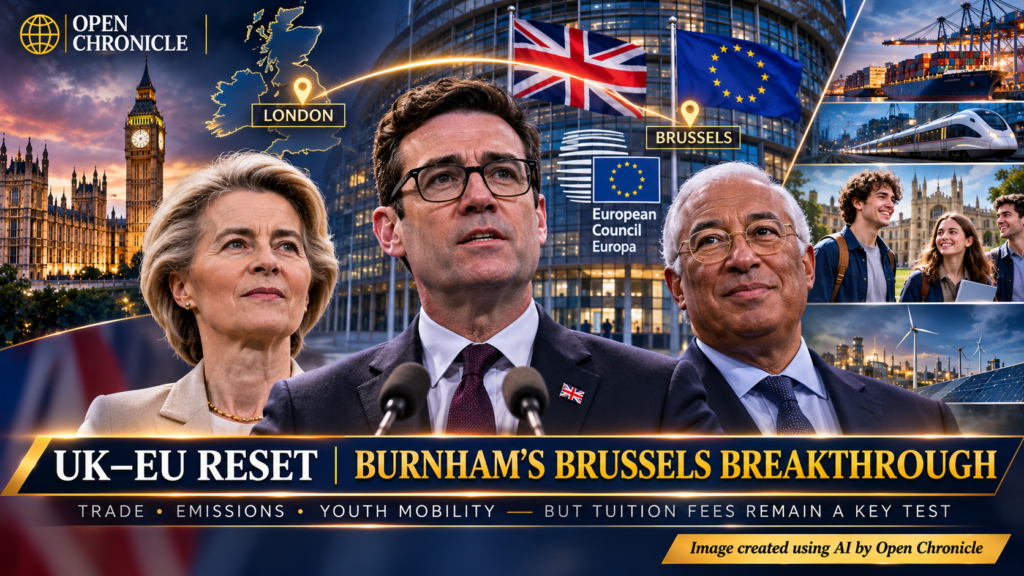
Britain and the European Union have reached a landmark political understanding covering food and drink trade, emissions trading and youth mobility. Prime Minister Andy Burnham calls it a new chapter in European relations, but unresolved university tuition fees, regulatory sovereignty and industrial competition could determine whether the agreements deliver their promised benefits.
By Open Chronicle News Desk
BRUSSELS, Belgium, November 20, 2026. British Prime Minister Andy Burnham has secured a major political breakthrough in relations with the European Union, announcing three agreements designed to bring the United Kingdom closer to its largest neighbouring economic bloc.
The agreements, presented at a summit in Brussels on Friday, cover food and drink trade, emissions trading and a reciprocal youth mobility programme.
Together, they represent one of the most significant efforts to rebuild practical cooperation between London and Brussels since Britain’s departure from the European Union.
Yet the diplomatic success comes with a potentially decisive complication.
European institutions have made clear that the agreements may not enter into force unless the United Kingdom reaches a satisfactory arrangement on university tuition fees for European students.
The dispute exposes a fundamental tension at the heart of Britain’s changing relationship with Europe: the desire to recover the economic advantages of closer integration without accepting all the obligations associated with EU membership.
Burnham has insisted that the negotiations are complete and that the government will introduce implementing legislation in Parliament.
European leaders have welcomed the political progress while acknowledging that important details remain unresolved.
A historic summit, but not the end of negotiations
The Brussels summit was designed to demonstrate that the United Kingdom and the European Union could move beyond the confrontational politics that dominated the Brexit years.
Burnham arrived with a clear political objective: establish practical agreements capable of delivering measurable economic and social benefits.
The resulting package covers three important areas.
The first seeks to simplify trade in food, drink and agricultural products by bringing British regulatory arrangements closer to those of the European Union.
The second concerns emissions trading, with the aim of improving cooperation between the British and European carbon markets.
The third establishes the framework for a youth mobility programme, allowing young people to spend extended periods living, working, studying and travelling across the two jurisdictions.
Each agreement addresses a different consequence of Britain’s departure from the EU.
Food exporters have faced additional administrative and regulatory barriers.
Businesses operating in carbon-intensive industries have had to navigate separate emissions trading arrangements.
Young people have experienced a substantial reduction in opportunities for mobility between Britain and continental Europe.
The summit seeks to address those problems without reopening the entire question of EU membership.
However, the political understanding announced in Brussels is not equivalent to the immediate implementation of every measure.
The agreements remain subject to further legal and procedural steps, with the tuition fees dispute creating an additional obstacle.
That distinction is essential to understanding what the summit has achieved.
Youth mobility: a new opportunity for 100,000 young people
The most immediately visible element of the agreement is the proposed youth mobility programme.
Under the arrangements reported from Brussels, up to 100,000 young British citizens would be able to participate annually in a scheme offering opportunities to live, work, study and travel in European Union countries.
A corresponding number of young Europeans would be able to access similar opportunities in the United Kingdom.
The programme would allow eligible participants to remain for up to three years, subject to the final rules and implementation arrangements.
The initiative represents a significant political development.
Since Brexit, British citizens have no longer enjoyed the same automatic rights to live and work across the European Union.
For young people, the change has affected employment opportunities, cultural exchanges, education and international experience.
The proposed programme would not restore unrestricted freedom of movement.
It would instead create a managed system with eligibility requirements and numerical limits.
Nevertheless, the potential benefits are considerable.
Young professionals could gain international work experience.
Students could explore educational opportunities in different countries.
Employers could benefit from access to a wider pool of young workers.
And cultural relationships between Britain and continental Europe could become easier to maintain.
For Burnham, youth mobility also carries political significance.
It provides a tangible example of how closer relations with the EU might benefit a generation that has grown up with the consequences of Brexit.
But the programme’s future remains closely connected to a dispute over the cost of university education.
The tuition fees dispute that could derail the reset
Despite the celebratory atmosphere, negotiations over university tuition fees remain unresolved.
The European Union wants students from its member states attending British universities to receive treatment comparable to that of domestic students.
British universities currently charge many international students substantially higher fees than those paid by domestic students.
European officials argue that meaningful educational mobility should not be undermined by financial barriers.
The British government faces a different calculation.
Universities depend heavily on international tuition fee income, and a substantial reduction in charges for European students could affect institutional finances.
The disagreement therefore involves more than a technical question of education policy.
It touches on university funding, public expenditure, political sovereignty and the distribution of economic benefits.
The joint summit statement establishes a six-month period for negotiating a supplementary agreement on tuition fees.
According to reporting by The Guardian, European institutions have linked the implementation of the three principal agreements to a satisfactory resolution of that issue.
Burnham has sought to distinguish the political conclusion of negotiations from the remaining implementation questions.
European Commission President Ursula von der Leyen has expressed confidence that a solution can be found.
Nevertheless, the disagreement creates uncertainty over the timetable.
For businesses, universities and young people hoping to benefit from the reset, the key question is no longer simply whether political leaders support closer cooperation.
It is whether both sides can resolve the remaining conditions without reopening the entire package.
Food and drink trade: reducing the economic friction of Brexit
The agreement on food and drink is intended to address one of the most persistent commercial problems created by Brexit.
Agricultural products and food exports are subject to sanitary and phytosanitary requirements designed to protect animal health, plant health and food safety.
When Britain left the EU’s regulatory framework, exporters faced additional procedures and documentation requirements.
These barriers have been particularly difficult for businesses dealing in perishable products.
Delays, inspections and administrative costs can affect competitiveness even when tariffs are low or absent.
Closer regulatory alignment could reduce some of those obstacles.
For British food producers, the potential benefits include simpler export procedures, lower administrative costs and more predictable access to European markets.
Importers and retailers could also benefit if reduced friction lowers supply chain costs.
Burnham has presented the agreement as part of a broader response to Britain’s cost-of-living pressures.
However, the relationship between regulatory simplification and consumer prices is not automatic.
Any savings would depend on implementation, competition, transport costs and the extent to which businesses pass lower costs on to consumers.
The agreement also involves a political compromise.
To secure easier market access, Britain would need to maintain alignment with relevant European regulations.
That requirement leads directly to one of the most controversial elements of the reset.
The sovereignty question: following rules without voting on them
Closer economic integration with the European Union raises a familiar constitutional and political issue.
Britain is no longer an EU member state.
It therefore does not participate in the bloc’s legislative institutions on the same basis as member countries.
Yet certain agreements providing access to European regulatory systems require British rules to remain aligned with EU standards.
This creates a situation in which Britain may be required to follow decisions it cannot formally determine.
Under the arrangements described after the summit, British specialists would be invited to participate in relevant European meetings.
Their involvement could include technical discussions concerning animal health emergencies and other regulatory matters.
However, they would not possess voting rights over EU decisions.
Burnham has argued that participation would still provide Britain with meaningful opportunities to contribute expertise.
Critics see a different problem.
They argue that the country would accept regulatory obligations without recovering the democratic influence it possessed as an EU member.
France was reported to have played an important role in maintaining the distinction between technical participation and formal decision-making authority.
The French position reflects a broader institutional principle: countries outside the European Union cannot expect the same decision-making rights as members.
For Britain, the central question is whether the economic advantages of regulatory alignment outweigh the political costs of reduced formal influence.
This issue is likely to remain central to the debate over any future expansion of UK and EU cooperation.
Emissions trading: reconnecting climate policy and industrial competitiveness
The second major economic agreement concerns emissions trading.
Both the United Kingdom and the European Union operate systems intended to reduce greenhouse gas emissions by placing a financial cost on carbon-intensive activity.
Although these systems share similar objectives, operating them separately can create additional complexity for businesses.
Closer coordination could improve predictability for companies that operate across the British and European markets.
It may also reduce certain regulatory and administrative frictions affecting industrial supply chains.
For sectors such as steel, chemicals, energy and manufacturing, carbon pricing is increasingly connected to international competitiveness.
Businesses must account not only for energy costs but also for the regulatory treatment of emissions.
The agreement therefore has implications beyond environmental policy.
It is also part of a wider attempt to preserve industrial competitiveness while maintaining climate commitments.
The challenge will be ensuring that closer alignment does not create new disputes over regulatory autonomy.
As with the food and drink agreement, the practical benefits will depend on the final legal arrangements and their implementation.
The economic argument: a projected £17 billion boost
Burnham has presented the reset as a strategy for economic renewal.
According to the prime minister, the agreements could increase Britain’s gross domestic product by approximately 0.5%, equivalent to an estimated £17 billion.
The figure has become a central element of the government’s political argument.
It suggests that reducing selected trade barriers and improving cooperation with the EU could deliver measurable economic benefits without reversing Brexit.
However, the projection must be understood as an estimate rather than a confirmed outcome.
The economic impact will depend on the final agreements, the timetable for implementation and how businesses respond to the new arrangements.
A reduction in trade friction does not immediately translate into equivalent growth in national output.
Companies must adjust their operations, rebuild commercial relationships and take advantage of the opportunities created by regulatory changes.
The benefits may also be unevenly distributed.
Agricultural exporters and certain manufacturers could experience more direct advantages than businesses operating primarily within the domestic market.
Similarly, some industries may benefit from regulatory convergence while others remain concerned about compliance costs.
The broader question is whether these agreements represent the beginning of a sustained improvement in Britain’s trading relationship with Europe or a limited correction to some of Brexit’s economic consequences.
Nigel Farage challenges Burnham’s European strategy
The agreements have already triggered a political confrontation in Britain.
Nigel Farage, the leader of Reform UK, travelled to Brussels to criticise the summit and challenge the government’s approach.
Farage accused Burnham of allowing European institutions to exert excessive pressure over university tuition fees.
He also criticised the prospect of Britain accepting European regulations without having a formal vote in their adoption.
His objections reflect a wider argument that the reset risks weakening the sovereignty Britain sought to recover through Brexit.
Burnham has rejected that interpretation.
He argues that the agreements should be judged by their practical consequences for businesses, households and young people.
The disagreement illustrates two competing approaches to Britain’s relationship with the EU.
For supporters of the reset, sovereignty should include the ability to negotiate arrangements that strengthen economic prosperity.
For opponents, sovereignty requires maintaining greater distance from European regulatory institutions, even when closer alignment might offer commercial advantages.
The political significance extends beyond the summit.
Future negotiations could test how far the British government can move toward European integration without provoking a larger domestic backlash.
A new partnership for economic resilience
Beyond the three principal agreements, Britain and the European Union have committed to developing closer cooperation on economic security.
The initiative responds partly to concerns over European industrial policy and the growing importance of strategic supply chains.
The European Union has been developing measures intended to strengthen European production in sectors including renewable energy, electric vehicles and advanced technologies.
Some proposals would give preference to European companies when public money is allocated to strategically important industries.
For Britain, such measures create a potential risk.
British manufacturers participate in European supply chains, and preferential rules could place them at a disadvantage.
London has therefore sought assurances that closer economic cooperation will prevent British companies from being unnecessarily excluded.
The summit produced a commitment to develop a common framework for prosperity and economic security.
That framework is intended to address shared vulnerabilities, including industrial competition and the impact of heavily subsidised imports.
China is an important part of this discussion.
European governments have expressed concern about low-cost Chinese products and the effects of state-supported industrial capacity on European manufacturers.
Britain faces similar pressures in several sectors.
Closer cooperation could allow London and Brussels to coordinate responses to shared economic threats.
However, an important question remains unresolved: whether Britain would be expected to align with European trade defence measures.
Such alignment could improve coordination but would also raise questions about Britain’s freedom to pursue independent trade policies.
The issue demonstrates how economic security and regulatory sovereignty are becoming increasingly difficult to separate.
The political symbolism of Brussels
The summit was also designed to communicate a change in diplomatic atmosphere.
Burnham was welcomed at the Europa building, the headquarters of the European Council, in a ceremony that emphasised the renewed importance of British and European cooperation.
European Council President António Costa described Britain as a close neighbour, reliable ally and natural partner.
The symbolism mattered.
Brexit negotiations were frequently characterised by public disagreements, procedural disputes and competing interpretations of sovereignty.
The Brussels summit sought to establish a different political narrative.
Rather than treating the relationship primarily as a question of separation, both sides presented cooperation as a practical response to shared challenges.
Nevertheless, the negotiations revealed that the underlying institutional differences remain.
Late discussions over tuition fees continued almost until the summit.
The disagreement over voting rights highlighted the consequences of Britain’s status outside the EU.
And the debate over industrial policy demonstrated that both sides retain distinct economic interests.
Diplomatic goodwill can improve the atmosphere.
It cannot eliminate structural disagreements.
Beyond the reset: how far could Britain move toward Europe?
Burnham has indicated that he wants to explore possible future developments in Britain’s relationship with the European Union.
He has also emphasised that the present Parliament will not pursue major changes substantially beyond the agreements reached in Brussels.
This approach suggests a distinction between immediate government policy and longer-term strategic debate.
The immediate priority is to implement practical agreements.
The longer-term objective is to consider whether deeper cooperation could become politically and economically desirable.
That discussion may eventually involve questions that have remained sensitive since Brexit, including the limits of regulatory alignment and the possibility of broader economic integration.
But a willingness to discuss options does not constitute a commitment to rejoin the European Union.
Nor does it establish public support for such a move.
The political environment remains divided.
Any significant future change would require a clear domestic mandate and negotiations with European institutions.
For now, the reset is best understood as an effort to improve the existing relationship rather than replace it with an entirely new constitutional settlement.
Why It Matters
The Brussels agreements matter because they address three practical areas where Brexit created additional barriers between Britain and the European Union.
For businesses, the food and drink arrangements could reduce administrative costs and improve access to neighbouring markets.
For industry, emissions trading cooperation could provide greater regulatory predictability.
For younger generations, the mobility programme could restore opportunities for international experience that have become more difficult since Britain’s departure from the bloc.
But the summit also demonstrates that closer relations come with political and institutional conditions.
The tuition fees dispute shows that even agreements supported by both sides can become entangled in broader negotiations.
The regulatory arrangements reveal the trade-off between economic integration and formal decision-making power.
And the debate over industrial policy illustrates the growing importance of economic security in relations between Britain and Europe.
The outcome will therefore be judged not only by what leaders announced in Brussels, but by whether the agreements enter into force and deliver measurable results.
The Bigger Picture | Brexit enters a new phase
For years, the central question in British European policy was how to leave the European Union.
The debate is now increasingly concerned with how to manage the relationship after departure.
That shift is significant.
It does not mean the political divisions surrounding Brexit have disappeared.
It means that practical economic pressures are forcing governments to reconsider how cooperation should operate.
Food prices, industrial competitiveness, climate policy, education and international mobility are not abstract diplomatic questions.
They affect businesses, households and opportunities for younger generations.
Burnham’s strategy seeks to demonstrate that closer European cooperation can improve those outcomes without requiring Britain to return to EU membership.
His opponents argue that the approach risks recreating some obligations of membership without restoring its political influence.
Both arguments will shape the next phase of Britain’s European debate.
For Brussels, the reset offers an opportunity to rebuild cooperation with a major economic and security partner.
For London, it offers a chance to reduce some of the economic friction created by Brexit.
But the relationship remains constrained by the institutional reality that Britain is outside the European Union.
The Brussels summit may mark a turning point in post-Brexit relations. Whether it becomes a lasting economic breakthrough will depend on what happens after the diplomatic celebrations end.
What to Watch Next
UK | EU Reset
University Tuition Fees
Britain and the EU have six months to negotiate a supplementary arrangement, with the outcome potentially determining when the wider package can enter into force.
Parliamentary Legislation
The British government intends to introduce legislation to advance the agreements. Its provisions and parliamentary progress will be important indicators of implementation.
Youth Mobility Arrangements
Eligibility requirements, application procedures, participation limits and the implementation timetable remain important practical questions.
Regulatory Alignment
The final arrangements governing food standards, emissions trading and British technical participation in EU meetings will determine the extent of future regulatory cooperation.
Industrial and Trade Policy
Negotiations over European industrial preferences, economic security and possible coordination of trade defence measures could produce further agreements or disagreements.
These are developments to monitor as of November 20, 2026. The political conclusion of negotiations does not mean that every agreement has entered into force.
Sources and Further Reading
Official European Union documentation and international reporting examining the November 2026 Brussels summit, the proposed post-Brexit agreements, youth mobility arrangements, university tuition fees and the political challenges surrounding closer relations between the United Kingdom and the European Union.
The Guardian | Burnham Seals Trade and Youth Mobility Deals in Biggest Step Towards EU Since Brexit
November 20, 2026. Main reporting on the Brussels summit, the three agreements, political reactions, regulatory questions and the tuition fees dispute.
Council of the European Union | Joint Statement of the EU–UK Summit
November 20, 2026. Official summit document setting out the political commitments, including the six-month negotiation period for a supplementary agreement on tuition fees.
The Guardian | Fallout Over Tuition Fees May Snag Burnham’s EU Deal, Say Insiders
November 20, 2026. Detailed reporting on the disagreement over domestic and international university tuition rates and the implications for the agreements’ implementation.
Sky News | No Deals to Be Signed at UK–EU Summit Due to Tuition Fees Dispute
November 20, 2026. Reporting on the distinction between political agreement, formal signature and the unresolved conditions affecting implementation.
The Guardian | UK and EU Close to Post-Brexit Deal as They Agree 100,000 Youth Mobility Cap
November 19–20, 2026. Background reporting on the final negotiations, mobility quotas, age limits and attempts to resolve outstanding differences before the summit.
OPEN CHRONICLE NEWS DESK | EUROPE | UNITED KINGDOM | NOVEMBER 20, 2026
Editorial Transparency
This article was prepared by Open Chronicle News Desk using reporting from The Guardian and Sky News, together with the official joint statement of the November 20, 2026, European Union and United Kingdom summit. The article distinguishes the political conclusion of negotiations from formal signature, legal implementation and entry into force. The reported £17 billion economic benefit is attributed to the British prime minister and is not presented as an independently verified or guaranteed outcome. The European Union’s position on tuition fees, British government statements, opposition criticism and institutional disagreements are identified according to their respective sources. Discussion of regulatory sovereignty, industrial competitiveness, economic security and the future of Britain’s European relationship represents independent editorial analysis. Information reflects developments reported through November 20, 2026, and may be revised as negotiations and legislative procedures progress.
Explore International Relations
Discover more reporting and analysis on diplomacy, international security, global governance and the changing balance of power.
Return to International Relations →