
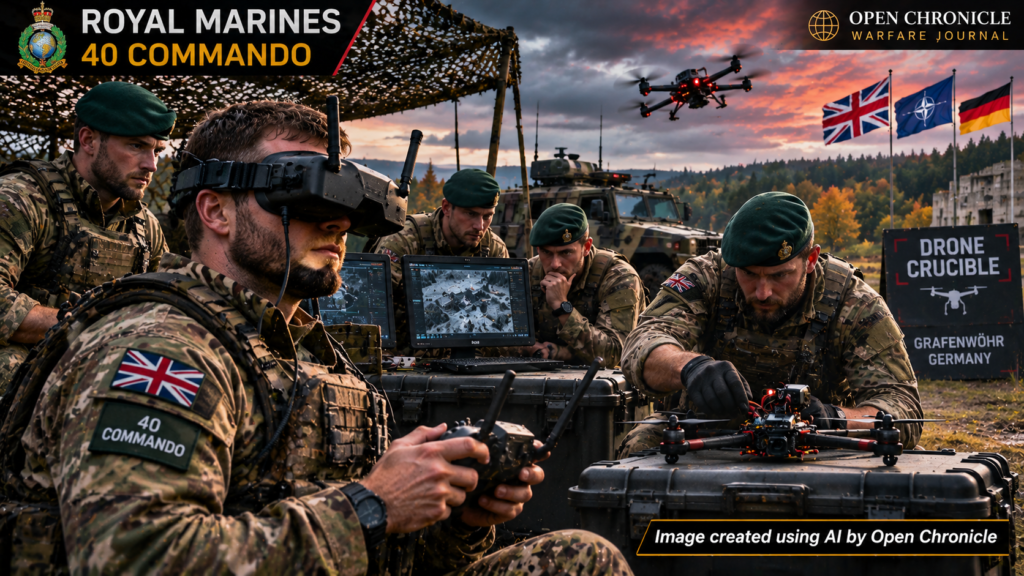
Five Royal Marines from 40 Commando defeated international rivals in a demanding military drone competition in Germany. Beyond the result, Drone Crucible reveals how reconnaissance, precision strike, electronic warfare and rapid technological adaptation are reshaping the capabilities expected of modern commando forces.
OPEN CHRONICLE | WARFARE JOURNAL
SPECIAL FORCES | DRONES | TRAINING AND PERSONNEL
21 November 2026 | By Open Chronicle Warfare Journal
A British victory with implications beyond the competition
A five-member team from Britain’s Royal Marines has won the inaugural Drone Crucible special operations competition in Germany, outperforming military teams representing the United States, Germany, Latvia and Ukraine.
The competition, held at the Grafenwöhr Training Area in Bavaria, brought together military drone operators for three days of demanding practical challenges.
According to an official Royal Navy announcement published on 17 November 2026, the event involved approximately 400 drone sorties and tested capabilities ranging from reconnaissance and target identification to coordinated strikes and operations inside buildings.
The British team came from the Information Warfare Company of 40 Commando, a Royal Marines unit based in Taunton, Somerset.
The result is significant because it demonstrates how rapidly unmanned aircraft have become an important element of military training.
For decades, special operations units were associated primarily with highly trained personnel conducting reconnaissance, raids, amphibious operations and other demanding missions.
Those capabilities remain relevant.
However, modern commandos increasingly need to understand how unmanned aircraft, digital communications, battlefield sensors and precision weapons can be integrated into their operations.
Drone Crucible provides a useful illustration of that transformation.
It also offers an opportunity to examine a wider question.
Are drones becoming as important to modern special operations as the traditional weapons and equipment carried by individual commandos?
The answer depends not simply on the aircraft themselves, but on how effectively military personnel can integrate them into a wider operational system.
What happened at Drone Crucible?
The competition took place at the Grafenwöhr military training area in southern Germany.
The event was hosted by the United States National Drone Association and brought together teams from five countries.
The Royal Navy confirmed that the British contingent consisted of five personnel from 40 Commando.
Reporting by specialised defence publications identified the event as the first Drone Crucible competition in Europe specifically focused on special operations forces.
Participants faced several scenarios designed to evaluate different aspects of drone employment.
These included locating targets, conducting reconnaissance, navigating confined environments and coordinating multiple aircraft.
The competition was not simply a test of individual flying skills.
It required teams to combine technical proficiency with communication, situational awareness and coordination.
According to the Royal Navy, different teams won individual challenges.
The British contingent secured the overall title through its performance across the competition.
This distinction matters.
The available official reporting does not establish that the Royal Marines won every individual event or achieved the best result in every technical category.
Instead, their victory reflected the combined assessment of their performance across several demanding scenarios.
That is an important indicator of the skills modern military drone teams are expected to develop.
The three challenges that defined the competition
The competition featured three principal operational scenarios.
Each examined a different aspect of unmanned aircraft employment.
01 | Reconnaissance and target assessment
The opening challenge required competitors to locate a target more than two kilometres away.
Teams had to use a surveillance drone to establish the target’s identity before completing the simulated engagement sequence and assessing the result.
The scenario tested the connection between observation, information processing and military action.
The important capability was not simply reaching a distant location.
It was the ability to move from reconnaissance to a coordinated response while maintaining an understanding of the situation.
In military terminology, this process is closely associated with the integration of intelligence, surveillance, reconnaissance and strike capabilities.
02 | Drone operations inside buildings
The second challenge focused on confined environments.
Participants had to fly drones into and through buildings, including structures with two storeys and restricted interior spaces.
This introduced a different set of difficulties.
Operations inside buildings can create challenges involving visibility, navigation, communications and spatial awareness.
For military units, small drones may provide additional information about environments that would otherwise be difficult to observe.
However, competition performance does not establish that the same systems would operate equally effectively under every combat condition.
03 | Coordinated multiple-drone engagements
The final challenge required teams to coordinate three drones against a single target in rapid succession.
The scenario also involved an urban environment and the coordination of activities across the participating team.
This tested the ability to manage several unmanned aircraft within one operational task.
Although such exercises are sometimes described as swarm operations, the public account specifically describes a coordinated sequence involving three drones.
It does not establish the use of a fully autonomous drone swarm.
That distinction is essential when assessing the technological significance of the event.
Why 40 Commando won
The Royal Navy attributed particular importance to the adaptability of the British team.
Major William Docherty, the officer commanding 40 Commando’s Information Warfare Company, highlighted how quickly personnel from different military specialisations learned to operate together.
The team reportedly had limited preparation time as a complete group.
Nevertheless, its members were able to combine their existing skills with the demands of the competition.
This provides an important insight into the organisational structure of modern military units.
A drone is only one component of an operational capability.
Effective employment also depends on the people responsible for collecting information, interpreting it, communicating with other personnel and coordinating the wider mission.
The Information Warfare Company brings together several of these functions.
Its personnel work with sensors, communications and other capabilities intended to support military decision-making.
The company’s structure may therefore have provided an advantage in a competition where success depended on coordination as well as individual flying proficiency.
The available information does not provide a complete breakdown of the competition’s scoring.
It would therefore be premature to attribute the victory to any single technical advantage, aircraft model or training method.
The stronger conclusion is that the Royal Marines demonstrated effective integration of several complementary skills.
Who are the Royal Marines?
The Royal Marines are Britain’s specialist amphibious commando force and form part of the Royal Navy.
Their responsibilities include operations in coastal environments, expeditionary missions and military tasks requiring highly trained personnel.
The force has a long history of operating in difficult environments.
Modern Royal Marines training emphasises adaptability, physical endurance, tactical proficiency and the ability to operate alongside other military capabilities.
The UK Commando Force is also undergoing a wider transformation intended to prepare it for increasingly complex security environments.
Unmanned aircraft are becoming part of that development.
Small drones can provide additional reconnaissance capabilities to units operating far from large military formations.
They may also support situational awareness and other functions that previously depended more heavily on conventional reconnaissance assets.
The significance of the Drone Crucible victory lies partly in demonstrating that personnel from an established commando formation can adapt to this changing technological environment.
40 Commando and the Information Warfare Company
40 Commando is based at Norton Manor Camp near Taunton in southwest England.
The unit forms part of the Royal Marines’ operational structure.
Its Information Warfare Company brings together personnel with different technical and military specialisations.
The company was represented by the five-member British team at Drone Crucible.
Its participation illustrates how information-related capabilities are becoming increasingly important within formations traditionally associated with direct military operations.
Modern military missions generate large amounts of information.
Drones, observation systems and other sensors can provide commanders with additional data.
However, collecting information is only useful if it can be interpreted and incorporated into military decisions.
This requires trained personnel, reliable communications and procedures for coordinating different capabilities.
The integration of those functions is becoming an increasingly important element of modern commando training.
Why the war in Ukraine changed the importance of drones
The war in Ukraine has accelerated military interest in small unmanned aircraft.
Both Ukrainian and Russian forces have employed drones for reconnaissance, battlefield observation and attacks against military targets.
The conflict has demonstrated how relatively inexpensive aircraft can influence operations involving much larger and more expensive military systems.
It has also shown that drone technology evolves rapidly.
Changes in communications, navigation, defensive countermeasures and operational practices can alter the effectiveness of particular systems.
This creates a demanding environment for military organisations.
Equipment that appears effective during one phase of a conflict may require modification as opposing forces develop new countermeasures.
The result is a continuing cycle of technological and tactical adaptation.
For special operations forces, the lesson extends beyond acquiring more drones.
Personnel must understand how unmanned systems fit into existing military capabilities and how those systems may be affected by changing battlefield conditions.
Drone Crucible reflects this wider emphasis on practical experience and rapid learning.
Did British commandos defeat Ukraine’s special operations forces?
Several publications have described the British victory as a defeat of Ukrainian special operations personnel.
The Royal Navy’s official announcement confirms that a Ukrainian team participated in the competition.
However, it does not identify the precise Ukrainian unit.
The Ukrainian defence publication Militarnyi reported on 21 November that the detailed composition of the participating teams remained unclear.
Its English-language report also stated that, although Ukrainian Special Operations Forces had been announced as participants, sources consulted by the publication disputed whether personnel from that specific formation actually competed.
This creates an important distinction.
The presence of a Ukrainian team is supported by the Royal Navy’s official account. The exact organisational identity of the Ukrainian participants remains unresolved in the sources examined.
The British victory should therefore be described as an overall win against international teams that included Ukrainian participants.
It should not be presented as definitive proof that the Royal Marines outperformed a specifically identified Ukrainian special operations unit unless that unit’s participation is independently confirmed.
The result also should not be interpreted as a direct comparison of national combat effectiveness.
A competition evaluates performance under its own rules and conditions.
Actual military operations involve many additional factors that cannot be reproduced fully in a training event.
FPV drones: A new capability for commando forces
First-person-view drones have become prominent in contemporary military operations.
The term FPV refers to aircraft operated using a video feed that allows the pilot to observe the drone’s surroundings from its onboard camera.
The technology originated in civilian and recreational applications but has been adapted for military use.
Some military FPV drones are designed primarily for reconnaissance.
Others are configured for attack missions.
Their relatively compact size and adaptable architecture make them attractive for certain military applications.
However, they also present operational limitations.
Performance depends on the aircraft, payload, communications environment, weather and other conditions.
Small drones are not substitutes for every conventional weapon or reconnaissance platform.
Instead, they add another capability to the range of systems available to military units.
For commandos, the key question is how to integrate these systems without compromising the other responsibilities of a small team.
That challenge is likely to become increasingly important as unmanned aircraft become more common.
The Archer drone and the role of military industry
The competition also provided an opportunity for defence manufacturers to demonstrate equipment.
According to Calibre Defence and Militarnyi, the California-based company Neros Technologies reported that all three teams finishing on the podium used its Archer FPV drone.
The company describes Archer as an eight-inch aircraft with a published payload capacity of approximately two kilograms and a stated range exceeding 19 kilometres.
These figures are manufacturer claims associated with the identified product.
They do not establish the payloads, operating ranges or mission configurations used by the British team during every competition event.
Nor does the reported use of Archer establish that the Royal Marines have selected it as their exclusive operational FPV platform.
The broader industrial significance lies in the relationship between military users and equipment manufacturers.
Drone competitions allow personnel to assess different products and provide feedback.
Manufacturers can observe how their systems perform in demanding scenarios.
Such interaction may accelerate technical improvements.
However, participation in a competition should not be confused with a government procurement decision.
Training matters more than equipment alone
The availability of small drones does not automatically create an effective military capability.
Operators require training.
Teams must learn to work together.
Commanders need to understand the possibilities and limitations of the systems available to them.
Maintenance, communications, logistical support and safety procedures also influence readiness.
These requirements create challenges for military organisations accustomed to longer equipment development cycles.
Small drone technology can change much faster than conventional procurement programmes.
This creates pressure to introduce new equipment while maintaining appropriate standards of reliability, security and operational effectiveness.
Reporting from the competition highlighted the importance of training personnel rather than concentrating exclusively on hardware acquisition.
That observation is relevant well beyond special operations forces.
An advanced drone operated without sufficient training may provide less useful capability than a simpler system integrated into an experienced team.
The British result suggests that organisational preparation and coordination deserve attention alongside aircraft performance.
Information warfare is becoming central to special operations
The term information warfare covers a broad range of military activities.
These may include intelligence collection, communications, electronic warfare and the management of information relevant to military operations.
Drones contribute to this environment by generating visual and other sensor data.
The information they provide may support military situational awareness.
However, their usefulness depends on how that information reaches the people responsible for making decisions.
A drone operating independently from the wider unit may provide valuable observations.
A drone integrated with communications, reconnaissance and command systems may provide a more comprehensive contribution.
This is one reason the participation of 40 Commando’s Information Warfare Company is noteworthy.
The company represents an organisational approach in which technical capabilities are brought together within a military formation.
The competition result offers evidence that this approach can perform effectively under the particular conditions tested at Grafenwöhr.
It does not establish that the same organisational model is optimal for every special operations mission.
The next step: Artificial intelligence and digital command systems
The Royal Marines’ growing interest in drones is taking place alongside wider British investment in digital military technology.
Defence reporting published in November 2026 describes plans to introduce Arondite’s Cobalt mission-planning software into the UK Commando Force.
The platform is intended to support the integration of information from different sensors and unmanned systems.
Such technology reflects a broader military effort to improve the management of battlefield information.
Artificial intelligence may assist with certain tasks involving data processing, information presentation and operational planning.
However, the presence of AI-enabled software does not establish that a military organisation has delegated independent lethal targeting authority to an autonomous system.
Different systems can provide very different levels of automation.
It is therefore important to distinguish decision-support technology from weapons capable of selecting and engaging targets without individual human approval.
The available Drone Crucible reporting does not establish that the Royal Marines used Cobalt during the competition.
The competition victory and the planned software introduction are separate developments.
Together, they illustrate the growing importance of digital integration within British commando modernisation.
NATO interoperability: Why international competitions matter
Drone Crucible brought together military teams from several NATO countries and Ukraine.
This multinational character is important.
Modern military operations often require forces from different countries to work together.
That cooperation can become more difficult when units employ different communications systems, equipment and operating procedures.
Training events provide opportunities to identify such differences.
They also allow participants to observe alternative approaches to similar operational challenges.
The value of Drone Crucible therefore extends beyond identifying the winning team.
The competition created an environment in which participants could compare equipment, exchange experience and evaluate practical skills.
The presence of Ukrainian participants is particularly relevant because Ukraine has accumulated extensive experience with unmanned systems during its war against Russia.
However, the available reporting does not establish the precise operational backgrounds of every competitor.
Nor does the result demonstrate that all interoperability challenges have been resolved.
The more defensible conclusion is that multinational training provides a useful mechanism for improving cooperation.
Drones and the future of amphibious operations
The Royal Marines have traditionally specialised in operations associated with the maritime environment.
This includes the ability to operate from naval platforms and conduct missions in coastal areas.
Small drones may support such operations by providing additional information about terrain and activity in the surrounding environment.
They may also contribute to logistics and other support functions.
These possibilities are especially relevant to small units operating with limited access to larger military assets.
However, maritime and coastal environments create additional challenges.
Weather, communications, equipment durability and the movement of supporting vessels may affect unmanned aircraft operations.
Systems developed for land-based use cannot automatically be assumed to perform equally well in every maritime environment.
The wider UK Commando Force will therefore need to consider how drone capabilities can be integrated into its particular operational requirements.
The Drone Crucible victory is one indicator of progress in personnel training.
It is not a complete demonstration of amphibious drone warfare capability.
Beyond attack drones: Unmanned logistics
The Royal Navy’s November announcement also highlighted a separate development involving Royal Marines logistics drones.
Personnel from Malloy Flight, Delta Squadron, 48 Commando Support Group, have been working on procedures to reduce the time needed to prepare and launch unmanned logistics aircraft.
The Royal Navy reported that the procedures under development could allow newly trained teams to prepare and launch their drones within approximately three minutes during daylight and five minutes at night.
The work involved the Malloy quadcopter, which the service described as capable of carrying payloads of up to 63 kilograms.
These figures concern the separate logistics training activity.
They are not performance results from Drone Crucible.
The distinction is important because the two developments illustrate different applications of unmanned technology.
FPV aircraft may support reconnaissance or attack functions.
Larger logistics drones can support the movement of supplies and equipment.
Together, they show that the Royal Marines’ unmanned systems programme extends beyond a single type of aircraft or mission.
Five questions the Drone Crucible result raises
1. Can the Royal Marines reproduce their competition performance in more complex military exercises?
The victory establishes success under the competition’s conditions. Additional exercises would provide broader evidence of operational readiness.
2. How will FPV drones be integrated into existing commando formations?
Military organisations must decide how personnel, equipment and training responsibilities should be distributed.
3. Will the British Armed Forces standardise particular drone platforms?
Manufacturer participation does not establish final procurement choices or fleet-wide adoption.
4. How quickly can training adapt to technological change?
Drone technology and countermeasures evolve rapidly, creating continuing demands on military training systems.
5. What lessons will NATO partners take from the competition?
The multinational format provides opportunities for exchanging experience, but any formal doctrinal changes will require additional evidence.
Strategic assessment: Special forces are becoming increasingly technology-dependent
The Royal Marines’ victory highlights a broader transformation in military capability.
Special operations forces have traditionally placed exceptional emphasis on personnel selection, training and adaptability.
Those qualities remain central.
However, the equipment and information systems available to personnel are becoming increasingly important.
A modern commando team may need to understand unmanned aircraft, digital communications, battlefield sensors and the effects of electronic warfare.
The challenge is not simply to add more technology.
It is to integrate new
Technical briefing | Drone Crucible 2026
DRONE CRUCIBLE 2026 | GRAFENWÖHR, GERMANY
Figures reported in the Royal Navy’s official announcement, 17 November 2026.
| Event | Drone Crucible |
| Location | Grafenwöhr Training Area, Bavaria, Germany |
| Host | US National Drone Association |
| Winning unit | 40 Commando, Information Warfare Company |
| Other nations | United States, Germany, Latvia, Ukraine |
| Principal systems | Surveillance drones and FPV aircraft |
| Result | British overall victory, different winners in individual challenges |
Figures and results confirmed by the Royal Navy announcement of 17 November 2026.
Sources and Further Reading
This article draws on official Royal Navy documentation and supplementary reporting from established military and defence publications. The following sources provide information about the Drone Crucible competition, the participation of Royal Marines from 40 Commando, international military drone training, emerging unmanned systems and the wider transformation of special operations capabilities.
Royal Marines Take Top Honours in Allied Drone Combat Competition
Primary official source confirming the Royal Marines’ overall victory at Drone Crucible, the participation of personnel from 40 Commando’s Information Warfare Company, the countries represented and the principal competition scenarios. The announcement includes comments from Major William Docherty and separately documents Royal Marines experimentation with unmanned logistics aircraft.
Royal Marines Have the Winning Altitude at Drone Crucible
British military news coverage examining the international drone competition, the performance of the Royal Marines team and the training objectives associated with reconnaissance, unmanned aircraft operation and coordination between military personnel. The report provides additional journalistic context for the official Royal Navy announcement.
40 Commando Win Inaugural Drone Crucible Contest
Defence technical reporting examining the British victory, the reported use of Neros Archer FPV drones and the broader development of unmanned systems within the Royal Marines. The analysis also discusses the relationship between military drone experimentation, information warfare and emerging digital technologies intended to support future commando operations.
British Commandos Defeat Team From Ukraine in Drone Competition
Ukrainian defence reporting providing additional information about international participation, drone manufacturers and the competition results. The publication also raises questions concerning the precise organisational identity of the Ukrainian military contingent, an issue that remains unresolved in the sources examined and should not be treated as independently confirmed.
British Commandos Beat American Green Berets at Europe’s First Special Operations Drone Contest
Special operations reporting examining the demands of military drone training, multinational participation and the importance of integrating unmanned aircraft into existing special operations formations. The article provides additional perspectives on the development of drone capabilities and the challenges facing military units adapting to rapidly evolving technology.
This article was prepared by Open Chronicle Warfare Journal using the Royal Navy’s official announcement of 17 November 2026 and supplementary reporting from Forces News, Calibre Defence, Militarnyi and SOFREP. The British victory is confirmed as an overall competition result, not a victory in every individual challenge or proof of superior national combat capability. The Royal Navy confirms Ukrainian participation but does not identify the specific Ukrainian unit. Militarnyi reports conflicting information concerning the participation of Ukrainian Special Operations Forces, and this uncertainty is explicitly preserved. Manufacturer specifications for the Neros Archer are attributed claims and are not presented as verified performance achieved during the competition. The reported Arondite Cobalt programme and Malloy logistics drone training are separate developments, not capabilities demonstrated by the winning team at Drone Crucible. Operational and strategic interpretations are independent editorial analysis based on publicly available information.