
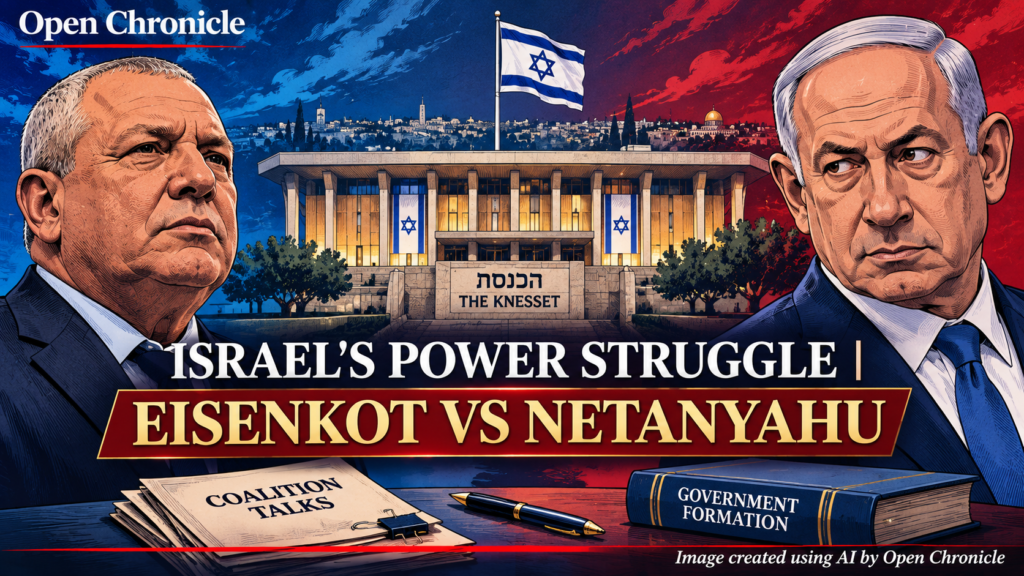
OPEN CHRONICLE | WORLD NEWS & POLITICS
Yashar leader Gadi Eisenkot is seeking a breakthrough in negotiations to form Israel’s next government, but disagreements over Benjamin Netanyahu’s political future, Arab party support and national security policy threaten to prolong the deadlock.
By Open Chronicle News Desk | November 21, 2026
Jerusalem | Political Developments & Strategic Analysis
Israel’s efforts to form a new government entered another critical phase on Saturday as Gadi Eisenkot invited caretaker Prime Minister Benjamin Netanyahu’s Likud party to resume coalition negotiations, seeking a political breakthrough before his mandate to form an administration expires in early December.
The invitation, reported by Israeli media and confirmed in a statement from Eisenkot’s Yashar party, calls for intensive negotiations beginning Sunday, November 22. The initiative follows an unsuccessful first round of discussions and growing disagreements over the composition, leadership and political direction of a possible national unity government.
Eisenkot’s party has presented the invitation as an attempt to establish the broadest possible coalition, even as the possibility of a minority government supported by Arab parties remains under consideration.
The negotiations have become a test of whether Israel’s political establishment can overcome deep divisions following an election that left neither major political camp with a straightforward parliamentary majority.
A renewed attempt to build a national unity government
The latest invitation comes after negotiations between Yashar and Likud failed to produce an agreement on November 15.
Both parties subsequently accused each other of obstructing efforts to establish a unity government.
Yashar maintains that it has repeatedly attempted to advance negotiations, while Likud argues that Eisenkot’s political allies have undermined the prospect of cooperation by pursuing parliamentary initiatives with support from Arab parties.
The disagreement goes beyond the allocation of ministerial portfolios.
At its centre is a fundamental question: Can Likud participate in a government led by Eisenkot without Netanyahu retaining the premiership?
Eisenkot has rejected a leadership rotation agreement that would allow Netanyahu to return to the prime minister’s office during the next government’s term.
Likud, meanwhile, has continued to advocate a broad arrangement that would preserve significant influence for Netanyahu and his existing political allies.
Reports published on November 21 indicate that some of Likud’s negotiating demands remain incompatible with Eisenkot’s stated conditions.
The parliamentary arithmetic behind the crisis
ISRAEL’S 120 SEAT KNESSET
Change Bloc
48 / 120
Change Bloc plus Arab Parties
67 / 120
Illustrative parliamentary arithmetic based on the reported seat distribution. The combined total of 67 seats represents potential parliamentary support, not a confirmed coalition agreement. External support does not necessarily imply participation in government.
Illustrative seat arithmetic, not a confirmed coalition agreement. External support does not necessarily imply participation in government.
Eisenkot’s Change Bloc controls 48 seats in the 120-member Knesset, leaving it 13 seats short of the 61 required for an absolute parliamentary majority.
The two Arab-led parties collectively hold 19 seats. Their support could theoretically provide 67 votes for a government headed by Eisenkot, although such an arrangement would require overcoming significant disagreements within his own political alliance.
The numbers illustrate the central paradox of the negotiations.
Eisenkot has sufficient recommendations from lawmakers to justify receiving the presidential mandate, but those recommendations do not automatically translate into a stable governing coalition.
President Isaac Herzog formally selected Eisenkot to attempt to form a government after 67 lawmakers recommended him, compared with 46 who supported Netanyahu. Another seven declined to recommend either candidate.
The presidency confirmed those figures in its official announcement on November 7.
Arab parties become the central political dividing line
The possibility of establishing a minority government with outside support from Arab-led parties has become one of the most contentious issues in the coalition negotiations.
According to Israeli reporting, Likud wants Eisenkot to abandon that option before negotiations advance.
The demand reflects both parliamentary strategy and the broader political divisions surrounding the role of Arab parties in Israeli government formation.
Yair Golan, leader of the Democrats, has advocated exploring cooperation with Arab political representatives to replace Netanyahu.
However, Avigdor Lieberman, leader of Yisrael Beytenu and a member of Eisenkot’s Change Bloc, opposes a government that includes Arab parties or depends on their parliamentary support.
This disagreement complicates Eisenkot’s position.
Although Arab party support could theoretically create a majority in parliamentary voting, the refusal of key coalition partners to accept such an arrangement could prevent a government from being formed or make it difficult to sustain.
The debate also reflects a wider question about the political representation of Israel’s Arab citizens, whose parties made significant gains in the 2026 election.
Ra’am and the Joint List do not hold identical political positions, and their potential support for a government should not be interpreted as a single, unconditional commitment.
Likud’s reported demands extend to Palestinian statehood and security policy
The negotiations are also shaped by major differences over national security, the Palestinian question and Israel’s domestic political institutions.
According to the Israeli reports supplied to Open Chronicle, Likud is seeking commitments on several issues:
Opposition to the establishment of a Palestinian state.
Continued Israeli military deployment in areas designated as security zones.
Maintenance of detention conditions for members of Hamas’ Nukhba unit.
An end to unilateral parliamentary moves concerning judicial reform and media legislation.
A commitment not to establish a minority government dependent on Arab parties.
These demands, as reported, would significantly constrain the policy agenda of an Eisenkot-led administration.
They also demonstrate why negotiations over a national unity government involve more than the question of who becomes prime minister.
A coalition agreement would need to address the future of Israeli security policy, relations with Palestinians, the role of the judiciary and the balance of power between the executive and parliament.
Not all of the reported conditions have been independently confirmed as formally agreed negotiating positions.
Naftali Bennett’s role adds another layer of uncertainty
Former Prime Minister Naftali Bennett has emerged as another influential figure in the negotiations.
His meeting with Netanyahu earlier in the week attracted considerable attention after Israeli media reported that the discussion, initially described as a security briefing, also included political matters.
Bennett has publicly supported the idea of a broad unity government led by Eisenkot.
His position suggests that parts of the Change Bloc still regard cooperation with Likud as preferable to a minority government dependent on outside parliamentary support.
However, Bennett has also expressed distrust of Netanyahu and warned against allowing negotiations to consume the time available under Eisenkot’s presidential mandate.
The former prime minister’s involvement therefore does not guarantee an agreement.
Instead, it highlights the competing calculations among opposition leaders who agree on the need for political change but disagree over the route to achieving it.
December 6: The deadline shaping every political calculation
Government Formation Timeline
Key dates in Israel’s coalition negotiations.
President Herzog formally tasks Eisenkot with forming a government.
First Yashar and Likud coalition meeting ends without a breakthrough.
Eisenkot invites Likud to renewed intensive negotiations.
Proposed start of the next round of coalition talks.
Eisenkot’s initial 28-day mandate expires.
CONSTITUTIONAL CONTEXT
Under Israel’s Basic Law: The Government, the president may grant an extension of up to 14 days to the initial government formation mandate. An extension is not automatic.
The president may grant an extension of up to 14 days under Israel’s Basic Law: The Government.
The approaching deadline is increasing pressure on Eisenkot to demonstrate progress.
Under Israel’s constitutional framework, the politician entrusted with forming a government initially receives 28 days to assemble a coalition. The president may grant additional time, but an extension is not automatic.
Eisenkot has indicated that he does not intend to allow negotiations to continue indefinitely.
Israeli media reported on November 20 that Yashar was considering presenting a minority government for a parliamentary vote before the mandate expires, even if negotiations with Likud and ultra-Orthodox parties fail.
Such a move could force lawmakers to choose between supporting an alternative administration and allowing the government formation process to continue.
It would also expose divisions within the Change Bloc, particularly over reliance on Arab parliamentary support.
Netanyahu’s political and legal challenges
Netanyahu remains caretaker prime minister while the negotiations continue.
His political future is complicated by the unresolved criminal proceedings against him in Israel, where he faces charges of bribery, fraud and breach of trust. Netanyahu denies wrongdoing.
Separately, the International Criminal Court issued arrest warrants in November 2024 for Netanyahu and former Defence Minister Yoav Gallant in connection with alleged war crimes and crimes against humanity in Gaza.
The warrants concern allegations and do not constitute criminal convictions.
These legal issues remain part of the broader political context, although the immediate coalition negotiations are primarily concerned with parliamentary numbers, leadership and policy commitments.
For Netanyahu, participation in a unity government could preserve Likud’s influence over national policy.
For Eisenkot, accepting Likud without Netanyahu as prime minister could provide a more stable parliamentary majority while allowing him to present the result as a change of government.
The difficulty is that the two objectives may be politically incompatible.
Strategic assessment: Three possible paths
Three Possible Paths to Government
The coalition negotiations now appear to be moving towards three broad possibilities.
A National Unity Government
Eisenkot reaches an agreement with Likud, potentially creating a broader parliamentary coalition. This would require major compromises on leadership, security policy and the legislative agenda.
STRATEGIC IMPLICATION
Greater potential parliamentary stability, but substantial political concessions.
A Minority Government with Outside Support
Eisenkot attempts to form an administration supported or tolerated by Arab parties without necessarily including them in the cabinet.
STRATEGIC IMPLICATION
A possible transfer of power, but with significant internal disagreements and vulnerability to parliamentary defections.
Failure to Form a Government
Negotiations collapse, Eisenkot cannot secure sufficient parliamentary support and the mandate eventually moves into the next constitutional stage.
STRATEGIC IMPLICATION
Prolonged political uncertainty, further negotiations and the possibility of another election if no government can be formed.
EDITORIAL METHODOLOGY
These scenarios are analytical possibilities rather than forecasts. No probability ranking is assigned.
The wider significance for Israel’s political future
The current negotiations represent more than another episode of coalition bargaining.
They expose a political system struggling to reconcile competing visions of national leadership, security and democratic representation.
For Eisenkot, the central challenge is to transform an electoral and parliamentary opportunity into an administration capable of governing.
For Netanyahu, the negotiations offer an opportunity to preserve political influence despite the loss of a clear path to another government under his leadership.
For Arab parties, the process raises questions about whether their parliamentary strength can translate into meaningful political influence.
And for Israel’s broader political establishment, the outcome will help determine whether the country enters a period of institutional cooperation or continued confrontation.
A unity government could offer a framework for addressing urgent security and economic challenges, but only if its participants can agree on fundamental political principles.
A minority government could bring about a change in leadership, yet its survival would depend on maintaining support across deeply divided parliamentary factions.
Another failed attempt to form a government would prolong uncertainty at a time when Israel continues to face major domestic and regional challenges.
The Bottom Line
Eisenkot’s invitation to Likud represents another attempt to break Israel’s political deadlock, but the renewed negotiations do not resolve the fundamental disagreements separating the two sides.
The central issue remains whether Netanyahu’s party is prepared to participate in a government led by Eisenkot, and whether Eisenkot can maintain the support of his political allies while negotiating with Likud.
The possibility of Arab parliamentary support gives Eisenkot an alternative route, but it also threatens to divide his own bloc.
With the December 6 deadline approaching, the negotiations are becoming a test of political flexibility and parliamentary arithmetic.
Israel’s next government may ultimately depend less on which political camp won the election than on which leaders are prepared to accept the compromises required to govern.
Sources and Further Reading
Selected international reporting and official institutional information supporting this article.
Eisenkot Invites Likud to Marathon Coalition Talks
November 21, 2026
Reporting on the invitation, the proposed Sunday meeting and the dispute over a national unity government.
Can Gadi Eisenkot Break Israel’s Political Deadlock?
November 7, 2026
Analysis of the parliamentary arithmetic, potential coalition arrangements and the obstacles facing Eisenkot.
Government Formation Mandate
November 7, 2026
Official confirmation of the presidential decision, parliamentary recommendations and the constitutional timetable.
Eisenkot Outlines Three Paths to Government
November 20, 2026
Examination of Eisenkot’s coalition options, including negotiations with Likud, ultra-Orthodox parties and potential Arab parliamentary support.
Eisenkot Says He Will Form Minority Government if Needed
November 20, 2026
Reporting on Eisenkot’s position ahead of the December deadline and his willingness to pursue alternative coalition arrangements.
Palestinian Citizens and Their Growing Political Influence
November 2026
Background on the role of Arab parties in the election and the debate over political representation.
Editorial Transparency
This article was prepared by Open Chronicle News Desk using the political developments supplied for editorial review, supplemented by reporting from Reuters, The Times of Israel, The Jerusalem Post, Associated Press and the Jewish Telegraphic Agency, together with official information from the Office of the President of Israel. Reported coalition demands and political negotiations are attributed to their respective sources where independent confirmation is unavailable. The discussion of parliamentary alternatives, political stability and potential government formation outcomes represents independent editorial analysis. The strategic scenarios are illustrative possibilities rather than predictions. Information reflects developments reported through November 21, 2026.