
Open Chronicle Formula One Magazine | Technical Focus | 21 November 2026
By Open Chronicle Sports
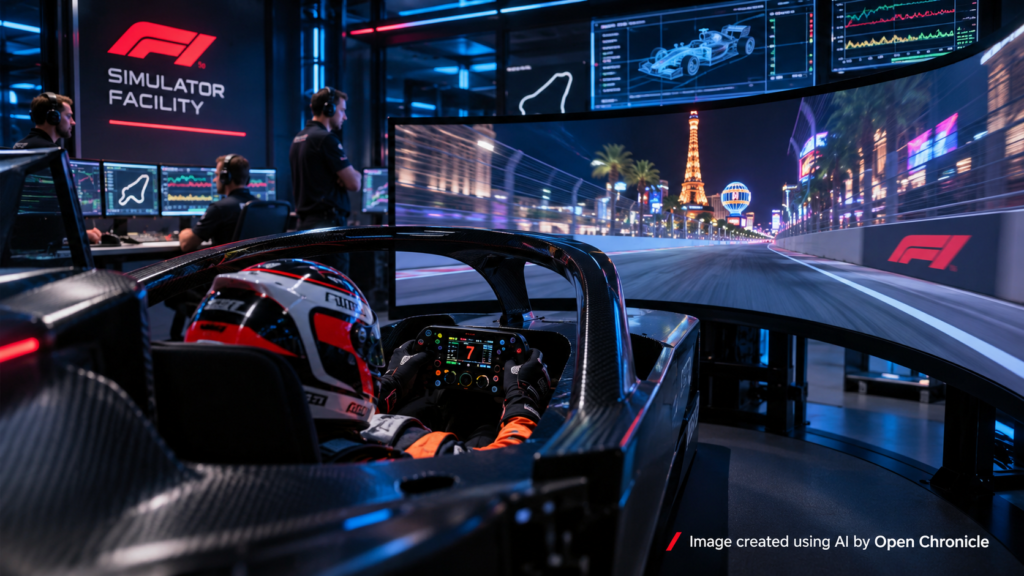
Before a Formula One driver completes the first real lap of a Grand Prix weekend, hundreds of virtual laps may already have been driven. Inside sophisticated simulation facilities, drivers and engineers are learning circuits, testing car setups, refining energy deployment and searching for performance advantages that could decide the race.
The Grand Prix Begins Long Before Friday Practice
When a Formula One driver leaves the garage for the first practice session, the circuit is rarely unfamiliar territory.
The braking zones have been studied. The corner sequences have been rehearsed. Different aerodynamic configurations have already been evaluated, and engineers have developed an initial understanding of how the car should behave.
Much of that preparation takes place hundreds or thousands of kilometres away from the circuit.
At facilities operated by teams such as Mercedes in Brackley and McLaren in Woking, sophisticated simulators allow drivers to experience a virtual representation of the car and the circuit before arriving at the Grand Prix.
These are not conventional racing games.
They are engineering systems that combine mathematical vehicle models, detailed circuit scans, telemetry, physical driver controls and sophisticated computing technology.
Their purpose extends far beyond teaching a driver which direction the next corner turns.
A Formula One simulator is simultaneously a training environment, a development laboratory and an essential tool for race weekend preparation.
And in the technical environment of 2026, its importance has become even greater.
1. What Is a Formula One Driver-in-the-Loop Simulator?
The most important simulation system used directly by Formula One drivers is known as a Driver-in-the-Loop simulator, often abbreviated as DiL.
Unlike a computer simulation in which software controls a virtual vehicle, a DiL system places a human driver inside the testing process.
The driver sits in a cockpit designed to reproduce the controls and driving position of a Formula One car.
Steering inputs, braking pressure, throttle application and gear changes are transmitted into a mathematical model of the vehicle.
The simulator calculates how the car should respond and communicates that behaviour back through visual, steering and, depending on the system, motion feedback.
The virtual vehicle can be modified to represent different aerodynamic packages, suspension configurations, tyre characteristics and power unit behaviour.
Mercedes describes its simulator as a virtual test track, allowing engineers to evaluate development directions and drivers to become familiar with the characteristics of a circuit.
The system relies on detailed three-dimensional track models, including laser-scanned information about the racing surface.
This means that a driver can experience not only the general layout of a circuit but also its elevation changes, braking zones and surface irregularities, subject to the accuracy of the underlying model.
The distinction between a professional Formula One simulator and a consumer racing game is therefore fundamental.
A racing game is primarily designed to provide a convincing driving experience.
A Formula One engineering simulator must also produce results that correlate with the behaviour of a real racing car.
2. Hundreds of Laps Before the Real Race
One of the most revealing aspects of Formula One simulator preparation is the amount of virtual running completed before a Grand Prix.
Mercedes has previously described a typical preparation programme for a familiar circuit involving approximately 450 simulator laps across two days, equivalent to around eight race distances.
Most of that work was performed by specialist simulator drivers, rather than the team’s two race drivers.
For a new circuit, Mercedes described an expanded programme with additional simulation days and a dedicated session for its race drivers to learn the layout.
The team has also explained that a simulator driver can complete as many as 170 laps during a typical working day.
These figures are examples from Mercedes’ published programmes, not fixed requirements applied to every team or every Grand Prix.
The scale of the work nevertheless illustrates an important point.
While the race drivers are travelling, training, fulfilling media obligations or preparing for the next event, the simulator department can continue evaluating the car.
The virtual preparation programme may involve testing multiple rear wing configurations, changing suspension stiffness, comparing braking characteristics and evaluating how different setups affect performance over a lap.
The objective is to arrive at the circuit with a strong baseline rather than beginning the weekend with unanswered questions.
3. Learning a New Circuit Without Driving It
Simulators become particularly valuable when Formula One visits a completely new circuit.
The 2026 Spanish Grand Prix at Madrid’s Madring provided a recent example.
Before the event, drivers had accumulated substantial virtual mileage despite having little or no real-world experience of the circuit.
Fernando Alonso explained that he typically needs only a handful of laps in the simulator to understand the layout of a new track.
However, optimising the driving lines, braking points and other details can require another 50 to 60 laps.
Oscar Piastri offered a similar perspective when discussing McLaren’s preparations for new venues.
He explained that approximately 15 to 20 simulator laps can be required before a driver begins to establish a comfortable rhythm, identify appropriate gears and understand how much speed can be carried through different corners.
That preparation is especially important because practice time is limited.
Without simulator experience, drivers would have to spend valuable real-world running learning information they could have acquired in advance.
Instead, they can begin the first practice session with a basic understanding of the circuit and concentrate on evaluating the actual car.
Nevertheless, the simulator cannot reproduce every aspect of the experience.
Alonso has highlighted the difference between virtual driving and the consequences of making a mistake in a real Formula One car.
The physical sensation of danger, the adrenaline associated with approaching barriers at high speed and the knowledge that an accident could end a session remain fundamentally different.
For that reason, even the most accurate simulator cannot completely eliminate the learning process once the driver reaches the circuit.
4. How Teams Build a Virtual Circuit
Before drivers can begin practising, engineers must construct a digital representation of the venue.
For established circuits, teams can use years of accumulated information, including track scans, telemetry and previous race data.
New venues are considerably more challenging.
McLaren provided a detailed explanation of this process in September 2026, describing its preparations for Madrid.
The initial model can begin with a preliminary circuit layout supplied by the FIA, supported by geographical information and architectural drawings.
Engineers use this material to establish the racing line, circuit boundaries, corner geometry and elevation changes.
As more accurate information becomes available, the model is refined.
One of the most important technologies involved is LiDAR, a laser-based measurement system that can capture the geometry of the track surface.
From Physical Circuit to Virtual Cockpit
Circuit Geometry
Track plans, elevation information and physical measurements establish the initial layout.
Digital Track Model
Engineers reproduce the racing surface, kerbs, walls and other relevant features.
Vehicle Simulation
A mathematical representation of the Formula One car is combined with the virtual circuit.
Driver Evaluation
Race drivers and simulator specialists assess braking, handling, racing lines and setup options.
Track Correlation
Real practice data is used to identify differences and improve the simulation model.
Editorial illustration of the workflow described by McLaren and Mercedes. Individual teams may use different procedures.
Why Model Accuracy Matters
The accuracy of this model matters enormously.
A small difference in kerb height, surface grip or corner radius can change how a driver approaches a section of track.
This is especially relevant at street circuits, where temporary barriers and evolving road surfaces introduce uncertainties that are difficult to reproduce perfectly before the event.
OPEN CHRONICLE FORMULA ONE MAGAZINE
| TECHNICAL FOCUS
5. Finding the Right Setup Before the Car Reaches the Garage
Learning the circuit is only one part of the simulator programme.
The second major objective is determining how the Formula One car should be configured.
Engineers use simulation to explore the compromises required by each circuit.
A track with long straights may reward reduced aerodynamic drag, while a circuit dominated by slower corners could require greater downforce and mechanical grip.
The simulator allows teams to investigate these choices before committing valuable track time to them.
Typical areas of evaluation include aerodynamic balance, suspension stiffness, braking behaviour, traction, ride height and the driver’s preferred handling characteristics.
For example, engineers may compare two aerodynamic configurations across several virtual runs.
The driver then provides feedback on how each version behaves during braking, corner entry, mid-corner rotation and acceleration.
The engineers combine that subjective feedback with quantitative performance data.
The objective is not simply to produce the fastest possible virtual lap.
It is to identify a setup that offers a useful combination of performance, predictability and consistency under realistic conditions.
McLaren has previously described how Lando Norris and his engineers used repeated comparisons between baseline and modified setups, including different downforce levels and suspension settings.
Virtual testing can make those comparisons much faster than physically replacing components in a garage.
However, the simulator’s recommendations remain provisional until the real car confirms them on track.
6. Why the 2026 Regulations Have Made Simulation Even More Important
The 2026 Formula One regulations have introduced an additional dimension to simulator preparation.
The increased importance of electrical energy within the power unit means that drivers must pay particular attention to how energy is recovered, stored and deployed throughout a lap.
This makes preparation more complex than simply learning braking points and selecting gears.
The driver must understand how different approaches to a corner or straight can affect the energy available later in the lap.
Engineers must consider the relationship between driving technique, aerodynamic configuration, power unit behaviour and energy management.
A lap that appears optimal from a conventional cornering perspective may not necessarily produce the best overall performance when energy deployment is considered.
This is one reason why the simulator has become especially valuable in 2026.
Formula One’s September report on preparations for the Madring specifically identified the additional complexity of energy deployment as a factor increasing the usefulness of simulator sessions for race drivers.
McLaren technical director for performance Mark Temple also explained that the 2026 power units had required teams to reconsider how they approached different circuits.
The simulator therefore serves as a training environment for a new driving discipline, not merely a tool for evaluating mechanical setup.
7. The Hidden Specialists: Formula One’s Simulator Drivers
The drivers competing in the Grand Prix are not necessarily the people completing the greatest number of simulator laps.
Specialist simulator drivers play an essential role in modern Formula One operations.
At McLaren, Oliver Turvey and Will Stevens have been among the drivers responsible for this work.
Turvey, who joined McLaren as a test and simulator driver in 2009, described the demanding schedule involved in supporting the race team.
In a 2024 interview, he explained that a Thursday session could involve approximately 150 to 200 laps.
During a race weekend, simulator operations could extend across nearly 12 hours on Friday, although not all of that time was spent driving continuously.
The work involves more than completing laps.
Simulator drivers follow live practice sessions, monitor information from the circuit, listen to driver feedback and work with engineers to evaluate possible solutions.
If a race driver reports excessive understeer, for example, the simulator team can investigate different setup changes and assess whether they offer a promising improvement.
The findings are then communicated to the engineers at the circuit.
This creates a continuous exchange between the real and virtual cars.
For overseas races, the simulator department may also work unusual hours to remain aligned with the race weekend schedule.
A Formula One team therefore has two parallel engineering environments operating during a Grand Prix: the physical garage at the circuit and the virtual development operation at the factory.
8. The Simulator Does Not Stop When Practice Begins
One of the most important misconceptions about Formula One simulators is that their work ends when the race weekend begins.
In reality, simulation continues throughout the event.
After Friday practice, engineers examine the telemetry collected from the real cars.
They compare the actual performance with the predictions generated before the Grand Prix.
Differences may emerge in tyre behaviour, braking stability, aerodynamic balance or track grip.
Those findings are communicated to the simulator department.
Specialist drivers can then evaluate alternative configurations while the race team prepares for the next session.
The objective is to identify promising adjustments before the cars return to the circuit.
This process becomes particularly valuable when practice sessions reveal unexpected problems.
Rather than testing every possible solution on the real car, teams can use the simulator to narrow the available options.
The McLaren team described this approach again in 2026, explaining how factory engineers and simulator specialists work together overnight to investigate ideas arising from practice sessions.
The simulator thus becomes an extension of the race engineering department.
It cannot guarantee that a proposed adjustment will work, but it can help teams make better-informed decisions with limited preparation time.
9. Why Simulators Cannot Reproduce Everything
Despite their sophistication, Formula One simulators remain imperfect representations of reality.
Their accuracy depends on the quality of the vehicle model, circuit data and assumptions used by the engineers.
Several variables are particularly difficult to reproduce.
Track grip can change dramatically during a Grand Prix weekend as rubber accumulates on the racing surface.
Wind direction and temperature can alter the aerodynamic behaviour of a car.
Tyre characteristics may differ from the predictions generated during virtual testing.
Rain creates additional uncertainty because water distribution, changing grip and visibility are difficult to model with complete accuracy.
There is also the human dimension.
Drivers do not experience exactly the same physical forces, sensations or psychological pressures inside a simulator as they do in a real Formula One car.
During the preparations for Madrid in September 2026, Lando Norris highlighted the difficulty of reproducing the full sensation of speed and acceleration.
Fernando Alonso also stressed that the absence of real consequences for an accident fundamentally changes the experience.
These limitations explain why simulator work must always be validated against actual track data.
A virtual lap can provide an excellent starting point.
It cannot replace the information obtained when a real Formula One car encounters the circuit under genuine racing conditions.
10. The Competitive Advantage of Better Simulation
Formula One teams compete in an environment where small performance differences can determine qualifying positions and race results.
Simulation offers a way to explore more engineering possibilities than could reasonably be tested during a Grand Prix weekend.
The potential advantages extend across several areas.
A more accurate circuit model can improve the initial setup.
A better vehicle model can make development decisions more reliable.
Experienced simulator drivers can identify handling characteristics that are difficult to detect through numerical analysis alone.
Efficient communication between factory and trackside engineers can accelerate the response to unexpected problems.
And better preparation allows the race drivers to spend less time learning basic information during practice.
However, simulator capability is not measured simply by the number of laps completed or the sophistication of the equipment.
The critical question is whether virtual predictions translate into genuine improvements on the circuit.
That process, known as correlation, is central to the usefulness of simulation.
A team with an impressive simulator but inaccurate models could reach misleading conclusions.
Conversely, a team that consistently understands the relationship between virtual and real performance can use simulation to make more effective decisions.
The competitive advantage lies in the quality of the entire engineering process.
Editorial Analysis: The Race Is Also Being Fought in the Factory
The modern Formula One Grand Prix is no longer an event confined to the circuit.
It is the visible result of an extensive preparation programme involving drivers, engineers, software specialists, vehicle dynamicists and simulator operators.
Long before the cars reach the starting grid, teams have already explored countless combinations of driving techniques and technical configurations.
The 2026 regulations have made this preparation especially significant.
Energy management adds new variables to the driver’s workload, while unfamiliar circuits require careful interpretation of virtual information.
The simulator has become a place where teams can experiment without consuming physical tyres, risking race cars or sacrificing valuable practice time.
Yet its greatest contribution may be less obvious.
It allows engineers to arrive at the circuit with better questions, more refined hypotheses and a clearer understanding of which technical directions deserve attention.
That does not eliminate uncertainty.
It makes the limited time available at a Grand Prix more productive.
Conclusion: The Invisible Laps Behind Every Grand Prix
Formula One drivers may complete only a relatively small number of real laps before qualifying, but those laps are supported by an enormous amount of preparation.
Inside the factories, virtual cars have already tested different setups, explored braking zones, evaluated racing lines and investigated energy deployment strategies.
Specialist simulator drivers continue that work while the Grand Prix weekend unfolds, helping engineers respond to problems and refine their understanding of the car.
The technology cannot reproduce every sensation of driving a Formula One car.
It cannot perfectly predict weather, grip or the psychological pressure of racing.
But it has fundamentally changed how teams prepare.
In modern Formula One, the first competitive lap of a Grand Prix is rarely the first lap of the weekend. Many of the most important laps have already been completed in a simulator.
Sources and Further Reading
Official technical features, engineering insights and interviews supporting this article.
How Does F1 Simulation Work?
Technical explanation of simulation programmes, virtual vehicle models and race weekend preparation.
How Do McLaren Prepare to Race at New Circuits?
9 September 2026. Detailed account of circuit modelling, driver preparation, LiDAR scanning and engineering simulation.
How F1 Drivers Used the Virtual World to Prepare for the Brand-New Madring
11 September 2026. Driver perspectives from Fernando Alonso, Oscar Piastri, Lando Norris and others on simulation accuracy and preparation.
Inside the Role of an F1 Sim Driver
20 November 2024. A behind-the-scenes explanation of simulator driver duties, preparation schedules and live Grand Prix support.
The Insider’s Guide to Preparing a Car Through Practice
Explains how drivers and engineers compare virtual setups, interpret feedback and refine the car during practice.
This feature is based on published technical explanations and interviews from Formula One, Mercedes AMG Petronas and McLaren Racing. Historical simulator workloads are identified as examples from the periods in which they were reported and should not be interpreted as universal figures for the 2026 season. The discussion of competitive advantages and engineering implications includes Open Chronicle editorial analysis.