
Open Chronicle Formula One Magazine | 21 November 2026
By Open Chronicle Sports
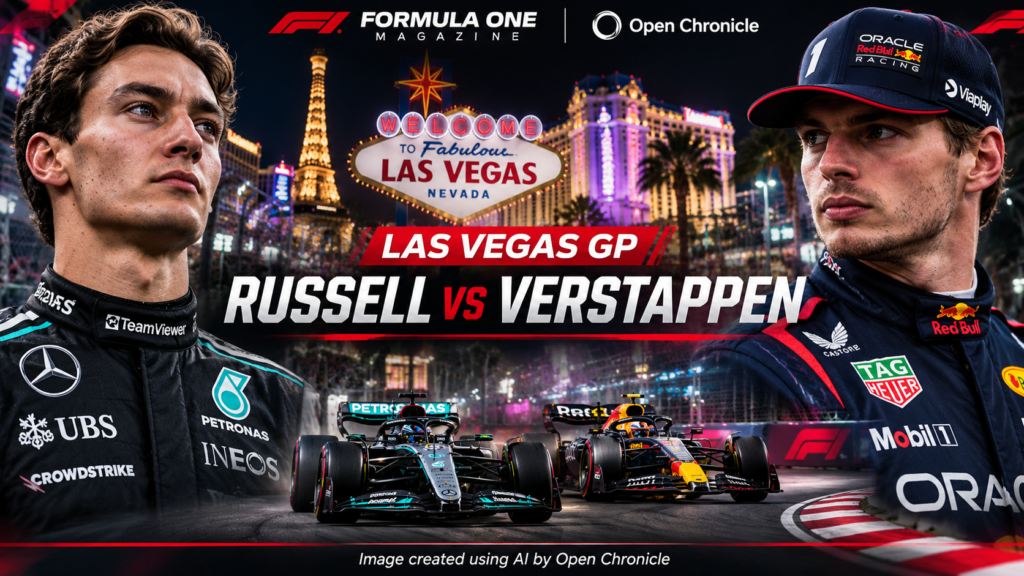
An incident during final practice at the Las Vegas Grand Prix has reignited tensions between George Russell and Max Verstappen, raising questions about driving standards, track positioning and the limits of acceptable behaviour during a Formula One practice session.
The Las Vegas Grand Prix weekend has produced another confrontation between two of Formula One’s most competitive personalities, with George Russell and Max Verstappen involved in an on-track incident that required intervention from the FIA stewards.
The encounter occurred near Turn 14 during the third free practice session, as the Mercedes and Red Bull drivers prepared their qualifying programmes on the demanding Las Vegas Strip Circuit.
What initially appeared to be a dispute over track positioning escalated into a formal investigation after the two cars made contact.
Following an examination of the available evidence, the stewards issued Verstappen with a warning rather than a sporting penalty.
The decision has added another dimension to a weekend already characterised by intense competition, difficult track conditions and strategic uncertainty.
It has also renewed discussion about the responsibilities of drivers when preparing flying laps, particularly on circuits where closing speeds can be substantial and track position is critical.
What Happened at Turn 14?
The incident developed during the final practice session, when teams were completing their last preparations ahead of qualifying.
At Las Vegas, positioning a car correctly before a flying lap is particularly important.
The circuit combines long straights with heavy braking zones and relatively slow corners. Drivers must manage tyre temperatures carefully while attempting to create sufficient space from other competitors.
These competing requirements can produce situations in which several cars approach the same section of track at different speeds.
Russell and Verstappen became involved in precisely such a situation near Turn 14.
Their disagreement over positioning resulted in contact, prompting scrutiny from race control.
The FIA subsequently referred the incident to the stewards, who examined the circumstances surrounding the encounter.
The available reporting identifies the incident as involving erratic driving by Verstappen, although the full reasoning behind the decision is best understood through the official stewards’ document.
The investigation was particularly significant because the contact occurred during practice rather than in a direct battle for race position.
That distinction matters when assessing whether a driver’s actions were reasonable and whether a sporting penalty was necessary.
The FIA’s Decision: Warning Rather Than Grid Penalty
After reviewing the incident, the FIA stewards decided to issue Verstappen with a warning.
The decision meant that the Red Bull driver avoided an immediate grid-place penalty for the encounter.
It also allowed him to continue into qualifying without an additional sporting disadvantage arising from the Turn 14 incident.
The ruling illustrates an important distinction within Formula One’s regulatory framework.
Not every driving infringement results in a time penalty, grid penalty or penalty points.
Depending on the circumstances and applicable regulations, stewards may consider a warning an appropriate response.
Such a decision does not necessarily mean that the conduct was acceptable. Rather, it indicates that the stewards considered a formal warning sufficient for the infringement under review.
The distinction is important when interpreting the outcome.
Verstappen was not cleared of all concern, but neither was he subjected to a penalty that would alter his qualifying or race position.
For Russell, the decision provided a formal acknowledgement that the incident warranted investigation, although it did not produce a direct sporting sanction against his rival.
Russell’s Frustration: A Dispute Over Respect on Track
Russell’s reaction made clear that his concerns extended beyond the immediate contact.
The Mercedes driver accused Verstappen of repeatedly compromising other competitors while they were preparing flying laps.
His argument centred on a distinction between what the regulations explicitly prohibit and what drivers generally regard as acceptable conduct.
Russell acknowledged that overtaking another driver before a flying lap is not automatically forbidden.
However, he argued that such manoeuvres can compromise the driver being overtaken, particularly when that driver has already established the space needed for a qualifying simulation.
Speaking after the incident, Russell suggested that competitors had tolerated Verstappen’s approach for too long.
The remarks reflected a broader frustration with what Russell perceives as the Dutch driver’s willingness to impose himself on other competitors.
The disagreement was therefore about more than a single corner.
It concerned whether Formula One’s leading drivers should respect informal conventions when those conventions are not explicitly written into the regulations.
Russell’s criticism was unusually direct, reinforcing the personal dimension of an already strained relationship.
Verstappen Rejects the Controversy
Verstappen presented a very different interpretation of the incident.
The Red Bull driver suggested that Russell’s response had been excessive and showed little interest in prolonging the argument.
After qualifying, he declined to engage in a detailed public discussion about the contact.
His reaction illustrated the contrast between the two drivers.
Russell wanted the incident to become part of a wider conversation about driving standards.
Verstappen appeared determined to treat it as an episode that did not deserve further attention.
From a competitive perspective, the Dutchman’s priority was clear.
Having inherited pole position following Antonelli’s five-place grid penalty, Verstappen was focused on converting his favourable starting position into a race victory.
The dispute nevertheless remained significant because Russell would start alongside him on the front row.
That created the prospect of the two drivers competing directly for the lead only hours after their confrontation.
The Unwritten Rules of Formula One
One of the most interesting aspects of the Las Vegas incident concerns the informal agreements that influence driver behaviour.
Formula One operates under an extensive regulatory framework covering safety, racing conduct, track limits and technical compliance.
However, not every aspect of competitive behaviour is governed by a detailed written rule.
Drivers also rely on conventions intended to make practice and qualifying sessions safer and more predictable.
One such convention concerns overtaking during the preparation phase before a flying lap.
When drivers are attempting to establish gaps, an unexpected overtake can disrupt tyre preparation, compromise track position or force another competitor to abandon a planned lap.
This becomes especially important at Las Vegas.
The long straights encourage drivers to seek slipstream advantages, while the relatively slow corners can create queues as competitors attempt to manage their gaps.
Consequently, drivers face conflicting incentives.
They want clear track space, but they may also benefit from following another car.
They need to preserve tyre temperatures, but excessive slowing can create dangerous closing speeds.
And they must respect the presence of other competitors while attempting to maximise their own performance.
The Russell and Verstappen incident exposed the tension between those objectives.
Why Las Vegas Makes Track Position So Important
LAS VEGAS GRAND PRIX 2026
km
laps
Las Vegas Strip Circuit | 2026 Layout
Explore the Las Vegas Strip Circuit through this Open Chronicle infographic, featuring the track layout, corner numbers, circuit sectors and key race information.
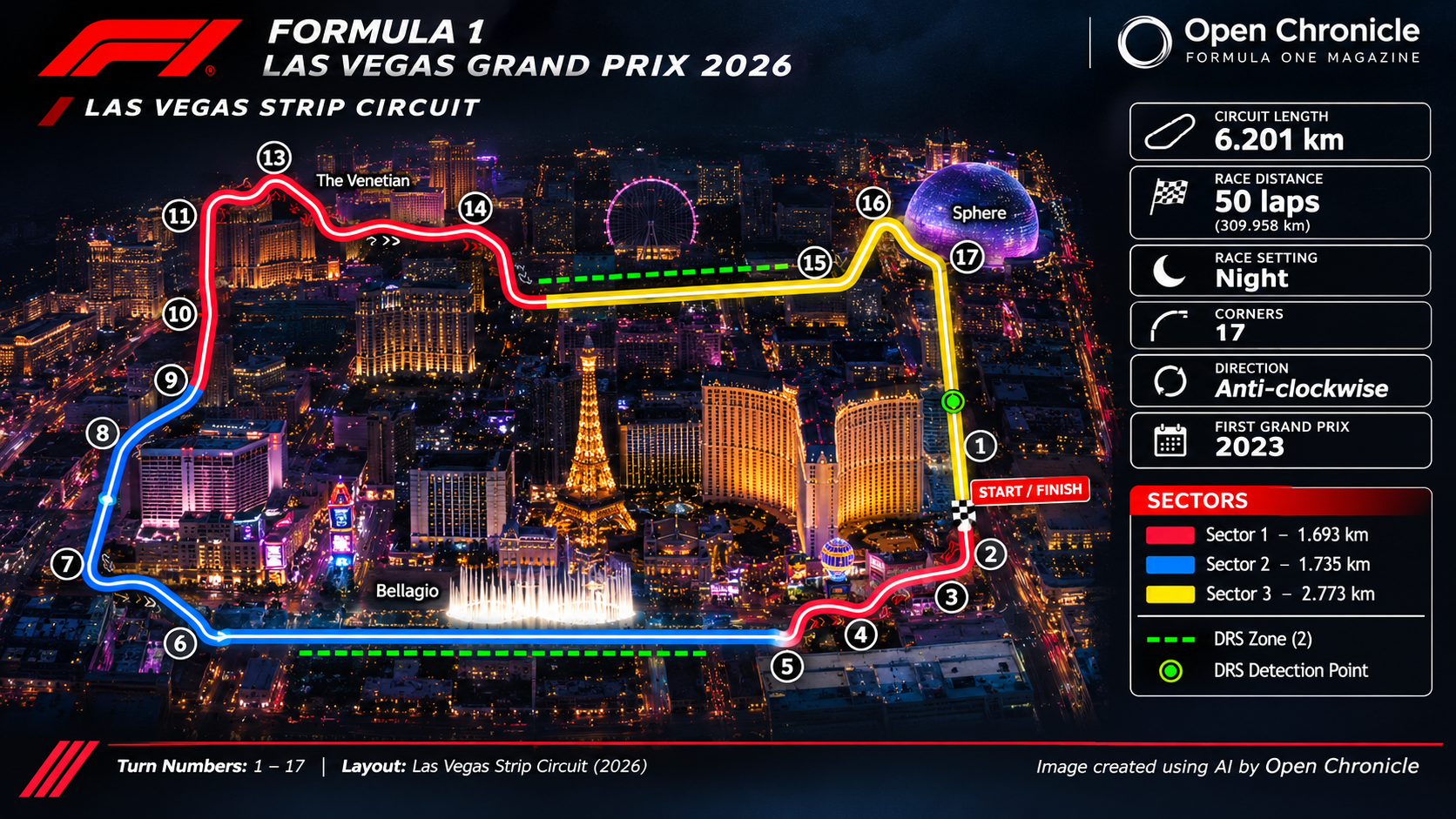
Image created using AI by Open Chronicle
Circuit Sectors
Its long straights place considerable emphasis on aerodynamic efficiency and straight-line speed.
The 2026 generation of Formula One cars adds another dimension through active aerodynamic configurations designed to optimise performance under different conditions.
During qualifying, the benefit of following another car proved particularly significant.
Drivers discovered that a well-timed slipstream could provide a substantial advantage, encouraging them to position themselves carefully before beginning their flying laps.
This created an environment in which track positioning became a tactical contest.
The same conditions that contributed to the Russell and Verstappen confrontation subsequently influenced qualifying strategy.
Red Bull used Isack Hadjar to provide Verstappen with a slipstream, while Mercedes adopted a different approach.
Antonelli eventually secured the fastest qualifying time, but his five-place penalty promoted Verstappen to pole position.
Russell inherited the other front-row position, ensuring that the two drivers involved in the practice controversy would start the race side by side.
A Rivalry with a Difficult History
The confrontation in Las Vegas did not emerge in isolation.
Russell and Verstappen have been involved in several previous disputes, including a particularly heated exchange surrounding the 2024 Qatar Grand Prix.
That controversy followed a qualifying incident and subsequent disagreement over the conduct of both drivers.
The relationship deteriorated further following their collision at the 2025 Spanish Grand Prix.
Russell criticised Verstappen’s behaviour after that encounter, while the Dutchman rejected the British driver’s interpretation.
These earlier episodes help explain why the latest incident attracted so much attention.
Both drivers have demonstrated a willingness to challenge one another publicly.
Their disagreements also reflect contrasting competitive philosophies.
Verstappen is widely recognised for an uncompromising racing style that has contributed to his success at the highest level.
Russell has increasingly positioned himself as a driver prepared to question conduct he considers unacceptable, even when the competitor involved is a multiple world champion.
Neither approach automatically determines responsibility for a particular incident.
That responsibility must be assessed using the evidence and regulations applicable to the specific circumstances.
In Las Vegas, the stewards’ decision to warn Verstappen provides the formal regulatory outcome, while the wider disagreement remains a matter of debate.
Was the FIA’s Response Sufficient?
The central regulatory question is whether a warning provides an adequate response when contact occurs during the preparation phase of a practice session.
There are arguments on both sides.
A warning can be proportionate when an incident causes limited consequences and does not justify a more severe sporting sanction.
It also gives the stewards an opportunity to formally identify unacceptable conduct without unnecessarily altering the competitive order.
However, warnings can raise questions about consistency.
Drivers and teams need to understand when aggressive positioning becomes an infringement and when similar conduct might result in a grid penalty or another sanction.
A consistent interpretation is particularly important on circuits where qualifying preparation creates congestion.
The FIA must balance several objectives: maintaining safety, allowing legitimate competition and avoiding excessive intervention in situations that do not justify substantial penalties.
The Las Vegas decision illustrates how difficult that balance can be.
It also demonstrates why the distinction between formal regulations and informal driver agreements deserves continued attention.
A Front-Row Showdown Adds Another Dimension
The timing of the controversy makes it particularly relevant to Sunday’s race in Europe, which takes place on Saturday evening in Las Vegas.
Verstappen will start from pole position, with Russell alongside him.
Antonelli, despite recording the fastest qualifying lap, will begin sixth following his engine-related grid penalty.
The front-row pairing creates an immediate competitive storyline.
Russell will have an opportunity to challenge Verstappen directly into the opening corners, while the Red Bull driver will attempt to defend his advantage.
Their recent confrontation may increase scrutiny of any close racing between them.
However, it would be speculative to suggest that the practice incident will necessarily influence their decisions during the Grand Prix.
Both drivers understand the importance of avoiding unnecessary contact, particularly when fighting for victory.
The race will provide a more meaningful test of whether the tension remains confined to public statements or becomes part of another on-track battle.
Editorial Analysis: Formula One Needs Clear and Consistent Standards
The Russell and Verstappen dispute raises a question that extends beyond individual personalities.
How should Formula One regulate aggressive behaviour during practice and qualifying when the relevant circumstances are not always addressed by explicit rules?
The answer cannot depend solely on whether contact occurs.
Dangerous positioning can create risks even when drivers avoid a collision.
Equally, not every instance of contact justifies a severe penalty.
The stewards must assess the context, available evidence, degree of responsibility and potential consequences.
In this case, the warning issued to Verstappen established a formal response without changing the starting grid.
Whether that response will influence future behaviour remains uncertain.
What is clear is that the 2026 cars and the characteristics of the Las Vegas circuit have increased the tactical importance of slipstreaming and track positioning.
Those factors make predictable driving standards especially valuable.
The FIA may therefore face growing pressure to clarify expectations surrounding overtaking and positioning before flying laps.
Such clarification could help reduce disagreements and improve consistency without unnecessarily restricting legitimate competition.
Conclusion: The Controversy Is Not Over
The Las Vegas Grand Prix has produced a confrontation that combines personal rivalry, regulatory interpretation and the technical demands of modern Formula One.
Russell believes Verstappen crossed an acceptable boundary.
Verstappen has shown little interest in continuing the public argument.
The FIA examined the incident and issued a warning.
Those three positions define the controversy.
Yet the most compelling development is still to come.
With Verstappen and Russell occupying the front row, the two drivers will have an opportunity to settle their immediate sporting contest on the circuit.
The stewards have delivered their decision.
Now Las Vegas awaits the race.
Sources and Further Reading
Documentation, reporting and references supporting this article.
FIA | Las Vegas Grand Prix 2026, Stewards’ Decision
Official document concerning car number 3 and the Turn 14 incident. The decision is identified in contemporary reporting as resulting in a warning for Verstappen. The PDF itself could not be retrieved directly during preparation.
The Guardian | Russell Lashes Out at Verstappen After Las Vegas GP Clash
21 November 2026. Reporting by Giles Richards on the incident, the drivers’ reactions, the FIA decision and the qualifying implications.
This article distinguishes the reported findings of the FIA stewards from the drivers’ public reactions and Open Chronicle’s independent editorial analysis. The warning and the absence of a grid penalty are reported outcomes. Discussion of driving standards, informal conventions and possible regulatory clarification represents analysis rather than additional FIA findings. The article reflects information available on 21 November 2026, before the Grand Prix.