
OPEN CHRONICLE | WORLD NEWS | MEXICO
The arrest of one of the FBI’s most wanted fugitives marks a significant victory for Mexican security forces, but deadly clashes in Guasave expose the risks of targeting cartel leaders amid an escalating struggle for control of Sinaloa.
By Open Chronicle News Desk | November 21, 2026
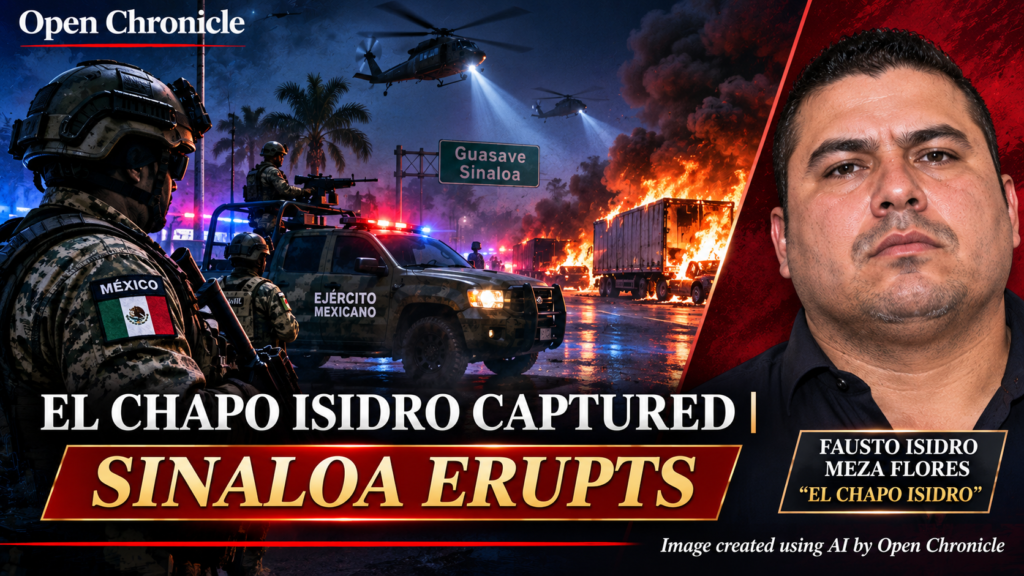
GUASAVE, Mexico. Mexican security forces captured Fausto Isidro Meza Flores, the powerful drug trafficking figure known as “El Chapo Isidro,” following an overnight military operation that triggered intense violence in the northern state of Sinaloa, leaving at least 11 people dead and parts of the city of Guasave devastated by gunfire, burning vehicles and armed roadblocks.
According to information released by Mexican authorities and reported by the Associated Press, seven suspected cartel gunmen and four Mexican soldiers were killed during the confrontation.
Meza Flores, a longtime figure in Mexico’s organized crime networks and one of the FBI’s ten most wanted fugitives, was detained alongside a senior associate after Mexican forces encountered heavy resistance from armed members of his organization.
The operation began on Friday evening, November 20, and continued into the early hours of Saturday as security forces struggled to extract the captured leader from a city where cartel gunmen had established roadblocks using burning vehicles.
His detention represents a significant blow to a criminal organization with longstanding connections to the Beltrán Leyva network and the faction of the Sinaloa Cartel known as Los Mayos.
But the violence that followed also illustrated a persistent dilemma in Mexico’s fight against organized crime: Removing a powerful cartel leader can weaken a criminal organization while simultaneously triggering new struggles for territory, leadership and control.
A military operation that turned Guasave into a conflict zone
The operation unfolded in Guasave, a municipality of approximately 290,000 inhabitants in the agricultural heartland of Sinaloa.
According to residents cited by the Associated Press, intense gunfire began around 7 p.m. Friday as Mexican security forces moved against Meza Flores and his associates.
Military helicopters and surveillance drones appeared above the city while armed confrontations spread across several neighborhoods.
Videos circulating from the area showed civilians fleeing gunfire, vehicles engulfed in flames and helicopters operating over urban areas.
Residents described scenes of panic as families sought shelter inside shops, homes and other buildings.
Local journalist Alma Camacho told the Associated Press that the fighting spread throughout Guasave rather than remaining confined to a single location.
Mexican authorities said the operation relied on surprise and a security perimeter established around the property where Meza Flores was believed to be hiding.
After armed suspects reportedly attacked security personnel with firearms and explosives, Mexican forces entered the property and detained the cartel leader.
The arrest itself was only the beginning of a much larger security challenge.
Armed groups responded by blocking major streets and access routes, setting vehicles on fire and attempting to prevent the authorities from leaving the area.
A federal official cited anonymously by the Associated Press said security forces faced at least ten roadblocks and were unable to complete the extraction until approximately 4 a.m. Saturday.
Meza Flores was subsequently transported to Mexico City to appear before federal prosecutors.
Eleven dead as cartel gunmen confront Mexican forces
GUASAVE OPERATION | REPORTED CASUALTIES
Reported fatalities following the operation against Fausto Isidro Meza Flores in Sinaloa, Mexico.
Suspected Cartel Gunmen
7
Mexican Soldiers
4
Suspected Cartel Gunmen
Mexican Soldiers
EDITORIAL NOTE | REPORTED FIGURES
According to figures attributed to Mexican security authorities on November 21, 2026, the operation and subsequent armed confrontations resulted in 11 reported fatalities, including seven suspected cartel gunmen and four Mexican soldiers. The complete number of wounded people was not established in the initial reporting. These figures remain subject to official confirmation and possible revision.
Figures attributed to Mexico’s security authorities in the supplied Associated Press report, November 21, 2026. The full number of wounded people was not established in the material provided.
The reported deaths underscore the scale of the confrontation and the operational risks faced by Mexican forces.
The authorities did not immediately provide a complete account of injuries or civilian casualties.
The absence of a comprehensive casualty assessment is particularly important because the violence extended beyond the immediate location of the arrest.
Residents reported gunfire in public areas, burning commercial properties and significant disruption to normal life.
The operation therefore had two distinct consequences: the capture of a major criminal figure and a wider outbreak of violence affecting the surrounding civilian population.
Who is ‘El Chapo Isidro’?
Fausto Isidro Meza Flores has been associated with some of Mexico’s most influential drug trafficking networks.
He rose through the ranks of the Beltrán Leyva organization, a criminal network that became deeply involved in the trafficking of cocaine, methamphetamine and other illegal drugs into the United States.
Following changes within that organization, Meza Flores consolidated his own network, known to US authorities as the Meza Flores Transnational Criminal Organization.
The group has been linked to drug trafficking operations, armed enforcement structures and territorial influence in northwestern Mexico.
Meza Flores eventually became one of the FBI’s ten most wanted fugitives.
US authorities offered a reward of up to $5 million for information leading to his arrest.
His capture carries particular significance because of his reported alliance with Los Mayos, a faction of the Sinaloa Cartel that has been involved in a violent internal struggle for control of the state.
The removal of such a figure could affect the balance of power between criminal factions, particularly if his organization provided armed personnel, territorial access or logistical support to allied groups.
However, the detention of a leader does not necessarily mean that the organization he commanded has been dismantled.
Criminal networks can retain financing, weapons, local commanders and operational infrastructure even after senior figures are arrested.
Washington and Mexico City deepen security cooperation
The arrest also carries diplomatic significance.
Mexican authorities acknowledged that intelligence provided through cooperation with the United States contributed to locating and detaining Meza Flores. Reporting by N+ and ABC News corroborates the involvement of Mexican special forces and US intelligence agencies.
Mexican reporting also identified two other detainees: Germán, known as “Serafín,” described as a senior commander, and José, identified as a financial operative. These identities and roles were attributed to Mexican officials.
The operation comes amid sustained pressure from President Donald Trump on Mexico to confront organizations responsible for trafficking illegal drugs into the United States.
For Mexican President Claudia Sheinbaum, cooperation with Washington presents both opportunities and political challenges.
Successful operations against high-profile trafficking figures can demonstrate the effectiveness of bilateral intelligence sharing.
At the same time, Mexico must manage the domestic consequences of operations that can provoke retaliatory violence and endanger civilians.
US Ambassador Ronald Johnson praised the capture as evidence of sustained cooperation between the two countries.
Mexican Security Secretary Omar García Harfuch described the arrest as an important step towards restoring peace in Sinaloa and indicated that security forces would remain deployed to protect residents.
The distinction between intelligence cooperation and direct operational involvement is important. Available reporting establishes US intelligence assistance but does not demonstrate that American forces participated directly in the arrest.
The cartel war already destabilizing Sinaloa
The arrest occurred against the backdrop of a prolonged conflict within the Sinaloa Cartel.
The organization has experienced significant internal fragmentation, with rival factions competing over trafficking routes, territory and the loyalty of armed groups.
Two principal factions, commonly identified as Los Mayos and Los Chapitos, have been involved in an increasingly violent struggle.
Meza Flores was regarded as an important ally of Los Mayos.
His detention could therefore alter the balance between competing groups, particularly in northern Sinaloa, where his organization reportedly maintained substantial influence.
However, the effects remain uncertain.
The arrest might weaken the faction’s operational capacity, create opportunities for rival groups or prompt surviving commanders to consolidate their positions.
The outcome will depend on factors that are not yet publicly established, including the organization’s remaining leadership, financial resources and relationships with other criminal networks.
The limits of Mexico’s kingpin strategy
Mexico has repeatedly targeted prominent criminal leaders in the belief that removing senior figures can disrupt trafficking operations and weaken organized crime.
This approach, often described as the kingpin strategy, has produced major arrests and military successes.
Yet its longer-term effectiveness remains contested.
Mexican security analyst David Saucedo, cited by the Associated Press, warned that capturing senior commanders does not automatically dismantle the networks beneath them.
A trafficking organization may continue operating through subordinate leaders, armed personnel, financial intermediaries and established criminal relationships.
In some circumstances, the removal of a dominant figure can produce fragmentation rather than stability.
Rival commanders may compete to inherit territory, resources and influence.
The result can be additional violence even after a successful arrest.
This risk is especially relevant in Sinaloa, where criminal factions are already engaged in a struggle for territorial control.
The central security question is whether Mexican authorities can translate the capture of Meza Flores into the sustained dismantling of his organization’s operational and financial infrastructure.
Without that broader effort, the arrest may change the leadership of the criminal network without ending its activities.
Strategic assessment: Three possible consequences
Sinaloa After El Chapo Isidro: Three Possible Scenarios
Potential security consequences following the capture of Fausto Isidro Meza Flores.
Disruption of the Meza Flores Network
Mexican authorities use information obtained through the arrests to identify financial structures, weapons networks and remaining commanders.
STRATEGIC IMPLICATION
Potential weakening of organized crime capabilities beyond the removal of individual leaders.
Retaliation and Territorial Competition
Surviving members of the organization retaliate or compete for leadership, while rival factions attempt to expand their influence.
STRATEGIC IMPLICATION
Greater insecurity in Sinaloa and additional risks for civilians.
Expanded Bilateral Security Operations
Mexico and the United States deepen intelligence cooperation and pursue additional senior figures and criminal infrastructure.
STRATEGIC IMPLICATION
Increased pressure on trafficking organizations, alongside continuing concerns about retaliation and civilian protection.
EDITORIAL METHODOLOGY
These scenarios represent analytical possibilities, not forecasts. No probability ranking is assigned.
Guasave faces the aftermath of the operation
For residents of Guasave, the immediate priority is not the geopolitical significance of the arrest but the restoration of security.
Burned trucks, damaged businesses and disrupted roads remained visible after the confrontation.
Firefighters were reportedly unable to respond to several incidents during the height of the violence because of the danger posed by continuing gunfire.
Residents described fear and uncertainty even after the most intense fighting subsided.
The authorities’ ability to restore normal life will be an important measure of the operation’s immediate consequences.
Securing the city, reopening transport routes and protecting commercial activity will be essential to preventing further disruption.
Equally important will be establishing the full civilian impact of the clashes and determining whether additional casualties occurred.
The Bottom Line
The capture of Fausto Isidro Meza Flores is one of Mexico’s most significant operations against organized crime in 2026.
It removes a high-profile trafficking figure wanted by US authorities, demonstrates the operational value of bilateral intelligence cooperation and places additional pressure on criminal networks operating in Sinaloa.
But the deadly violence in Guasave also illustrates the limitations of measuring security progress solely through arrests.
The removal of a cartel leader can represent an important tactical achievement without necessarily producing lasting stability.
For Mexico, the more difficult challenge begins after the arrest: preventing retaliation, dismantling the remaining criminal infrastructure and protecting communities that have endured years of insecurity.
The success of the operation will ultimately be measured not only by the capture of El Chapo Isidro, but by whether Sinaloa becomes safer in the months that follow.
Sources and Further Reading
Selected international reporting and official institutional information supporting this article.
Eleven Killed Following Cartel Leader’s Capture
November 21, 2026
Principal reporting on the operation, fatalities, civilian experiences and warnings from security analysts.
Fausto Isidro Meza Flores Added to Ten Most Wanted List
February 4, 2025
Official background on the criminal allegations, federal indictment and reward.
Narcotics Rewards Program
Official Background Information
Details concerning Meza Flores, his alleged organization and the historical reward offer.
Capture of El Chapo Isidro Triggers Chaos in Guasave
November 21, 2026
Mexican reporting on the security operation, armed confrontations, vehicle fires and roadblocks.
Inside the Operation to Capture El Chapo Isidro
November 21, 2026
Reporting on Mexican special forces and intelligence coordination with US agencies.
Authorities Report Attacks Against Federal Agents in Sinaloa
November 21, 2026
Reporting on the initial security alerts and instructions for civilians to remain sheltered.
Editorial Transparency
This article was prepared by Open Chronicle News Desk using reporting supplied for editorial review, supplemented by the Associated Press, La Jornada, N+, EFE and official information from the Federal Bureau of Investigation and the US Department of State. Casualty figures are attributed to Mexican authorities and may be revised as further information becomes available. Criminal allegations against Meza Flores are presented as allegations unless established by judicial proceedings. The discussion of cartel fragmentation, bilateral security cooperation and possible consequences for Sinaloa represents independent editorial analysis. The three strategic scenarios are illustrative possibilities rather than forecasts. Information reflects reporting available on November 21, 2026.