
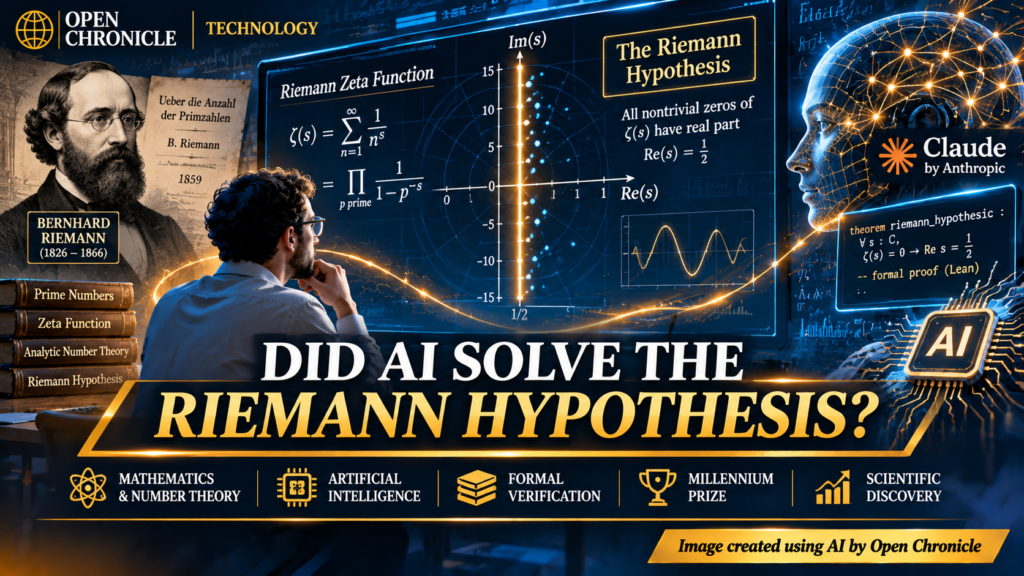
An extraordinary claim involving artificial intelligence and one of mathematics’ most famous unsolved problems is raising questions about the future of scientific discovery. But a convincing mathematical argument is not the same as an independently verified proof.
By Open Chronicle Technology
November 21, 2026 | Artificial Intelligence & Mathematical Research
For more than a century and a half, the Riemann hypothesis has stood as one of the most formidable challenges in mathematics.
First proposed in 1859 by German mathematician Bernhard Riemann, the hypothesis concerns the hidden mathematical structure governing the distribution of prime numbers.
Now, reports of a researcher associated with Anthropic claiming an artificial intelligence-assisted breakthrough have brought the problem into the spotlight.
The possibility is extraordinary.
If a correct proof has genuinely been found, it would represent one of the most important mathematical achievements of modern times.
If artificial intelligence played a substantial role in producing that proof, the implications could extend far beyond number theory.
It would raise fundamental questions about the relationship between human reasoning, machine intelligence and the process of scientific discovery.
But there is a crucial distinction.
A claim that a proof has been found is not evidence that the problem has been solved.
Before mathematics can recognise such a breakthrough, the argument must withstand detailed examination by independent experts.
That process, rather than the excitement surrounding the announcement, will determine whether this is a historic scientific discovery or another unsuccessful attempt to resolve an exceptionally difficult problem.
The mathematician behind the claim
The researcher at the centre of the story is Levent Alpöge.
On November 20, Alpöge published a four-page note stating that he believed he and Anthropic’s Claude AI system had discovered a proof of the Riemann hypothesis.
He also suggested that the method could extend to the Generalized Riemann Hypothesis, a broader family of mathematical conjectures.
Rather than releasing a conventional mathematical paper containing a readable proof, Alpöge made available a large collection of computer-formalised mathematical arguments.
According to Associated Press reporting, the material includes approximately 17 million lines of Lean code, while the underlying work generated more than 250,000 pages of material.
These figures illustrate the extraordinary scale of the project, but they do not establish the validity of its conclusions.
The announcement has attracted attention partly because Alpöge is a professional mathematician, rather than an anonymous internet commentator making an unsupported claim.
That distinction gives the work scientific relevance.
It does not exempt the proposed proof from scrutiny.
What exactly is the Riemann hypothesis?
To understand why the announcement matters, it is necessary to understand the problem itself.
Prime numbers are whole numbers greater than one that cannot be divided evenly by any positive integers other than one and themselves.
Examples include 2, 3, 5, 7, 11 and 13.
Although their definition is simple, the distribution of prime numbers becomes increasingly complicated as numbers grow larger.
Mathematicians have developed powerful methods for estimating how frequently prime numbers occur.
But important questions remain about the precise fluctuations in their distribution.
In 1859, Bernhard Riemann connected this problem to the behaviour of a mathematical object known as the Riemann zeta function.
The hypothesis concerns the locations of certain zeros of that function in the complex number plane.
In mathematical terms, it states that every nontrivial zero of the Riemann zeta function has a real part equal to one-half.
That statement may appear abstract.
Its consequences are not.
A proof would provide exceptionally precise information about the distribution of prime numbers and confirm numerous results that currently depend on the hypothesis being true.
The Clay Mathematics Institute identifies it as one of the seven Millennium Prize Problems, each associated with a $1 million award.
The Riemann Hypothesis | Key Facts
Official status checked against the Clay Mathematics Institute on November 21, 2026.
Why the Lean proof matters
One of the most unusual aspects of the announcement is the use of Lean, a formal proof assistant.
Traditional mathematical proofs are written in language and notation intended for human mathematicians.
They are then examined by other researchers, who evaluate whether each step follows logically from the assumptions.
Lean provides a different form of verification.
Mathematical statements and arguments are expressed in a formal language that a computer can check against precise logical rules.
If the proof is correctly represented and the software’s trusted foundations are sound, a proof assistant can identify logical inconsistencies that might be difficult for human readers to detect in an enormous argument.
This makes formal verification particularly attractive for complex mathematical work.
However, several important questions remain.
First, researchers must establish that the formalised theorem corresponds exactly to the mathematical statement being claimed.
Second, the proof must not depend on hidden assumptions that undermine the result.
Third, independent verification must establish that the files and software behave as reported.
Finally, mathematicians must determine whether the argument provides a meaningful and understandable explanation of why the theorem is true.
Early independent technical checks of Alpöge’s Lean material have reportedly produced encouraging results.
But the mathematical interpretation remains under examination, and technical acceptance of code does not automatically settle every question about the claimed result.
A new relationship between mathematicians and artificial intelligence
If the proposed proof survives scrutiny, the role played by Claude could become as significant as the mathematical result itself.
AI systems have already demonstrated growing abilities in programming, mathematical reasoning and scientific research.
They can help researchers explore alternative approaches, identify patterns and test possible arguments.
But there is a difference between assisting a mathematician and producing genuinely new mathematical knowledge.
The Alpöge announcement raises the possibility that AI could contribute substantially to the discovery of arguments beyond what researchers have previously been able to construct.
That possibility would challenge traditional assumptions about the division of intellectual labour.
Human mathematicians might increasingly define research problems, evaluate promising directions and interpret results, while AI systems generate or formalise large portions of the technical reasoning.
Yet the human role would remain essential.
A mathematical discovery must be correctly formulated, its assumptions understood and its significance explained.
Even a completely valid machine-generated proof could be difficult for mathematicians to interpret.
That creates a new scientific challenge: determining not only whether an argument is correct, but also what it teaches us.
Why a computer-checked proof may still be disputed
The phrase computer-verified proof can suggest that the question has already been settled.
In practice, verification has several layers.
A program can confirm that a sequence of formal statements follows from a specified collection of axioms and definitions.
But researchers must also confirm that those definitions represent the intended mathematical objects.
A technically valid proof of a weaker or differently formulated statement would not establish the original hypothesis.
Likewise, a formal system could accept an argument containing an assumption that effectively presupposes the desired conclusion.
These concerns do not establish that Alpöge’s proposed proof is wrong.
They explain why independent scrutiny remains necessary.
The mathematical community must examine both the formal verification and the substance of the underlying argument.
A proposed solution to a problem of this importance is unlikely to receive universal acceptance immediately.
Indeed, the Clay Mathematics Institute requires a proposed solution to be published in a qualifying outlet, followed by at least two years of consideration and general acceptance within the global mathematical community before the institute will consider awarding a prize.
What would a confirmed proof change?
The most immediate consequences would be mathematical.
Thousands of papers and results in number theory involve statements that assume the Riemann hypothesis.
A confirmed proof would turn many conditional results into unconditional ones.
It could also provide new techniques applicable to other problems.
However, it would be misleading to suggest that proving the hypothesis would immediately break modern encryption or transform every digital security system.
Prime numbers are important in cryptography, but the practical security of modern cryptographic algorithms does not simply depend on the Riemann hypothesis remaining unsolved.
The wider impact would depend on the mathematical techniques used in the proof and whether they lead to new algorithms or discoveries.
There is also a possibility that the greatest long-term impact would come from the research process itself.
If artificial intelligence helped discover a correct proof of this complexity, researchers in physics, chemistry, computer science and other fields would have a powerful reason to investigate similar approaches.
The achievement could become a landmark in the development of AI-assisted science.
But such consequences remain conditional on verification.
The credibility challenge facing AI research
The announcement arrives at a time when artificial intelligence companies are competing to demonstrate increasingly sophisticated reasoning capabilities.
Scientific discoveries offer a particularly compelling way to show progress.
Unlike many demonstrations of AI performance, a mathematical proof can, in principle, be evaluated against strict logical standards.
That makes mathematics an important testing ground for claims about advanced machine reasoning.
It also creates incentives for premature announcements.
A spectacular claim can attract worldwide attention long before independent researchers have completed their assessment.
For AI companies, this creates a reputational risk.
If a claimed discovery proves incorrect, the resulting disappointment can undermine confidence in other legitimate achievements.
If the proof is correct, however, the achievement could demonstrate capabilities that go far beyond conventional chatbot applications.
The appropriate response is therefore neither automatic enthusiasm nor reflexive dismissal.
It is rigorous examination.
Why It Matters
The reported Riemann hypothesis breakthrough sits at the intersection of three major developments.
The first is the accelerating improvement of artificial intelligence systems.
The second is the increasing use of formal verification in advanced mathematics.
The third is the possibility that scientific discovery itself is entering a new technological phase.
If Alpöge’s claim is confirmed, it could become an important milestone in all three areas.
If the proof fails, the investigation may still reveal useful information about the strengths and limitations of AI-assisted reasoning.
Either outcome could advance understanding of how artificial intelligence should be used in research.
The central question is not simply whether a machine can produce an impressive mathematical argument.
It is whether humans can establish that the argument is correct, understand its significance and build upon it.
The Bigger Picture | When machines become research partners
For decades, artificial intelligence was primarily associated with automation, classification and the processing of large quantities of information.
More recently, AI systems have begun performing tasks requiring complex reasoning, coding and multi-stage problem-solving.
The possibility of AI contributing to a proof of the Riemann hypothesis suggests a further transition.
Machines may increasingly become active participants in the creation of scientific knowledge.
That prospect raises questions extending beyond mathematics.
Who deserves credit for a discovery produced through close collaboration between a researcher and an AI system?
How should scientific journals evaluate extremely large machine-generated proofs?
What happens when a proof can be verified computationally but cannot easily be understood by human specialists?
And how should the scientific community distinguish genuine discoveries from sophisticated but ultimately incorrect machine-generated arguments?
These questions will become more important as AI systems develop.
The Riemann hypothesis claim offers an unusually clear example because the standard for success is exceptionally demanding.
Either the proposed argument proves the mathematical statement, or it does not.
For now, that question remains open.
The excitement is understandable. The verdict belongs to mathematics.
What to Watch Next
AI & MATHEMATICS | DEVELOPING SITUATION
Independent verification: Whether mathematicians and formal methods specialists can reproduce and validate the complete Lean proof.
Mathematical scrutiny: Whether the formalised statements precisely establish the Riemann hypothesis without unacceptable assumptions or definitional gaps.
A readable mathematical paper: Whether Alpöge publishes a conventional explanation that specialists can independently understand and evaluate.
Anthropic’s response: Whether the company provides further details about Claude’s role, the research process and the verification methodology.
Official recognition: Whether the Clay Mathematics Institute eventually changes the problem’s status, following the required publication and acceptance process.
Status as of November 21, 2026. The reported proof has not been accepted as a settled solution.
Sources and Further Reading
Reporting, scientific analysis and official mathematical documentation concerning the reported AI-assisted proof of the Riemann hypothesis and the process required for independent verification.
Associated Press | Anthropic Worker Claims to Have Solved a Holy Grail of Math Problems With the Help of AI
Reporting on Alpöge’s announcement, the scale of the Lean formalisation, early expert reactions and the verification process.
Agence France-Presse | Anthropic Researcher Says Claude Solved Math’s Greatest Riddle
Independent reporting on the announcement and the absence of completed external review.
Clay Mathematics Institute | Riemann Hypothesis
Official mathematical description and status of the Millennium Prize Problem.
Clay Mathematics Institute | Rules for the Millennium Prize Problems
Official requirements governing publication, mathematical acceptance and prize consideration.
Le Monde | The Likely Solution to the Riemann Hypothesis by AI Marks a Turning Point for Mathematics
Scientific analysis of the potential breakthrough, formal verification and the difficulty of understanding machine-generated proofs.
The reported AI-assisted proof of the Riemann hypothesis remains subject to independent mathematical scrutiny. The publication of a proposed proof or its formalisation in a computer-assisted proof system does not, by itself, establish that the mathematical problem has been conclusively solved. Scientific acceptance requires verification of the underlying argument, its assumptions and the precise theorem demonstrated.
Editorial Transparency
This article was prepared by Open Chronicle Technology using reporting from Associated Press, Agence France-Presse and Le Monde, together with official documentation from the Clay Mathematics Institute. The article distinguishes Levent Alpöge’s claim of an AI-assisted proof from an independently validated mathematical result. The reported Lean formalisation, computational checks and research process are attributed to their respective sources and are not presented as conclusive evidence that the Riemann hypothesis has been solved. Discussion of artificial intelligence, mathematical verification, scientific discovery and the future relationship between human researchers and AI systems represents independent editorial analysis. Information reflects developments available through November 21, 2026, and may change as specialists examine the proposed proof.