
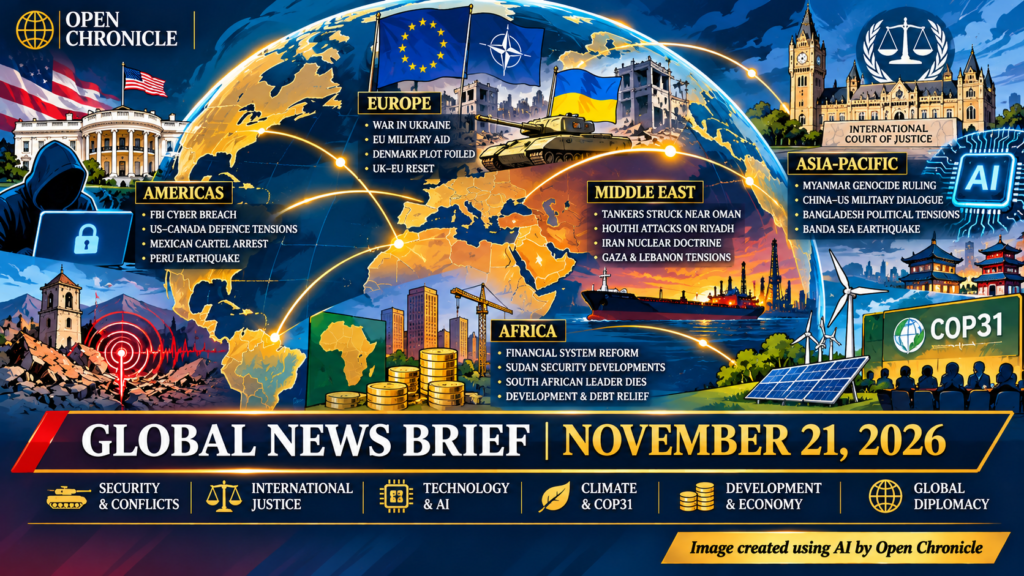
OPEN CHRONICLE NEWS DESK | GLOBAL NEWS BRIEF | NOVEMBER 21, 2026
From escalating maritime insecurity in the Strait of Hormuz and renewed attacks in Ukraine to international legal disputes, artificial intelligence breakthroughs and stalled climate negotiations, today’s global developments reveal a world confronting overlapping security, economic, technological and humanitarian challenges.
By Open Chronicle News Desk
GLOBAL DESK, November 21, 2026. International developments on Saturday highlight the growing connections between regional conflicts, strategic competition, technological change and economic instability.
The Middle East remains a major focus after reports that two oil tankers were struck near Oman, while Saudi Arabia reported intercepting missiles launched from Yemen. Iran’s nuclear doctrine has also returned to the diplomatic agenda.
In Europe, Russia’s war against Ukraine continues to generate military and political consequences, with reports of new strikes, expanded European defence assistance and an alleged Russian assassination plot in Denmark.
Across Asia, Myanmar faces renewed scrutiny over the Rohingya genocide case, while significant earthquakes have been reported in Indonesia’s Banda Sea and central Peru.
In technology, reports of a possible security breach affecting the FBI and claims of an artificial intelligence-assisted mathematical breakthrough raise very different questions about the accelerating influence of advanced digital systems.
Meanwhile, COP31 negotiations face difficult disagreements over fossil fuels, and African leaders are pressing for reforms to the international financial system.
The following regional and thematic briefing consolidates the principal developments reported on November 21, distinguishing official claims, preliminary reports and unresolved allegations from established outcomes.
Global Overview | The Main Developments
Middle East
Tankers reportedly struck near Oman, renewed Houthi attacks and questions over Iran’s nuclear policy.
Europe
Ukraine strikes, European defence measures, Baltic security tensions and the British reset with Brussels.
Asia-Pacific
Myanmar’s international legal dispute, regional security developments and a Banda Sea earthquake.
Americas
FBI cybersecurity concerns, US–Canada defence tensions, a major Mexican arrest and a Peruvian earthquake.
Africa
Calls for financial reform, Sudanese security developments and the death of a prominent South African leader.
Technology & Climate
AI-assisted mathematical research, autonomous weapons regulation and deadlocked COP31 negotiations.
Editorial selection based on the November 21 news monitoring material. Several developments remain subject to independent confirmation or further official information.
1. Middle East | Maritime Security, Iran and Regional Escalation
Two tankers reportedly struck near Oman
Maritime security returned to the centre of international attention following reports that two oil tankers were struck by unidentified projectiles near the Strait of Hormuz.
The incidents were reported close to Oman’s Musandam Peninsula, near Khasab, in one of the world’s most strategically important maritime corridors.
The United Kingdom Maritime Trade Operations agency, UKMTO, was cited in reports concerning the attacks.
The identity of those responsible and the precise nature of the projectiles had not been established in the supplied initial reporting.
Some accounts referred to possible naval mines, while others described unidentified projectiles. These explanations should not be treated as equivalent or confirmed.
The incidents raise concerns about the safety of commercial shipping and the potential consequences for global energy markets.
The Strait of Hormuz is a critical passage for oil and liquefied natural gas exports from the Gulf.
A sustained increase in attacks could affect shipping insurance, freight costs and international energy prices.
Strategic significance: Maritime security incidents can rapidly become global economic problems when they affect major energy transportation routes.
Saudi Arabia reports intercepting Houthi missiles
Saudi Arabia and the Saudi-led coalition reported intercepting three ballistic missiles directed toward Riyadh, while separate reporting described a Houthi drone threat.
The reported attacks followed renewed military tensions involving Yemen’s Houthi movement.
The developments illustrate the continuing danger of regional escalation.
Missile and drone attacks against major urban centres create immediate security risks while increasing pressure on air defence systems.
They also threaten to expand the economic consequences of the conflict through disruption to aviation, trade and infrastructure.
The United Nations has separately warned that attacks affecting Yemen’s Port of Hudaydah could threaten essential humanitarian supplies.
What to watch: Further missile launches, Saudi military responses, maritime incidents and the security of humanitarian access to Yemen.
Iran’s nuclear doctrine returns to the diplomatic agenda
Iran’s foreign minister has reportedly suggested that there is strong logic behind reconsidering the country’s nuclear doctrine.
The remarks come amid continuing military and diplomatic pressure on Tehran.
A debate over nuclear doctrine does not, by itself, establish that Iran has formally changed its policy or decided to develop a nuclear weapon.
Nevertheless, such statements carry significant strategic implications.
Iran’s nuclear programme remains central to relations with the United States, Israel, European governments and international nuclear monitoring institutions.
The United States has also announced new sanctions targeting individuals accused of managing or recovering proceeds from Iranian oil sales.
The combination of economic sanctions, military pressure and nuclear uncertainty increases the importance of diplomatic communication.
Strategic significance: Any verified change in Iran’s nuclear policy would affect regional deterrence calculations and the wider international non-proliferation framework.
Gaza and Lebanon remain under humanitarian pressure
Reports from Gaza describe further casualties following Israeli military activity, including incidents involving Palestinians wounded by gunfire.
Separate accounts describe deteriorating conditions for displaced families, with flooding affecting temporary shelters.
In southern Lebanon, renewed Israeli military operations have been reported, while the United Nations Interim Force in Lebanon has highlighted the continuing impact of conflict on civilians.
These developments underline the difficulty of translating ceasefire arrangements or diplomatic commitments into sustained civilian protection.
Casualty figures from individual incidents require continuing verification as additional information becomes available.
2. Europe | Ukraine, Russia and a Changing Security Environment
Russian strikes continue across Ukraine
Ukraine reported further Russian attacks affecting several regions, including Kryvyi Rih, Kyiv, Kharkiv and Zaporizhzhia.
Initial accounts described civilian casualties, injuries and damage to residential buildings, industrial facilities and other infrastructure.
In Kryvyi Rih, reports identified an emergency medical worker and a young child among those killed in an attack.
The continuing strikes highlight the pressure facing Ukrainian cities and infrastructure as winter approaches.
Damage to energy facilities, transport links and residential areas can compound humanitarian difficulties even when military operations are concentrated elsewhere.
Ukraine has also continued long-range operations against Russian infrastructure.
Reports describe drone attacks affecting the Baltic port of Ust-Luga and a Russian cargo vessel in the Gulf of Finland.
The full extent of the damage and the operational consequences remain subject to further confirmation.
Crimea’s Kerch Bridge becomes a renewed focus
Ukrainian President Volodymyr Zelenskyy has warned that the Kerch Bridge linking Russia with occupied Crimea will not remain operational indefinitely.
Ukrainian reporting claims that recent attacks have seriously damaged parts of the crossing.
The bridge is important because it connects the Russian mainland with Crimea and has been used for civilian and military logistics.
Its condition therefore has implications for Russia’s ability to sustain operations in the occupied peninsula and southern Ukraine.
However, assessments of the bridge’s structural condition and the time required for repairs should be treated cautiously until supported by reliable technical evidence.
Europe expands military assistance and air defence preparations
European governments continue to strengthen support for Ukraine.
Reports indicate that the European Union has allocated an additional €1 billion in military assistance, while Norway has announced substantial investment in air defence.
The Netherlands has also joined a growing group of European countries procuring or operating the Patria 6×6 armoured personnel carrier.
The programme reflects wider efforts to standardise equipment, increase production capacity and improve interoperability among European forces.
In Britain, BAE Systems has opened a fully automated ammunition production facility, highlighting the growing importance of industrial capacity in European defence planning.
Together, these developments demonstrate that the war in Ukraine is influencing procurement decisions well beyond the immediate battlefield.
Denmark reports foiling an alleged Russian assassination plot
Danish authorities have reportedly disrupted a plot to assassinate a Ukrainian-American rapper.
The allegations have prompted a diplomatic response, including reports that Denmark expelled a Russian defence representative.
European officials have expressed concern about the incident, which they view in the context of wider Russian hostile activities.
The allegations are serious but require careful distinction between the statements of investigating authorities and findings established through judicial proceedings.
If substantiated, the case would reinforce concerns about the vulnerability of political opponents, dissidents and prominent Ukrainians living in European countries.
Britain and the EU pursue a post-Brexit reset
The United Kingdom and European Union have announced political agreements covering food and drink trade, emissions trading and youth mobility.
British Prime Minister Andy Burnham has described the outcome as an important step toward closer cooperation.
However, the arrangements face uncertainty over the treatment of European students attending British universities.
The dispute illustrates the continuing tension between Britain’s desire for improved access to European markets and its position outside the EU’s decision-making institutions.
The next phase will depend on legislation, supplementary negotiations and the final conditions for implementation.
3. Asia-Pacific | International Justice, Strategic Competition and Natural Disasters
Myanmar rejects international ruling on the Rohingya genocide
Myanmar has reportedly rejected an international court ruling concerning its responsibility for the treatment of the Rohingya population, describing the decision as unfair.
The development places renewed attention on one of Asia’s most serious human rights crises.
Hundreds of thousands of Rohingya fled Myanmar during military operations in Rakhine State in 2017, with many seeking refuge in neighbouring Bangladesh.
The proceedings before the International Court of Justice concern Myanmar’s obligations under the Genocide Convention.
It is important to distinguish the court’s assessment of state responsibility from individual criminal responsibility, which is addressed through different legal mechanisms.
The significance of the reported ruling extends beyond Myanmar.
International legal proceedings involving allegations of genocide can influence how states interpret their obligations to prevent atrocities, protect vulnerable populations and respond to mass violence.
The precise legal findings, operative provisions and Myanmar’s formal response should be checked against the court’s published judgment before further conclusions are drawn.
Why it matters: International judicial decisions may establish legal responsibilities, but meaningful protection for affected communities depends on compliance, international action and conditions on the ground.
China and the United States resume military dialogue
Chinese and American military representatives have reportedly concluded working group meetings in Shanghai.
The discussions follow high-level diplomatic contacts involving Presidents Donald Trump and Xi Jinping.
Military communication between the two countries is particularly important because of their competing interests in the Taiwan Strait, South China Sea and wider Pacific.
Direct communication can reduce the risk of miscalculation during encounters involving aircraft, naval vessels and other military assets.
Reports also suggest that Washington and Beijing discussed the importance of maintaining human involvement in decisions concerning military artificial intelligence.
However, a political expression of support for human control should not be confused with a binding international agreement governing autonomous weapons.
The broader relationship remains shaped by competition over semiconductors, advanced computing, military technology and regional influence.
Bangladesh faces renewed political tensions
Reports from Bangladesh describe attacks on properties associated with the Awami League amid tensions surrounding the possible return of former Prime Minister Sheikh Hasina.
Several accounts describe houses and political properties being set on fire.
The developments reflect continuing divisions over political legitimacy, accountability and the country’s future institutional direction.
Political violence could complicate efforts to restore stability and public confidence.
The immediate priorities include protecting civilians, investigating reported attacks and preventing retaliation.
Earthquake strikes the Banda Sea near Timor-Leste
German geoscience monitoring was cited in reports of a magnitude 6.8 earthquake in the Banda Sea region near Timor-Leste.
The area lies within a complex tectonic zone where interactions between major geological plates generate frequent seismic activity.
The immediate consequences of the earthquake, including potential damage, casualties and tsunami-related risks, require confirmation through official geological and emergency management authorities.
A reported earthquake magnitude does not, on its own, establish the scale of damage.
The depth, distance from populated areas, local geology and construction standards all influence the effects experienced on land.
India reports deaths from suspected contaminated alcohol
Authorities in India’s northeastern state of Manipur are investigating a suspected contaminated alcohol incident.
Initial reports describe at least 11 deaths and more than 180 people affected, with some accounts reporting 12 fatalities.
The differing figures may reflect updates issued at different stages of the response.
The incident highlights the public health dangers associated with illicit alcohol production and distribution.
Investigators will need to establish the source of the contaminated products, identify the substances involved and determine how the alcohol reached consumers.
4. Americas | Cybersecurity, Defence Relations and Organised Crime
FBI investigates suspected breach of criminal information database
The Federal Bureau of Investigation is reportedly investigating a suspected cybersecurity breach affecting its criminal information systems.
Several news reports identify the National Crime Information Center, NCIC, as a possible target.
The database supports law enforcement operations by providing access to information relevant to criminal investigations and public safety.
A successful intrusion could create serious concerns about data confidentiality, system integrity and the security of sensitive records.
However, the existence of an investigation does not establish that attackers obtained unrestricted access to the database or successfully extracted information.
The nature of the suspected intrusion, its scope and any confirmed data exposure remain important unresolved questions.
Separate reporting also describes cyber incidents affecting the United States Department of Agriculture.
Why it matters: Security breaches involving government information systems can affect operational confidence even before the full technical consequences are known.
Washington reportedly restricts defence cooperation with Canada
Reports indicate that US Defence Secretary Pete Hegseth has introduced new restrictions affecting military cooperation between the United States and Canada.
The measures come at a time of broader political and economic tensions between Washington and Ottawa.
The two countries maintain extensive defence cooperation through NATO, NORAD and bilateral military arrangements.
Any significant restriction on information sharing, operational coordination or defence planning could therefore have consequences beyond their bilateral relationship.
The precise scope of the reported measures requires confirmation through official statements and defence documentation.
The development is particularly relevant as Canada seeks to diversify its international economic partnerships while preserving its longstanding security relationship with the United States.
Mexico captures a wanted organised crime figure
Mexican authorities have reportedly captured a prominent suspected drug trafficking figure known as El Chapo Isidro during a military operation.
The suspect has been associated with major organised crime investigations and has appeared on American law enforcement wanted lists.
The arrest, if confirmed through official documentation, would represent an important development in cooperation against transnational organised crime.
However, the detention of a major suspect does not necessarily dismantle the criminal networks associated with that individual.
Such organisations may retain financial resources, trafficking routes and operational structures after leadership arrests.
The next developments will include criminal proceedings, possible extradition questions and the response of competing criminal groups.
Central Peru struck by a powerful earthquake
A strong earthquake struck central Peru, with initial magnitude estimates ranging from 6.7 to 6.9.
The affected region was identified in reports as Junín, in the Peruvian Andes.
Some accounts described residents leaving buildings, including in Lima, while early reports did not establish widespread damage or casualties.
Differences between preliminary magnitude estimates are common and can result from revisions by seismic monitoring agencies.
Authorities will need to assess the condition of buildings, transport routes and essential infrastructure.
The event highlights Peru’s exposure to seismic hazards associated with the tectonic processes along western South America.
Haiti seeks cooperation with El Salvador on prison infrastructure
Haiti has reportedly reached an agreement with El Salvador concerning the development of new prison facilities.
The initiative follows diplomatic engagement between officials from the two countries.
Haiti continues to face severe security challenges linked to armed gangs, weak institutional capacity and pressure on its justice system.
Expanded detention capacity could form part of a broader security strategy.
Nevertheless, prison construction alone cannot resolve problems involving criminal investigations, judicial delays, corruption and the protection of detainees’ rights.
The agreement’s implementation, financing and oversight arrangements will be important issues to monitor.
5. Africa | Debt, Security and Political Change
Egypt calls for reform of the international financial system
Egyptian President Abdel Fattah el-Sisi has presented three proposals intended to reform the international financial system and reduce the debt burden facing African countries.
The reported initiative reflects growing concern over the financial pressures affecting governments across the continent.
High borrowing costs, debt servicing obligations and limited access to affordable financing can restrict public investment in healthcare, education, infrastructure and climate resilience.
Many African economies face additional pressure from currency volatility, commodity price movements and external economic shocks.
Reform proposals in this area frequently involve greater access to concessional finance, more effective debt restructuring and changes to the governance of international financial institutions.
The precise content of Sisi’s three proposals should be checked against the original presidential statement before they are presented as specific policy commitments.
Strategic significance: Debt sustainability increasingly influences African governments’ capacity to invest in development and respond to climate-related emergencies.
Sudan’s Blue Nile region faces renewed instability
Reports describe continuing security operations and territorial disputes in Sudan’s Blue Nile State.
One account indicates that the Tasis Alliance has taken control of the strategically important Bau district, while Sudanese authorities have said the army is working to restore security.
The competing claims require independent confirmation.
Sudan’s prolonged conflict has weakened state institutions, displaced large populations and disrupted essential services.
Further fighting in Blue Nile could create additional risks for civilians and complicate humanitarian operations.
The situation also has regional implications because instability in Sudan affects neighbouring countries through displacement, trade disruption and border security pressures.
South Africa mourns Phumzile Mlambo-Ngcuka
Phumzile Mlambo-Ngcuka, a former South African deputy president and former executive director of UN Women, has reportedly died at the age of 71.
Mlambo-Ngcuka was a prominent figure in South African politics and international advocacy for women’s rights.
She served as South Africa’s first woman deputy president and later led UN Women, where her work focused on gender equality, women’s empowerment and international development.
Her reported death marks the loss of an influential voice in African politics and global gender equality advocacy.
Official family or institutional confirmation should be used when preparing a separate obituary.
South Africa faces renewed electoral competition
The African National Congress is reportedly confronting intensified political competition in major urban centres following electoral setbacks.
The struggle for control of key municipalities illustrates the continuing transformation of South Africa’s political landscape.
Urban governance, public services, infrastructure and economic performance are likely to remain central issues in coalition negotiations and electoral competition.
The outcome could influence the balance of power between established parties and emerging political movements.
6. Technology & Cybersecurity | Artificial Intelligence, Digital Security and Scientific Claims
Anthropic researcher claims AI-assisted progress on a major mathematical problem
A mathematician associated with Anthropic has reportedly claimed an artificial intelligence-assisted breakthrough involving a mathematical problem dating back approximately 167 years.
Several headlines have connected the claim to the Riemann hypothesis, one of the most famous unsolved problems in mathematics.
First proposed by Bernhard Riemann in 1859, the hypothesis concerns the distribution of prime numbers through the properties of the Riemann zeta function.
A rigorous proof would represent an extraordinary mathematical achievement.
However, claims of a breakthrough require particular caution.
A proposed proof must be made available for detailed examination and withstand independent mathematical scrutiny before the problem can be considered solved.
The involvement of artificial intelligence does not change that requirement.
AI systems may assist researchers in identifying patterns, testing conjectures or exploring possible approaches.
They can also produce plausible-looking but invalid mathematical arguments.
The significance of this report therefore lies in the potential role of AI in advanced research, not in an independently established resolution of the Riemann hypothesis.
Editorial assessment: The claimed result remains unverified in the supplied material. Open Chronicle should not describe the Riemann hypothesis as solved without a publicly available proof and credible independent assessment.
Governments debate restrictions on Chinese AI systems
American lawmakers have reportedly called for restrictions on the use of Chinese artificial intelligence models in federal government systems.
The proposals reflect concerns about data protection, foreign influence and the security of sensitive government information.
The debate is part of a wider strategic competition over advanced computing infrastructure.
AI systems increasingly process documents, communications, software code and other potentially sensitive information.
For government agencies, the central questions include where data is stored, who can access it and how the technology is governed.
Any restrictions would need to be evaluated against their specific legal scope and technical requirements.
UN talks on autonomous weapons produce limited progress
United Nations discussions on lethal autonomous weapons have reportedly ended with agreement to continue negotiations toward possible international rules by 2028.
However, participants did not secure a firm commitment to adopt binding restrictions.
The debate concerns weapons capable of selecting and engaging targets with varying degrees of human involvement.
Supporters of stronger international regulation argue that meaningful human control is essential for accountability and compliance with international humanitarian law.
Other governments emphasise the military and technological complexity of defining prohibited autonomy.
The central disagreement is not simply whether artificial intelligence should be used in military systems.
It concerns the circumstances under which machines may make decisions involving lethal force and who remains legally responsible for their actions.
The outcome illustrates the difficulty of establishing international governance while military technology develops rapidly.
The semiconductor dispute between Washington and Beijing continues
President Donald Trump has reportedly suggested that only older generations of advanced computing chips should be available for sale to China.
The comments follow renewed debate over American export controls and the commercial interests of semiconductor manufacturers.
American lawmakers have also expressed concern that advanced AI chips could strengthen China’s technological and military capabilities.
The dispute highlights a recurring strategic dilemma.
Restricting access to sophisticated technology may slow a competitor’s progress in certain areas.
But restrictions can also encourage domestic alternatives, disrupt supply chains and affect the revenues of American technology companies.
The next stage will depend on formal export regulations rather than political statements alone.
7. Climate & Environment | COP31 Deadlock and Growing Disaster Risks
COP31 negotiations face a dispute over fossil fuels
International climate negotiations at COP31 have reportedly continued beyond their scheduled conclusion as governments struggle to agree on language concerning fossil fuels.
The disagreement reflects competing national interests.
Countries highly dependent on fossil fuel production are concerned about the economic consequences of stronger commitments.
Climate-vulnerable states and environmental organisations argue that more ambitious action is necessary to limit future warming.
Developing economies also emphasise the need for financial assistance and technological support to make energy transitions affordable.
The difficulty lies in converting broad climate objectives into commitments that governments are prepared to implement.
A final agreement will need to address the relationship between emissions reductions, energy security, economic development and financial responsibility.
What to watch: Whether negotiators can reach consensus on fossil fuel language, climate finance and the mechanisms intended to support implementation.
China resists expectations of global climate leadership
The international debate over climate leadership has intensified as the United States and China pursue competing economic and strategic priorities.
China plays a central role in global clean energy manufacturing, particularly in solar technology, batteries and electric vehicles.
It also remains a major consumer of coal and a significant source of greenhouse gas emissions.
These realities complicate expectations that Beijing will assume a straightforward leadership role in international climate diplomacy.
China’s decisions will be shaped by domestic energy security, industrial policy, economic growth and relations with other major powers.
The broader challenge is that technological leadership in clean energy does not automatically translate into diplomatic leadership or faster domestic decarbonisation.
Extreme weather exposes infrastructure vulnerabilities
Reports of flooding in northern France, heavy snowfall in Japan’s Fukushima Prefecture and other disruptive weather events highlight the pressure extreme conditions can place on infrastructure.
In northern France, initial reporting describes approximately 850 homes affected by flooding.
In Japan, heavy snowfall has reportedly left nearly 1,500 people stranded in Fukushima Prefecture.
These incidents have different meteorological causes and should not automatically be attributed to climate change without event-specific scientific analysis.
Nevertheless, they illustrate the importance of resilient transport networks, emergency services, housing and energy systems.
8. Defence & Global Security | Rearmament, Hybrid Threats and Strategic Competition
European defence production expands
The opening of an automated ammunition manufacturing facility by BAE Systems in the United Kingdom reflects a wider effort to increase European defence production.
The war in Ukraine has demonstrated the importance of industrial capacity, ammunition availability and the ability to sustain military operations over extended periods.
European governments are investing in production facilities, armoured vehicles, air defence systems and counter-drone technologies.
The Netherlands’ participation in the Patria 6×6 programme is one example of efforts to improve procurement cooperation.
Such investments may strengthen national and collective defence capabilities, but their effectiveness will depend on production rates, delivery schedules and integration into operational forces.
NATO faces renewed concerns over airspace security
Reports of Russian military activity near European airspace have prompted warnings from several NATO members.
Finland and Estonia have also reported drone-related security concerns, while Poland has faced renewed attention over reported missile incursions.
Airspace incidents create risks because military forces must make rapid decisions with incomplete information.
An incorrect assessment could produce an unintended confrontation.
The growing use of drones and long-range weapons makes reliable identification, communication and coordination increasingly important.
Strategic competition extends into the Arctic and the Baltic
Reports of attacks involving Russian vessels in the Gulf of Finland underline the strategic importance of the Baltic Sea.
The region connects commercial shipping, energy infrastructure and military operations involving Russia and NATO members.
Further north, Arctic infrastructure and economic projects are attracting increasing attention because of their implications for transport, natural resources and security.
These developments demonstrate that strategic competition is not limited to conventional front lines.
Ports, maritime routes, industrial facilities and communications infrastructure are becoming increasingly important elements of national security.
Global Strategic Assessment | Five Trends Shaping November 21
Five Trends Shaping the Global Landscape
Regional Conflicts Are Producing Global Economic Consequences
Maritime attacks near the Strait of Hormuz, disruption to transport infrastructure and pressure on energy supplies demonstrate how local military developments can affect international markets.
Europe Is Adjusting to a Prolonged Security Confrontation
Defence production, procurement cooperation, air defence investment and concern over hostile activities suggest that European governments are preparing for persistent instability.
International Institutions Face Growing Tests of Authority
The Rohingya genocide case, autonomous weapons negotiations and climate diplomacy raise questions about the ability of international institutions to secure compliance and enforce common standards.
Technology Is Becoming Inseparable from National Security
AI research, semiconductor controls, government cybersecurity and autonomous military systems increasingly shape strategic competition.
Economic Resilience Is Becoming a Central Political Priority
African debt reform proposals, Britain’s European trade reset and concerns over industrial supply chains illustrate the growing connection between economic policy and strategic autonomy.
This assessment identifies five interconnected trends emerging from the international developments monitored on November 21, 2026. The analysis reflects Open Chronicle News Desk’s editorial interpretation of reported events and their potential geopolitical, economic, institutional and technological implications. These trends are analytical observations rather than predictions of specific future outcomes.
The Bigger Picture | A World of Interconnected Crises
The developments reported on November 21 reveal a recurring pattern in international affairs.
Security, economics, technology and diplomacy can no longer be understood as separate areas of policy.
A maritime incident near Oman can influence energy markets thousands of kilometres away.
A cybersecurity investigation involving an American government database can raise questions about the resilience of public institutions.
A judicial decision concerning Myanmar can influence wider debates about international accountability.
A dispute over European trade regulations can affect British economic policy.
And a claimed mathematical breakthrough involving artificial intelligence can reopen fundamental questions about how scientific knowledge is produced and validated.
The international system is becoming more interconnected at the same time that geopolitical competition is making cooperation more difficult.
Governments are responding by strengthening defence capabilities, diversifying economic partnerships and seeking greater control over strategically important technologies.
But national resilience cannot eliminate international dependence.
Energy markets remain interconnected.
Supply chains cross borders.
Climate risks extend beyond national jurisdictions.
And the consequences of armed conflict frequently reach populations far removed from the original fighting.
The challenge for international policymakers is therefore not simply to respond to individual crises.
It is to understand how those crises interact.
The defining feature of today’s global environment is not the existence of multiple simultaneous emergencies. It is the speed with which developments in one region can reshape conditions elsewhere.
What to Watch Next | Global Monitoring Priorities
GLOBAL NEWS DESK | DEVELOPING SITUATION | NOVEMBER 21, 2026
Middle East: Confirmation of the circumstances surrounding tanker attacks near Oman, further Houthi operations and any formal changes in Iran’s nuclear policy.
Russia and Ukraine: Civilian casualties, infrastructure damage, the condition of the Kerch Bridge and developments in international peace negotiations.
European security: Official findings concerning the alleged assassination plot in Denmark, defence assistance commitments and new military procurement announcements.
Asia: Publication and interpretation of the Myanmar genocide judgment, the situation in Bangladesh and updated assessments of the Banda Sea earthquake.
Americas: FBI findings concerning the suspected database intrusion, the scope of US defence restrictions involving Canada and updated earthquake assessments from Peru.
Technology: Independent review of the reported AI-assisted mathematical result and progress toward international rules governing autonomous weapons.
Climate and Africa: The final outcome of COP31, developments in African debt reform proposals and humanitarian conditions in Sudan.
These are issues to monitor, not confirmed future outcomes. This briefing reflects reports supplied for November 21, 2026.
Sources and Further Reading
The briefing draws on the international news monitoring material supplied for November 21, 2026, including reports attributed to international news agencies, national media, government institutions and specialist defence publications.
For publication, the principal developments should be checked against the following primary institutions and reference sources.
United Kingdom Maritime Trade Operations | Maritime Security Advisories
Official maritime incident reporting and navigation security notices relevant to the Strait of Hormuz and waters near Oman.
International Court of Justice | Cases and Judgments
Official court documents and judgments concerning proceedings under the Genocide Convention, including the case involving Myanmar.
NATO | News and Official Statements
Alliance statements concerning European security, air defence, military cooperation and support for Ukraine.
United Nations | News and Official Documentation
International humanitarian reporting, autonomous weapons discussions, peace and security developments and climate diplomacy.
GFZ Helmholtz Centre for Geosciences | Earthquake Information
Seismic monitoring and earthquake parameters relevant to the reported Banda Sea and Peru events.
United Nations Framework Convention on Climate Change | COP31
Official conference documents, negotiation outcomes and information on international climate commitments.
These links lead to official reference portals rather than verified articles documenting every development in this briefing. The individual headlines and figures have not all been independently corroborated against their original reports.
Editorial Transparency
This Global News Brief was prepared by Open Chronicle News Desk using the international news monitoring material supplied for November 21, 2026. The briefing consolidates developments by geographical region and editorial theme, removing repeated headlines and distinguishing preliminary reports, official statements, allegations, forecasts and analytical interpretations. Reported casualty figures, earthquake magnitudes, military incidents, cybersecurity investigations and diplomatic claims may be revised as further information becomes available. Claims concerning the reported mathematical breakthrough, international judicial decisions and sensitive security incidents require confirmation through authoritative primary documentation before being treated as established conclusions. The regional assessments and discussion of wider geopolitical, economic and technological implications represent independent editorial analysis.