
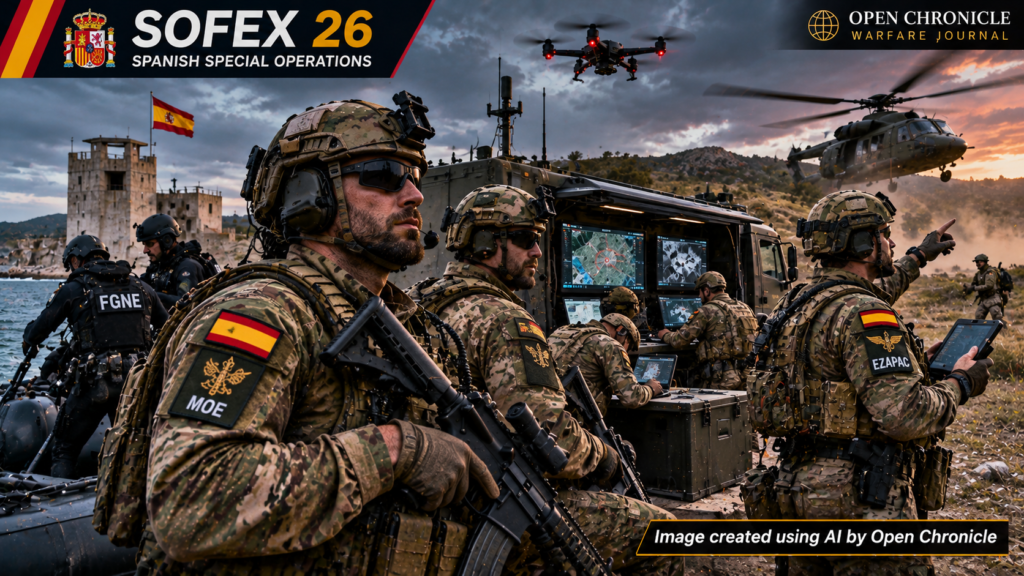
Spain’s most specialised military units have completed a major joint exercise involving simulated hostage rescue, high-value target capture, electronic warfare and unmanned systems. SOFEX 26 reveals how the country’s special operations forces are preparing for increasingly complex missions across land, sea, air and the information environment.
OPEN CHRONICLE | WARFARE JOURNAL
SPECIAL FORCES | SPECIAL OPERATIONS | MILITARY TRAINING
21 November 2026 | By Open Chronicle Warfare Journal
Spain’s special operations forces test their readiness
Spain’s Joint Special Operations Command has completed SOFEX 26, its principal annual training exercise, bringing together elite military formations from the country’s Army, Navy and Air and Space Force.
The exercise, conducted across several locations in Spain, placed particular emphasis on two demanding operational scenarios: rescuing hostages and locating and capturing high-value individuals.
Both missions required the coordination of specialised personnel, intelligence capabilities, aircraft, surveillance systems and command structures.
The Spanish Defence Staff announced the exercise’s completion on 17 November 2026, describing it as an important step in strengthening the integration and interoperability of the country’s special operations forces.
The exercise involved three principal formations:
- Mando de Operaciones Especiales (MOE), the Spanish Army’s Special Operations Command.
- Fuerza de Guerra Naval Especial (FGNE), the Spanish Navy’s Special Naval Warfare Force.
- Escuadrón de Zapadores Paracaidistas (EZAPAC), the Air and Space Force’s Parachute Sappers Squadron.
These units operated alongside additional military capabilities, including aircraft, unmanned systems and electronic warfare assets.
The objective was not simply to evaluate individual teams.
It was to determine how effectively Spain’s special operations structure could coordinate different military capabilities under a single command framework.
That distinction is fundamental to understanding the significance of SOFEX 26.
Modern special operations increasingly depend on the ability to combine intelligence, mobility, communications and specialist military personnel within a rapidly changing operational environment.
What is SOFEX 26?
SOFEX stands for Special Operations Forces Exercise.
The 2026 edition was organised under the authority of Spain’s Joint Special Operations Command, known by its Spanish acronym MCOE.
The command is responsible for the joint planning and coordination of special operations capabilities within the Spanish Armed Forces.
SOFEX 26 was its principal annual training activity.
According to the Spanish Defence Staff, the exercise was designed to evaluate the ability of joint special operations structures to respond to crises and emerging threats in a multidomain environment.
The activities took place in different coastal and inland locations across Spain.
The exercise was directed from the MCOE facilities at Retamares Base, near Madrid, with support from other military installations, including Rota Naval Base in Cádiz.
Major General Ángel Ramón Herrezuelo Pérez, a Spanish Marine Corps officer, commanded the MCOE during the exercise.
The training brought together operational units and supporting capabilities that would need to cooperate during a complex military mission.
This included intelligence collection, surveillance, aviation support, electronic warfare and direct action personnel.
The exercise’s structure reflected a central principle of contemporary special operations doctrine.
A successful mission depends not only on the team conducting the final action, but also on the wider network of capabilities supporting that team.
Three elite formations, one joint command
One of the most important features of SOFEX 26 was the participation of special operations units from all three Spanish military services.
Each formation brings different operational experience and capabilities.
Their integration is essential when a mission extends beyond the responsibilities of a single service.
01 | MOE: Spanish Army Special Operations Command
The Mando de Operaciones Especiales is the Spanish Army’s principal special operations formation.
Its responsibilities include specialised military missions requiring highly trained personnel and the ability to operate in demanding environments.
Army special operations forces can contribute to reconnaissance, direct action and other missions assigned within the military command structure.
In a joint exercise such as SOFEX 26, their contribution must be coordinated with naval and air capabilities.
This requires compatible procedures, communications and planning arrangements.
The exercise provided an opportunity to practise those relationships.
02 | FGNE: Spanish Navy Special Naval Warfare Force
The Fuerza de Guerra Naval Especial is the Spanish Navy’s specialist naval special operations formation.
Its capabilities are particularly relevant to missions involving maritime and coastal environments.
Naval special operations may require cooperation with ships, naval aircraft and other military assets.
SOFEX 26 involved support from the Navy’s aircraft flotilla, known as FLOAN.
This created opportunities to practise the integration of naval aviation with special operations personnel.
The Spanish Defence Staff did not publicly provide a complete breakdown of the missions conducted by each participating formation.
It would therefore be inaccurate to assign every exercise scenario to a particular unit without additional evidence.
03 | EZAPAC: Air and Space Force Parachute Sappers Squadron
The Escuadrón de Zapadores Paracaidistas is a specialist unit of Spain’s Air and Space Force.
Its capabilities include military tasks associated with air operations and the employment of specialised personnel in demanding environments.
During joint special operations, the integration of air-related expertise can be particularly important.
Aircraft may provide mobility, reconnaissance support and other capabilities required by ground or maritime teams.
The participation of EZAPAC reinforced the exercise’s joint character.
Together, MOE, FGNE and EZAPAC represented three complementary components of Spain’s special operations structure.
The hostage rescue scenario
One of the central training scenarios involved a simulated hostage rescue operation.
Hostage rescue is among the most demanding missions assigned to specialist military or security formations.
Such operations may involve significant uncertainty, limited information and the need to protect people exposed to immediate danger.
For SOFEX 26, the Spanish Defence Staff emphasised the importance of coordinating intelligence, surveillance, aircraft and direct action teams.
The command structure was required to assess changing information and determine when the conditions for action were appropriate.
This illustrates why hostage rescue cannot be understood solely as a tactical assault.
Before any intervention, commanders must consider the reliability of available information, the risks to hostages and the capabilities available to the operation.
Coordination becomes especially important when several military services are involved.
Aircraft may support the movement of personnel.
Surveillance systems may provide additional information.
Command elements must maintain an understanding of the situation and coordinate the participating units.
The Spanish military identified the protection of hostages as a fundamental priority.
The available official reporting does not disclose the detailed exercise scenario, simulated casualty outcomes or a quantified success rate.
It establishes that hostage rescue formed part of the training programme, not that a real hostage rescue occurred.
High-value target missions
The second major scenario involved locating and capturing several high-value individuals.
In military terminology, a high-value individual may be someone considered important to an opposing organisation or operational network.
The precise definition depends on the mission and applicable command framework.
The SOFEX 26 scenario required participating units to coordinate information collection, surveillance and operational planning.
The Spanish Defence Staff described the integration of intelligence and targeting processes with air assets and direct action teams.
In this context, targeting refers to a military planning and assessment process.
It should not be interpreted as evidence that the exercise involved autonomous lethal engagement or an actual strike against a real person.
The public announcement identified the scenario as involving the location and capture of high-value individuals.
That distinction matters.
Capture operations may require different planning assumptions from missions intended to destroy a military objective.
They can involve considerations related to identification, detention, the protection of civilians and the legal framework governing military action.
The exercise provided a setting in which Spanish units could practise coordinating the capabilities needed for such a mission.
However, the official account does not disclose the identities of simulated targets, detailed methods or final assessment scores.
Why intelligence integration matters
A central theme of SOFEX 26 was the integration of intelligence into operational planning.
Special operations forces often depend on accurate information about their operating environment.
That information may come from several sources.
Surveillance systems, military personnel and other intelligence capabilities can contribute to an evolving understanding of a situation.
The challenge is to transform this information into decisions.
During SOFEX 26, command posts were required to monitor developments, update their understanding of the situation and coordinate the participating forces.
The Spanish Defence Staff described a continuous process of reassessment.
This is particularly relevant to complex missions in which circumstances may change quickly.
An operational plan based on outdated information can become less useful as the situation develops.
Command structures therefore need procedures that allow information to be reviewed and decisions to be adjusted.
The exercise tested those processes within a joint military environment.
It also highlighted the relationship between intelligence and operational timing.
The effectiveness of a military unit depends partly on whether commanders can make appropriate decisions using the information available to them.
Helicopters and special operations mobility
Aviation support was another major component of SOFEX 26.
The exercise involved aircraft from the Spanish Army’s Airmobile Forces, known as FAMET, and the Spanish Navy’s aircraft flotilla, FLOAN.
According to the Defence Staff, these assets supported specialised insertion and extraction procedures.
For special operations forces, mobility can be a decisive enabler.
Military aircraft may allow personnel to reach locations that are difficult to access using conventional ground transport.
They can also support the movement of teams and equipment across different operational environments.
However, the availability of aircraft introduces additional coordination requirements.
Aircrews and ground personnel must understand their respective responsibilities.
Communications and operational planning must be compatible.
The wider command structure must coordinate the movement of aircraft with other military activities.
SOFEX 26 provided an opportunity to practise these relationships.
The official announcement did not specify a complete inventory of participating aircraft or the number of sorties conducted.
It would therefore be inappropriate to attribute particular helicopter models or flight totals to the exercise without further confirmation.
Unmanned systems enter the special operations environment
The Spanish Defence Staff confirmed the involvement of unmanned systems during SOFEX 26.
This reflects the increasing importance of drones and other remotely operated platforms in contemporary military operations.
Unmanned systems can provide additional information about the operational environment.
Depending on their design, they may support reconnaissance, surveillance or other military functions.
For special operations forces, these capabilities may be particularly useful when personnel need information without exposing additional teams to unnecessary risk.
However, drones also create new requirements.
Operators need training.
Communications must be reliable.
Commanders must understand the limitations of the systems available to them.
Electronic warfare and other countermeasures may affect their performance.
SOFEX 26 brought unmanned systems into a wider joint training framework rather than presenting them as an isolated capability.
The official report does not identify every drone model employed.
It also does not establish that autonomous weapon systems independently selected or engaged targets during the exercise.
The supported conclusion is that unmanned capabilities contributed to the coordination of the participating forces.
Electronic warfare: An increasingly important factor
Electronic warfare was explicitly identified among the supporting capabilities used during SOFEX 26.
Modern military operations depend heavily on electronic systems.
Communications, navigation, surveillance and other functions can rely on access to the electromagnetic spectrum.
Electronic warfare concerns military activities involving that environment.
Its relevance to special operations is substantial.
A unit may possess highly trained personnel and advanced equipment but still face serious difficulties if essential electronic systems are disrupted.
The integration of electronic warfare into training therefore reflects the need to prepare for contested technological environments.
During SOFEX 26, electronic warfare assets were used alongside aviation and unmanned systems to support the participating units.
The public announcement does not specify the electronic warfare equipment involved or provide detailed information about simulated interference.
It is therefore not possible to assess the precise technical effects achieved during the exercise.
Nevertheless, the inclusion of this capability demonstrates that Spain’s special operations training is addressing more than conventional tactical tasks.
Three phases of SOFEX 26
The exercise followed a structured progression from planning to practical execution.
Phase 01 | Command Post Exercise
The initial phase focused on preparation and planning.
Command posts participated in a Command Post Exercise, commonly abbreviated CPX.
This allowed military personnel to establish planning arrangements and coordinate the responsibilities of participating formations.
The emphasis was on preparing the command structure for the operational activities that would follow.
Phase 02 | Cross-training
The second phase involved cross-training between participating units.
This provided an opportunity to familiarise personnel with the procedures and capabilities of other formations.
Cross-training is important in joint operations because units from different services may use different equipment, terminology and operating practices.
The purpose was to improve coordination before the practical execution phase.
Phase 03 | Live Exercise
The final phase involved practical operational activities under the LIVEX format.
The participating units conducted training missions based on the exercise objectives.
These activities were intended to test the coordination and procedures developed during the earlier phases.
The Spanish Defence Staff confirmed that the exercise was completed.
However, its public announcement did not publish detailed evaluation scores for individual units or specific mission outcomes.
The completion of the training programme should not be confused with independent verification that every operational objective was achieved without difficulty.
Why joint command matters
SOFEX 26 was fundamentally an exercise in joint military coordination.
The participation of three military services created opportunities to practise the integration of different capabilities.
A complex special operation may require more than one specialist formation.
It may also depend on intelligence, aircraft, surveillance, communications and logistical support.
The challenge is to coordinate these elements within a coherent command structure.
Spain’s Joint Special Operations Command provides the organisational framework for that coordination.
During SOFEX 26, the MCOE directed activities from Retamares Base while participating forces operated across several locations.
This arrangement illustrates the distinction between operational command and the units conducting activities in the field.
A command headquarters must maintain an overview of the wider operation.
Individual teams must carry out their assigned responsibilities.
Effective coordination depends on the relationship between those levels.
The exercise was intended to strengthen that relationship.
Multidomain operations and the changing battlefield
The Spanish Defence Staff described SOFEX 26 as training conducted in a multidomain environment.
The term reflects the increasing interaction between different military operating environments.
Land, maritime and air capabilities may need to cooperate with information systems, electronic warfare and other supporting functions.
For special operations forces, this creates additional complexity.
A mission conducted by a relatively small team may depend on capabilities distributed across several military organisations.
The personnel conducting the final task may represent only one part of a much larger operational structure.
SOFEX 26 illustrates this relationship.
The participating units trained alongside aviation, unmanned systems and electronic warfare capabilities.
Their command structures also integrated intelligence and surveillance.
The exercise therefore provides a useful example of how special operations are being adapted to a more interconnected military environment.
However, the public evidence does not support claims that every military domain was exercised to the same extent.
The term multidomain should be understood in the context of the capabilities and scenarios identified by the Spanish Defence Staff.
The strategic importance of Rota and Retamares
Two military installations played important supporting roles in SOFEX 26.
Retamares Base served as the location from which the Joint Special Operations Command directed the exercise.
The base is an important element of Spain’s military command infrastructure.
Rota Naval Base, in Cádiz, was also identified as a supporting installation.
Rota occupies a significant position in Spain’s naval and wider defence infrastructure.
Its location in southern Spain makes it relevant to maritime operations and military activities associated with the Atlantic and Mediterranean regions.
The involvement of both installations reflects the geographical and organisational scope of the exercise.
However, the public announcement does not establish that every participating unit operated directly from either base.
The exercise involved several locations across Spain.
The significance of Retamares and Rota lies in their confirmed command and support roles.
Spain’s special operations forces and NATO
Spain is a member of NATO and contributes military capabilities to the Alliance’s collective defence framework.
Special operations forces can play important roles in multinational military activities.
Such cooperation requires compatible procedures and effective command relationships.
Joint national training can contribute to that readiness.
By bringing together its own Army, Navy and Air and Space Force units, Spain can practise coordination that may also be relevant in multinational settings.
However, SOFEX 26 was described by the Spanish Defence Staff as an exercise conducted on Spanish territory under Spanish command.
The official reporting does not identify it as a NATO-led multinational exercise.
It would therefore be inaccurate to describe the event as a NATO special operations exercise.
Its relevance to NATO is principally analytical.
Improved national interoperability can support the broader military readiness of an allied country.
That does not establish any specific NATO certification outcome or operational commitment arising from SOFEX 26.
The human factor in special operations
Modern special operations increasingly involve sophisticated technology.
However, the success of a military mission still depends heavily on personnel.
Training, judgement, communication and leadership remain essential.
SOFEX 26 placed particular emphasis on the coordination of different formations.
This is important because the introduction of new technology can increase the amount of information available to commanders.
More information does not automatically produce better decisions.
Personnel must understand which information is relevant and how it should influence their actions.
Joint exercises provide opportunities to develop these skills.
They also allow military organisations to identify problems that may not be visible during isolated unit training.
The Spanish exercise demonstrates an institutional emphasis on integrating specialist personnel with supporting capabilities.
That approach is consistent with the broader evolution of modern special operations.
What SOFEX 26 tells us about future missions
The exercise highlights several developments that are likely to remain important for special operations forces.
First, complex missions increasingly require coordinated capabilities from different military services.
Second, intelligence and surveillance are central to operational planning.
Third, aviation remains an important enabler of special operations mobility.
Fourth, unmanned systems are becoming part of the wider operational environment.
Fifth, electronic warfare is an increasingly relevant consideration.
These developments do not eliminate the importance of traditional special operations skills.
Instead, they create additional requirements for the personnel and organisations responsible for conducting such missions.
SOFEX 26 was designed to address these requirements through joint training.
Its value lies in the opportunity to test how different elements work together.
Five questions following SOFEX 26
1. How effectively did the three principal special operations formations integrate their procedures?
The Spanish Defence Staff reported successful completion, but detailed assessment scores were not released.
2. What role did unmanned systems play in the practical exercise scenarios?
Their participation is confirmed, but the public report does not identify every platform or operational function.
3. How were electronic warfare capabilities evaluated?
Their involvement is documented, although specific technical results remain undisclosed.
4. What lessons were identified during the hostage rescue and high-value target scenarios?
The official announcement describes the missions and their objectives but does not publish a comprehensive lessons-learned report.
5. Will the exercise lead to changes in equipment, training or doctrine?
Such changes are possible, but no specific procurement or doctrinal decision should be inferred from the exercise’s completion alone.
Strategic assessment: Integration is becoming the defining capability
SOFEX 26 offers an important insight into the direction of Spanish special operations training.
The most significant development is not the introduction of a particular weapon or aircraft.
It is the emphasis on combining multiple military capabilities within a single operational framework.
Special operations forces have long depended on specialised training and the ability to operate in demanding circumstances.
Those characteristics remain essential.
However, contemporary missions may also depend on intelligence systems, unmanned platforms, electronic warfare and aviation support.
The operational challenge is to coordinate these capabilities without sacrificing flexibility or decision-making speed.
SOFEX 26 addressed that challenge through a structured training programme involving planning, cross-training and practical execution.
The participation of MOE, FGNE and EZAPAC demonstrated the importance Spain places on joint military cooperation.
The exercise also showed that command structures must remain capable of adapting to changing information.
This is particularly relevant to scenarios involving hostages or high-value individuals, where operational circumstances can evolve quickly.
Nevertheless, the public reporting supports a measured assessment.
SOFEX 26 was a training exercise, not a combat deployment.
Its successful completion does not establish that every participating capability has been independently validated under operational conditions.
The broader significance lies in Spain’s continuing investment in the coordination and readiness of its specialist military forces.
Conclusion: Preparing Spain’s elite forces for complex operations
SOFEX 26 brought together some of Spain’s most specialised military formations in a demanding joint training environment.
The exercise involved the Army’s MOE, the Navy’s FGNE and the Air and Space Force’s EZAPAC.
It tested the planning and coordination of simulated hostage rescue and high-value target capture missions.
Aircraft, unmanned systems, electronic warfare and intelligence capabilities contributed to the wider training programme.
The Spanish Joint Special Operations Command directed the exercise from Retamares Base, supported by military installations including Rota Naval Base.
The exercise’s central message is clear.
Modern special operations depend on more than the capabilities of individual elite units.
They require effective coordination between people, information, equipment and command structures.
For Spain, SOFEX 26 represents another step in developing that integrated approach.
For the wider military community, it illustrates how special operations forces are adapting to missions in which technological complexity and joint coordination are becoming increasingly important.
The future of special operations will depend not only on how well individual units perform, but on how effectively they operate together.
Technical Briefing | SOFEX 26
SOFEX 26 | SPANISH JOINT SPECIAL OPERATIONS COMMAND
Source: Spanish Defence Staff | November 2026
| Exercise | SOFEX 26 |
| Country | Spain |
| Organising command | Joint Special Operations Command (MCOE) |
| Commander | Major General Ángel Ramón Herrezuelo Pérez |
| Participating units | MOE, FGNE, EZAPAC |
| Aviation support | FAMET and FLOAN |
| Other capabilities | Unmanned systems, electronic warfare, intelligence and surveillance |
| Command location | Retamares Base, Spain |
| Additional support | Rota Naval Base |
| Completion announced | 17 November 2026 |
Information based on the Spanish Defence Staff’s official announcements of 5 and 17 November 2026.
Sources and Further Reading
This article draws on official Spanish Defence Staff announcements and supplementary reporting from Spanish defence publications. The sources document the organisation, participating formations, training objectives and operational context of SOFEX 26, including joint special operations, simulated hostage rescue, high-value target capture, aviation support, unmanned systems and electronic warfare.
Joint Special Operations Command Successfully Concludes SOFEX 26
Principal official source confirming the completion of SOFEX 26, the participating special operations formations and the joint command structure. The announcement describes simulated hostage rescue and high-value target capture missions, the involvement of aviation assets, unmanned systems and electronic warfare capabilities, and the coordination of the participating military services.
SOFEX 26: Joint Special Operations Command Leads Its Main Annual Exercise
Official announcement introducing SOFEX 26 and outlining its initial objectives, planning stages and multidomain training environment. The report identifies the role of the Joint Special Operations Command, the participating military capabilities, the exercise’s geographical scope and the importance of Retamares Base and Rota Naval Base in supporting the training programme.
Spain’s Elite Units Complete Joint SOFEX 26 Exercise
Independent Spanish defence reporting examining the participation of the Army’s MOE, the Navy’s FGNE and the Air and Space Force’s EZAPAC. The publication discusses the integration of military aviation, electronic warfare and other supporting capabilities during the exercise, together with the simulated hostage rescue and high-value target missions.
Joint Special Operations Command Completes SOFEX 26
Spanish defence news coverage of the conclusion of SOFEX 26, focusing on joint military coordination, the participation of specialised formations and the exercise’s principal training scenarios. The report provides additional context for the simulated hostage rescue and capture operations described in the official military announcements.
MCOE Completes SOFEX 26 After Testing Two Complex Missions
Spanish military reporting examining the integration of intelligence, surveillance, aviation and direct action capabilities during the exercise’s two principal mission scenarios. The article provides additional discussion of the coordination required for simulated hostage rescue and high-value target capture operations.
This article was prepared by Open Chronicle Warfare Journal using official Spanish Defence Staff announcements published on 5 and 17 November 2026, supplemented by reporting from Infodefensa, El Español and El Confidencial Digital. SOFEX 26 is identified as a Spanish military training exercise, not a combat operation or a NATO-led multinational exercise. Hostage rescue and high-value target capture were simulated training scenarios, and no actual hostage rescue or detention operation is implied. The participation of MOE, FGNE, EZAPAC, FAMET, FLOAN, unmanned systems and electronic warfare capabilities is documented, but the available official reporting does not disclose a complete equipment inventory, detailed exercise results, unit-level performance scores or specific electronic warfare effects. The completion announcement does not establish independent combat validation of every participating capability. Broader interpretations concerning military doctrine, interoperability and future special operations are independent editorial analysis based on publicly available information.